
Road transport · containers
Container transport from port and terminal to your site
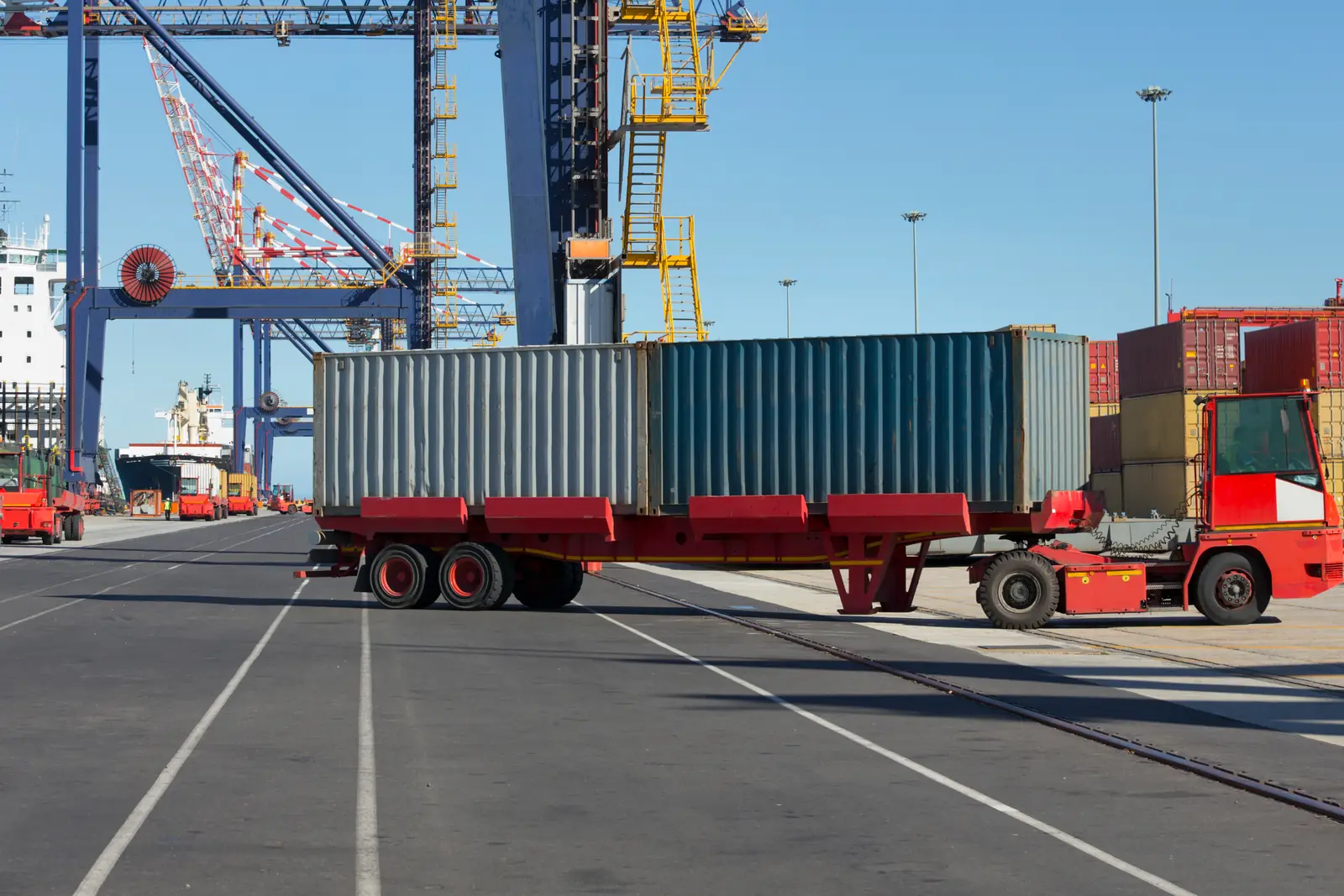
We collect the container from the port or the rail terminal, deliver it to your site and return the empty container within the free days, for import and export.
- Import · export From the port to your site Collection, delivery and empty return.
- Free time Free days coordinated Planned to avoid demurrage and detention.
- Containers 20′, 40′, 40′ HC, 45′ On the right chassis, a lowered one for HC.
- Ports Constanța and other terminals Confirmed in the quote.
On this page
Containers
What road container transport means
A shipping container that arrives in port must be collected, delivered to your site, unloaded and returned empty to the depot indicated by the shipping line, all within the free days granted (free time).
If any stage is delayed, the line or the terminal charges demurrage (the full container stays in the terminal) or detention (the container is kept outside the terminal). These costs are not part of the transport, but they can exceed the cost of the transport. The HONEXPRES team coordinates the collection, delivery and return so that they stay within the free time.
Import · export
Import and export
-
Import: from the port to your site
After the line releases the container and after the customs formalities (or under T1 transit to an inland customs office), we collect it from the terminal and deliver it to your site.
-
Export: empty container, loading, delivery to the terminal
We collect the empty container, bring it for loading, then deliver it to the terminal before the vessel’s cut-off, with the verified gross mass (VGM) declared by the shipper.
Containers and vehicles
Containers and vehicles
Containers are carried on a container chassis. High cube containers need a lowered chassis, so that the total height stays within the legal limits.
-
20′ dry container
For heavy, compact goods; we check the permitted weight on the road.
-
40′ dry container
The most widely used container for general goods.
-
40′ high cube container
Taller than the standard one; carried on a lowered chassis.
-
45′ high cube container
For large volumes; we confirm the route and the chassis in the quote.
Also: reefer container (with generator), open top, flat rack. Container chassis sheet
Ports and terminals
Ports and terminals
We collect containers from the port of Constanța and from other ports or terminals confirmed in the quote, including inland rail terminals. In the quote we confirm the port, the terminal and the return depot for the empty container.
For the sea leg see sea freight (FCL/LCL), and for the train to an inland terminal, rail and intermodal transport.
Sea freightRail freightCustoms formalities associated with the transport
At destination
Unloading the container at your site
We plan the unloading together with the collection from the port, because the waiting time, the vehicle and the return of the empty container depend on it.
-
On the chassis
Unloading on the chassis
The container stays on the chassis, and the goods are unloaded from it at a loading dock or with a pallet truck. The time included is stated in the quote; beyond it, waiting time may be charged.
-
Grounded
Container left at your site
If unloading takes several days, the container can be set down by side-lifter or crane, arranged on request. The days you keep it count towards detention.
-
Access
Loading dock and access
Tell us whether you have a loading dock or forklift and whether a long truck has room to get in and turn around.
-
Return
Returning the empty container
After unloading, the empty container goes to the depot indicated by the line, within the free days, so that you avoid detention costs.
Types of transport
Which containers we move by road
- Full import containers, from the port to your warehouse or factory
- Empty containers brought for loading for export and delivered to the port
- Containers between the rail terminal and the customer (first or last mile)
- Reefer containers, with a generator for the road
- Containers with dangerous goods, with ADR carriers
How it works
How container transport works
- Step 1
Container details
The direction (import or export), the container type and number, the port or terminal, the bill of lading or booking number and the last free day.
- Step 2
Release and scheduling
We check the release by the line and the customs status, and schedule the collection from the terminal.
- Step 3
Transport to your site
The container arrives at your address for unloading on the spot or is left there for later unloading, as agreed.
- Step 4
The return
The empty container (on import) is returned to the depot indicated by the line; the full one (on export) is delivered to the terminal before the vessel’s cut-off.
- Step 5
The documents
You receive the terminal handover documents and the return confirmation.
Information needed
Information needed for a quote
The container details and the last free day matter most: we plan the collection and the return from them.
- Direction: import (port to customer), export (customer to port) or repositioning
- Container type (20′, 40′, 40′ HC, 45′, reefer, open top, flat rack)
- Container number and whether it is full or empty
- The port or terminal and the return depot for the empty container
- Bill of lading (BL) or booking number; we receive the release code on booking
- The last free day (free time) granted by the line and by the terminal
- Customs status: cleared, under T1 transit or not cleared
- Gross mass of the full container (on export, the VGM)
- Unloading on the spot or container left on site; generator for reefer containers
Documents
Documents for container transport
- Bill of lading (BL) or delivery order / line release Without the release, the terminal does not hand over the container.
- Import customs declaration or T1 transit document Depending on where clearance takes place: in the port or at an inland office.
- VGM declaration On export; made by the shipper, before the line’s deadline.
- CMR consignment note For the international road leg.
- Terminal handover documents They show the condition of the container at collection and at return.
Restrictions
Restrictions we take into account
- A heavy container can exceed the permitted weight on the road, even if the shipping line accepts it; we check before collection.
- High cube containers are carried on a lowered chassis, so that the total height stays within the legal limits.
- Terminals work by appointment and have their own opening hours; collection depends on their availability.
- Demurrage and detention are charged by the shipping line or by the terminal, separately from the transport.
- Containers with dangerous goods are carried only by ADR carriers and with the required documents.
Costs
What affects the cost of container transport
We do not publish fixed rates: the quote starts from the port, your address and the return depot, and states separately what is not related to the transport.
-
01
The distance between the port or terminal, your address and the return depot
-
02
Waiting time at the terminal and at unloading
-
03
Unloading on the spot or container left overnight
-
04
Container type, weight and type of chassis
-
05
The generator for reefer containers
-
06
Road tolls and any weighing
-
07
Costs not related to the transport
Demurrage, detention, storage at the terminal
Related services
Container, sea or rail?
A container’s journey has several stages. See the services that connect them.
-
Sea freight (FCL / LCL)
Full containers (FCL) or groupage (LCL), port-to-port or door-to-door.
-
Rail and intermodal transport
Containers by train, with trucks at both ends.
-
Customs formalities
Import, export and transit (T1) for the containers organised by HONEXPRES.
-
Container types
Dimensions and capacities for 20′, 40′, 40′ HC and 45′.
What is the difference between demurrage and detention?
Demurrage is paid for a full container kept in the terminal beyond the free days; detention for a container kept outside the terminal (at your site or on the road) beyond the free time. Both are charges of the line or the terminal; the definitions are also in the glossary.
Can you collect a container that has not been cleared through customs?
Yes, if it travels under the transit procedure (T1) to an inland customs office, where clearance takes place. We coordinate the formalities through a customs broker; see customs formalities associated with the transport.
What is VGM and who declares it?
VGM is the verified gross mass of the full container, mandatory before loading on board. It is declared by the shipper, before the shipping line’s deadline; without it the container is not loaded onto the vessel.
Can the container stay at my site overnight?
Yes, if we agree in advance: the container stays on the chassis or is set down by side-lifter or crane, arranged on request, for later unloading. The time spent at your site counts towards the container’s free time, matters for detention and may involve a waiting charge; we state it in the quote.
Which ports do you collect containers from?
From the port of Constanța and from other ports or terminals confirmed in the quote, including inland rail terminals. In the quote we confirm the port, the terminal and the return depot for the empty container.
Guides
Useful guides and articles
Guides on shipping containers: identification, advantages and standards.
-
How do we identify a shipping container?
To prevent theft, freight forwarders take care of identifying every shipping container by the identification numbers written on the B/L…
-
The container and the advantages of containerised sea transport
The container, and with it containerised transport, is one of the inventions that revolutionised sea transport.
-
Standards for sea freight containers
Last time we saw that the arrival of containers revolutionised the carriage of goods by sea. There is also a series of standards for sea…
Related articles
More about ports and containers
- How does a sea container terminal operate? Nov 30, 2022
- The Port of Constanța: how important is it in Europe? Oct 10, 2022
- Which is the largest container ship? Nov 25, 2022
Suitable vehicles
-
Container chassis (20' / 40' / 45')
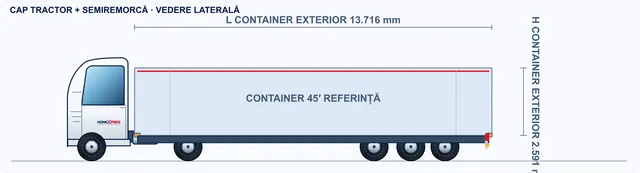
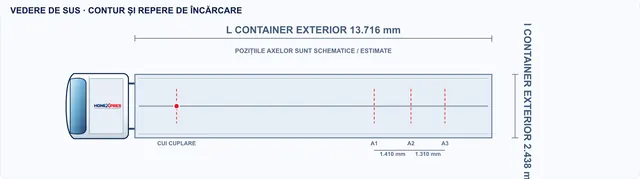
cargo of ~26 t in a 20' / ~22 t in a 40' HC (at 40 t)
Indicative Sketch: Container chassis
Suitable containers
-
20' Dry Van
Internal dimensions
- length ~5.9 m
- width ~2.35 m
- height ~2.39 m
Container capacity
- volume ~33 m³
- EUR pallets 11 EUR pallets
- payload ~26 t on the road (40 t)
The capacity is the container's own, not a legal mass limit on public roads: the road mass of the load is checked separately (vehicle, axles, country).
-
40' Dry Van
Internal dimensions
- length ~12.0 m
- width ~2.35 m
- height ~2.39 m
Container capacity
- volume ~67 m³
- EUR pallets 25 EUR pallets
- payload ~23 t on the road (40 t)
The capacity is the container's own, not a legal mass limit on public roads: the road mass of the load is checked separately (vehicle, axles, country).
-
40' High Cube
Internal dimensions
- length ~12.0 m
- width ~2.35 m
- height ~2.7 m
Container capacity
- volume ~76 m³
- EUR pallets 25 EUR pallets
- payload ~22 t on the road (40 t)
The capacity is the container's own, not a legal mass limit on public roads: the road mass of the load is checked separately (vehicle, axles, country).
-
45' High Cube (ISO width)
Internal dimensions
- length ~13.56 m
- width ~2.35 m
- height ~2.7 m
Container capacity
- volume ~86 m³
- EUR pallets 27 EUR pallets
- payload ~22 t on the road (40 t)
The capacity is the container's own, not a legal mass limit on public roads: the road mass of the load is checked separately (vehicle, axles, country).
-
45' Pallet-Wide High Cube
Internal dimensions
- length ~13.56 m
- width ~2.44 m
- height ~2.7 m
Container capacity
- volume ~89 m³
- EUR pallets 33 EUR pallets
- payload ~22 t on the road (40 t)
The capacity is the container's own, not a legal mass limit on public roads: the road mass of the load is checked separately (vehicle, axles, country).
Practical reference values. We confirm the exact dimensions in the quote. Honexpres organises transport with this vehicle, on request.
Quote request
Do you have a container to move?
Tell us what you are transporting, from where and to where. The HONEXPRES team reviews your request and gets back to you with a quote.
Automatic translation, automatically checked. This page was translated automatically from Romanian and passed the automatic checks for language, terminology, figures and links. If there is any difference, the Romanian version prevails. How we use automatic translation