Sea freight · Guides
Which is the largest container ship?
Article translated automatically from Romanian and checked automatically. If there is any difference, the original prevails. See the original in Romanian · How we use automatic translation
In short
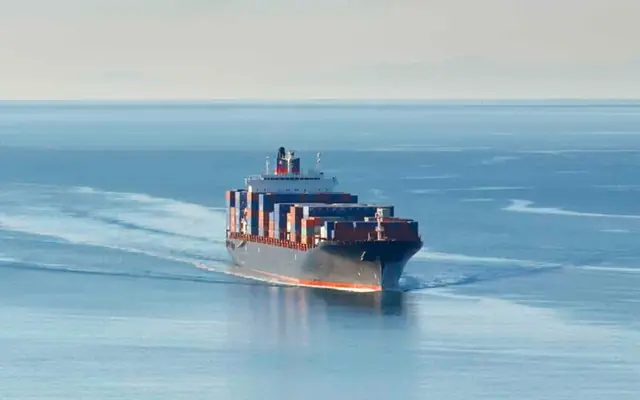
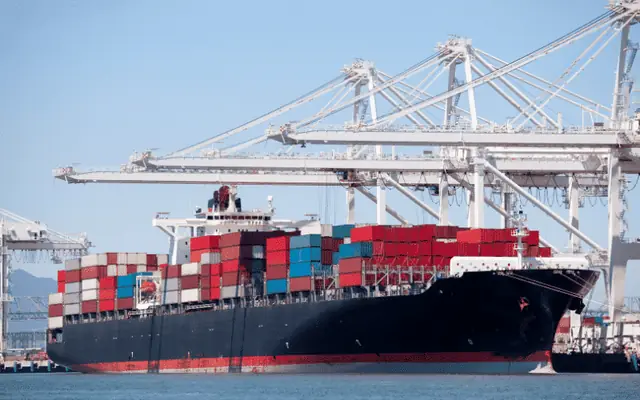
Container ships are the vessels designed for carrying containers by sea. In this article we will see how many types there are and which is the largest of them.
Contents
Container ships are the vessels designed for carrying containers by sea. In this article we will see how many types there are and which is the largest of them.
The first generations of container ships
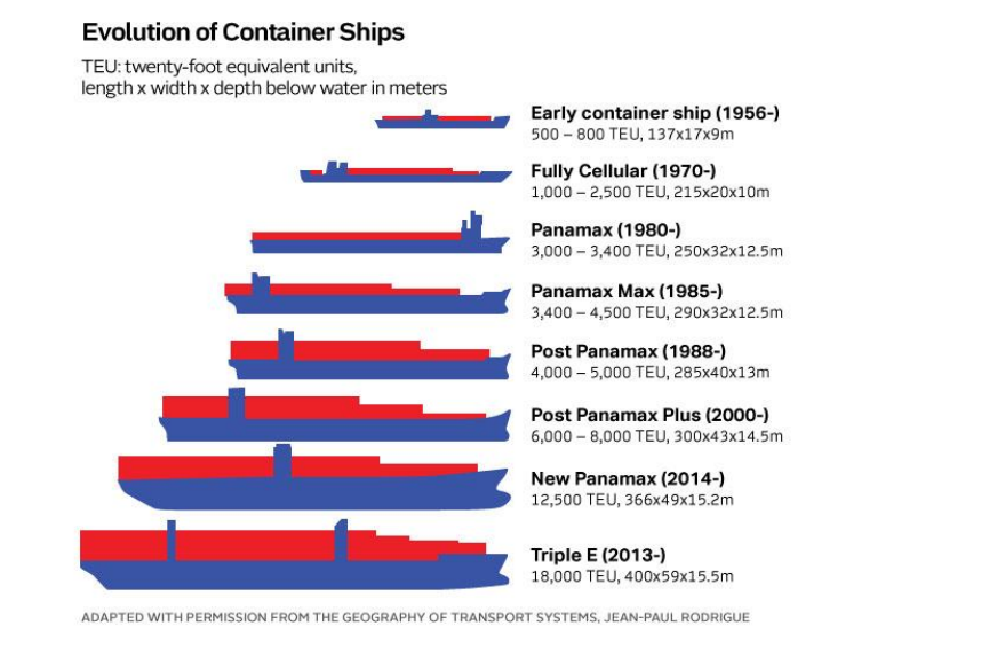
The first generation of container ships was made up of modified bulk vessels or tankers. They could carry up to 1,000 TEU. At the beginning of the 1960s, the container was a transport technology that was being tested and gradually developed. Converting existing ships proved to be cheaper and less risky.
These ships carried cranes on board. Most port terminals were not equipped to handle containers. They were relatively slow and could carry containers only on their converted decks.
The container began to be adopted on a massive scale at the beginning of the 1970s. That was also when construction began of the first cellular container ships (FCC – fully cellular containerships – the second generation), dedicated entirely to handling them.
All container ships are made up of cells that house containers in stacks of different heights, depending on the capacity of the ship. Cellular container ships offer the advantage of using the whole ship to stack containers, including below deck. Cranes were removed from the ship's design so that more containers could be carried.
The ability of ports to handle cellular container ships ceased to be a major concern once specialised terminals had been set up around the world. Cellular container ships were much faster, with speeds of 20-24 knots. This was to become the reference speed in containerised transport.
Panamax
In the 1980s, the building of larger container ships began. The greater the number of containers carried, the lower the costs per TEU. The size limit of the Panama Canal (the Panamax standard) was reached in 1985 with a capacity of about 4,000 TEU.
At the same time, the design of Panamax container ships was evolving to take maximum advantage of the canal's width limitation. These ships came to be known as Panamax Max. The original dimensions of the Panama Canal are similar to the dimensions of the locks on the inland waterways of the USA, resulting in a narrow and long ship design.
Post Panamax I and II
Going beyond Panamax was perceived as a risk in terms of the configuration of shipping networks, additional handling infrastructure and draught limitations in ports. The APL C10 class of container ships, with a capacity of 4,500 TEU, was introduced
in 1988 and was the first container ship class to exceed the 32.2 m width limit of the Panama Canal.
By 1996, fully fledged Post Panamax container ships had been introduced, with capacities reaching 6,600 TEU. The first Post Panamax ship classes were not much longer than the Panamax class, but wider, making them more efficient. Once the Panamax threshold had been crossed, ship size grew rapidly, with capacities reaching 8,000 TEU (Post Panamax II; “Sovereign Class”).
New Panamax
This refers to ships designed to fit exactly into the locks of the expanded Panama Canal. These ships have a capacity of about 12,500 TEU, but there are several configurations of New Panamax ships in terms of length and width. New Panamax ships will probably become the new standard in the design of port infrastructure in the coming decades.
Very large container ships
A further extension of the Post Panamax design led to the introduction of the ultra-large container ship class, of more than 18,000 TEU, in 2013 ( “Triple E” ). This class was extended further and, by 2017, ships of more than 20,000 TEU had begun to be delivered. A further extension in 2019 introduced ships called Megamax-24 (MGX-24).
ULCS/Megamax-24 is approaching the technical limits that the Suez Canal can accommodate. It remains to be seen which routes and ports these ships would serve, but they are limited mainly to the routes between Asia and Europe. There are designs for larger ships on the drawing boards, such as the “Malacca Max” class. They could carry about 27,000-30,000 TEU. They are not, however, expected to be built until there are sufficient volumes.
Honexpres offers complete sea freight services. From the shipper’s door to your door, including inland transport and customs procedures.
We are not only a freight forwarder providing professional services in organising domestic and international transport and advice on insurance. Honexpres also brings you essential information and relevant news from the world of freight transport!
Have something similar to move? Request a quote →
All guides in Sea freight (18)
Related services