Sea freight · Guides
How do we identify a shipping container?
Article translated automatically from Romanian and checked automatically. If there is any difference, the original prevails. See the original in Romanian · How we use automatic translation

In short
To prevent theft, freight forwarders take care of identifying every shipping container by the identification numbers written on the B/L, together with the shipping line.
Contents
- Marking in accordance with the ISO 6346:1995 standard
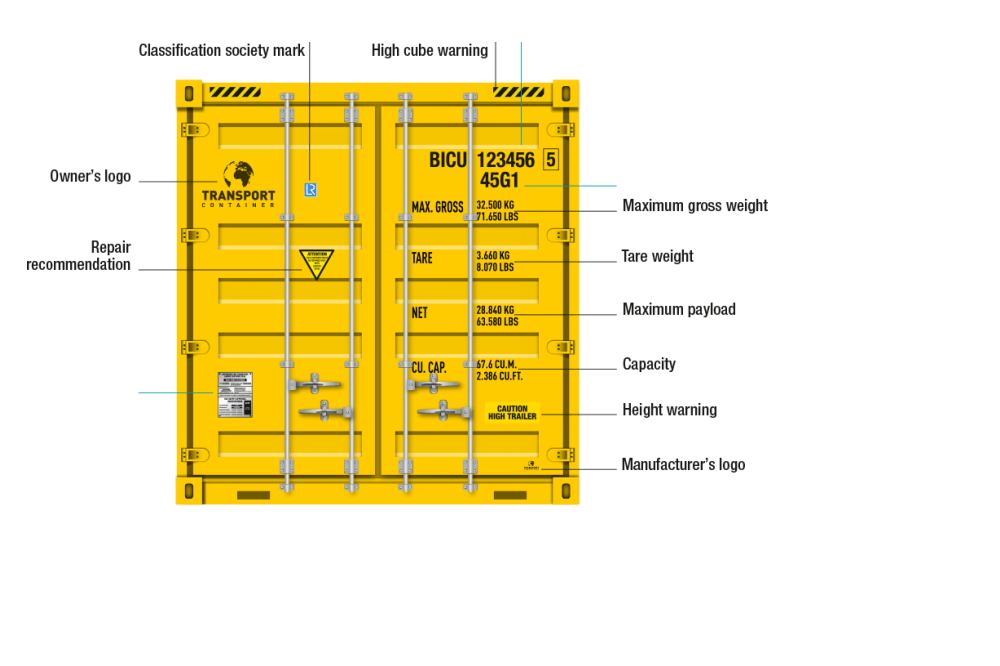
- This marking contains: 1. an owner code (or BIC code) – made up of three capital letters of the Latin alphabet. It must be unique and registered with the BIC (Bureau International des Containers) 2. an equipment category identifier. It is represented by one of the following three capital letters of the Latin alphabet: – U for all freight containers; – J for all detachable freight container-related equipment; – Z for trailers and chassis. Together with the owner code it forms the so-called alpha code. 3. a serial number – six digits assigned by the owner or operator. If the container number consists of fewer than six digits, enough zeros are added in front to reach a sequence of 6. 4. a check digit system for verifying the accuracy of the owner code and the serial number. The check digit consists of one digit placed in a box so that it stands out from the serial number.
- 5. a country code (optional) – made up of two capital letters of the Latin alphabet, in accordance with the abbreviations described in ISO 3166 (for example RO – Romania). 6. a code for the dimensions of the container – the first digit of the size code indicates the length of the container, and the second digit indicates the height of the container.
- 7. a code for the type of container – the first letter indicates the type of container (for example: G – general purpose container), and the second digit refers to the special characteristics (for example: 1 – without ventilation: passive vents in the upper part of the cargo space).
- The Convention for Safe Containers (CSC)
- The essential details displayed on a CSC plate are: – the classification company approval code. This code shows the authorised company or society that was responsible for approving the container; – the month and year of manufacture of the container; – the container manufacturer's identification number – this is sometimes used as the general ID of the container. It can also be used to trace the previous inspections the container has undergone; – the gross weight of the container – this is the total weight of the cargo and the weight of the empty container that can be carried safely. It is displayed in kilograms and LBS;
- – the stacking load value – a container on board a ship faces strong gravitational forces, especially in bad weather, when the ship is thrown up and down at sea. The stacking load value shows the weight that can safely be stacked on top of a container when it is subjected to a gravitational force of 1.8 g. – the racking test load value for the top frame of the container – this value denotes the force that can be applied to the top edge of the container. It is also called the transverse test force. – the next date for inspection of the container.
- Honexpres offers complete sea freight services. From the shipper’s door to your door, including inland transport and customs procedures.
To prevent theft, freight forwarders take care of identifying every shipping container by the identification numbers written on the B/L, together with the shipping line.
Marking in accordance with the ISO 6346:1995 standard
So that containers can be identified more easily, they are marked with alphanumeric symbols. These markings must comply with international conventions and standards.
The current standard that establishes the coding, identification and marking of containers is ISO 6346:1995. It sets up a system of marking by alphanumeric code (17 characters) for freight containers. It allows unique international identification.
This marking contains:
1. an owner code (or BIC code) – made up of three capital letters of the Latin alphabet. It must be unique and registered with the BIC (Bureau International des Containers)
2. an equipment category identifier. It is represented by one of the following three capital letters of the Latin alphabet:
– U for all freight containers;
– J for all detachable freight container-related equipment;
– Z for trailers and chassis.
Together with the owner code it forms the so-called alpha code.
3. a serial number – six digits assigned by the owner or operator. If the container number consists of fewer than six digits, enough zeros are added in front to reach a sequence of 6.
4. a check digit system for verifying the accuracy of the owner code and the serial number. The check digit consists of one digit placed in a box so that it stands out from the serial number.
This is a means of validating, recording and transmitting the first 10 symbols. The check can be made quickly, by computer, on the basis of an algorithm described in the ISO 6346:1995 standard.
5. a country code (optional) – made up of two capital letters of the Latin alphabet, in accordance with the abbreviations described in ISO 3166 (for example RO – Romania).
6. a code for the dimensions of the container – the first digit of the size code indicates the length of the container, and the second digit indicates the height of the container.
7. a code for the type of container – the first letter indicates the type of container (for example: G – general purpose container), and the second digit refers to the special characteristics (for example: 1 – without ventilation: passive vents in the upper part of the cargo space).
On the website www.bic-code.org you will find SEARCH TOOLS FOR CONTAINER SIZE AND TYPE.
Apart from these codes, the container also carries symbols that give other information (for example: maximum gross mass, tare, warning symbol, owner's logo).
The Convention for Safe Containers (CSC)
Freight containers that are used for international intermodal transport have small data plates fixed to them. These are usually found riveted to one of the container doors. This is the safety approval plate, which contains the main details of the
container.
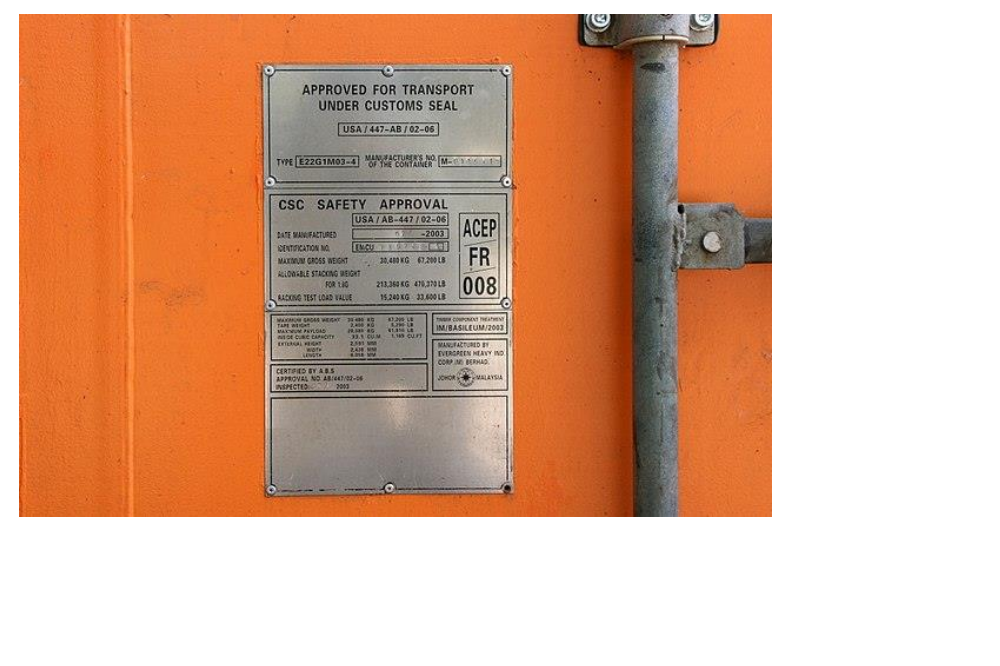
The details shown on a CSC plate are those prescribed by the Convention for Safe Containers (1972). CSC 1972 requires these minimum details to be displayed on all containers that are used in freight transport.
The essential details displayed on a CSC plate are:
– the classification company approval code. This code shows the authorised company or society that was responsible for approving the container;
– the month and year of manufacture of the container;
– the container manufacturer's identification number – this is sometimes used as the general ID of the container. It can also be used to trace the previous inspections the container has undergone;
– the gross weight of the container – this is the total weight of the cargo and the weight of the empty container that can be carried safely. It is displayed in kilograms and LBS;
– the stacking load value – a container on board a ship faces strong gravitational forces, especially in bad weather, when the ship is thrown up and down at sea. The stacking load value shows the weight that can safely be stacked on top of a container when it is subjected to a gravitational force of 1.8 g.
– the racking test load value for the top frame of the container – this value denotes the force that can be applied to the top edge of the container. It is also called the transverse test force.
– the next date for inspection of the container.
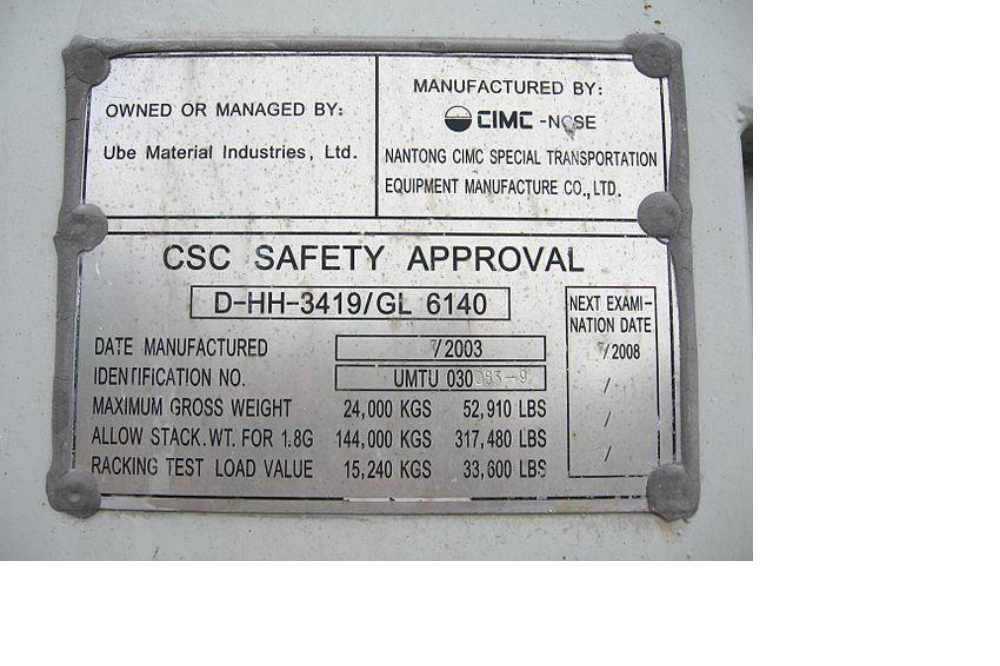
This rectangular plate, with a minimum size of 200 mm X 100 mm, must be made of a non-corrosive, fire-resistant material.
A valid CSC plate ensures that the container has undergone the tests needed to verify its strength and specifications and that it meets the standards set by the International Organization for Standardization (ISO) and the Convention for Safe Containers (CSC).
Understanding a CSC plate is therefore very important when it comes to buying or leasing containers for transport, storage or any other purposes.
It is the responsibility of the container owner to keep a container in good condition. The owner must also make sure that it is inspected at appropriate intervals.
The format of CSC plates may vary, but the minimum data requirements are mandatory. Even if a container has a valid CSC plate but is in a damaged condition, it must be taken out of service for repair or scrapped immediately.
Honexpres offers complete sea freight services. From the shipper’s door to your door, including inland transport and customs procedures.
We are not only a freight forwarder providing professional services in organising domestic and international transport and advice on insurance. Honexpres also brings you essential information and relevant news from the world of freight transport!
Have something similar to move? Request a quote →
Sources (1)
All guides in Sea freight (18)
Related services