Sea freight · Guides
How does a sea container terminal operate?
Article translated automatically from Romanian and checked automatically. If there is any difference, the original prevails. See the original in Romanian · How we use automatic translation
In short
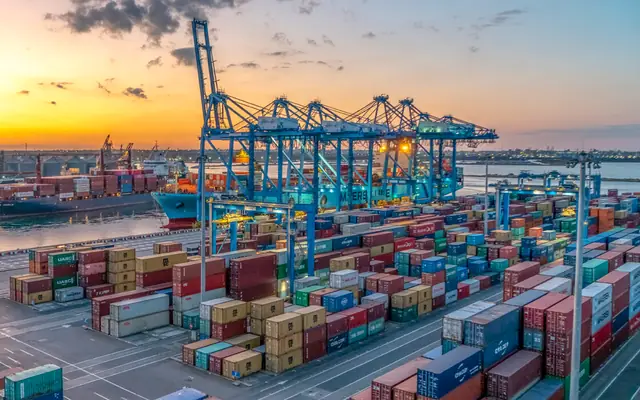
Ports are gateways for goods and passengers and are made up of specialised terminals. A container terminal is a part of a port in which containerised goods are moved from land to sea and from sea to land.
Contents
- Equipment and machinery used in terminals
- The main activities carried out in a container terminal
- Logistics activities related to containerised transport
- Container management.
- Container transport.
- Handling of containers (cargo).
- Honexpres offers complete sea freight services. From the shipper’s door to your door, including inland transport and customs procedures.
Ports are gateways for goods and passengers and are made up of specialised terminals. A container terminal is a part of a port in which containerised goods are moved from land to sea and from sea to land.
When containers arrive by sea, they will very often be transhipped onto another form of transport, such as a truck or, increasingly, a train.
The container terminal is therefore a specially laid out area, with special facilities for carrying out the operations of receiving, transhipping, internally moving and storing containers.
Depending on the size of the port and its throughput, a port may have one or more container terminals. For example, the Port of Rotterdam has nine container terminals, while the port of Rijeka, Croatia, has only one.
Equipment and machinery used in terminals
A container terminal relies on a range of equipment and machinery to carry out its operations. Their choice and combination are linked to a number of factors in terms of capital investment, volume, stacking density and productivity.
The equipment used for handling and moving containers in ports is:
- Tractors and trailers/semi-trailers
- Forklift trucks
- Quay cranes
- Yard cranes (RMGC, RTGC)
- Transport vehicles (AGV – automated guided vehicles, straddle carrier)
The main activities carried out in a container terminal
At a container terminal, the most important activity is the movement of containers, while the secondary function is storage.
These tasks of a container terminal can be divided into different parts:
– container handling – unloading a container, followed by its temporary storage at the terminal. It is finally followed by loading the container onto another means of transport for onward carriage;
– direct transhipment of containers – this is unloading the container, followed directly by loading it onto another means of transport.
At a container terminal we can find the following activities:
A. Ship-oriented services: unloading the ship, loading the ship, direct transhipment, lashing/unlashing of containers.
B. Yard-oriented services: handling of full and empty containers, storage, consolidation, cleaning, maintenance and repair of containers.
C. Other services: production, rental/leasing/sale, collection/distribution of containers, physical transport of containers, container monitoring and others
Logistics activities related to containerised transport
The logistics activities that support container transport fall into four broad categories:
Container management.
This covers activities related to making the container available to the transport market, which involves brokering or leasing containers, managing the existing container stock according to customers' requirements, and tracking the location of the container.
Container transport.
This involves all the activities related to the physical movement of containers along transport chains. It refers to sea transport, terminal operations and inland transport.
Handling of containers (cargo).
This involves activities related to handling the goods carried in containers, in particular loading, transhipment and unloading.
Storage and maintenance of containers. This refers to the activities before and after container transport. Empty containers must be brought to a terminal or a depot to be inspected for transport, cleaned and repaired, if necessary. Once this has been done,
they are ready to be reused or repositioned.
Honexpres offers complete sea freight services. From the shipper’s door to your door, including inland transport and customs procedures.
We are not only a freight forwarder providing professional services in organising domestic and international transport and advice on insurance. Honexpres also brings you essential information and relevant news from the world of freight transport!
Have something similar to move? Request a quote →
All guides in Sea freight (18)
Related services