Guides
Oversized transport permit (AST): when you need it, who issues it and how to prepare
AI Text written with AI assistance and checked by the editorial team. How we work with AI
Article translated automatically from Romanian and checked automatically. If there is any difference, the original prevails. See the original in Romanian · How we use automatic translation
In short
You need an AST when the vehicle, loaded or empty, exceeds the maximum masses or dimensions permitted under annexes 2 and 3 to Government Ordinance 43/1997. The AST is obtained before departure from the road administrator: CNAIR for national roads, the county or local council for the others. It is valid only for the vehicles, route and period entered in it.
Contents
- What the AST is and what it regulates
- When the permit for oversized transport is required
- Conditions of circulation for a vehicle exceeding the limits
- Who issues the AST: the issuing authority depends on the road
- Transport project, route study and authorised route
- Escorting oversized transport
- What data to prepare before applying
- How long it takes to obtain the AST
- Factors that influence the cost
- Cancellation, refund and differences on entry into the country
- The role of HONEXPRES in an oversized transport
- Frequently asked questions
- Do I need an AST if the vehicle is travelling empty?
- Who issues the special transport permit on a county road?
- Can I use the same AST for another lorry?
- What happens if the transport is postponed?
- How much does an AST for oversized transport cost?
- Request a quote for your oversized transport
- Official sources consulted
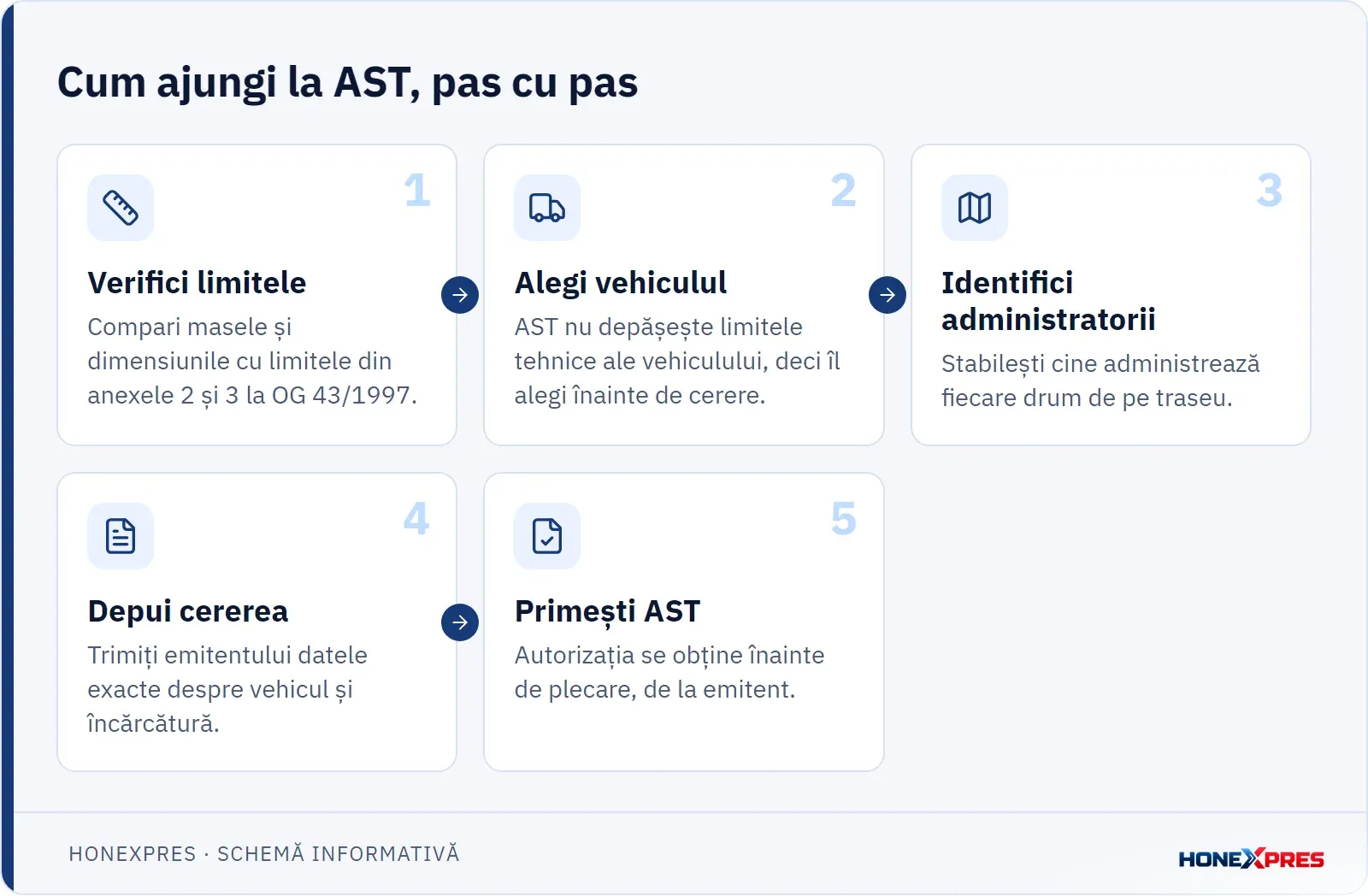
If the vehicle, with or without cargo, exceeds the maximum permitted masses or dimensions on public roads in Romania, you need a special transport permit (AST). It is obtained before departure from the administrator of the road on which the transport will travel. In short: you check whether you exceed the legal limits, identify who administers each road on the route and prepare accurate data about the vehicle and the load. Below you will find what the rules say, what affects the charges and where delays usually occur.
What the AST is and what it regulates
The rules for the oversized transport permit are laid down in the norms approved by Order No 1.236/6.509/126/2018, published in Monitorul Oficial No 48 of 18 January 2019. [1] These norms regulate the authorisation and circulation of vehicles with masses and/or dimensions above the limits set out in Government Ordinance No 43/1997 on the road regime, on the public road network in Romania. [1]
The special transport permit is defined as the document by which the road administrator sets the route, the conditions of circulation for vehicles exceeding the limits, and the charges due. [1] The AST is valid only for the registration numbers of the vehicles, the technical characteristics, the route, the direction, the period and the conditions of circulation entered in it. [1] In practice, an AST cannot be “transferred” to another lorry, another route or another date. What to do if the vehicle or the schedule changes should be checked directly with the issuing authority.
When the permit for oversized transport is required
The norms use the term “vehicle exceeding the limits” for a vehicle, with or without a load, whose masses and/or dimensions exceed the maximum permitted limits set out in annexes 2 and 3 to GO 43/1997. [2] The total masses, axle masses, maximum dimensions and related characteristics for each category of public road are set out in the same annexes. [3] The list of public roads with their maximum permitted masses is established and updated by ministerial order and published in Monitorul Oficial. [3]
We do not reproduce the numerical limit values here. They depend on the road category and the vehicle configuration, and the text changes over time. Check the current consolidated version of annexes 2 and 3 to GO 43/1997 or ask the AST issuing authority directly.
A few concepts from the norms will help you classify the transport correctly:
- Indivisible load: a load that cannot be divided into two or more loads without unnecessary cost or risk of damage. Because of its mass or dimensions, it cannot be transported within the maximum permitted limits. [1] Typical examples are a transformer, a long beam or a machine that cannot be dismantled.
- Total mass of the vehicle includes the tractor unit, the trailers/semi-trailers, the load, the securing devices and the load spreader. [1] The weight of the goods alone is therefore not enough for the calculation.
- The registration number may also be the provisional or trade plate number of the vehicle exceeding the limits. [2] This matters when you are moving a self-propelled machine that has not yet been permanently registered.
Conditions of circulation for a vehicle exceeding the limits
A vehicle exceeding the limits may travel on public roads in Romania only if it meets five conditions cumulatively. [4]
- It is approved for use on the road.
- It is in a satisfactory condition in terms of technical state and road safety.
- It does not exceed the vehicle's maximum constructively authorised masses.
- It holds an AST issued by the administrator of the road on which it travels.
- It complies with the provisions entered in the AST.
The third condition is important when choosing the vehicle. The AST allows the limits permitted on the road to be exceeded, but not the technical limits of the vehicle. [4] For this reason, the choice between a low bed, a semi-low loader or an extendable platform is made before the permit application. The vehicle chosen determines the data entered in the AST.
Who issues the AST: the issuing authority depends on the road
The AST is issued before the transport starts, by the administrator of the road on which the vehicle exceeding the limits will travel. [4]
| Road category | AST issuing authority |
|---|---|
| Motorways and national roads (of national interest) | CNAIR S.A. and its subunits, within the limits of competence set out in annex 1 to the norms [4] |
| County roads | The county council [4] |
| Local roads | The local council [4] |
There is also a useful exception. CNAIR may also issue the AST for roads that it does not administer, if they form part of the same route as roads of national interest. [4] This is worth checking when the transport departs from an industrial area served by county or local roads.
If the transport exceeds the limits of competence of a CNAIR subunit (inspection and collection agency, national roads section or regional directorate), the AST is issued on the basis of an approval from a higher level. [4] This approval is used only when the AST does not require a transport project or a route study. [4]
Transport project, route study and authorised route
For large or heavy transports, the issuing authority may request additional technical documentation. The norms define two types:
- The transport project: a technical project that determines whether the vehicle exceeding the limits may travel on public roads. It includes the stages, the necessary adaptation works and the conditions for safety and protection of the infrastructure. [2]
- The route study: a technical study with similar content, focused on exceeding the maximum permitted dimensions. [2]
The route is not chosen by the carrier. The authorised route is imposed by the road administrator, depending on the origin, the destination, the actual masses and dimensions, the load-bearing capacity of the road, the infrastructure elements and the permanent or temporary traffic restrictions. [2] By “engineering structures” the norms mean bridges, viaducts, overpasses and other similar constructions. [2] They are often the reason why the authorised route differs from the shortest road.
The authorised route may be simple, meaning a single origin–destination relation, or multiple, meaning more than one route, but not more than 4. [2] For the general principles of choosing a route, you can also read our guide to the road route.
Escorting oversized transport
Escorting means accompanying the vehicle exceeding the limits by specialised economic operators, with authorised escort vehicles and specialised personnel. [1] The specialised operator must be authorised under the same norms. [2] Escort vehicles must be registered in Romania. [5] The list of authorisations issued for these vehicles and their registration numbers are public on the CNAIR website. [5] You can thus check for yourself whether the proposed escort is authorised.

Whether a particular transport must be escorted, and under what conditions, is checked on the AST issued, in the current text of the norms and, if necessary, directly with the issuing authority. You check them on the issued document; you do not assume them in advance.
Separately from the AST, there is also a certificate for oversized transport. It is issued on request by the Autoritatea Rutieră Română and is valid for 5 years. [6] When it is mandatory for the driver should be checked in the regulations in force and with the ARR.
What data to prepare before applying
The issuing authority has the right not to issue the AST if the applicant has not provided all the necessary data. [4] The exact list of documents and the form should be checked with the issuing authority. Even so, the way the AST is defined shows what has to be established from the outset:

- The vehicle: the registration numbers of the tractor unit and of the semi-trailer or trailer, plus the axle configuration. The norms use codes of the AnSm type, meaning a tractor unit with “n” axles and a semi-trailer with “m” axles. [1]
- The technical characteristics: the actual length, width and height of the loaded combination, the total mass and the axle masses.
- The route and direction: the exact loading and unloading addresses, including gate access, and any border crossing point.
- The period: the interval in which the cargo is ready and the consignee can unload.
- The cargo: drawings or technical data sheets with dimensions and centre of gravity, lashing points and information on whether parts can be dismantled.
The most frequent problems arise when the dimensions in the application do not match reality. We have written separately about the technical requirements for the vehicle and for securing the cargo in the article technical conditions for the transport of oversized goods.
How long it takes to obtain the AST
We do not indicate a number of days for issuing the AST, because it depends on several factors and must be confirmed by the issuing authority. The firm rule is that the AST is obtained before departure. [4] The duration depends mainly on:
- the number of road administrators on the route: CNAIR, county councils, local councils;
- the need for an approval from a higher level of CNAIR, beyond the limits of competence of the subunit;
- the need for a transport project or a route study, which are drawn up before authorisation;
- the organisation of the escort and the availability of escort vehicles;
- the accuracy of the data submitted from the outset.
The practical recommendation is to plan oversized transport with a much larger margin than for a standard load. Check the current time limits directly with CNAIR or with the competent county or local council.
Factors that influence the cost
For the circulation of vehicles exceeding the limits, the transport operator owes additional road usage charges for the use of public roads. [2] For national roads, Order No 1.836/2018 calculates these charges according to the maximum permitted values in annexes 2 and 3 to GO 43/1997. [7] We do not give amounts, but the factors are clear:
- Exceeding the mass: the total mass and the axle masses. The actual mass is established from documents or by weighing. [7]
- Exceeding the dimensions: the actual length, width and height, established from documents or by measurement. [7]
- The distance travelled on the authorised route. A detour imposed by bridges or restrictions increases the cost.
- Escorting, the transport project or the route study, where they are required.
- The specialised vehicle and the standing time, including waiting for traffic windows.
The charge does not increase linearly with the excess, but according to formulas. For this reason, a few extra centimetres or a few extra tonnes can noticeably change the cost. The tariff table also provides for an estimate that includes the travel conditions, the distance and the cost, but not the route. [7] Separately, Law No 226/2023 regulates road charges on national roads, set according to the period or the distance travelled. [8] How these charges apply together with those in the AST should be checked with CNAIR. For a general picture of the price factors, see also the article on the cost of freight transport.
Cancellation, refund and differences on entry into the country
For national roads there are clear rules for situations where the plan changes:
- You may request cancellation and a refund of the additional charges if the AST has not been collected from the issuing authority. The same applies if you submitted the request together with the original before the start of validity. [9]
- In justified cases, the request may be submitted within 3 days at most from the start of validity, with supporting documents. Examples are dangerous weather phenomena signalled by an orange or red code, or cancellation of the transport order. [9]
- In all cases, the issuing authority retains the issuing charges. [9]
- If the vehicle travels with masses or dimensions lower than those in the AST, the permit remains valid, but the additional charges are not refunded. [9] A “safety” overestimate is therefore paid for.
- If masses or dimensions greater than those in the AST are found at the entry points into Romania, a complementary AST is issued. [9] It is calculated at the actual values established by weighing and measuring at entry. [9]
At the user's request, re-weighing or re-measuring can also be carried out. [7] The Romanian AST covers only public roads in Romania. [1] For sections in other countries, the rules and permits differ and should be checked with the competent authorities in each country.
The role of HONEXPRES in an oversized transport
HONEXPRES is a freight forwarder based in Oradea and has no fleet of its own. We organise oversized transport together with partner carriers that own the suitable vehicles. Specifically, we do the following:
- we collect the technical data of the cargo from you and check it before passing it on;
- together with the partner carrier, we choose the vehicle type and axle configuration;
- we coordinate the preparation of the AST application, as well as the organisation of the escort through authorised operators;
- we align the loading date, the period in the AST and the consignee's schedule;
- for international transports, we flag what must be checked in each transit country.
You will find details about the service on the oversized transport page. For moving excavators, combine harvesters or production lines, see also machinery transport.
Frequently asked questions
Do I need an AST if the vehicle is travelling empty?
It may be required. The definition of a vehicle exceeding the limits includes a vehicle “with or without a load” that exceeds the permitted limits. [2] A combination that exceeds the limits even without cargo therefore falls under the norms.
Who issues the special transport permit on a county road?
The county council issues the AST for roads of county interest. [4] If the county road forms part of a route together with national roads, the AST may also be issued by CNAIR. [4]
Can I use the same AST for another lorry?
No. The AST is valid for the registration numbers, technical characteristics, route, direction and period entered in it. [1]
What happens if the transport is postponed?
On national roads you may request cancellation and a refund of the additional charges under the conditions in the tariff order, but the issuing charges are retained. [9] Check the time limits with the issuing authority immediately.
How much does an AST for oversized transport cost?
There is no fixed price. The charges depend on how much you exceed the permitted mass and dimensions and on the distance travelled. [7] To these are added the costs of the vehicle, the escort and, where applicable, the route study.
Request a quote for your oversized transport
Send us the dimensions, the mass, the loading and unloading addresses and the desired period. We organise the transport with a suitable partner carrier, and we discuss the cost factors transparently before confirmation. Request a quote for oversized transport.
Official sources consulted
- [1] Norms approved by Order No 1.236/6.509/126/2018 – approval note
- [2] Norms approved by Order No 1.236/6.509/126/2018, art. 2 pt. 28 – vehicle exceeding the limits
- [3] Government Ordinance No 43/1997 on the road regime, art. 40 para. (2)
- [4] Norms approved by Order No 1.236/6.509/126/2018, art. 3 – Conditions for the circulation of vehicles exceeding the limits
- [5] Norms approved by Order No 1.236/6.509/126/2018, authorisation of escort vehicles, para. (4)
- [6] Norms approved by Order No 1.214/2015 – certificate for oversized transport, art. 4 para. (6)
- [7] Order No 1.836/2018 – additional charges for the use of roads of national interest, part 2 letter A)
- [8] Law No 226/2023 on the application of certain road charges on the national road network in Romania, art. 1 para. (1)
- [9] Order No 1.836/2018 – how the charges are applied, letter L) pt. 1
Send us the dimensions, the mass and the route of your cargo, and we will organise the oversized transport with a partner carrier and prepare a quote for you.
Have something similar to move? Request a quote →
Related services