Freight forwarding · Guides
A short guide to choosing a road route in freight transport
Article translated automatically from Romanian and checked automatically. If there is any difference, the original prevails. See the original in Romanian · How we use automatic translation

In short
Planning a road route is an essential part of the shipping process. It prepares you, as a customer, to avoid unforeseen complications as far as possible. It can reduce petrol consumption, improve vehicle utilisation and raise the quality of customer service by promoting efficiency in time and costs.
Contents
Planning a road route is an essential part of the shipping process. It prepares you, as a customer, to avoid unforeseen complications as far as possible. It can reduce petrol consumption, improve vehicle utilisation and raise the quality of customer service by promoting efficiency in time and costs.
Planning a route for your shipment can become an effort when you consider all the necessary factors that could influence the decision. Time windows, driving-hours restrictions and driver availability are just a few of these factors.
Transport networks in Romania
Situated on the transit corridor between Western Europe and the Middle East, itself a regional power, a producer and a consumer, Romania, once it had become independent in the second half of the nineteenth century, began to develop its transport by investing resources, talent and work in creating infrastructure at the highest technological level of the age.
At the end of 2020, the length of public roads totalled 86791 km, of which:
- 17913 km (20.6%) national roads;
- 35085 km (40.4%) county roads;
- 33793 km (39.0%) communal roads.
In terms of the type of surface, the structure of the public road network showed 45.2% (39189 km) modernised roads.
As regards the technical condition of public roads, 33.4% of the length of modernised roads and 40.9% of the length of roads with light road surfacing had exceeded their service life.
Of the length of national roads:
- 6178 km (34.5%) – European roads;
- 920 km (5.1%) – motorways.
In terms of the number of traffic lanes:
- 1959 km (10.9%) – roads with 4 lanes;
- 297 km (1.7%) – roads with 3 lanes;
- 35 km (0.2%) roads with 6 lanes.
Modernised roads made up 43.4% of the length of county roads, and 35.8% of communal roads were gravel roads.
The main modernisation works are set out in Romania's General Transport Master Plan, which can be consulted on the website of the Ministry of Transport and Infrastructure.
The General Transport Master Plan is an integrated strategic document that underpins the planning of transport investment for the period 2014-2030, and its objective is to ensure the conditions for achieving a transport system that is efficient, sustainable, flexible, safe, balanced between modes of transport, in harmony with the environment and connected to the trans-European transport networks – essential preconditions for the country's economic development.
The figure below shows Romania's road network at the end of 2020:
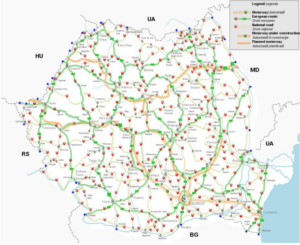
Romania's road network
Factors influencing the choice of route and of a road route in freight transport
To travel from the place of dispatch to the place of destination, goods can usually be routed along a multitude of routes.
The optimum one, however, can be chosen by the forwarding company after analysing and comparing factors characteristic of each mode of transport and each route.
In road transport, the convenient route is generally determined according to:
- the nature and characteristics of the goods (general, perishable, oversized, flammable goods, etc.);
- national and international commercial and administrative regulations on the transport of goods;
- reciprocal agreements concluded between countries to mutually stimulate the transit of goods;
- the level of the preferential rates resulting from the agreements concluded between the forwarding company and carriers;
- possibilities for handling, storage or transhipment en route.
A road route that is short in geographical terms is not necessarily the cheapest or the one with the shortest transit time. That is why determining the optimum route has become an activity specific to the forwarding company, which has the ability to keep creating new routes favourable to the flow of goods to/from the areas concerned.
Honexpres – complete solutions for domestic and international freight shipments
Whenever you are looking for a freight forwarder with experience in organising both domestic and international transport, Honexpres is the ideal solution.
We have complete transport solutions.
We also offer related services such as goods warehousing, etc.
We take care of the documentation from A to Z.
We organise the transport in detail and deliver your goods anywhere. For each transport we look for the shortest possible transit time and an advantageous rate; the delivery time and the rate are confirmed in the quotation.
Request a quotation for your transport and see for yourself!
Choose Honexpres for freight transport and conclude a contract for the carriage of goods safely!
Have something similar to move? Request a quote →
All guides in Freight forwarding (11)
Related services