Guides
Oversized transport: process, costs and what you need for a quote
AI Text written with AI assistance and checked by the editorial team. How we work with AI
Article translated automatically from Romanian and checked automatically. If there is any difference, the original prevails. See the original in Romanian · How we use automatic translation
In short
An oversized transport moves a load that exceeds the permitted dimensions or weights. It requires a verified route, a special permit from each road administrator and, often, an escort. Costs depend on dimensions, weight, distance, permits and escort. For a quote we need exact dimensions, weight, centre of gravity, loading and unloading locations, and the deadline.
Contents
- What is an oversized transport?
- Oversized transport and heavy transport: the difference in practice
- The indivisible load – why it matters
- Typical goods for oversized transport
- The oversized transport process: from request to delivery
- Route check: the core of every oversized transport
- Permits – the example of Romania
- Conditions for movement
- Who issues the special permit
- Complete data are mandatory
- When the actual values differ
- Germany and the transit countries
- Escort and qualified drivers
- Vehicles for oversized transport
- Documents for oversized transport
- Oversized transport costs: the main cost factors
- Additional charges for road use
- Other cost factors, in brief
- The quote for oversized transport: the data we need
- How HONEXPRES organises your oversized transport
- Frequently asked questions about oversized transport
- When is a transport considered an oversized transport?
- Who applies for the permit?
- Is an escort always required?
- What happens if the load is larger or heavier than stated?
- How long does it take to prepare an oversized transport?
- Request an oversized transport
- Official sources consulted
A machine wider than a standard semi-trailer, a bridge girder of excessive length or a transformer whose weight exceeds any standard load: goods like these do not fit the usual pattern of road freight transport. They require an oversized transport – with a verified route, a special permit, a suitable vehicle and, often, an escort. In this guide you will find out what defines an oversized transport, what the process looks like from request to unloading, which factors determine the costs and what data we need from you for a reliable quote. Using the Romanian regulations as an example, we show how an authorisation procedure is structured in practice.
What is an oversized transport?
We speak of an oversized transport when a vehicle together with its load exceeds the dimensions permitted for normal road traffic – width, height or length. If the permitted total mass or the axle loads are also exceeded, it is at the same time a heavy transport. The limit values are set by each country in its own regulations; for the specific route they must always be checked with the competent authority or in the current text of the law.
In Romania, specific rules govern the authorisation and conduct of the movement of road vehicles whose masses and/or dimensions exceed the maximum values laid down in Government Ordinance No. 43/1997 on the regime of roads [1]. These maximum values are set out in Annexes 2 and 3 of that ordinance [3]. Dimensions and weight are therefore treated there within a common regulatory framework – the legislator speaks of vehicles “with exceedances”, without distinguishing between oversized and heavy transport [1].
Oversized transport and heavy transport: the difference in practice
In German, people often speak in a single phrase of “oversized and heavy transport”, because the two frequently occur together. For your planning, however, the distinction is still worth making:
- Oversized (width, height, length): what matters are clearance heights, carriageway widths, curve radii, roundabouts, signs and traffic-light poles along the route.
- Heavy (total mass, axle loads): what matters are the load-bearing capacity of bridges and of the carriageway, as well as the vehicle's axle configuration.
Important for the weight analysis: under the Romanian rules, the total mass includes not only the tractor unit and the load, but also the trailer or semi-trailer, the securing devices and the load distributors [1]. For an in-depth presentation of heavy goods, see our guide to the heavy transport of oversized goods.
The indivisible load – why it matters
An oversized transport is not a substitute for more convenient loading. The Romanian rules define an indivisible load as a load that cannot be divided, for road transport, into two or more loads without unnecessary costs or risk of damage [1]. In addition, because of its dimensions or mass, it cannot be transported in such a way that the vehicle complies with the maximum permitted values [1]. If an installation can be dismantled – for example by removing attached parts – you should check this beforehand: every excess avoided simplifies the authorisation.
Typical goods for oversized transport
We organise oversized transports in particular for the following groups of goods:
- construction and agricultural machinery, such as excavators, front loaders, combine harvesters or road rollers
- industrial installations, presses, machine frames, tanks and vessels
- prefabricated steel and concrete elements, girders, trusses, bridge elements
- transformers, generators and other energy equipment
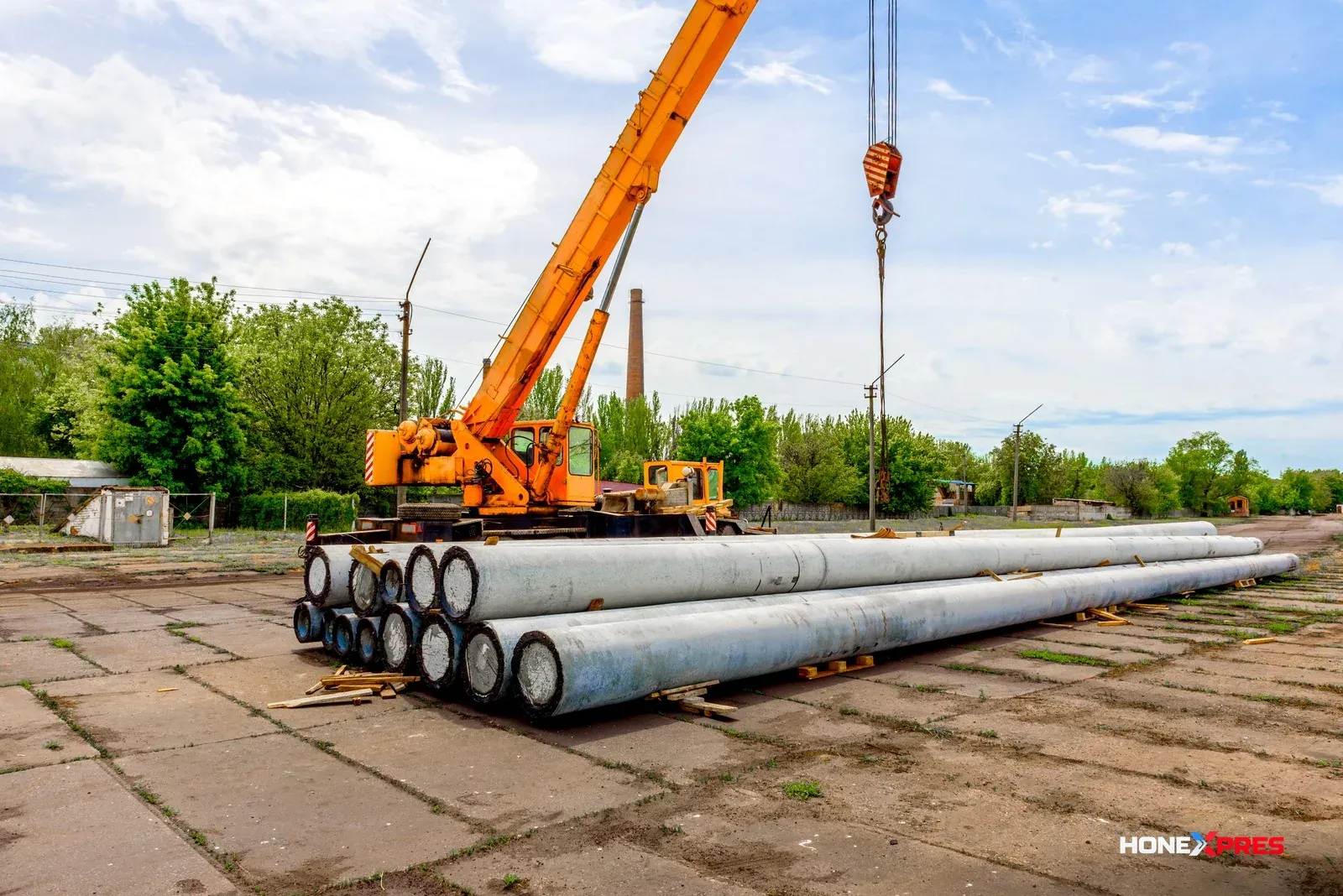
- silos, pipes and long profiles
- components for wind and industrial projects
For machinery that is heavy or bulky but stays within normal dimensions, machinery transport is often the more suitable solution.
The oversized transport process: from request to delivery
Every oversized transport is an individual project. The typical process, as we organise it together with our partner companies, looks like this:
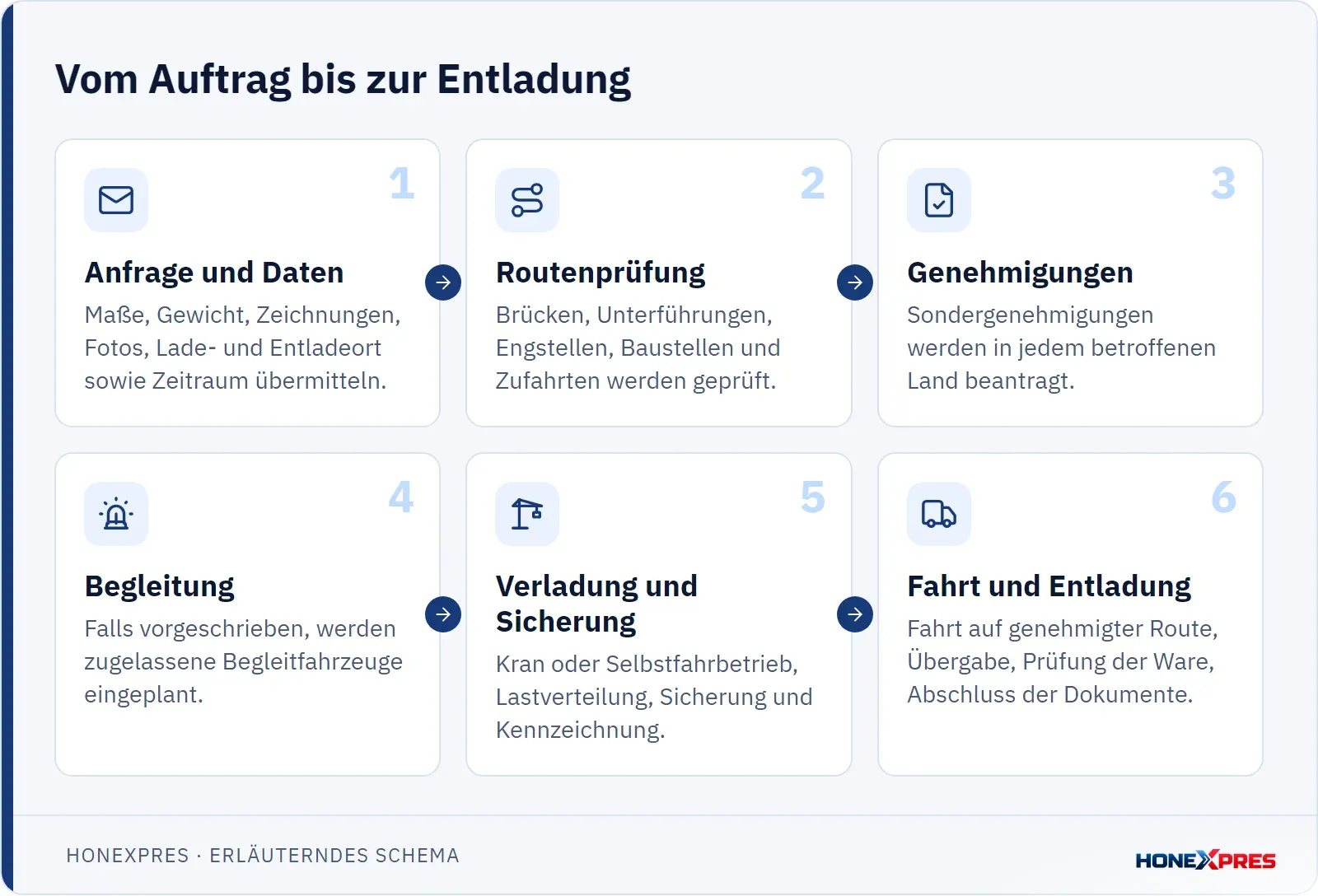
- Request and data collection: you send us the dimensions, weight, drawings, photographs, loading and unloading locations and the desired time window.
- Technical assessment: together with the partner company, we determine which vehicle is suitable and what overall dimensions and total weight result from it.
- Route check: the route is checked with regard to bridges, underpasses, narrow sections, roadworks and access roads.
- Permits: the special permits are requested from the competent institutions in each country involved.
- Organising the escort: if the permit requires it, an escort with authorised escort vehicles is planned.
- Loading and load securing: crane or self-propelled driving, load distribution, securing and marking.
- Carrying out the transport: travel along the authorised route, under the conditions set out in the permit.
- Unloading and completion: handover at the unloading location, checking of the goods, completion of the documents.
Stages 3 and 4 deserve particular attention: without an authorised route there is no transport. Allow sufficient preparation time, therefore, and clarify processing times with the competent authorities.
Route check: the core of every oversized transport
With standard transports, the driver largely chooses the route alone. With an oversized transport the situation is the reverse: the route is prescribed. Under the Romanian rules, the road administrator sets out in the special permit the route to be followed, the traffic conditions and the charges due [1]. The permit is valid for specific registration numbers, technical characteristics, route, direction of travel, period and imposed conditions [1].
In the case of greater excesses, a detailed check may be necessary: the rules expressly provide for cases in which a transport project or a route study is required for the permit to be issued [2]. For you, as the consignor, this means: the greater the deviation from normal dimensions, the more time you should allow for preparation.
The route check also covers the loading and unloading locations themselves: can the vehicle access the factory premises? Is there room for manoeuvring and for a crane? Is the ground sufficiently load-bearing? You will find general guidance on route selection in our guide to choosing a road route.
Permits – the example of Romania
Because we are based in Oradea, we show you the authorisation procedure on the basis of the Romanian rules, approved by Order No. 1.236/6.509/126/2018. In Germany and in the transit countries, their own procedures and competences apply – you, or the partner company performing the transport, should check these with the competent authorities there.
Conditions for movement
Over-limit vehicles may travel on public roads in Romania only if they are approved for road use and are technically and safety-wise faultless [2]. They must not exceed the maximum masses permitted under the vehicle's construction [2]. In addition, they must hold a special transport authorisation (AST) from the road administrator and comply with its conditions [2].
Who issues the special permit
The AST is issued before the start of the journey by the administrator of the roads on which the vehicle will travel [2]. For motorways and national roads, this is the national road infrastructure company CNAIR, with its subunits; for county roads it is the county councils, and for communal roads the local councils [2]. If the route runs on national roads as well as on other categories of roads, CNAIR may issue the AST for these additional sections too [2]. Which subunit is competent depends on the height, width, length and total mass of the vehicle; the competence limits are set out in Annex 1 of the rules [10]. The maximum processing times are given in Annex 2 of the rules [10].
Complete data are mandatory
The issuing institution may refuse the AST to persons who have not provided all the necessary data [2]. That is precisely why we ask for so much detail when preparing the quote – incomplete data delay not only the quote but, later, the authorisation as well.
When the actual values differ
If a check finds masses or dimensions greater than those entered in the AST, an additional AST is issued for the values found [10]. In this case the difference in the additional charges is paid, and the original AST is retained by the issuing institution [10]. Besides the costs and the loss of time, this shows that exact data on dimensions and weight, provided by the consignor, are not a formality.
Germany and the transit countries
Whether and which permit is required for the German section and for each transit country depends on the respective national law – check this with the competent authorities there. Competences, application channels, deadlines and escort obligations differ from country to country. Check these points with the competent authorities, or have the partner company performing the transport clarify them as part of organising the transport. For further information on vehicles and equipment, read the article Technical requirements for heavy transports.
Escort and qualified drivers
Many oversized transports do not travel alone. The Romanian rules define the escort as the escorting of over-limit vehicles by specialised companies, authorised escort vehicles and specialised persons [1]. Companies engaged in road freight transport or in activities ancillary to transport, and holding at least one escort vehicle, may be authorised for escorting [9]. The list of the authorisations issued and of the specialised companies is public and is published on the CNAIR website [9]. The persons providing the escort must be individually certified by CNAIR and by the Romanian road authority ARR [9].
There are also requirements for the driver: drivers operating over-limit vehicles registered in Romania need a certificate for oversized and heavy transports (oversized transport certificate) [6]. The prerequisite for this is a certificate of professional competence (CPC or CPI) for the carriage of goods [6]. The certificate is issued by ARR and is valid for five years [7]. The training covers, among other things, the types of loads, the indivisible load and the choice of vehicle according to the load [8]. It also deals with loading, axle loads, the centre of gravity and the stability of the vehicle [8].
Vehicles for oversized transport
Which vehicle is suitable follows from the dimensions, weight and centre of gravity of the load. The most common types:
- low-bed semi-trailer for tall and heavy loads, where every centimetre of loading height counts
- semi-low-loader semi-trailer for machinery and many oversized transports of moderate height
- telescopic extendable platform for long goods, such as girders, pipes or prefabricated elements
- modular vehicles and special equipment for very heavy one-off pieces
A lower loading surface can avoid or reduce a height excess – which has a direct effect on the route, the permit and the costs.
Documents for oversized transport
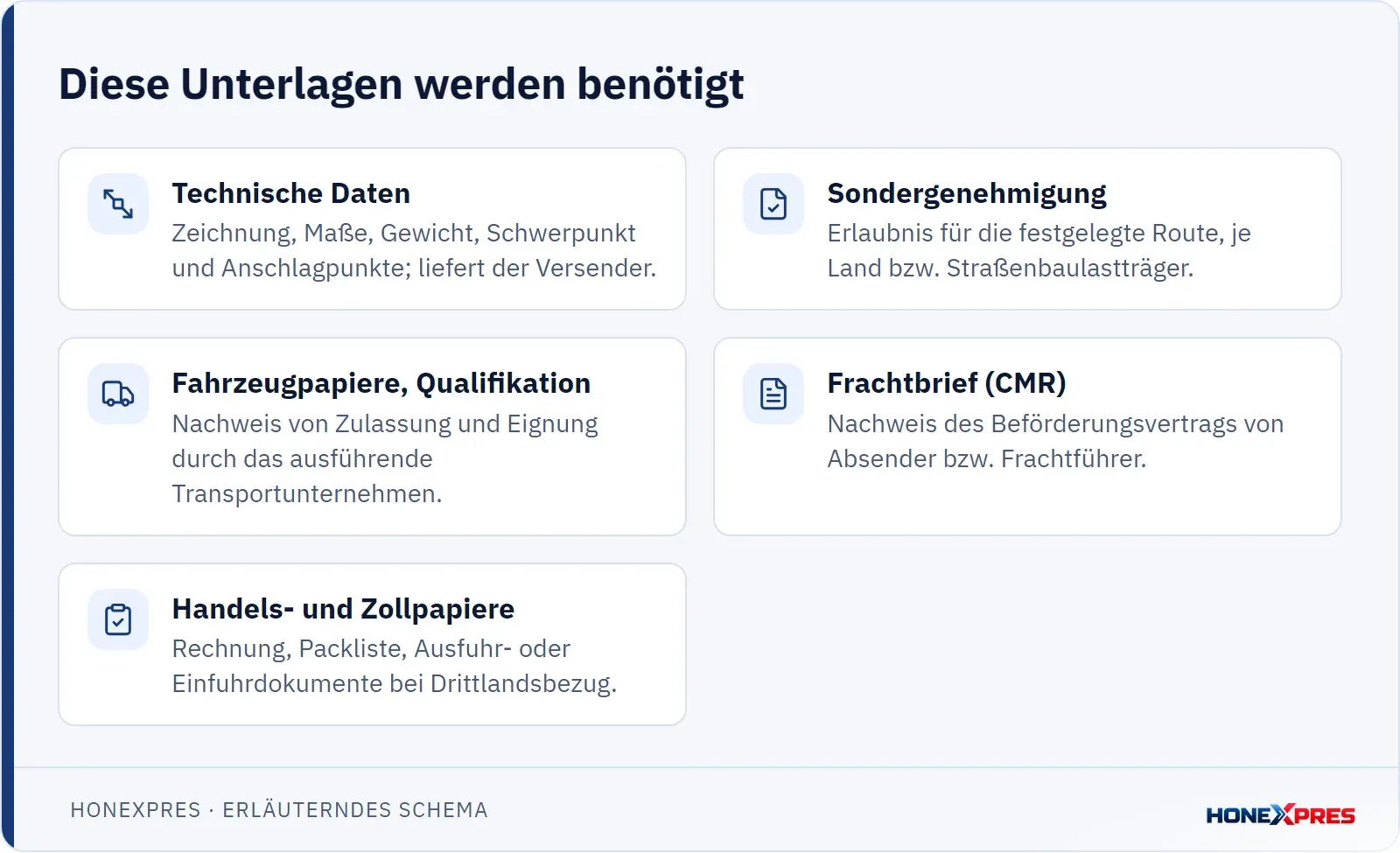
| Document | Purpose | Who provides / requests it |
|---|---|---|
| Technical data of the load (drawing, dimensions, weight, centre of gravity, lashing points) | Basis for choosing the vehicle, checking the route and authorisation | Consignor |
| Special permit per country, or per road administrator | Permission to travel on the route laid down | The carrier performing the transport, or its authorised representative |
| Vehicle documents and driver qualification | Proof of registration and of fitness | The carrier performing the transport |
| Consignment note (international: CMR) | Proof of the contract of carriage | Consignor / carrier |
| Commercial and, where applicable, customs documents | Invoice, packing list, export or import documents where a third country is involved | Consignor / consignee, where applicable customs broker |
Also clarify the insurance cover for the goods: check the extent of liability on the basis of the contract of carriage and the legal provisions in force, and for high-value installations consider whether separate cargo insurance is advisable.
Oversized transport costs: the main cost factors
There is no flat price for an oversized transport. The costs are made up of several elements that influence one another.
Additional charges for road use
In Romania there are additional charges for the use of roads of national interest by vehicles whose total mass, axle loads and/or dimensions exceed the maximum permitted values; they are regulated in Order No. 1.836/2018 [3]. They are calculated separately for the excess of total mass, axle load, length, width and height, each time multiplied by the distance [3]. The basis is the actual mass, determined from documents or by weighing [3]. If special rules apply to vehicles registered abroad, clarify this on the basis of the current version of the order, or with CNAIR. Check the version of this regulation currently in force.
In addition, the usual road-use charges are due: Law No. 226/2023 regulates the charges on Romania's national road network, which are set according to the period or the distance travelled [5].
Other cost factors, in brief
| Factor | Why it affects the costs |
|---|---|
| Degree of excess (width, height, length, weight) | Determines the vehicle type, the authorisation effort, the charges and, where applicable, the escort |
| Route and countries | Own permits and charges in each country; detours because of prescribed routes |
| Vehicle type | Special semi-trailers are less readily available and are often associated with empty return runs |
| Escort | Escort vehicles and personnel for the entire route or for parts of it |
| Route study / transport project | In the case of large excesses, additional planning effort |
| Restrictions on travel times | Prescribed time windows can extend the journey over several days |
| Loading and unloading equipment | Crane, lifting equipment or assembly personnel at both ends |
| Waiting times | Delayed loading or changed deadlines tie up costly special equipment |
How freight costs arise in general is explained in our article How much does freight transport cost?.
The quote for oversized transport: the data we need
The more complete your request, the faster and more reliable the quote. Please state:
- Goods: description, number of pieces, whether they can be dismantled
- Dimensions of each piece: length, width, height – with a drawing if possible
- Weight: weight of each piece, position of the centre of gravity, lashing and anchoring points
- Loading location and unloading location: full addresses, situation of the access roads, photographs of the site
- Loading equipment: who provides the crane or forklift? Is self-propelled driving possible (e.g. for construction machinery)?
- Deadline: earliest loading day, last delivery day, flexibility
- Value of the goods and customs status: relevant for insurance and documents
- Special features: sensitive components, covering, storage en route
How HONEXPRES organises your oversized transport
HONEXPRES is a freight forwarder based in Oradea. We do not own a fleet of vehicles; instead, we organise oversized and heavy transports with specialised partner companies. For you this means: a single point of contact for coordinating your technical data, the right vehicle, the route, permits and escort. You will find more about our range of services on the page Heavy transport in Romania and internationally.
Frequently asked questions about oversized transport
When is a transport considered an oversized transport?
As soon as the vehicle and the load together exceed the maximum permitted dimensions. In Romania, the maximum values are set out in Annexes 2 and 3 of Government Ordinance No. 43/1997 [3]. For Germany and the transit countries, check the limit values with the competent authorities there.
Who applies for the permit?
As a rule, the carrier performing the transport or a service provider authorised by it, because the permit is tied to the vehicle's data. In Romania, the AST is valid for the registration numbers and technical characteristics of the vehicles [1]. We coordinate this with our partner companies and need your complete data on the load for it.
Is an escort always required?
No. Whether and which escort is required follows from the permit and from the regulations of the country concerned. Where an escort is mandatory, it is provided in Romania by authorised companies, escort vehicles and specialised persons [1].
What happens if the load is larger or heavier than stated?
The vehicle is then no longer travelling within the limits of the permit. In Romania, where deviations are found an additional AST is issued, and the difference in the additional charges must be paid [10]. The loss of time and the additional costs can be avoided only through exact data provided beforehand.
How long does it take to prepare an oversized transport?
This depends on the degree of excess, the number of countries and the processing time at the authorities. In Romania, the maximum processing times for AST applications are regulated in Annex 2 of the rules [10]. For other countries, find out the deadlines from the competent institutions – and it is better to plan with a generous margin.
Request an oversized transport
Do you have an oversized or heavy load to move? Send us the dimensions, weight, photographs and route – we check feasibility together with our partner companies and organise the transport from route planning to unloading. Request a quote for your oversized transport now.
Official sources consulted
- [1] Rules on the authorisation and conduct of the movement of over-limit road vehicles, approved by Order No. 1.236/6.509/126/2018 – title
- [2] Rules annexed to Order No. 1.236/6.509/126/2018, art. 3 lit. a–b
- [3] Order No. 1.836/2018, Annex 1, part 2 lit. A
- [4] Order No. 1.836/2018 of the Ministry of Transport, art. 1 para. (1)
- [5] Law No. 226/2023 on road charges on the national road network of Romania, art. 1 para. (1)
- [6] Order No. 1.214/2015, Annex 5, art. 1 para. (1)
- [7] Order No. 1.214/2015, Annex 5, art. 4 para. (6)
- [8] Order No. 1.214/2015, Annex 5a (training programme), load domain
- [9] Rules annexed to Order No. 1.236/6.509/126/2018, authorisation of specialised companies, para. (1)
- [10] Rules annexed to Order No. 1.236/6.509/126/2018, art. 66 para. (3) (additional AST)
Send us the dimensions, weight and route of your load – we organise your oversized transport with specialised partner companies and prepare a quote for you.
Have something similar to move? Request a quote →
Related services