
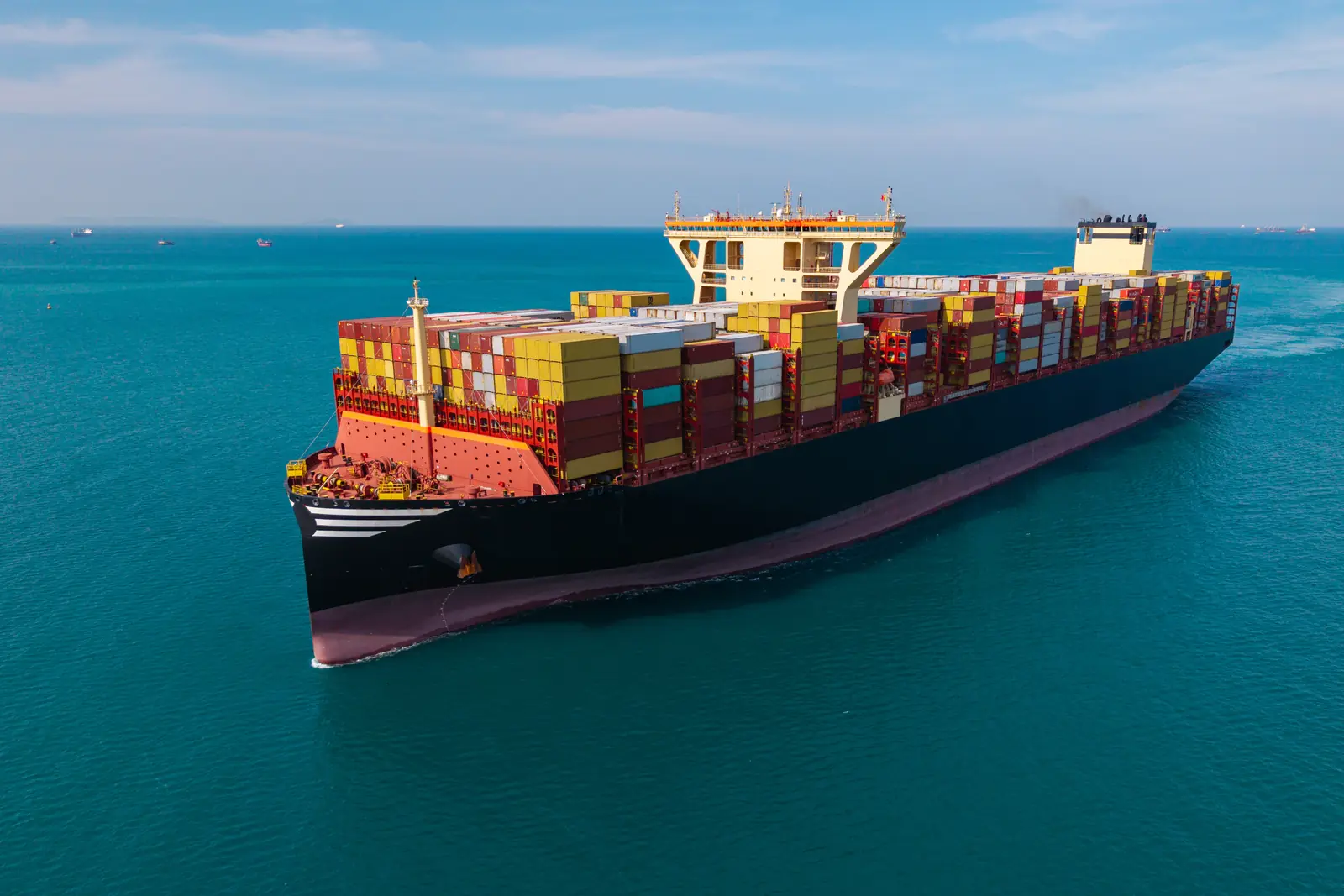
Sea freight · containers
Sea freight for FCL and LCL containers, import and export
We organise international sea freight by full container (FCL) or sea groupage (LCL), port-to-port or door-to-door, with shipping lines and agents in the ports. The quote shows each cost component separately.
- FCL and LCL Full container or groupage You choose by volume: a container of your own or space in a shared container.
- Import and export Port-to-port or door-to-door With road transport at both ends, when you need it.
- Separate costs A quote by component Ocean freight, terminal charges, road transport and customs, on separate lines.
- Customs With a customs broker We coordinate import and export formalities through a customs broker.
Options
FCL or LCL: full container or sea groupage
The choice depends on the volume, the deadline and how separate the goods need to stay. When the volume is borderline, we calculate both options for you.
-
Full container (FCL)
The container is yours alone, sealed at loading. It pays off when you have enough goods to fill a container.
-
Sea groupage (LCL)
You share the container with other shippers and pay by volume or weight. For a few cubic metres.
On this page
Port-to-port · door-to-door
Port-to-port or door-to-door
Port-to-port means only the sea leg: from the port of loading to the port of discharge. Door-to-door means the whole journey, from your supplier’s door to yours, with road transport and customs included. You choose only the stages you need.
-
Collection from the supplier
-
Port of loading
-
The vessel
-
Port of discharge
-
Customs
-
Delivery and return of the empty container
Containers
Containers for sea freight
-
Dry 20′ and 40′
The standard containers, for general goods that are palletised or packed in parcels.
-
High cube 40′
About 30 cm taller than the standard, for bulky goods.
-
Refrigerated (reefer)
Controlled temperature throughout the journey, with power supplied on board and at the terminal.
-
Open top and flat rack
For machinery and goods that do not fit through the doors or exceed the container.
Ports and routes
Ports and routes
In Romania, sea containers come in and go out mainly through the port of Constanța; from there they continue by road or by rail to their destination. We organise imports and exports on the routes where we work with shipping lines and agents; we confirm the ports and transshipments in the quote.
Incoterms®
Incoterms® in sea freight
The Incoterms® rule in the sales contract sets how far the seller pays and from which point the buyer takes over the costs and the risk. In sea freight, the most common ones are:
- EXW / FCA — The buyer organises almost the whole journey, from the seller onwards.
- FOB — The seller delivers the goods on board the vessel, at the port of loading.
- CFR / CIF — The seller pays the ocean freight to the port of destination; under CIF this also includes minimum insurance.
- DAP / DDP — The seller delivers to the buyer’s address; under DDP the seller also pays the import customs costs.
For a decision with legal effects, check the contract and, if needed, consult a lawyer.
Indicative duration
How long sea freight takes (indicative)
The duration depends on the line, the port of loading, transshipments and congestion in the ports. In the quote you receive the transit time estimated by the shipping line; road legs, time at the terminal and customs are added to it.
- No promised deadlines — The arrival date remains the line’s estimate and may change. We let you know in good time when it changes.
Cargo types
What goods we ship by sea
- Equipment, furniture, consumer goods and raw materials, on import
- Palletised general goods, on export
- A few cubic metres of goods, in sea groupage (LCL)
- Refrigerated goods, in reefer containers
- Machinery and out-of-gauge goods, on flat racks or open tops
- Dangerous goods accepted by the line under the IMDG Code
How it works
How it works: from request to delivery
- Step 1
The request and the Incoterms® rule
You tell us from where to where, who pays what under the contract, the goods, the volume and the date they are ready.
- Step 2
FCL or LCL, and the quote
We choose the option and the container type; the quote shows separately the transport to the port, the port charges, the ocean freight, the surcharges, customs and delivery.
- Step 3
Booking and documents
The HONEXPRES team books space with the line and coordinates loading, the VGM and the documents within the vessel’s deadlines.
- Step 4
Transit
We follow the vessel and let you know if the estimated arrival date changes.
- Step 5
Arrival, customs and delivery
We coordinate the release of the goods, the customs formalities, the road delivery and the return of the empty container.
What we need for a quote
Information needed for a quote
The more accurate the details, the more precise the quote. Whatever you do not know, mark “I don’t know”: we will fill it in together.
- Origin and destination: port or address (door-to-door)
- The Incoterms® rule in the contract (or “I don’t know”)
- FCL: type and number of containers; LCL: packages, dimensions, weight, volume
- Description of the goods and the tariff code (HS), if you have it
- Dangerous goods (IMDG class, UN number, SDS) or controlled temperature
- The date the goods are ready for loading
- Customs clearance at origin or at destination
- The value of the goods, if you want cargo insurance
Documents
Documents for sea freight
- Bill of lading (B/L) The shipping line’s document: a receipt for the goods and evidence of the contract; the original can be a document of title to the goods.
- Sea waybill A non-negotiable alternative; the goods are released to the named consignee, without a paper original.
- Commercial invoice and packing list Issued by the seller, required for customs.
- Proof of origin (EUR.1 or origin declaration) For preferential duties, where a trade agreement exists.
- VGM declaration The verified gross mass of the container, declared before loading on board.
- Dangerous goods declaration (IMDG) Only for dangerous goods.
- Import or export customs declaration Prepared by the customs broker.
Restrictions
Restrictions we take into account
- Dangerous goods are accepted only if the line accepts them on the route in question, under the IMDG Code.
- Goods that exceed the container require the line’s approval and special equipment.
- Vessel schedules are set by the lines and may change; arrival dates are estimates.
- Free days at the terminal and for the container are limited; after them, demurrage and detention apply.
- Shipments to or from countries and parties under international sanctions are checked before the quote and may be refused.
Cost factors
What affects the cost of sea freight?
We do not publish sea freight rates: ocean freight changes often, and the price of shipping a container depends on the route, the period and the stages included. The quote shows each component separately, with the date until which it is valid.
-
01
Ocean freight and the validity of the quote
The line’s price for the sea leg, which follows the market
-
02
Line surcharges
Fuel (BAF), season, security, emissions
-
03
Terminal handling charges (THC), at origin and at destination
-
04
Road transport to and from the port, including the return of the empty container
-
05
Customs and inspections, including any physical checks
-
06
Container type (standard, high cube, refrigerated, special); for LCL, the volume or weight
-
07
Free days, demurrage and detention, if the container stays beyond the free period
Destination costs — terminal, customs, delivery, days beyond the free period — often only become visible on arrival; that is why we put them in the quote from the start.
How much does it cost to ship a container by sea?
We do not publish rates, because ocean freight changes often, sometimes from one week to the next. For your route we send you a quote that separates ocean freight, surcharges, terminal charges, road transport and customs, with the date until which it is valid.
FCL or LCL: which should I choose?
For a few cubic metres, LCL is usually more cost-effective. The more the volume grows, the more attractive a full container becomes, especially if your goods should not be handled together with other people’s. When the volume is borderline, we calculate both options for you.
Why does the price of sea freight change from one week to the next?
Ocean freight and the lines’ surcharges follow the market: demand, vessel capacity, fuel. That is why the quote has a validity date; after it, we recalculate.
How long does sea freight from China to Romania take?
It depends on the port of loading, the line and transshipments. In the quote you receive the transit time estimated by the shipping line to the port of discharge; added to it are the time at the terminal, customs and the road or rail transport to you. The arrival date remains the line’s estimate, and if it changes we let you know.
What do port-to-port and door-to-door mean?
Port-to-port covers only the sea leg, from the port of loading to the port of discharge. Door-to-door means the whole journey, from the supplier to you, with road transport at both ends, port charges and customs. You choose only the stages you need, and the quote shows them separately.
What do THC, BAF, demurrage and detention mean?
THC are the container handling charges at the terminal; BAF is the line’s fuel surcharge. Demurrage is paid for a full container kept at the terminal beyond the free days, and detention for a container kept outside the terminal beyond the free time. You will find them explained in the glossary, and in the quote they appear separately.
Do you also handle customs?
Yes. We coordinate import or export customs formalities through a customs broker; HONEXPRES is not a customs broker. Details on the customs formalities page.
Guides
Useful guides and articles
Guides to help you prepare your sea shipment: documents, Incoterms® and costs.
-
What is a bill of lading (B/L)?
There are two types of document, the Charter Party and the Bill of Lading, which embody the contract of carriage by sea. They differ from…
-
What does FOB mean?
FOB, the term “Free On Board”, indicates that the seller is responsible for delivering the goods on board the ship, at an agreed port, and…
-
How is the quotation determined in maritime transport?
Tense situations around the world constantly influence quotations in maritime transport. Between Asia and Europe, they fell slightly at…
Related articles
More about sea freight
- The updated INCOTERMS delivery terms Apr 1, 2022
- Are there several types of bills of lading? Nov 4, 2022
- The contract of carriage by sea: importance and rules Oct 24, 2022
- The Port of Constanța: how important is it in Europe? Oct 10, 2022
- Transhipment of goods: what does it involve? Oct 7, 2022
Related services
-
Container haulage
containers from the port or terminal, by road
-
Rail and intermodal transport
rail and rail–road combinations
-
Air freight
urgent cargo, for tight deadlines
-
Customs formalities
import, export and transit
-
Freight forwarding
who we are and how we organise transport
Suitable vehicles
-
Container chassis (20' / 40' / 45')
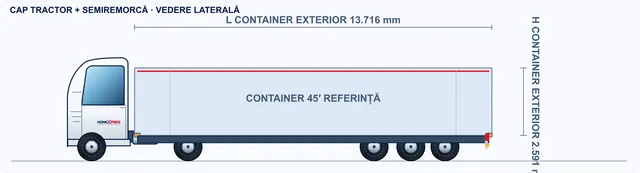
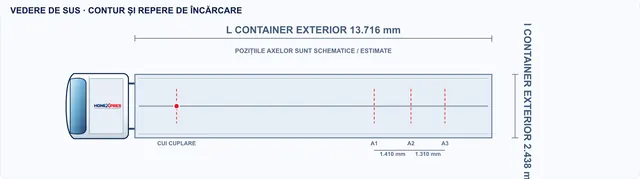
cargo of ~26 t in a 20' / ~22 t in a 40' HC (at 40 t)
Indicative Sketch: Container chassis
Suitable containers
-
20' Dry Van
~5.9 m · ~2.35 m · ~2.39 m · ~33 m³ · 11 EUR pallets · ~26 t on the road (40 t)
-
40' Dry Van
~12.0 m · ~2.35 m · ~2.39 m · ~67 m³ · 25 EUR pallets · ~23 t on the road (40 t)
-
40' High Cube
~12.0 m · ~2.35 m · ~2.7 m · ~76 m³ · 25 EUR pallets · ~22 t on the road (40 t)
-
20' Reefer
~5.45 m · ~2.29 m · ~2.15 m usable (up to the load line) · ~28 m³ (~27 m³ usable) · 10 EUR pallets · ~25 t on the road (40 t, without genset)
-
40' Reefer High Cube
~11.6 m · ~2.29 m · ~2.4 m usable (up to the load line) · ~67 m³ (~65 m³ usable) · 23 EUR pallets · ~22 t on the road (40 t, without genset)
-
20' Open Top
~5.9 m · ~2.35 m · ~2.35 m · ~32.5 m³ · 11 EUR pallets · ~25 t on the road (40 t)
Practical reference values. We confirm the exact dimensions in the quote. Honexpres organises transport with this vehicle, on request.
Quote request
Do you have goods to bring in or send overseas?
Tell us the origin, the destination, the Incoterms® rule, the goods and the volume. The HONEXPRES team sends you a quote showing each cost component.
Automatic translation, automatically checked. This page was translated automatically from Romanian and passed the automatic checks for language, terminology, figures and links. If there is any difference, the Romanian version prevails. How we use automatic translation