Freight forwarding · Guides
The updated INCOTERMS delivery terms
Article translated automatically from Romanian and checked automatically. If there is any difference, the original prevails. See the original in Romanian · How we use automatic translation
In short
The updated INCOTERMS delivery terms seem complicated and dense. However, once we have explained them in detail in this Honexpres article, you will see that they are simple to understand and to apply.
Contents
- What does INCOTERMS delivery mean?
- The rules of INCOTERMS delivery
- Group C
- Group D
- Group E
- Group F
- Terms applicable to all modes of transport
- 1. EXW = Ex Works
- 2. FCA = Free Carrier
- 3. CPT = Carriage Paid To
- 4. CIP = Carriage and Insurance Paid To
- 5. DPU = Delivered at Place Unloaded
- 6. DAP = Delivered at Place
- 7. DDP = Delivered Duty Paid
- Terms that apply only to sea transport or inland waterway transport
- 8. FAS = Free Alongside Ship
- 9. FOB = Free on Board
- 10. CFR = Cost and Freight
- 11. CIF = Cost, Insurance and Freight
- Honexpres – international transport in accordance with INCOTERMS
The updated INCOTERMS delivery terms seem complicated and dense. However, once we have explained them in detail in this Honexpres article, you will see that they are simple to understand and to apply.
What does INCOTERMS delivery mean?
First of all, we need to understand what this term means. INCOTERMS is short for INternational COmmercial TERMS. It therefore refers to the terms and conditions for international commercial shipments.
The delivery terms codified in the INCOTERMS system are an extremely useful guide for all economic operators engaged in international commercial transactions. These rules make it possible to define exactly the extent of the parties' obligations in connection with one of the essential components of performing the contract of sale: DELIVERY.
The rules of INCOTERMS delivery
The INCOTERMS rules focus on two key questions relating to each transaction:
1) Which party – buyer or seller – is responsible for organising and paying for the transport and for the ancillary activities (loading or unloading, import and export procedures, insurance of the goods, etc.)?
2) At which point in the transport process does the transfer of responsibility from the seller to the buyer take place? This becomes even more important if the goods are lost or damaged during transport.
The current INCOTERMS delivery terms are divided into four groups (C, D, E, F). The rules are classified according to charges, risk, responsibility for formalities, as well as aspects
related to import and export:
Group C
In group C (main carriage paid), the seller concludes a contract of carriage with the forwarding company and bears the costs. In this case, the seller is responsible for carrying out export clearance. The risk is transferred when the goods are delivered to the buyer. Group C includes the following INCOTERMS rules: CFR, CIF, CPT and CIP.
Group D
Group D provides that the seller is obliged to deliver the goods to a specified place or to the port of destination. This group includes the following INCOTERMS rules: DAP, DPU and DDP.
Group E
In group E, the seller places the goods at the buyer's disposal at the delivery point indicated by the seller. The seller is not obliged to carry out the export clearance formalities and does not bear the risk and costs of loading. In group E there is only one INCOTERMS rule: EXW.
Group F
Group F (main carriage unpaid) obliges the seller to carry out export clearance. The seller does not pay the transport and insurance costs. Group F includes the following INCOTERMS rules : FCA, FAS and FOB.
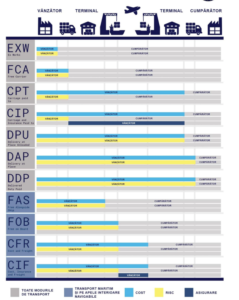
In terms of the mode of transport used, the INCOTERMS delivery terms are divided into two main categories:
1) those that apply to all modes of transport;
2) those that apply only to sea transport or inland waterway transport.
Terms applicable to all modes of transport
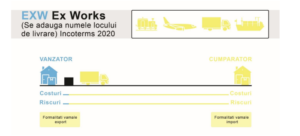
1. EXW = Ex Works
The goods are delivered when they are placed at the buyer's disposal at the seller's premises or at another named location (e.g. works, factory, logistics warehouse, etc).
The seller is not responsible for loading the goods, nor for completing the export clearance formalities.
The buyer covers all the costs and organises the transport. The risk of loss of or damage to the goods transfers when they are placed at the buyer's disposal on the seller's premises.
It is recommended that EXW should not be used when the buyer is not in a position to carry out the export customs formalities. In that case, the use of FCA is recommended, without forgetting to specify that the seller undertakes to load the goods and to complete the export clearance formalities, at its own expense and risk.
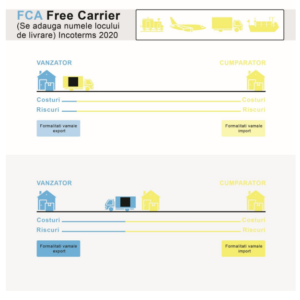
2. FCA = Free Carrier
The goods are delivered when:
– the seller has handed over the goods, cleared for export, into the care of the carrier nominated by the buyer, at a place specified in the contract which is the seller's own premises;
or
– the seller has handed over the goods, cleared for export, into the care of the carrier nominated by the buyer, at a place specified in the contract which is not the seller's premises (e.g. seaport, terminal).
The seller may, at the buyer's request, conclude a contract of carriage with the carrier on usual terms and conditions, at the buyer's cost and risk.
The buyer is obliged to organise the transport and the insurance of the goods.
The risk of loss of or damage to the goods transfers when they are placed at the buyer's disposal at the place specified in the contract.
FCA is the most widely used term (approximately 40% of international commercial operations are carried out under it).
This is because it is very versatile and allows goods to be delivered from various places in the seller's country. These include: the seller's address, the inland transport terminal, the port, the airport, etc.
3. CPT = Carriage Paid To
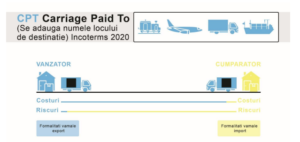
The goods are delivered when they have been handed over to the carrier, at the agreed place, for the agreed mode of transport.
The seller must complete the export clearance formalities, contract a carrier and pay for the carriage of the goods to the agreed destination.
The buyer takes delivery of the goods and assumes liability for damage to or loss of the goods from the moment they have been handed over to the carrier.
The risk of loss of or damage to the goods transfers at the moment they have been handed over to the carrier. The seller therefore does not guarantee that they will reach the place of destination in good condition, in the stated quantity or at all, even though it pays the cost of carriage. Where successive carriers are used to transport the goods, the risks pass from the seller to the buyer. This happens at the moment the goods have been handed over to the first carrier.
CPT may be used for all modes of transport, including multimodal transport.
4. CIP = Carriage and Insurance Paid To
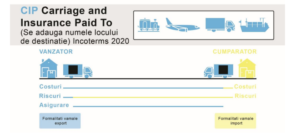
The goods are delivered when they have been handed over to the carrier, at the agreed place, for the agreed mode of transport.
The seller must complete the export clearance formalities; contract a carrier; pay for the carriage of the goods to the agreed destination. The seller is obliged to conclude a contract of insurance covering the risk of loss of or damage to the goods from the point of delivery to at least the place of destination.
The buyer takes delivery of the goods and assumes liability for damage to or loss of the goods from the moment they have been handed over to the carrier.
The risk of loss of or damage to the goods transfers at the moment they have been handed over to the carrier. The seller therefore does not guarantee that they will reach the place of destination in good condition, in the stated quantity or at all, even though it pays the cost of carriage. Where successive carriers are used to transport the goods, the risks pass from the seller to the buyer at the moment the goods have been handed over to the first carrier.
CIP may be used for all modes of transport, including multimodal transport. CIP can cause difficulties when the country of destination requires insurance to be purchased locally. In that case, the parties should consider selling and buying under the CPT rule.
5. DPU = Delivered at Place Unloaded
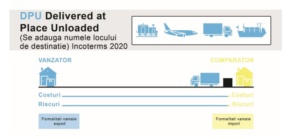
The goods are delivered when, once unloaded from the arriving means of transport, they are placed at the buyer's disposal at a named place of destination or at the agreed point within that place, if any such point is agreed.
The seller must complete the export clearance formalities, pay for the carriage of the goods to the agreed destination and bear all the risks involved in bringing the goods to, and unloading them at, the place of destination. In this Incoterms rule, therefore, delivery and arrival at destination are the same. DPU is the only Incoterms rule that requires the seller to unload the goods at destination. The seller should therefore make sure that it is in a position to organise unloading at the named place.
The buyer is obliged to carry out the import customs formalities.
The risk of loss of or damage to the goods transfers when, once unloaded from the arriving means of transport, they are placed at the buyer's disposal at a named place of destination or at the agreed point within that place, if any such point is agreed. Where the parties intend the seller not to bear the risk and costs of unloading, the DPU rule should be avoided and DAP should be used instead.
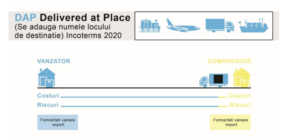
6. DAP = Delivered at Place
The goods are delivered when they are placed at the buyer's disposal on the arriving means of transport, ready for unloading, at the named place of destination.
The seller must complete the export clearance formalities. It must pay for the carriage of the goods to the agreed destination. It bears all the risks involved in bringing the goods to the agreed place at the agreed time (e.g. the station; the industrial siding; the unloading bay; the agreed address).
The buyer is responsible for unloading the goods and for carrying out the import customs formalities.
The risk of loss of or damage to the goods transfers when they are placed at the buyer's disposal on the arriving means of transport. This applies only if they are ready for unloading, at the named place of destination.
DAP is used for all types of transport, including multimodal transport.
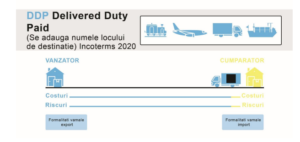
7. DDP = Delivered Duty Paid
The goods are delivered when they have been placed at the buyer's disposal at the agreed place in the importing country.
The seller must bear all the costs and risks involved in bringing the goods to that place. It must bear the payment of customs duties. It must bear the payment of other taxes and official charges payable on import, as well as the costs and risks of completing the customs formalities.
The buyer bears all the costs from the moment the goods are delivered.
The risk of loss of or damage to the goods transfers exactly from the moment the products are delivered to the buyer at the agreed place in the importing country. It is therefore recommended that the parties specify the destination of the transport precisely.
Under DDP, the seller has the greatest responsibility.
Terms that apply only to sea transport or inland waterway transport
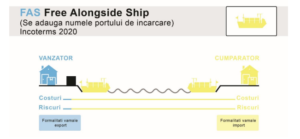
8. FAS = Free Alongside Ship
The goods are delivered when they are placed alongside the vessel. For example: on the quay; on lighters; on barges or on a ferry nominated by the buyer, at the named port of shipment.
The seller is obliged to deliver the goods cleared for export, placing them alongside the ship at the port indicated by the buyer.
The buyer bears all the costs from the moment the goods are delivered.
The risk of loss of or damage to the goods transfers when the goods are placed alongside the vessel, at the agreed port of loading.
In the case of FAS, it is recommended to specify as clearly as possible the loading point at the named port of shipment where the goods are to be transferred from the quay or barge to the ship. This is because the handling charges and the transport of the goods from the quay or barge may vary according to the practice of the port.
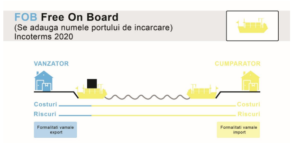
9. FOB = Free on Board
The goods are delivered when they are delivered on board the vessel nominated by the buyer at the named port of shipment, or the seller procures the goods already so delivered.
The seller is obliged to deliver the goods cleared for export, placing them on board the vessel.
The buyer bears all the costs from the moment the goods are delivered.
The risk of loss of or damage to the goods transfers when the goods are on board the vessel at the port of shipment.
The rule is very often misapplied. Why? Because it cannot be used for the transport of containers (in that case, the FCA rule is recommended).
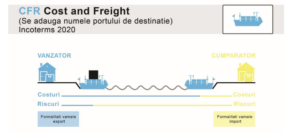
10. CFR = Cost and Freight
The goods are delivered when they are delivered on board the vessel nominated by the buyer at the named port of shipment, or the seller procures the goods already so delivered.
The seller is obliged to deliver the goods cleared for export; to conclude a contract for the carriage of the goods to the port of destination. This applies regardless of the transfer of risk at the port of delivery. It must also bear all the costs of unloading at the port of destination. These costs arise from the contract of carriage, unless otherwise agreed. It does not guarantee that the goods will reach the place of destination in good condition, in the stated quantity or at all, even though it pays the cost of carriage.
The risk of loss of or damage to the goods transfers when the goods are on board the vessel at the port of shipment. The obligations under this rule are relatively similar to the seller's obligations under the FOB rule. There is, however, one fundamental difference between them. Under the CFR rule, the seller is responsible for the carriage. This means that the exporter finds the carrier, negotiates the appropriate contract and pays for the carriage. In addition, the use of the CPT rule is recommended if several modes of transport are used.
11. CIF = Cost, Insurance and Freight
The goods are delivered when they are delivered on board the vessel nominated by the buyer at the named port of shipment.
The seller is obliged to deliver the goods cleared for export. It is also obliged to conclude a contract for the carriage of the goods to the port of destination. This applies regardless of the transfer of risk at the port of delivery. The seller is obliged to conclude a contract of insurance. This covers the risk of loss of or damage to the goods from the port of shipment to the named port of destination.
The risk of loss of or damage to the goods transfers when the goods are on board the vessel at the port of shipment.
Apart from the FOB rule, the rule most frequently used in the carriage of bulk goods by sea is the CIF rule. It is not recommended for the transport of containers. In that case, the FCA and CIP terms are recommended. The use of CIF for multimodal transport is not permitted. The CIP rule is used for that purpose.
Honexpres – international transport in accordance with INCOTERMS
Whatever transport you have, we give you advice to work out which form of transport is the most advantageous for you. We then organise the transport down to the smallest details and take your goods out or bring them in under the best conditions. We offer domestic or international transport services, ADR transport services and any other type of transport in accordance with the INCOTERMS rules.
Photo source: metals-hub.com
Have something similar to move? Request a quote →
All guides in Freight forwarding (11)
Related services