Guides
Abnormal load transport: how it works in the UK, what drives the cost and how to get a quote
AI Text written with AI assistance and checked by the editorial team. How we work with AI
Article translated automatically from Romanian and checked automatically. If there is any difference, the original prevails. See the original in Romanian · How we use automatic translation
In short
An abnormal load is an indivisible load that cannot travel within normal weight or size limits. In Great Britain it moves under STGO in three weight categories, with advance notice to authorities and attendants above set dimensions. Cost depends on permits, vehicle, escorts, route and timing.
Contents
- What counts as an abnormal load in the UK
- STGO categories for abnormal indivisible load vehicles
- When a Special Order is needed
- Width, length and projections: notice and attendants
- Length
- Width
- Attendants and escort vehicles: not the same thing
- Notifications, paperwork and who is responsible
- Abnormal loads from mainland Europe to the UK
- What drives the cost of abnormal load transport
- What to send for an accurate quote
- How HONEXPRES organises abnormal load haulage
- FAQ
- Is every oversized load an abnormal load?
- Who notifies the police and highway authorities?
- Does every abnormal load need an escort vehicle in the UK?
- Can a vehicle registered outside GB carry an abnormal load in Great Britain?
- What happens if the actual load differs from the notice?
- Are UK and EU abnormal load rules the same?
- Request an abnormal load transport quote
- Official sources consulted
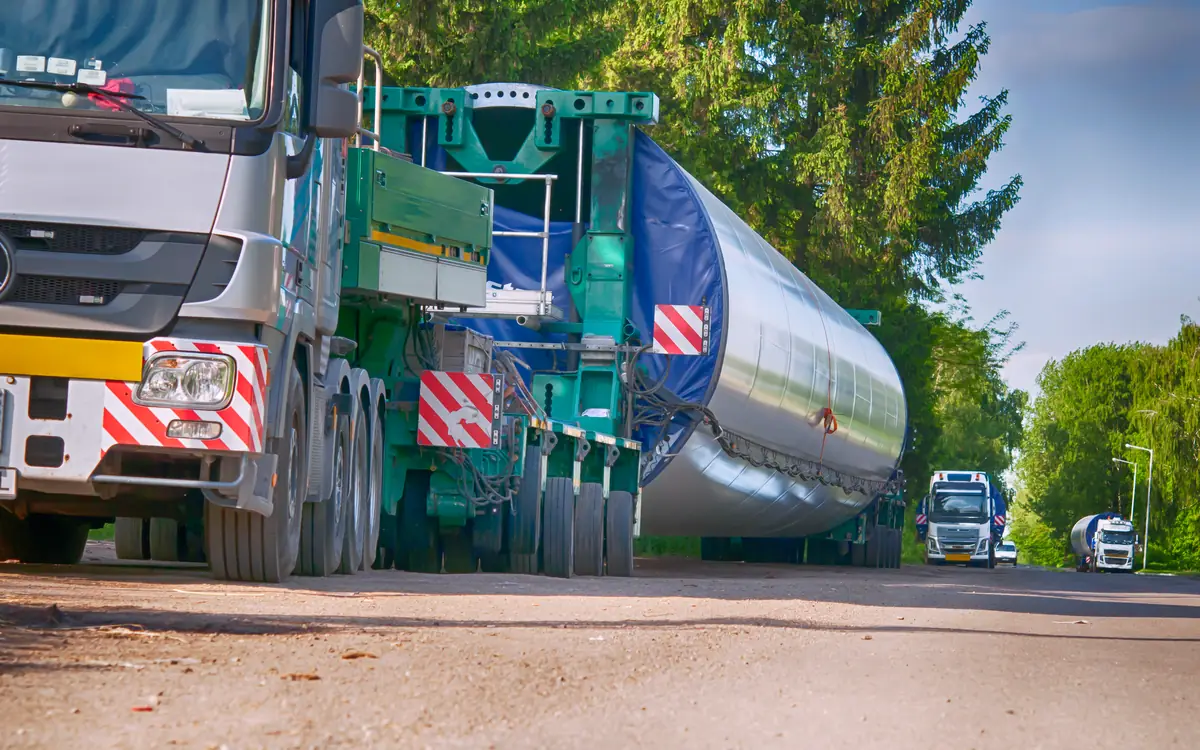
Abnormal load transport means moving a load that cannot reasonably be split into smaller parts and which, once loaded, takes the vehicle outside the normal legal limits for weight or dimensions. In Great Britain these movements run under a dedicated legal framework, the Road Vehicles (Authorisation of Special Types) (General) Order 2003 (STGO). It sorts abnormal indivisible load vehicles into three weight categories, each with its own advance notice, signage and speed limits. Above certain thresholds, a Special Order is required. What you pay depends mainly on the vehicle combination, notices and permits, attendants or escorts, the route and the timing. A precise description of the load is therefore the starting point for any reliable quote.
Special types vehicles are those that do not meet the normal Construction and Use (C&U) and Authorised Weight (AW) Regulations but may be used outside those rules under the authority of STGO. [1] HONEXPRES is a freight forwarder based in Oradea, Romania. We do not run our own trucks. We organise oversized and abnormal load transport with partner carriers who hold the right equipment and authorisations for each route.
What counts as an abnormal load in the UK
The DVSA Special types enforcement guide defines an abnormal indivisible load (AIL) as a load that cannot be divided into two or more loads for transport by road. [1] The guide gives a practical example: dismantling an aircraft wing would be unreasonable given the cost involved. A large load that can easily be split in half by undoing a few bolts, however, must be split up for transport. [1]
This test matters commercially. If your machine can be partly dismantled without undue cost, the authorities expect you to do it, and a standard vehicle may then be enough. Two further rules shape the planning:
- If it is possible and safe, a normal-sized vehicle must be used, even if the load overhangs at the front, rear or sides. [1]
- Loads that comply with C&U and AW limits cannot be carried on an AIL vehicle, even as a backload. [1] An AIL vehicle that is dual-plated for both C&U and STGO use can carry normal loads within the weights on its ministry plate. [1]
As a general rule, only one abnormal load may be carried at a time. The guide allows multiple loads only in two special cases: certain engineering plant components, and two or more loads of similar shape, size and weight under specific conditions. [2]
STGO categories for abnormal indivisible load vehicles
STGO Schedule 1 deals with abnormal indivisible load vehicles. It sets construction rules, plates and signs, conditions of use and weight limits for Category 1, 2 and 3 vehicles. [6] The DVSA guide summarises the three categories as follows:
| Category | Weight and axles | Notice to highway and bridge authorities | Speed limits (motorway / dual carriageway / other roads) |
|---|---|---|---|
| Cat 1 | Up to 46,000 kg on at least 5 axles, or up to 50,000 kg on at least 6 axles | 2 working days | 60 / 50 / 40 mph |
| Cat 2 | Not exceeding 80,000 kg; at least 6 axles; maximum axle weight 12,500 kg | 2 working days | 40 / 35 / 30 mph |
| Cat 3 | Not exceeding 150,000 kg; at least 6 axles; maximum axle weight 16,500 kg | 5 working days | 40 / 35 / 30 mph |
Category 1 and 2 figures, notice periods and speeds come from the DVSA guide. [1] So do the Category 3 limits and its five working days' notice. [2] For Category 1, the AW maximum axle and gross weights still apply, so only the train weight may exceed AW limits. [1] Each category must display an "STGO Cat 1", "Cat 2" or "Cat 3" plate at the front of the drawing vehicle. In all categories the police may also need to be told the dimensions. [1]
Category 2 and 3 vehicles must also carry a plate marked "Special Types Use". It shows the manufacturer's recommended gross, train and axle weights at certain maximum speeds. [2] Because these speeds are well below normal truck speeds, transit times are longer.
When a Special Order is needed
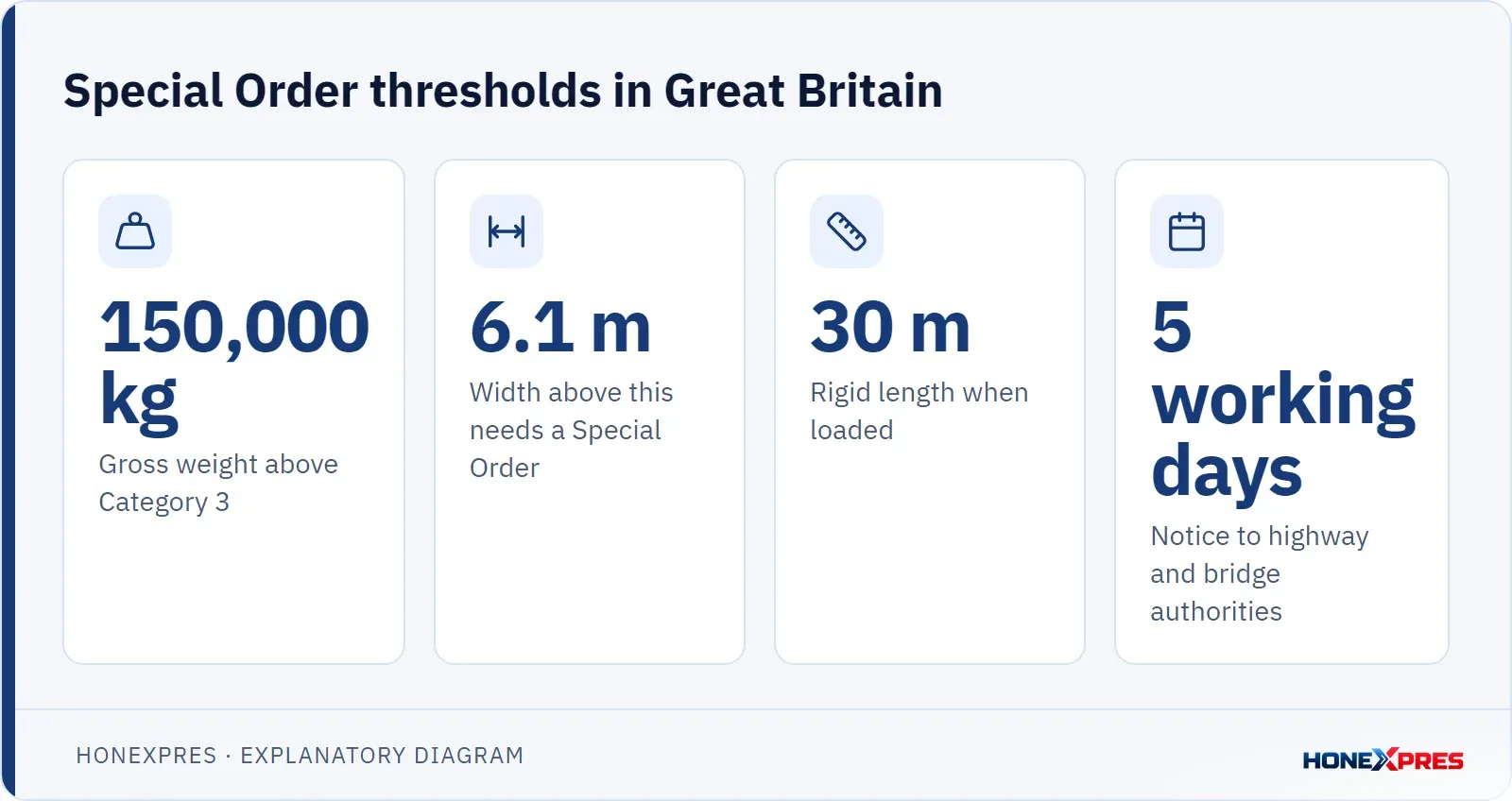
Beyond Category 3, the movement needs a Special Order. According to the DVSA guide, this applies to vehicles over 150,000 kg or 16,500 kg per axle, over 6.1 metres wide, or over 30 metres in rigid length when loaded. [2] Special Order movements need 5 working days' notice to highway and bridge authorities and 2 working days' notice to the police. The Special Order authorisation must be carried in the vehicle. [2] National Highways issues these orders on behalf of the Secretary of State. [3]
Width, length and projections: notice and attendants
Weight is only half of the picture. The guide's rules on over-length and over-width apply to every vehicle operating under STGO or a Special Order. Similar notification rules also apply to normal C&U vehicles carrying wide or long loads where this is allowed. [3]
Length
A vehicle is over-length when a single rigid unit exceeds 18.75 metres including projections, or when a combination exceeds 25.9 metres. [3] Such vehicles need 2 days' notice to the police in every area they will use, and must be accompanied by an attendant. [3] Front or rear projections over 3.05 metres also require 2 days' notice to the police. An attendant is needed where a projection exceeds 2 metres at the front or 3.05 metres at the rear. [3]
Width
- Load width over 3 metres, including projections: 2 days' notice to the police. [3]
- Load width over 3.5 metres: 2 days' notice to the police and an attendant. [3]
- Load width over 5 metres: approval from the Secretary of State as a VR1 permit, plus 2 days' notice to the police and an attendant. [3]
Projections must also be marked. A front or rear projection over 2 metres needs an end marker. [3] Any lateral projection over 305 millimetres needs two side markers, one visible from the front and one from the rear, or suitable reflective or fluorescent tape. [4] The detailed marking rules are in STGO Schedule 8. [7]
Attendants and escort vehicles: not the same thing
An attendant is a person, and the attendant triggers above are set out in the rules. Under the guide, an attendant can travel in the abnormal load vehicle itself. Alternatively, they can travel in an escort vehicle, provided they stay in radio contact with the vehicle and can see it as far as reasonably practical. [4] When three or more loads travel in convoy, only the first and last vehicles need an attendant. [4]
A dedicated escort vehicle is a separate question. The guide states that no law requires an STGO or Special Order vehicle to be accompanied by an escort vehicle, but the police can make sure one is used when necessary. [4] National Highways, local councils and police forces publish codes of practice on escorts. [5] Whether an escort will be required for a specific movement should be checked with the police and the competent authorities on the route. A quote should therefore show escort costs as a separate, conditional item.
Notifications, paperwork and who is responsible
There is no set format for notifying the police, highway and bridge authorities. The notification document does not have to be carried in the vehicle, but the operator should be able to produce a copy on request. [5] STGO contains separate schedules for notices to the police, attendants, notices to the Secretary of State, and notices and indemnities for road and bridge authorities. [7]
One point is often overlooked when booking abnormal load haulage through an intermediary. The notice is operator-specific, so the movement cannot be subcontracted without the consent of the relevant authority. [5] The carrier that will actually run the movement must therefore be fixed before notification. As a forwarder, we agree the performing carrier first and then let that carrier handle its notifications. We do not swap vehicles at the last minute.
Deviations have consequences. If the vehicle does not match the notice on weight, dimensions, operator or route, the exemptions do not apply and enforcement action may follow. [5] The guide also explains that failing to comply with STGO or Special Order rules removes the exemptions, so the normal C&U and AW limits apply instead. [5] Goods vehicles under STGO and Special Orders must still follow EU drivers' hours and tachograph rules. [2] Operators are also expected to make a separate plan for every abnormal load movement and secure the load appropriately. [2]
Abnormal loads from mainland Europe to the UK
According to the DVSA guide, non-GB vehicles can use the STGO exemptions under the same conditions as GB vehicles. [4] Alternative signage, typically the French "Convoi Exceptionnel" and the square white/red chevron plates, is acceptable in Great Britain. [4]
The UK leg is only part of the trip. Each country crossed applies its own permit, escort and timing rules. These differ from GB rules and must be checked with each national authority. Romania shows how different the rules can be:
- A special transport authorisation (AST) is the document through which the road administrator sets the route, the traffic conditions and the charges due for vehicles exceeding the maximum masses or dimensions. [8]
- One authorised escort vehicle must precede the load in several cases, including a width over 3.2 m and up to 4.5 m. [9] Two escort vehicles, one in front and one behind, are required in further cases. [9] A traffic police crew is added in other cases, for example a width over 5.0 m. [9]
- Panels reading "TRANSPORT EXCEPŢIONAL!" or "ATENŢIE! GABARIT DEPĂŞIT!" are required on the cab and at the rear. [10]
- Drivers of Romanian-registered vehicles with excess mass or dimensions must hold a specific certificate for abnormal transport. [11]
Thresholds in Romania, Great Britain and the countries in between do not line up. A load that needs no escort in one country may need two in the next. Route choice therefore has a direct impact on cost. Our guide to choosing a road route explains the general logic.
What drives the cost of abnormal load transport
We do not publish prices, because no two abnormal loads are alike. These are the factors that move the figure:
- Dimensions and weight band. These decide the STGO category or Special Order, the notice periods, the speed limits and whether attendants are needed. Each step up adds time and resources.
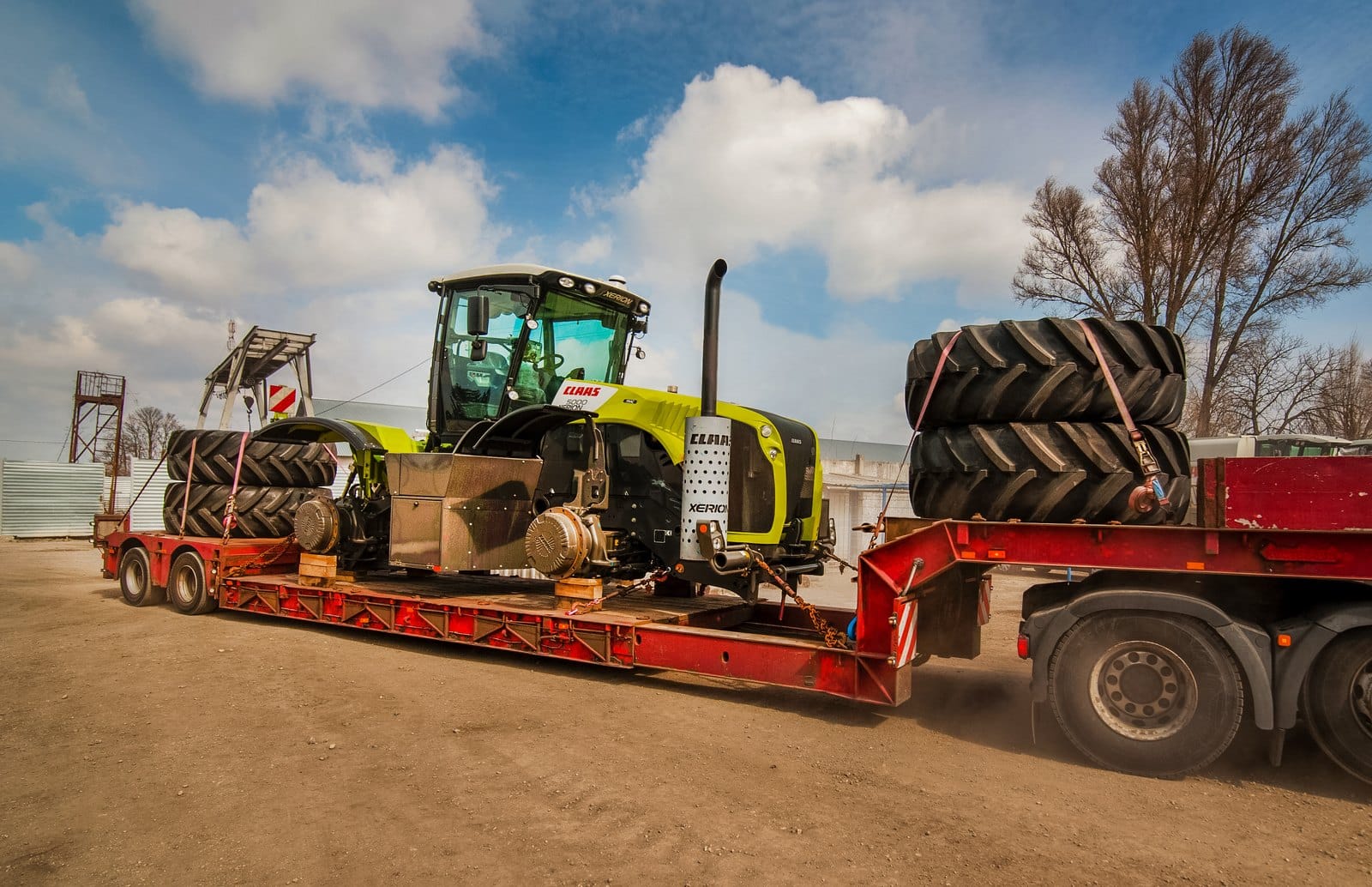
- Vehicle type. Options include an extendable flatbed for long loads, a semi low-loader or a low-bed for tall or heavy items. Multi-axle modular combinations are used for the heaviest loads. Fewer carriers have the specialised equipment, and it is seldom available as a return load.
- Permits and authority charges. These vary by country. In Romania, for example, the AST charge combines an issue fee with charges for excess mass and excess dimensions. [12] Distance enters the calculation in kilometres. [12]
- Attendants, escorts and police. Requirements depend on the load and the route and should be checked with the competent authorities for each movement, so they are best quoted as conditional items.
- Route and timing. Detours around bridges and restricted roads, waiting for notice periods, night or off-peak movement windows, and ferry or tunnel conditions all add cost.
- Empty running. Specialised trailers are often positioned empty to the loading point and back.
- Loading and unloading. Cranes, jacking, securing and site access must be arranged and are usually priced separately from the haulage itself.
For general road freight pricing logic, see our article on freight transport cost factors.
What to send for an accurate quote
- Exact length, width and height of the load. Include a drawing or photos with the measuring points marked.
- Gross weight and, if known, the centre of gravity and lifting points.
- Whether parts can be removed, and at what cost. This directly affects the indivisibility test.
- Full loading and delivery addresses, plus site access constraints: gates, ground conditions, overhead lines.
- Who loads and unloads, and with what equipment.
- Earliest ready date and latest delivery date. Remember the notice periods described above.
- Goods value and any customs status if the load crosses the EU–GB border.
For machinery that may fall just inside normal limits, our machinery transport page explains standard options. The technical requirements for oversized freight article covers vehicle-side aspects in more detail.
How HONEXPRES organises abnormal load haulage
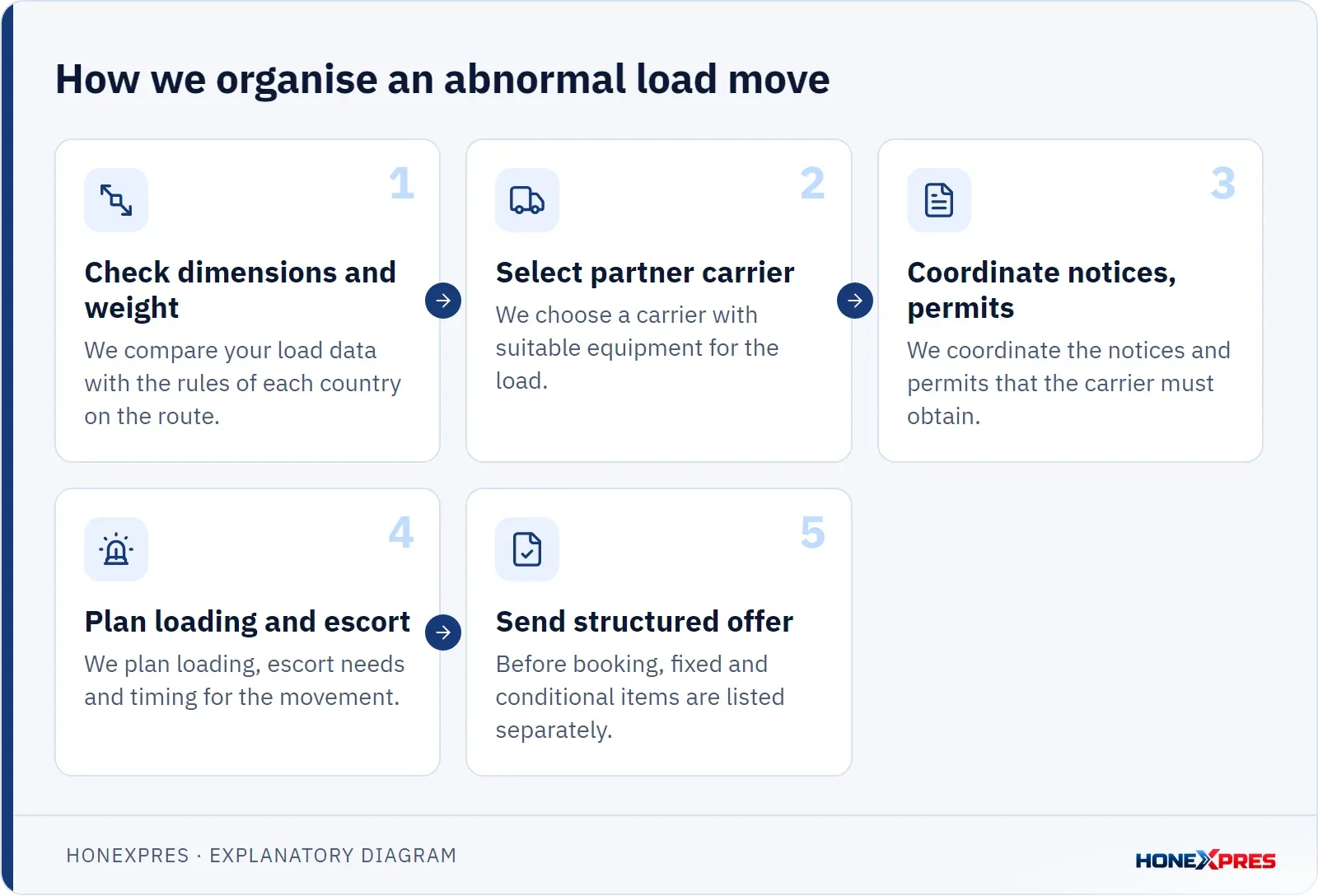
We check your dimensions and weight against the rules of each country on the route and select a partner carrier with suitable equipment. We then coordinate the notices and permits that carrier must obtain, and plan loading, escort needs and timing. Before booking, you receive a structured offer that lists fixed and conditional items separately. We cannot guarantee authority response times. We can make sure that complete information reaches the carrier early, which is what prevents most delays.
FAQ
Is every oversized load an abnormal load?
No. Under the DVSA guide, an abnormal indivisible load is one that cannot be divided into two or more loads for road transport. [1] If the load can be reasonably split, it must be, and it then travels within normal limits.
Who notifies the police and highway authorities?
The operator moving the load. The notice is operator-specific, and the movement cannot be subcontracted without the authority's consent. [5]
Does every abnormal load need an escort vehicle in the UK?
No. The guide states that no law requires an escort vehicle under STGO or a Special Order, although the police can require one when necessary. [4] Attendants are a separate requirement, triggered by width, length and projections.
Can a vehicle registered outside GB carry an abnormal load in Great Britain?
Yes. Non-GB vehicles can use the STGO exemptions under the same conditions as GB vehicles. [4]
What happens if the actual load differs from the notice?
If weight, dimensions, operator or route do not match the notice, the exemptions do not apply and enforcement action may be taken. [5] Accurate measurements at quote stage protect you from this.
Are UK and EU abnormal load rules the same?
No. Each country sets its own thresholds, permits and escort rules. Romania's escort triggers, for instance, are structured differently from the GB attendant rules. [9] Always check each competent authority on the route.
Request an abnormal load transport quote
Send us the dimensions, weight, photos and addresses of your load. We will organise an abnormal load transport offer with partner carriers, with permits, escorts and timing clearly itemised. Request a quote here.
Official sources consulted
- [1] DVSA, Special types enforcement guide (updated 27 September 2018), section 1 Introduction and 1.1–1.2
- [2] DVSA, Special types enforcement guide, section 1.2, Cat 3
- [3] DVSA, Special types enforcement guide, section 5.1 Over length
- [4] DVSA, Special types enforcement guide, section 5.4 Projection markers
- [5] DVSA, Special types enforcement guide, section 9 Documentation
- [6] The Road Vehicles (Authorisation of Special Types) (General) Order 2003 (SI 2003/1998), Schedule 1 – Abnormal indivisible load vehicles
- [7] The Road Vehicles (Authorisation of Special Types) (General) Order 2003 (SI 2003/1998), Schedules 5–9 (notices to police, attendants, marking of projections, road and bridge authorities)
- [8] Romanian Norms approved by Order no. 1236/6509/126/2018 on authorising vehicles exceeding maximum permitted masses and/or dimensions, Article 2 point 2
- [9] Romanian Norms approved by Order no. 1236/6509/126/2018, Article 46 (escort of vehicles with excess dimensions), paragraphs (1)–(3)
- [10] Romanian Norms approved by Order no. 1236/6509/126/2018, Article 35(a) – signalling of vehicles with excess dimensions
- [11] Romanian Norms of 11 November 2015 approved by Order no. 1214/2015, Annex 5, Article 1(1)
- [12] Romanian Order no. 1836 of 7 December 2018, section J (tariffing of the special transport authorisation) and section K point 4
Send us the dimensions, weight and route of your load and we will organise an abnormal load transport offer with partner carriers.
Have something similar to move? Request a quote →
Sources (2)
Related services