Guides
Wide load trucking: width thresholds, signage, route planning and getting a quote
AI Text written with AI assistance and checked by the editorial team. How we work with AI
Article translated automatically from Romanian and checked automatically. If there is any difference, the original prevails. See the original in Romanian · How we use automatic translation
In short
A wide load is cargo that makes the vehicle wider than the normal limits. In Great Britain, specific widths trigger police notice, an attendant, a VR1 permit or a special order. Signage, mirrors, route and timing follow from the width. Send exact dimensions, weight and addresses, and we arrange the move with partner carriers.
Contents
- What counts as a wide load in practice
- Width thresholds in Great Britain
- Attendants and escort vehicles
- Notifications: who sends them
- Signage and marking of wide loads
- Wide loads starting from or crossing Romania
- Route planning for width
- Ireland
- Equipment for wide load transport
- What drives the cost of wide load trucking
- What to send for an accurate quote
- FAQ
- At what width does a load need police notice in Great Britain?
- When is an attendant required?
- When do I need a VR1 permit or a special order?
- Can a foreign-registered truck use its own wide load signs in GB?
- Can the forwarder hand the move to another carrier after notice is given?
- Request a quote for your wide load
- Official sources consulted
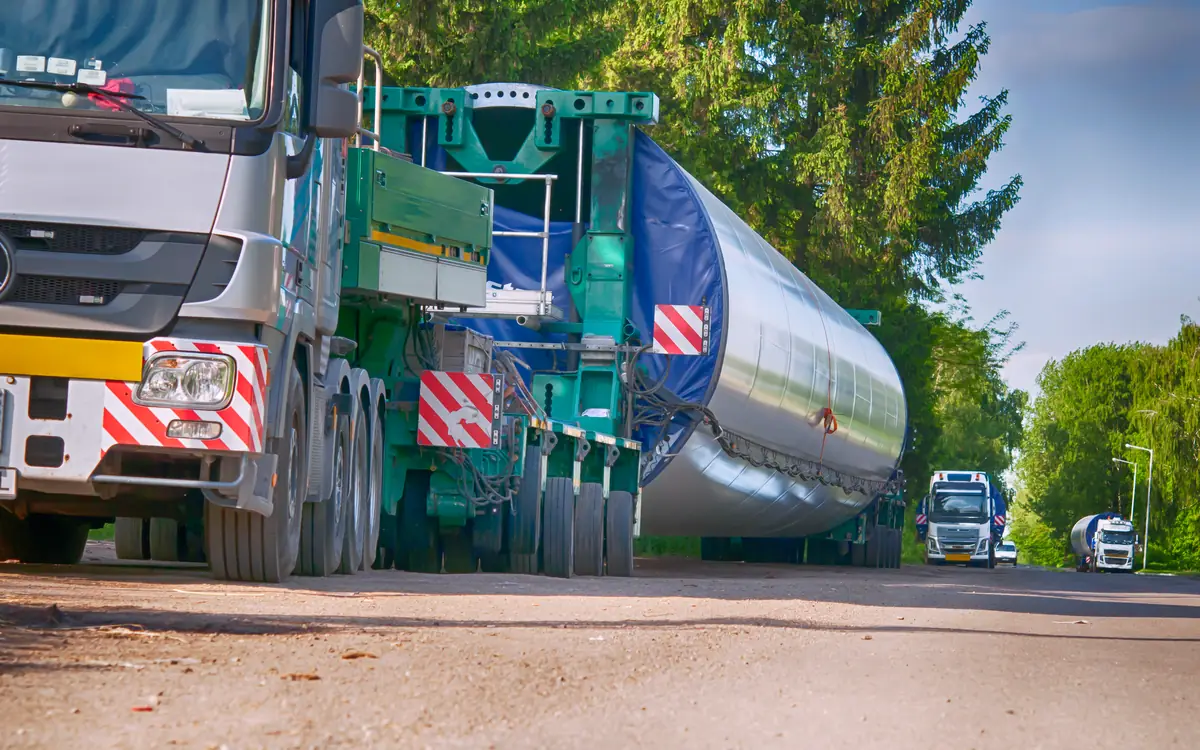
Wide load trucking means moving cargo that makes the vehicle wider than the normal legal limits. In Great Britain the width you declare determines what is needed. From a certain width you must notify the police. Beyond that comes an attendant, then a VR1 permit, and above that a special order. Signage, mirrors, routing and timing all follow from the same number. HONEXPRES is a freight forwarder in Oradea, Romania. We have no trucks of our own. We organise wide load transport with partner carriers that hold the right equipment and handle the notifications. This guide covers width-specific questions: thresholds, markings, route planning, cost factors and what to send for a quote. For heavy, axle-load-driven moves, see our guide to shipping oversized goods.
What counts as a wide load in practice
In Great Britain, vehicle dimensions and weights are regulated by the Road Vehicles (Construction & Use) Regulations 1986 (C&U) and the Road Vehicles (Authorised Weight) Regulations 1998. Vehicles that do not meet those rules can run under the Road Vehicles (Authorisation of Special Types) (General) Order 2003, known as STGO. [1] The key test is whether the load is indivisible. A large load that can easily be split by undoing a few bolts must be split for transport. [1]
The DVSA guidance also says that, where possible and safe, a "normal-sized" vehicle must be used, even if the load overhangs one or both sides. [1] So many oversize truck loads are not carried on special vehicles at all. They travel on a standard trailer with a side overhang, and that overhang itself triggers notice and marking duties. STGO contains specific provisions on width and lateral projections, covering police notification, Secretary of State notification and attendants. It also has a separate category for vehicles carrying loads of exceptional width. [2] [3]
Scope note: the DVSA "Special types enforcement guide" applies to England, Scotland and Wales and was last updated in September 2018. [1] Check the current version on gov.uk before planning a move, and check Northern Ireland rules separately.
Width thresholds in Great Britain
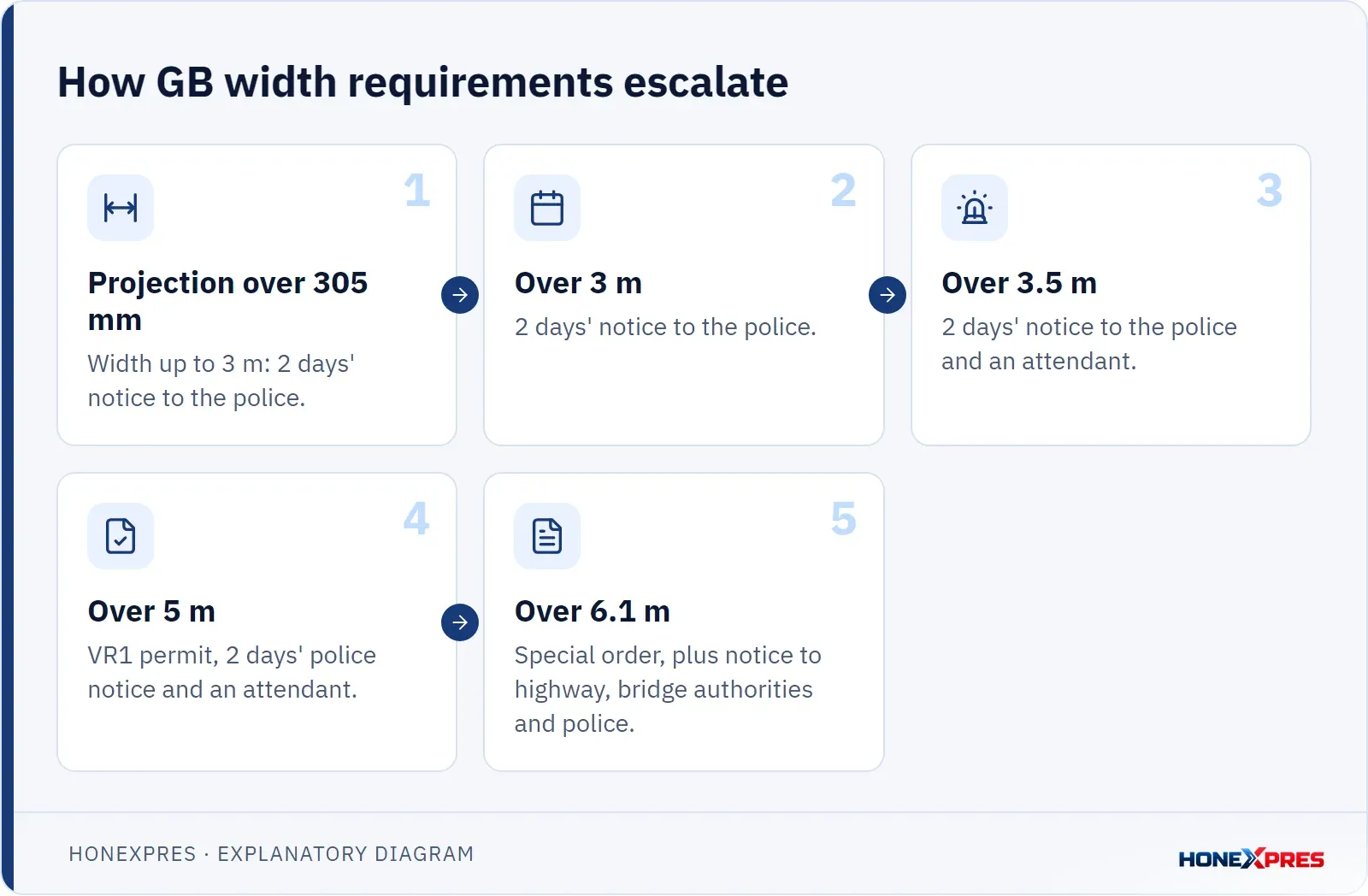
For vehicles operating under STGO or a Special Order, the DVSA guide sets out these width steps. [4]
| Load width (including projections) | What is required |
|---|---|
| 3 m or less, but projecting more than 305 mm on one side | 2 days' notice to the police |
| Over 3 m | 2 days' notice to the police |
| Over 3.5 m | 2 days' notice to the police and an attendant |
| Over 5 m | VR1 permit (Secretary of State approval), 2 days' notice to the police and an attendant |
| Over 6.1 m | Special order, 5 working days' notice to highway and bridge authorities and 2 working days' notice to the police |
Special orders are issued on behalf of the Secretary of State by National Highways. [4] The special order authorisation must be carried in the vehicle. [5]
For a normal C&U vehicle with a side overhang, the C&U rules apply instead. A lateral projection over 305 mm on either side requires 2 clear working days' notice to the police, marker boards front and rear, and additional lights in darkness or poor visibility. [6] Above 3.5 m and up to 4.3 m overall width, an attendant is also required. [6]
Attendants and escort vehicles
An attendant is required where the vehicle width exceeds 3.5 m. [7] The attendant may travel in the vehicle itself or in an escort vehicle. If they use an escort vehicle, they must be in radio contact with the vehicle and able to see it, as far as reasonably practical. [7] No law requires an escort vehicle under STGO or a Special Order. However, the police can require one when necessary. [7] National Highways, various local councils and police forces publish codes of practice on escorts. [8]
Notifications: who sends them
There is no set format for notifying the police and the highway and bridge authorities. The notice does not have to be carried in the vehicle. [8] The notice is operator-specific. This means the movement cannot be subcontracted without the consent of the relevant authority. [8] For you as a shipper, the carrier who will actually perform the move should normally give the notice. That carrier must then actually do the move.
Signage and marking of wide loads
In Great Britain, any projection exceeding 305 mm width-wise must carry two side markers: one visible from the front and one from the rear. [7] Instead of markers, red, white or yellow fluorescent or retro-reflective tape may be used, so that the widest point is clearly visible from the front, rear and side. [7] Markers authorised in another European country for projecting loads are also accepted. Non-GB vehicles may use the French "Convoi Exceptionnel" sign and the square white/red chevron plates. [7]
Signage is not a formality. If STGO signage is not displayed, the exemption is breached. The load then falls under the normal C&U and AW limits, and enforcement action may follow. [8]
Visibility matters for the driver too. The mirrors must give a clear view to the rear and side. A camera system is not suitable if the driver cannot see fully down the side of the trailer past a wide load. [5]
Wide loads starting from or crossing Romania
If a wide load starts in or passes through Romania, different rules apply there. Under the norms approved by Order no. 1.236/2018, an over-dimension vehicle needs these devices: [9]
- a yellow reflective panel reading "TRANSPORT EXCEPŢIONAL!" or "ATENŢIE! GABARIT DEPĂŞIT!" on the cab and at the rear;
- two amber flashing beacons visible from at least 100 m;
- 42 cm x 42 cm plates with red-white 45° stripes at the lateral extremities, front and rear, when the maximum width is exceeded;
- amber outline lights along the side, spaced at least 1.5 m apart, when the width exceeds 2.55 m.
Where escort vehicles are required, the over-dimension vehicle must also carry radio equipment to stay in contact with the certified escort staff. [9]
Route planning for width
Width, more than weight, decides which roads are physically usable. Narrow bridges, roadworks, central islands, roundabouts, street furniture and urban sections can all be problems. The DVSA guide states that operators should make a separate plan for every abnormal load movement and secure the load appropriately. [5] Once notified, the route is binding. If the vehicle does not follow the notice on weight, dimensions, operator or route, the exemptions no longer apply. [8]
In Romania, the carrier needs a special transport authorisation (AST). The road administrator issues it, and it sets the route, the traffic conditions and the fees due. It is valid for the specific registration numbers, route, direction and period. [10] The AST is issued before the movement by the administrator of each road category: national roads, county roads or local roads. [11] If several over-dimension vehicles travel in convoy, the convoy may not exceed 200 m or three vehicles. [12] It must be escorted by authorised vehicles in front of and behind each vehicle, plus a traffic police crew. [12]
For general principles of route choice, see our short guide to choosing a road route.
Ireland
We have not set out Irish wide load thresholds, permits or notice periods here, because they must be confirmed at source. If your oversize loads trucking job involves Ireland, check the current requirements with the competent Irish road and police authorities. Otherwise, ask us to confirm them through the carrier before you book.
Equipment for wide load transport
The trailer choice depends on width, height and how the load sits on the deck:
- a standard flatbed semi-trailer for loads that only overhang moderately;
- a semi low-loader when height also matters;
- an extendable flatbed when the load is also long.
Extendable trailers can carry long loads if they comply with STGO. [7] The technical side is covered in our article on technical requirements for oversized freight.
What drives the cost of wide load trucking
We do not publish price lists, because every wide load is assessed individually. These factors move the price:
- Width band. Each threshold adds requirements: notice, an attendant, a VR1 permit or a special order. [4]
- Authorisation fees in transit countries. In Romania, the fee for exceeding dimensions is calculated from the difference between the real and the maximum permitted dimension. [13] Where several dimensions are exceeded, the fees add up. [13] The total AST fee combines the issuing fee with the fees for exceeding mass and dimensions. [13]
- Distance-based road charges. From 1 January 2026, Romania applies the TollRo distance-based charge to goods vehicles over 3.5 t. [14] It is calculated as the unit rate multiplied by the distance travelled. [14]
- Time on the road. Goods vehicles under STGO and Special Order must follow EU drivers' hours and tachograph rules. [5] Lower speeds, restricted time windows and detours therefore mean more days.
- Empty running and positioning of specialised trailers and escort vehicles.
- Loading and securing work, waiting time and any lifting equipment at either end.
For how general road freight prices are built, see our freight cost factors guide.
What to send for an accurate quote
- Exact length, width and height of the load, and the widest point (with a drawing or photos).
- Weight, and whether the load can be dismantled.
- Loading and delivery addresses, access conditions and the lifting equipment available.
- Desired loading date and how flexible it is.
- Number of pieces, and whether several identical items are involved.
- Any customs or transit requirements for the cross-border legs.
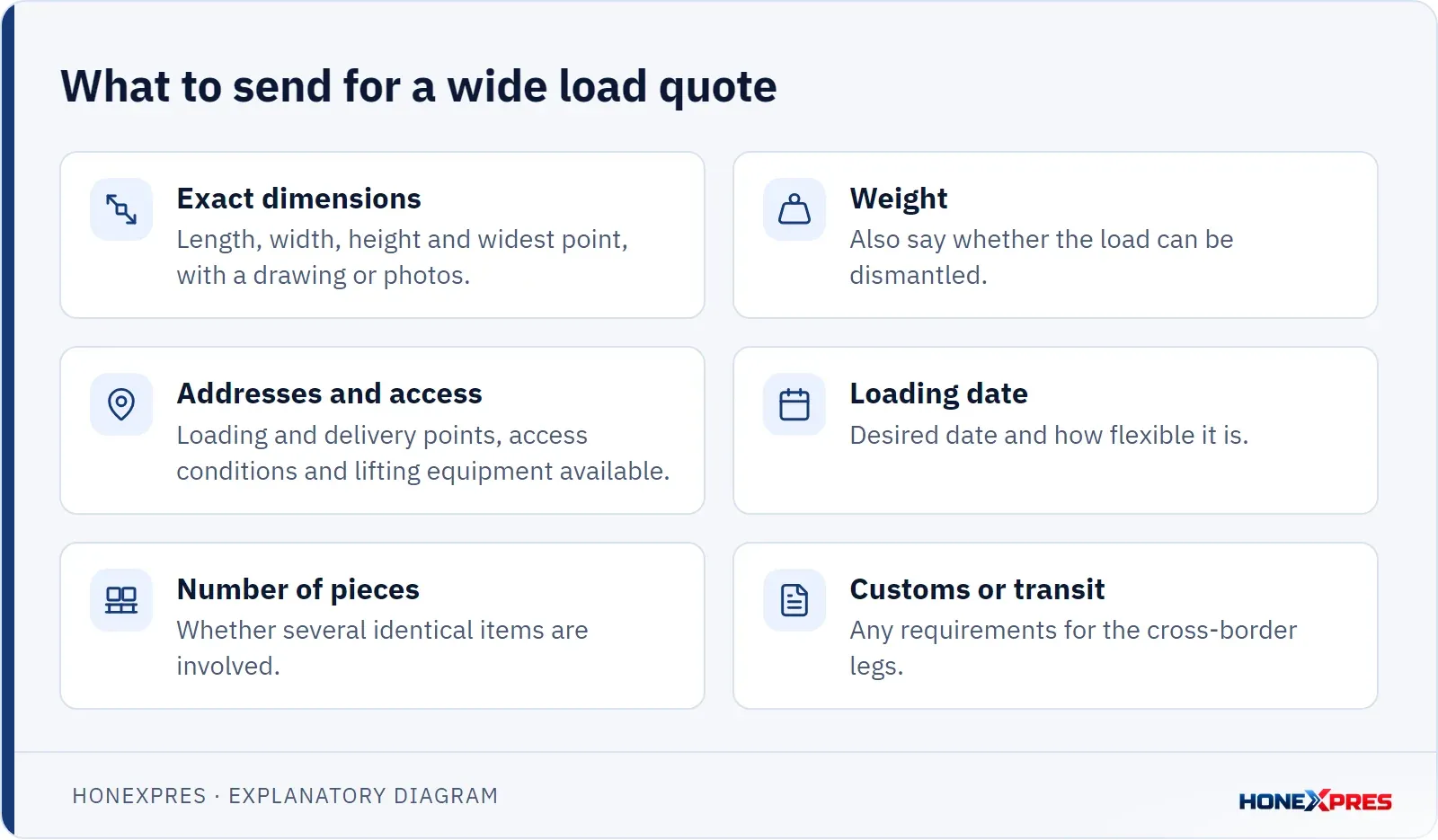
With this data, we check suitable carriers and the expected authorisations. We then propose a solution through our oversized transport service.
FAQ
At what width does a load need police notice in Great Britain?
Under STGO, notice is needed when a load projects more than 305 mm on one side, or when the load width exceeds 3 m. [4] For C&U vehicles, a lateral projection over 305 mm also requires 2 clear working days' notice to the police. [6]
When is an attendant required?
An attendant is required when the vehicle width exceeds 3.5 m. [7] They may ride in an escort vehicle if they keep radio contact with the vehicle and can see it. [7]
When do I need a VR1 permit or a special order?
Above 5 m, a VR1 permit is needed. [4] Above 6.1 m, a special order is needed. [4]
Can a foreign-registered truck use its own wide load signs in GB?
Yes. The DVSA guide accepts alternative signage such as "Convoi Exceptionnel" and white/red chevron plates. [7]
Can the forwarder hand the move to another carrier after notice is given?
Not freely. The notice is operator-specific, so the move cannot be subcontracted without the consent of the relevant authority. [8] We therefore confirm the performing carrier before any notice is filed.
Request a quote for your wide load
Send us the dimensions, weight, addresses and dates of your wide loads. We will check the requirements on each leg and arrange the transport with partner carriers equipped for the job. Request a quote for wide load transport.
Official sources consulted
- [1] DVSA, Special types enforcement guide, section 1 Introduction
- [2] Road Vehicles (Authorisation of Special Types) (General) Order 2003, table of contents, article 15
- [3] Road Vehicles (Authorisation of Special Types) (General) Order 2003, table of contents, Part 4
- [4] DVSA, Special types enforcement guide, section 5.2 Over-width projections
- [5] DVSA, Special types enforcement guide, section 1.3 Special order movements
- [6] DVSA, Special types enforcement guide, Annex A, 12.2 Loads overhanging the sides of the vehicle (C&U regulation 82, Schedule 12)
- [7] DVSA, Special types enforcement guide, section 8 Attendants and escort vehicles
- [8] DVSA, Special types enforcement guide, section 8.1 Escort vehicles
- [9] Norms approved by Order no. 1.236/2018 (Romania), article 35 letter h)
- [10] Norms approved by Order no. 1.236/2018 (Romania), article 2 point 2 (definition of the special transport authorisation)
- [11] Norms approved by Order no. 1.236/2018 (Romania), article 4 paragraph (1)
- [12] Government Ordinance no. 15/2025 amending Government Ordinance no. 43/1997 (Romania), article 41 paragraph (27)
- [13] Order no. 1.836/2018 (Romania), annex, Part 2, letter H) point 1
- [14] Law no. 226/2023 (Romania), article 12 paragraph (1)
Send us the dimensions, weight and route of your wide load and we will arrange a quote with suitable partner carriers.
Have something similar to move? Request a quote →
Sources (2)
Related services