Guides
T1 transit: how it works from the customs office of departure to closure of the operation
AI Text written with AI assistance and checked by the editorial team. How we work with AI
Article translated automatically from Romanian and checked automatically. If there is any difference, the original prevails. See the original in Romanian · How we use automatic translation

Illustrative photograph: a long line of lorries waiting to cross the border, seen from above, between fields.
In short
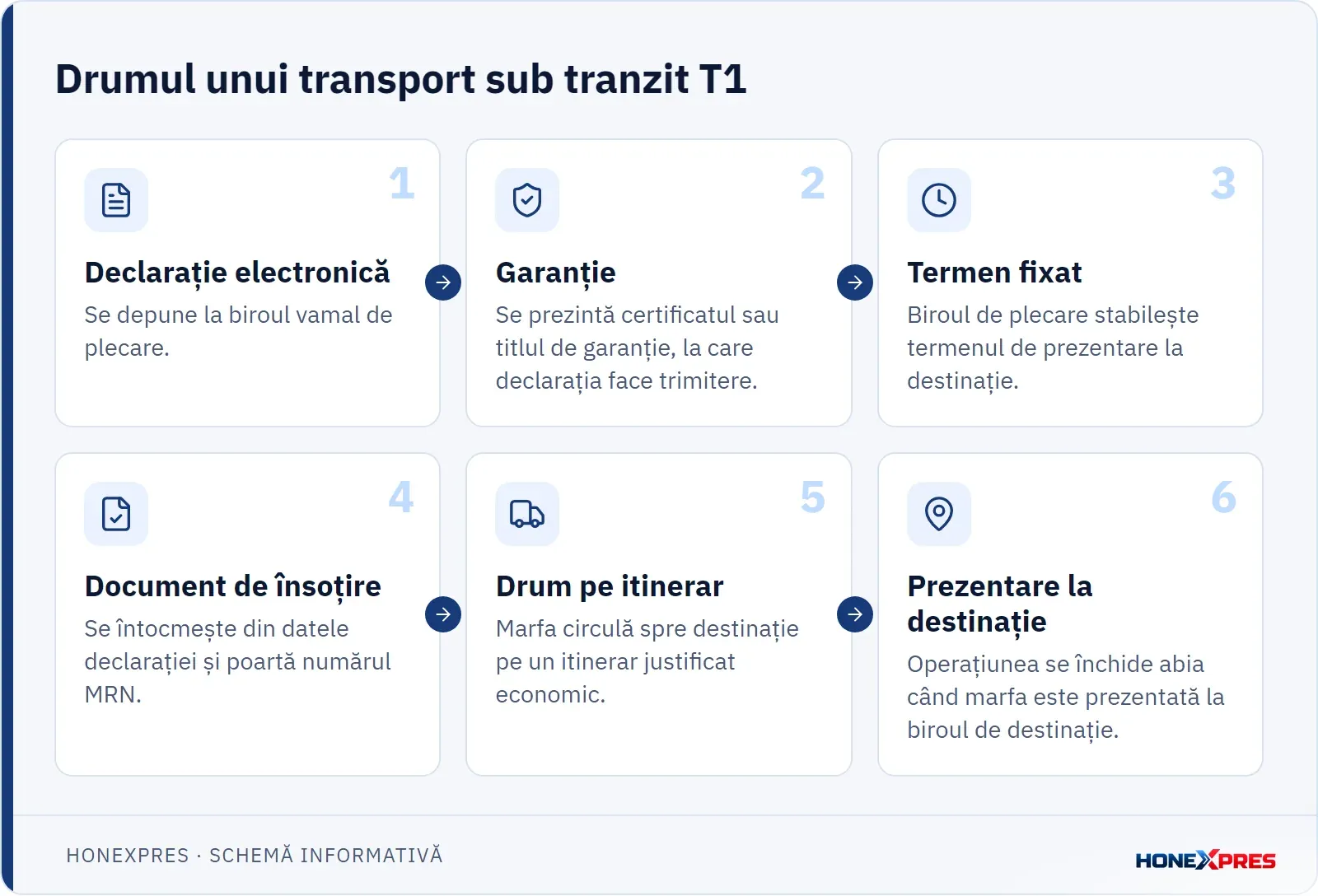
T1 is external Union transit: goods move under customs supervision, with a declaration lodged electronically at the customs office of departure. The office sets a time limit and an economically justified route is expected. Transit is closed at the customs office of destination. T2/T2L concern Union goods.
Contents
- What T1 transit is and when it arises in practice
- The T1 transit declaration: what it contains and who lodges it
- One declaration, one route, one means of transport
- The document that accompanies the lorry
- What to send us so that we can prepare a T1
- The guarantee in T1 transit
- The time limit for presentation and the itinerary
- En route: transhipment and incidents
- Closure of T1 transit
- When the electronic system is not working
- T1 compared with T2 and T2L
- What affects the cost of a transport under T1
- Frequently asked questions
- Who lodges the T1 transit declaration?
- Can I change the customs office of destination en route?
- What happens if the time limit for presentation is exceeded?
- Can a T1 travel by train?
- Why does the transit still appear open although the goods have been delivered?
- Request a quote for a transport under T1 transit
- Official sources consulted
T1 transit (Union external transit, also called in practice “Community external transit T1”) allows goods to move between two customs offices under customs supervision. In practice: a T1 transit declaration is lodged electronically at the customs office of departure. That office sets a time limit within which the lorry must reach the customs office of destination. The operation is closed only when the goods are presented there. Below we explain, from the perspective of the consignor and the transport manager, what needs to be prepared, what can delay closure and how T1 differs from T2/T2L.
What T1 transit is and when it arises in practice
In everyday customs language, “T1” refers to the Union external transit procedure. The typical case: goods arriving from a third country that are not cleared at the border but at a customs office inside the country, close to the consignee. The exact definition of the goods that may move under this procedure must be checked in the current text of the Union Customs Code.
The Union Customs Code (Regulation (EU) No 952/2013) lists, among the forms of external transit, the Union external transit procedure, the TIR Convention and the ATA Convention/Istanbul Convention. [9] For TIR operations, the Code provides, among other things, that the movement must have begun or must end outside the customs territory of the Union. [9] The differences between these variants are explained in our articles on the TIR Convention and on the ATA transit procedure.
Internal transit is a separate procedure. It allows Union goods to move from one point to another of the customs territory of the Union, passing through a country or territory outside it, without any change to their customs status. [9] By rail, in the cases governed by Delegated Regulation (EU) 2016/341, goods are placed under Union external transit, unless the customs status of Union goods is established in accordance with the Code. [8]
The T1 transit declaration: what it contains and who lodges it
The customs formalities of Union transit are carried out through an electronic system, the electronic transit system. [10] The declaration uses only some of the data elements provided for by the legislation, depending on the customs procedure concerned. [1] The formats and codes of these data are laid down in Implementing Regulation (EU) 2015/2447. [1]
One declaration, one route, one means of transport
A transit declaration may cover only goods moving from a single customs office of departure to a single customs office of destination, on a single means of transport. [12] A road vehicle with a trailer or semi-trailer is considered a single means of transport, provided the goods are consigned together. [12] If the same lorry loads at several customs offices of departure or unloads at several customs offices of destination, separate declarations are lodged for each consignment. [12] For groupage shipments with several consignees, this rule multiplies the number of declarations and must be taken into account from the planning stage.
The document that accompanies the lorry
The transit accompanying document is drawn up on the basis of the data in the transit declaration. [3] The MRN appears on the document and also as a barcode. [3] The document may not be amended, supplemented or cut, except in the cases expressly provided for by the regulation. [3]
Some companies have authorised consignor status. The authorised consignor lodges the declaration at the customs office of departure and records in the system the itinerary (if one was prescribed), the time limit and, where applicable, the seals. [6] It may print the accompanying document only after the customs office of departure has notified the release of the goods for transit. [6]
What to send us so that we can prepare a T1
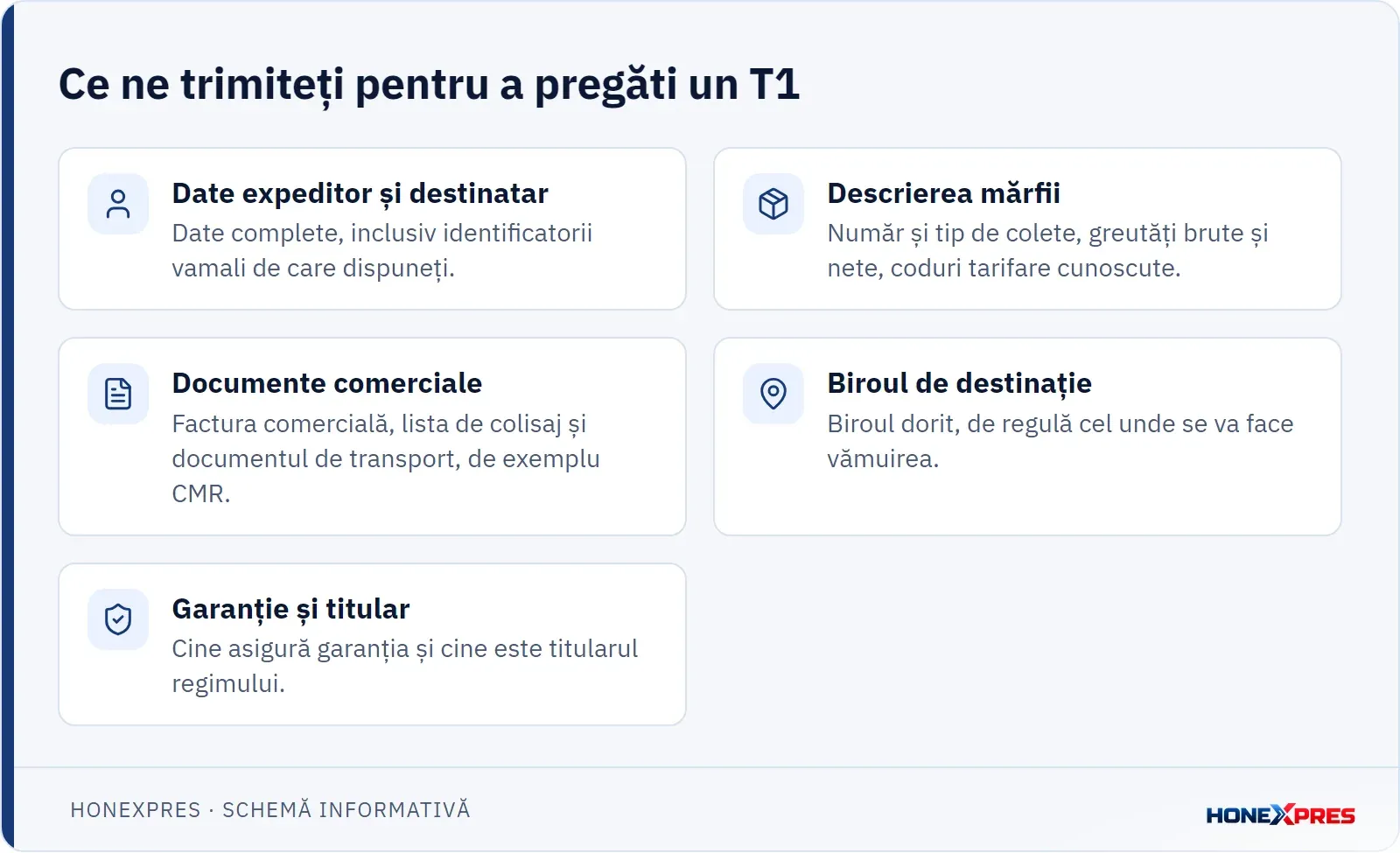
- the full details of the consignor and the consignee, including any customs identifiers you have;
- the description of the goods, the number and type of packages, gross and net weights, and any known tariff codes;
- the commercial invoice, the packing list and the transport document (for example the CMR consignment note);
- the desired customs office of destination, as a rule the one where customs clearance will take place;
- who provides the guarantee and who is the holder of the procedure (see the next section).
The guarantee in T1 transit
The guarantee covers any customs debt that may arise. The conditions in which it is required, the possible exemptions and the way the amount is set must be checked in the Union Customs Code and with the customs authority. On the practical side, the procedural rules provide as follows:
- at the customs office of departure, the comprehensive guarantee certificate, the guarantee waiver certificate or the individual guarantee voucher is presented, as applicable [5];
- transit declarations must refer to these certificates and vouchers [5];
- the holder of a guarantee with a reference amount must ensure that the sum concerned does not exceed the reference amount, also taking into account operations not yet completed [5];
- the holder informs the customs office of guarantee when the reference amount proves insufficient for its transit operations [5].
Operational conclusion: transits that are not closed “use up” part of the guarantee. An operation left open through oversight can block the same holder’s next shipments.
The time limit for presentation and the itinerary
The customs office of departure sets the time limit within which the goods must be presented at destination. It takes into account the itinerary, the means of transport, transport legislation or other relevant rules, and the information supplied by the holder of the procedure. [12] The time limit is binding on the customs authorities of the Member States crossed, which may not change it. [12] The goods must travel to the customs office of destination along an economically justified itinerary. [12]

That is why it is worth telling us in good time everything that can affect the duration of the trip: traffic restrictions, driving hours, stops for loading. For machinery or bulky parts, road permits and mandatory routes directly affect the duration. When we organise an oversized transport under a transit procedure, this information reaches the person drawing up the declaration before the time limit is set.
En route: transhipment and incidents
Goods in transit may be transhipped only with the authorisation of the customs authorities of the country where the transhipment takes place, subject to the exceptions provided for by Implementing Regulation (EU) 2015/2447. [3] Moving the goods from a broken-down lorry to another one is therefore not done “on the move”. You will find details of the operation in the guide on transhipment of goods.
When the business continuity plan (the paper fallback procedure) applies, incidents occurring en route are noted on the accompanying document by the carrier responsible for the means of transport, as they occur. [3] Where goods are loaded in intermodal transport units (containers, swap bodies, semi-trailers), these units must bear unique identification numbers. [3]
Closure of T1 transit
The exact conditions in which the transit procedure is considered to have ended must be checked in the current text of the Union Customs Code or with the customs office of destination. It does not end when the lorry arrives at the customer’s warehouse. In the paper version of the SAD, copies 1, 4 and 5 are used for Union transit. [4] Copy 4 stays at the customs office of destination, and copy 5 is the return copy. [4]
The rules laid down for paper declarations in the continuity plan show what happens when confirmation does not arrive. If the copies have not been returned within 30 days of the time limit for presentation, the customs authority of the State of departure invites the holder to prove that the procedure was correctly ended. [5] If it does not receive proof of discharge within 60 days of the same time limit, the authority requests the necessary information. [5] If the procedure cannot be discharged, the authority determines whether a customs debt has arisen and identifies the debtor. [5] The time limits applicable in the ordinary electronic procedure must be checked in the current text or with the customs office.
When the electronic system is not working
The customs authority accepts a paper transit declaration in the event of a temporary failure of the electronic transit system, of the holder’s computer system or of the connection between them. [11] The rules of this procedure are laid down in Annex 72-04 to Implementing Regulation (EU) 2015/2447. [11] The documents admitted are the SAD, the SAD printed on plain paper or the transit accompanying document (TAD/TSAD), supplemented where necessary with the list of items. [2] The customs authority monitors the use of this procedure in order to prevent its abusive use. [2]
T1 compared with T2 and T2L
| Aspect | T1 (Union external transit) | T2 / T2L |
|---|---|---|
| Practical purpose | Movement of goods between two customs offices, under customs supervision | Internal transit: Union goods passing through a territory outside the Union without changing their status [9] (the exact correspondence with the “T2” entry should be checked with the customs authority); T2L: proof of Union status |
| Paper document | SAD, copies 1, 4 and 5 [4] | T2L: copy 4 of the SAD, used as a T2L document [4] |
| Details | this article | Community internal transit T2 |
What affects the cost of a transport under T1
- the number of declarations (several customs offices of departure or destination mean several declarations);
- the type of guarantee available and who provides it;
- the distance and the itinerary, including restrictions that lengthen the time limit;
- waiting times at customs offices and any inspections;
- transhipments or incidents that require customs intervention;
- the need for a customs broker at departure and at destination.
Frequently asked questions
Who lodges the T1 transit declaration?
The declaration is lodged at the customs office of departure, by the holder of the procedure or through its representative. An authorised consignor may lodge it from its own system. [6] For the customs side, we can put you in touch with our partners through the customs services that we coordinate.
Can I change the customs office of destination en route?
The texts cited here do not address changing the customs office of destination. Check the possibility with the customs office before departure. Note that the time limit set at departure cannot be changed by the authorities of the States crossed. [12]
What happens if the time limit for presentation is exceeded?
The concrete consequences depend on the situation and must be clarified with the competent customs office. Report the delay as soon as you become aware of it.
Can a T1 travel by train?
Yes. For paper transit by rail, the CIM consignment note accepted by an authorised railway undertaking may serve as a transit declaration. [7]
Why does the transit still appear open although the goods have been delivered?
Probably the goods were not presented at the customs office of destination, or the confirmation did not reach the customs office of departure. Until discharge, the operation affects the holder’s guarantee. [5]
Request a quote for a transport under T1 transit
HONEXPRES is a freight forwarder based in Oradea. We organise transport with partner carriers and coordinate the transit formalities with customs brokers, without promising time limits that we do not control. Send us the route, the goods and the documents available through the quote request form and we will come back with the suitable solution.
Official sources consulted
- [1] Delegated Regulation (EU) 2015/2446, Annex B, Title I, Chapter 1, introductory note 1
- [2] Implementing Regulation (EU) 2015/2447, Annex 72-04, Part I, Chapter I, point 2.1
- [3] Delegated Regulation (EU) 2015/2446, Annex B-02, Chapter II
- [4] Delegated Regulation (EU) 2016/341, Annex on SAD forms, point (8)
- [5] Implementing Regulation (EU) 2015/2447, Annex 72-04, point 16 (OJ L 343/2015)
- [6] Implementing Regulation (EU) 2015/2447, Article 314(1)–(2)
- [7] Delegated Regulation (EU) 2016/341, Article 31(1)(a)
- [8] Delegated Regulation (EU) 2016/341, Article 40 (External transit procedure)
- [9] Regulation (EU) No 952/2013 (Union Customs Code), Article 226(3)
- [10] Implementing Regulation (EU) 2015/2447, Article 273(1)
- [11] Implementing Regulation (EU) 2015/2447, Article 291(1)
- [12] Implementing Regulation (EU) 2015/2447, Article 296(1)
Send us the route, the goods and the documents available, and we will organise, with partner carriers, a transport under T1 transit, with the customs formalities coordinated.
Have something similar to move? Request a quote →
Related services