ADR dangerous goods by road · Guides
Examples of completing the CMR
Article translated automatically from Romanian and checked automatically. If there is any difference, the original prevails. See the original in Romanian · How we use automatic translation

In short
This article is intended in particular for consignors of dangerous goods (logistics centres, warehouses, manufacturers, etc…).
Contents
Completing the CMR - a guide
This article is intended in particular for consignors of dangerous goods (logistics centres, warehouses, manufacturers, etc…).
Given that, in accordance with the provisions of the CMR Convention and also under the ADR Agreement, chapter 1.4.2.1.1 (b), consignors are obliged to provide the carrier with information and data in a traceable form.
Where applicable, they must provide the transport documents and the necessary documents accompanying the goods (authorisations, approvals, notifications, certificates, etc.).
They must take into account in particular the requirements of chapter 5.4 (the way dangerous goods are declared in the transport document) and the tables in Part 3.
However, there are situations in which the consignor does not provide this information, and the carrier has to complete the transport document and declare the dangerous goods in the transport document (completing the CMR).
To assist consignors, and carriers too, we present a few situations involving consignments of dangerous goods, explaining how the goods are declared in the transport document.
The basic information that must be given in the transport document (completing the CMR) about the dangerous goods:
- The UN number, preceded by the letters “UN”
- The proper shipping name of the substance, supplemented where applicable by the technical name of the substance
- The number of the danger label or labels
- The packing group of the substance, except for substances of classes 1, 2, 5.2, 6.2, 7 and self-reactive goods of class 4.1
- The tunnel restriction code – except where it is known at the time of loading that there are no tunnels on the route on which the transport will be carried out, or no tunnels with restrictions for dangerous goods.
- The number of packages
- The description of the type of packaging, which may be supplemented in brackets by the code that indicates precisely, in accordance with ADR, the type and material of the packaging.
- The total quantity per type of packaging.
- Other additional information
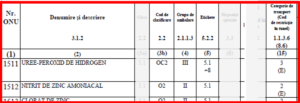
The information needed to declare dangerous goods in the transport document is taken from Table A in Chapter 3.2 of ADR
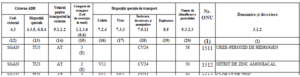
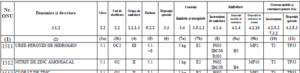
Columns (1), (2), (4), (5) and (15) are the ones we must take into account when we declare the dangerous goods in the transport document. If you fill in the information in the order (1)-(2)-(5)-(4)-(15), the dangerous goods will be declared correctly.
-
Transport/Consignment
Ammonium nitrate assigned to UN number 2067, carried in flexible intermediate
bulk containers, 10,000 kg (10 tonnes) in total
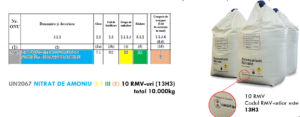
UN2067 AMMONIUM NITRATE 5.1 III (E) 10 IBCs (13H3) total 10,000 kg |
-
Transport/Consignment
DISINFECTANT, LIQUID, CORROSIVE assigned to UN number 1903, packed in inner receptacles of 20 L contained in outer packagings of the fibreboard box type. The total quantity of corrosive
substance is 2000 litres
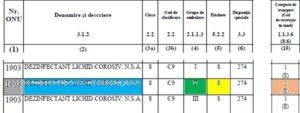
|
ATTENTION! – For this UN number, all three packing groups I, II and III appear in the Table When declaring the goods, the appropriate group must be chosen, in accordance with the manufacturer's specifications, which can be found in the product's safety data sheet – Because the technical name ends with the letters N.O.S. (DISINFECTANT, LIQUID, CORROSIVE, N.O.S.) and special provision 274 is indicated in column (6), it is mandatory for the proper shipping name of the goods to be supplemented with the technical name of the product written in brackets (C12-16 alkyl dimethylbenzylammonium chloride). |
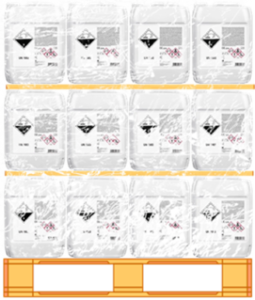
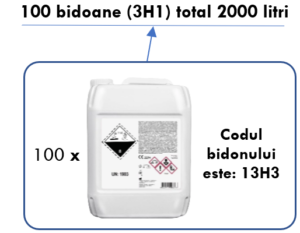
| UN1903 DISINFECTANT, LIQUID, CORROSIVE, N.O.S. (C12-16 alkyl dimethylbenzylammonium chloride) 8 II (E).
100 jerricans (3H1) total 2000 litres |
-
Transport/Consignment
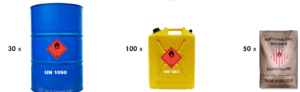
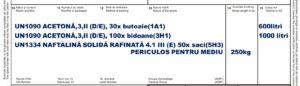
- 30 drums of acetone, 600 litres in total
- 100 jerricans of acetone, 1000 litres in total
- 50 bags of solid naphthalene, 250 kg in total
-
Transport/Consignment
Dangerous goods consigned in limited quantities, which fall under exemption 1.1.3.6 of ADR. The calculated ADR points total does not exceed 1000 points.
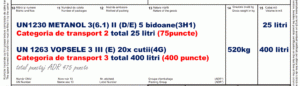
5 jerricans of METHANOL, UN 1230, 75 litres in total.
20 boxes of PAINT, UN 1263, packing group III, 400 litres in total and a gross weight of 520 kg.
NOTES: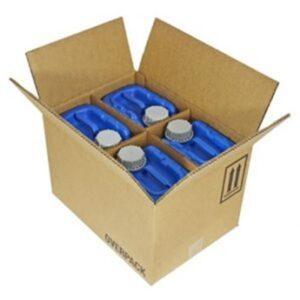
- The PAINTS are packed in inner receptacles, plastic jerricans, overpacked in fibreboard boxes. For combination packagings of this kind, the type of inner packaging must NOT be indicated in the transport document, only the outer one, in this case fibreboard box
- For the exemption below 1000 points to apply to consignments of dangerous goods in limited quantities, the transport document must indicate, after the declaration of the dangerous goods, the quantities for each transport category and the points calculated per transport category.
- The total number of points per consignment does NOT have to be indicated; it is not mandatory, BUT it can help carriers, and drivers directly, to identify more quickly whether or not the goods fall within the exempted limits for carriage under 1.1.3.6.
Choose Honexpres!
Honexpres is an experienced freight forwarder. We offer complete freight forwarding services and make sure your goods arrive safely and quickly, anywhere. We have the connections needed to organise any kind of domestic or international transport. We also offer the complete package of related services you need, plus professional advice. Your business is in good hands with Honexpres!
Have something similar to move? Request a quote →
All guides in ADR dangerous goods by road (22)
Related services