Customs procedures · Legislation and customs
Special customs procedures – the TIR Convention
Article translated automatically from Romanian and checked automatically. If there is any difference, the original prevails. See the original in Romanian · How we use automatic translation

In short
The Union Customs Code (UCC) of the European Union provides for certain special customs procedures with the aim of promoting international competitiveness and improving export opportunities. In this Honexpres article we look at the special customs procedures, with a focus on the TIR Convention.
Contents
The Union Customs Code (UCC) of the European Union provides for certain special customs procedures with the aim of promoting international competitiveness and improving export opportunities. In this Honexpres article we look at the special customs procedures, with a focus on the TIR Convention.
Special customs procedures
Under the UCC, there are 4 categories of special customs procedures:
- customs transit,
- customs warehousing,
- specific use,
- processing.
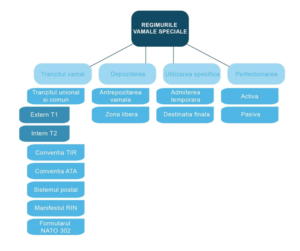
Customs transit is one of the four categories of special procedures. It is a customs procedure used to facilitate the movement of goods between two points of a customs territory, through another customs territory, or between two or more different customs territories.
One way of placing goods under the customs transit procedures is in accordance with the TIR Convention. Below we will discuss what the TIR Convention consists of and what the conditions for its application are.
The TIR Convention
The TIR Convention (Transports Internationaux Routiers – International Road Transport) establishes an international customs transit system offering maximum ease for the movement of goods:
- in sealed vehicles or containers;
- from a customs office of departure in one country to a customs office of destination in another country;
- without requiring extensive and lengthy customs checks at intermediate border points;
- all of this while, at the same time, providing the customs authorities with the necessary security and guarantees.
The TIR system does not cover road customs transit alone. A combination with other modes of transport (for example rail, inland waterways and even sea transport) is possible, provided that at least part of the total transport is carried out by road.
The conditions for the application of the TIR Convention are the following:
- the movement of the goods must begin or end outside the customs territory of the European Union;
- the movement of the goods must be carried out from one point to another of the customs territory of the Union, crossing a country or territory situated outside the customs territory of the Union.
The TIR carnet
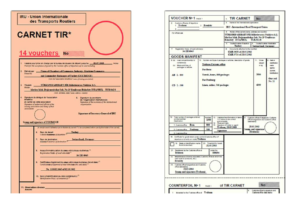
Means of transport using the TIR procedure must first obtain an internationally harmonised customs document called a TIR carnet. TIR carnets are issued by the national road transport associations. This customs document is valid internationally and has the value of a customs transit declaration. The TIR carnet contains:
- the description of the goods,
- the identification of the consignor
- the specification of the destination of the goods
In addition, the TIR carnet is a financial guarantee in itself.
When a lorry arrives at a border customs post, it does not have to pay import duties on the goods at that moment, but only at the final destination. Thus:
- If the vehicle transits a country without delivering goods in that country, no customs duties are due.
- If, on the other hand, it does not leave the country with all the goods, the related duties are invoiced to the importer, and the financial guarantee reinforces the importer's obligation to pay these duties.
TIR transits are carried out under certain conditions – the lorry must be sealed and must have the TIR carnet.
In addition to the paper TIR carnet, the holder is obliged to enter the data in the NCTS system.
The TIR carnet is valid only when the related guarantee is accepted in the customs territory of the Union.
TIR procedures
Following the European Commission's approval of the amendment of art. 163 of Commission Implementing Regulation (EU) 2015/2447, increasing the amount guaranteed by the guaranteeing associations for goods covered by the TIR operation up to the monetary limit of EUR 100,000 for each TIR carnet, all TIR carnets issued by UNTRR (the National Union of Road Hauliers from Romania) are covered by the guarantee of EUR 100,000.
The main difference between common transit and the TIR operation is that common transit means a single transit operation through a territory. The TIR operation, on the other hand, means a series of national transit procedures, but using the standardised rules of the TIR Convention.
The TIR procedure is used mainly in the countries of Eastern Europe that are not in the EU (for example Russia and Ukraine), Turkey and parts of the Near East. Since the creation of the European single market, the TIR procedure has become unnecessary for intra-Community freight transport.
As a result of Brexit, TIR carnets have become part of the solution for freight transport between Great Britain and other European countries.
Lorries using this convention display a set of large plates bearing the letters TIR in white on a blue background. For this reason, the word “TIR” has entered many languages (Romanian, Italian, Polish, Turkish, Portuguese) as a neologism. In practice, the word TIR has become, in everyday speech, the default generic name for a large lorry.
The mission of the freight forwarder Honexpres
We, at the freight forwarder Honexpres, have taken on the mission of managing supply and demand on the freight transport market efficiently and fairly. We arrange the transport of any goods, over any distance, and create the link between the consignor of the goods and the carrier suited to its needs. We also connect the carrier looking for a limited quantity of goods with the right goods that need to be transported.
Whichever side you are on, we have the ideal solutions for you! Contact us!

Photo sources: iru.org, unescap.org
Have something similar to move? Request a quote →
All guides in Customs procedures (6)
Related services