Guides
Ex Works (EXW) in Incoterms 2020: what it means and what it involves for the buyer
AI Text written with AI assistance and checked by the editorial team. How we work with AI
Article translated automatically from Romanian and checked automatically. If there is any difference, the original prevails. See the original in Romanian · How we use automatic translation
In short
EXW (Ex Works) means that the seller places the goods at the buyer's disposal at its premises or at another agreed place, on the agreed date. The seller does not clear the goods for export and does not bear the risk and cost of loading. The buyer organises almost the whole rest of the chain.
Contents
- Ex works: what it means, in brief
- EXW in Incoterms 2020: where it fits
- The obligations of the seller and the buyer under EXW
- Transfer of risk: from the moment the goods are placed at disposal
- Export customs clearance: where EXW gets complicated
- How EXW appears in customs and shipping documents
- In the customs declaration
- The FIATA FCR certificate
- Advantages and disadvantages of the EXW term
- For the seller
- For the buyer
- EXW vs FCA: which one suits better?
- Common mistakes with EXW
- What influences the cost of transport under the EXW term
- How a freight forwarder helps you with EXW
- Frequently asked questions about EXW
- What does EXW mean on an invoice or quotation?
- Who handles export customs clearance under the EXW term?
- When does the risk pass to the buyer under EXW?
- Can EXW also be used for sea or air transport?
- Is EXW or FCA better?
- What must be written in the contract under EXW?
- Request a quote for collecting your EXW goods
- Official sources consulted
The ex works EXW term often appears in supplier quotations, especially when the seller wants to be involved in transport as little as possible. For the buyer, "ex works" looks like good news at first sight: a lower price on the invoice and the freedom to choose the carrier yourself. In practice, EXW shifts almost the entire logistics chain onto the buyer's shoulders, including the most delicate part: export formalities and the risk from the moment the goods are placed at your disposal. Below we explain what EXW means in Incoterms 2020, how the risk is transferred, what happens with export customs clearance, how EXW differs from FCA and which mistakes most often occur in contracts and at collection.
Ex works: what it means, in brief
Incoterms is short for International Commercial Terms, a set of rules that define precisely the extent of the parties' obligations in relation to delivery, one of the essential components of the contract of sale [1]. In these rules, "delivery" is linked to the transfer of risk and responsibility for transport from the seller to the buyer, and the place of delivery is not the same thing as the place of destination of the goods [1].
EXW (Ex Works) is the rule under which delivery takes place when the goods are placed at the buyer's disposal at the seller's premises or at another place named in the contract, for example a factory or warehouse, on the agreed date [2]. The seller is not obliged to carry out export customs formalities and does not bear the risk and costs of loading [2]. In international forwarding terminology, Ex Works (EXW) corresponds to the expressions "A l'usine / en entrepôt" (French) and "ex Werk / ab Fabrik" (German) [5], and in the EU customs nomenclature it is rendered in Romanian as "Franco fabrică" [3].
In other words: under EXW, the seller prepares the goods and keeps them available; the rest – the truck, loading, export customs clearance, main carriage, insurance, customs clearance at destination – remains for the buyer to organise.
EXW in Incoterms 2020: where it fits
The Incoterms 2020 rules are divided into four groups (C, D, E, F), classified by charges, risk, responsibility for formalities and aspects relating to import and export [1]. Group E includes only the EXW rule [1]. Group F, described as "main carriage not paid by the seller", includes FCA, FAS and FOB [1].
By mode of transport, the rules are divided into those applicable to all modes of transport and those applicable only to sea and inland waterway transport [1]. EXW is one of the terms applicable to all modes of transport [2]. EXW can therefore be used equally well for a collection by truck, for an air shipment or for a container heading to the port. For an overview of all the terms, see our quick guide to Incoterms® 2020.
The Incoterms rules focus on two questions: which party organises and pays for transport and the ancillary activities (loading, unloading, import and export procedures, insurance), and at what point in the transport the responsibility passes from the seller to the buyer [1]. Under EXW, both answers lean heavily towards the buyer.
The obligations of the seller and the buyer under EXW
The table below summarises the split, as it follows from the description of the rule. For any contractual detail, the reference text remains the official ICC publication Incoterms® 2020.
| Item | Seller | Buyer |
|---|---|---|
| Placing the goods at the buyer's disposal | At its premises or at the place named in the contract, on the agreed date [2] | Collects the goods from the agreed place |
| Loading onto the means of transport | Does not bear the risk and costs of loading [2] | Organises the loading (the contract should clarify who physically carries it out) |
| Export customs formalities | Is not obliged to carry them out [2] | Must take them into account and organise them, as a rule through a customs broker |
| Main carriage | To be checked in the text of ICC Incoterms® 2020 | To be checked in the text of ICC Incoterms® 2020 and agreed in the contract |
| Risk of loss or damage | Until delivery | From the moment of delivery, that is, of placing at disposal [1] [2] |
The table shows that, under EXW, the seller is not obliged to carry out export formalities and does not bear the risk and costs of loading. For the buyer, this means having, in-house or through partners, the capacity to manage the collection, the documents and the transport from a country where it may have no presence at all.
Transfer of risk: from the moment the goods are placed at disposal
Because in Incoterms delivery is linked to the transfer of risk [1], under EXW the risk passes to the buyer at the moment the goods are placed at its disposal at the agreed place, on the agreed date [2]. It does not matter that the goods are still physically in the seller's warehouse: once placed at disposal in accordance with the contract, any subsequent loss or damage is, as a rule, no longer the seller's problem.
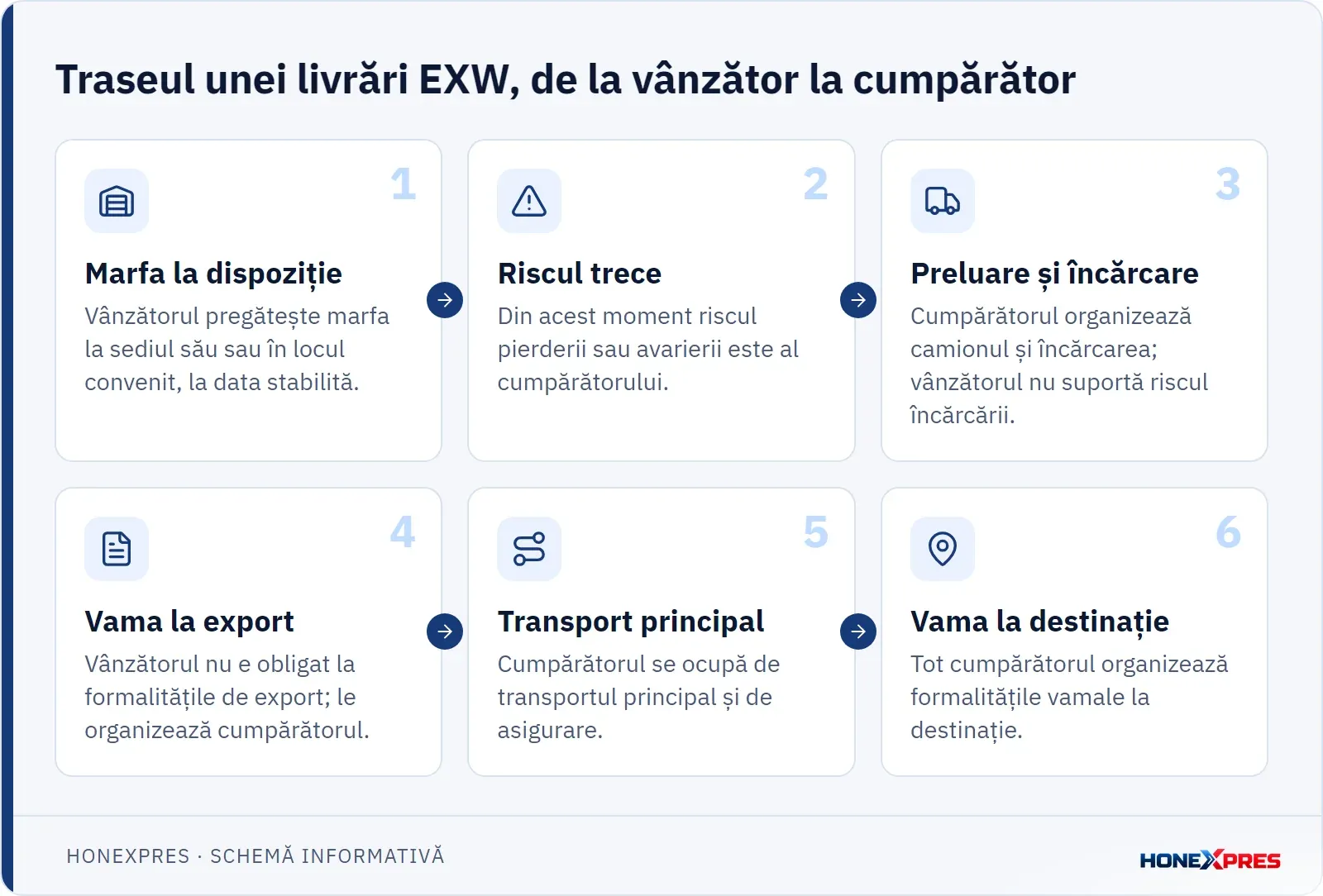
Practical consequences for the buyer:
- Loading is a sensitive area. The seller does not bear the risk of loading [2]. If a pallet falls off the forklift at the loading dock, the discussion about who is liable can become complicated, especially if the forklift belongs to the seller. Set out in the contract who actually loads and at whose risk.
- Insurance is the buyer's decision. Being exposed from the supplier's gate, the buyer should consider cargo insurance that also covers the collection stage. The difference between the carrier's liability and cargo insurance is explained in the article CARGO insurance – why is it important?
- The agreed date matters. The placing at disposal takes place on the agreed date [2]. If the truck arrives later, the goods wait at the buyer's risk.
Export customs clearance: where EXW gets complicated
Under EXW, the seller is not obliged to carry out export customs formalities [2]. For a buyer in the same country as the seller, or for a delivery within the single market without export formalities, this matters less. For a delivery from the EU to a third country (or vice versa), however, someone has to prepare the export declaration, and EXW leaves this task outside the seller's obligations.
A few questions the buyer should ask itself before signing:
- Who will actually lodge the export declaration in the seller's country and on whose behalf? Check with the competent customs authority or with a customs broker who may appear as the exporter.
- Will the seller provide, on request, the necessary information and documents (invoice, packing lists, tariff codes, any licences)? It is advisable to state this explicitly in the contract.
- Will the seller receive proof that the goods have left the EU, which it may need for its own records? This link between customs and taxation should be discussed with each party's tax adviser.
The role of a customs representative is described at length in Customs broker: what they do and when you need one, and the general steps are presented in Customs formalities for import and export.
How EXW appears in customs and shipping documents
In the customs declaration
EU customs declarations contain a data element dedicated to delivery terms: in the code list, EXW appears with the meaning "Franco fabrică" (ex works), and the second subdivision requires a "Named place" to be specified [3]. In the same table, FCA appears with the meaning "Franco transportator" (free carrier), also with a "Named place" [3]. The same structure is found in box 20 "Delivery terms" of the forms provided for by Delegated Regulation (EU) 2016/341 [4]. Note that these code lists mention the Incoterms 2010 version alongside the code [3]; if you use the 2020 version in your contract, state the version explicitly, and when completing the declaration follow the customs authority's current instructions.
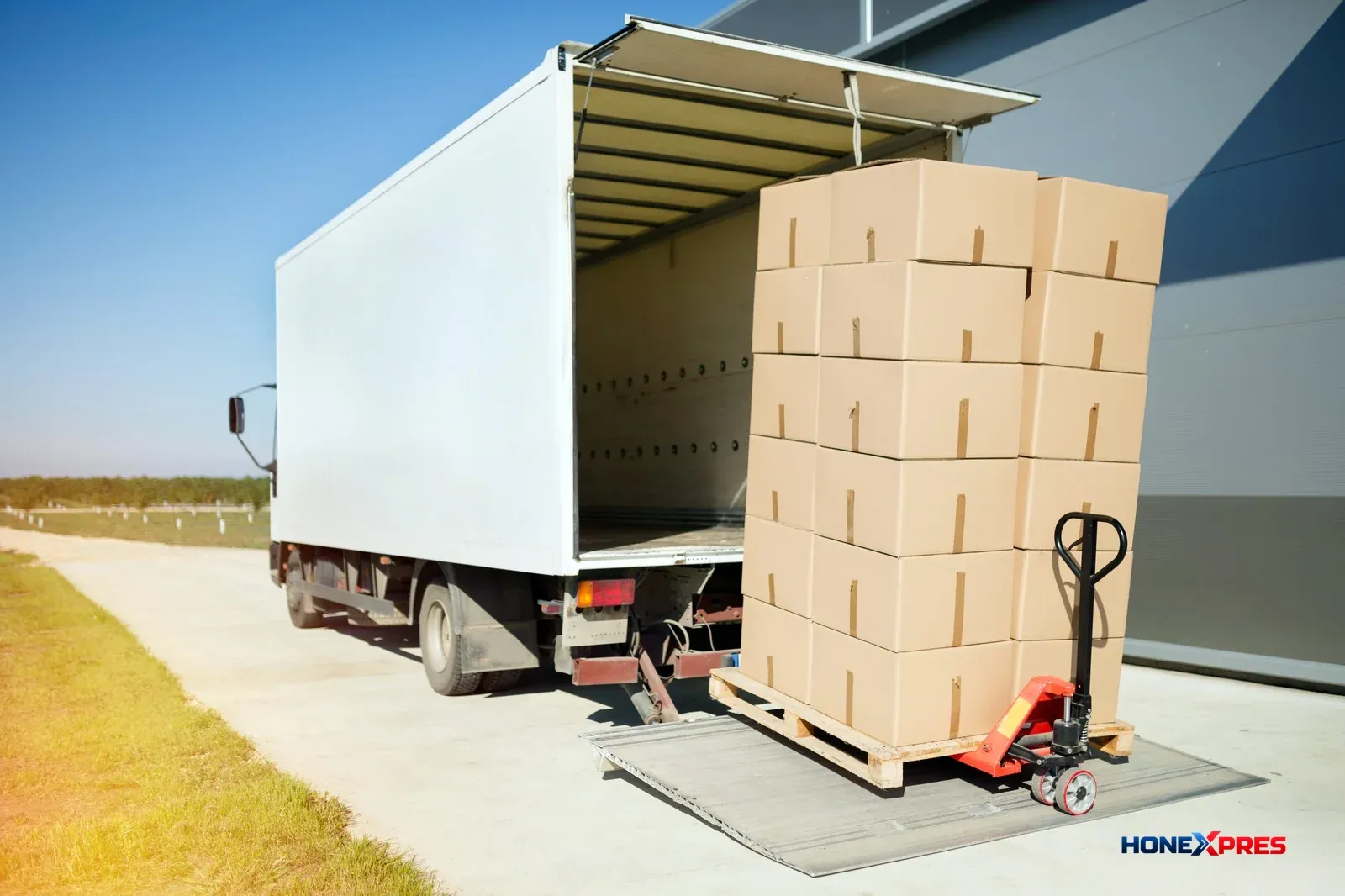
The practical rule: "EXW" alone is not enough. The place must be named as precisely as possible (address, gate, warehouse), because it defines both the point of delivery and the information required in the declaration.
The FIATA FCR certificate
When selling EXW, the seller may need to prove that it has fulfilled its obligations, for example under a letter of credit. The Forwarder's Certificate of Receipt (FIATA FCR) will be used mainly when the supplier sells the goods ex works and has to demonstrate that it has complied with its obligations towards the buyer by presenting this document [7]. In the case of a letter of credit, the seller may present a FIATA FCR issued by a freight forwarder in order to obtain payment of the price [7]. The FIATA FCR document is not negotiable and a single original is issued [7]. For other transport documents, see our index of transport documents.
Advantages and disadvantages of the EXW term
For the seller
- Advantage: is not obliged to carry out export formalities and does not bear the risk and costs of loading [2].
- Disadvantage: loses control over how the goods leave its yard and may depend on the buyer for the documents it needs later (for example proof of export).
- Practical disadvantage: even without the obligation, it often helps with loading using its own staff, which raises liability questions if not clarified in the contract.
For the buyer
- Advantage: full control over transport: chooses the type of vehicle, the route, the partners and the time of collection; can consolidate several suppliers into a single shipment.
- Advantage: transparency of the logistics cost, separate from the price of the goods.
- Disadvantage: assumes the risk as soon as the goods are placed at disposal [2], including during loading.
- Disadvantage: must deal with export formalities in a country where it may have no representation.
- Disadvantage: if the information about the goods (weight, dimensions, packaging, any dangerous goods) is incomplete, the truck sent may be unsuitable.
EXW vs FCA: which one suits better?
The EXW vs FCA comparison comes up in almost every negotiation in which the buyer organises the transport. Both rules apply to all modes of transport, and in the customs nomenclature EXW is "Franco fabrică" (ex works) and FCA is "Franco transportator" (free carrier), both with a named place [3]. FCA (Free Carrier) belongs to group F, where the main carriage is not paid by the seller [1] [6], whereas EXW is the only rule in group E [1].
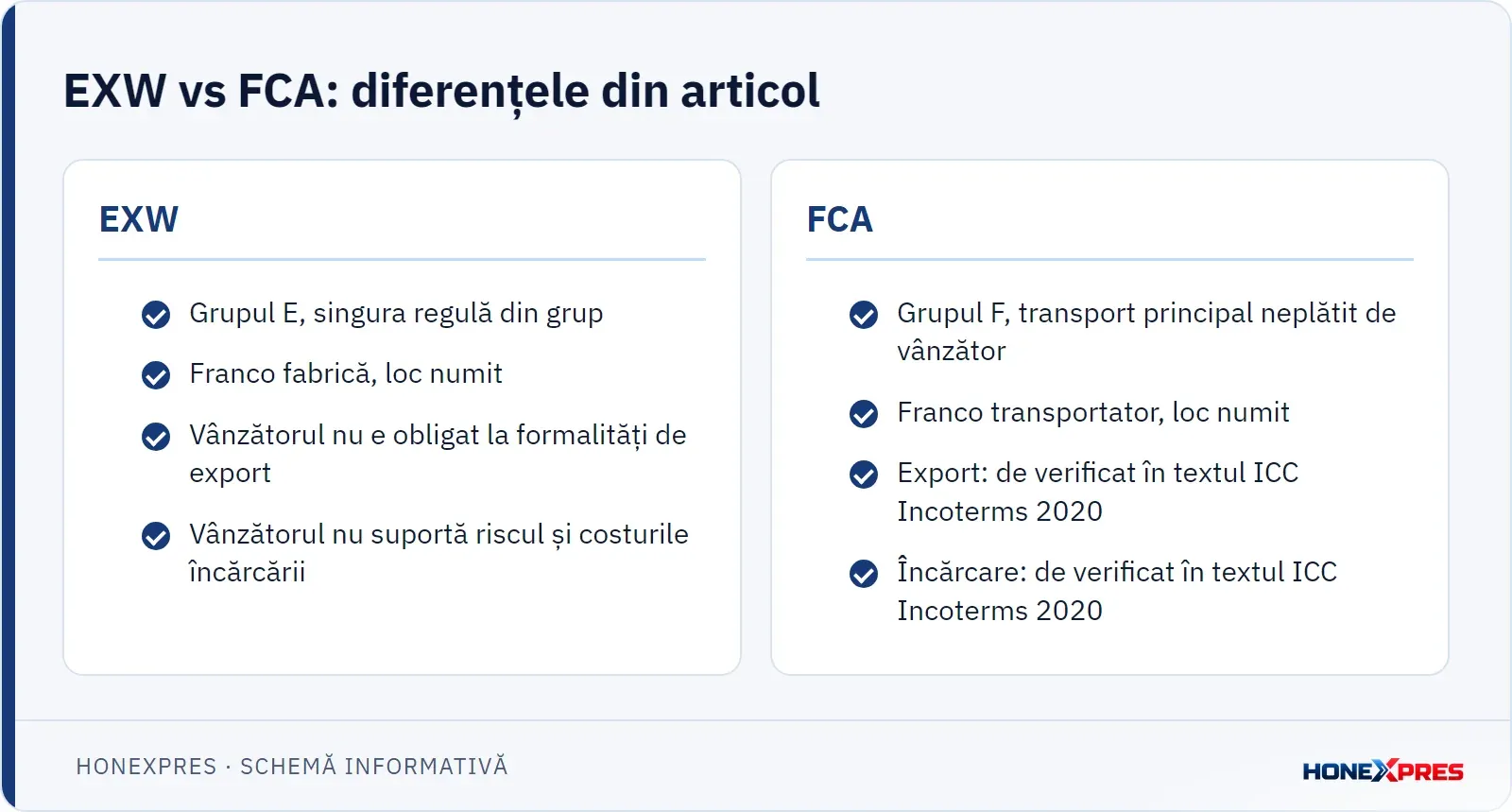
The fundamental difference lies in the point at which the seller's involvement stops. Under EXW, the seller merely places the goods at disposal, without export customs clearance and without the risk and costs of loading [2]. Under FCA, the seller has a broader role; the exact way in which Incoterms 2020 splits loading and export formalities under FCA must be checked in the official ICC text before using it in a contract.
| Criterion | EXW | FCA |
|---|---|---|
| Incoterms 2020 group | Group E (the only rule) [1] | Group F [1] |
| Name in the EU customs nomenclature | Franco fabrică (ex works), named place [3] | Franco transportator (free carrier), named place [3] |
| Export formalities | The seller is not obliged [2] | To be checked in the text of ICC Incoterms® 2020 |
| Loading at the seller's premises | The seller does not bear the risk and costs [2] | To be checked in the text of ICC Incoterms® 2020 |
| Suitable for | Buyers with access to customs representation in the seller's country, or deliveries without export formalities | Situations in which the buyer organises the transport but wants the departure part to be handled by the seller |
The common-sense rule: if the seller has loading staff and equipment and is established in the exporting country, it is worth checking whether FCA reflects the operational reality better than EXW. For sea transport, also compare with FOB, which applies only to transport by water.
Common mistakes with EXW
- Place not named or vague. "EXW Germany" says nothing about the collection address. Delivery takes place at the seller's premises or at the place named in the contract [2], and the customs declaration requires a named place [3]. State the exact address.
- Incoterms version omitted. State it explicitly, for example "EXW [address] Incoterms® 2020", especially as the customs code lists still mention the 2010 version [3].
- Loading not clarified. The seller does not bear the risk and costs of loading [2], but often it is the one that actually loads. Establish in writing who loads and at whose risk.
- Export left "for later". The truck arrives, the goods are ready, but nobody has prepared the export declaration.
- Insurance started too late. The buyer insures the goods "from departure", but the risk has already passed on placing at disposal [2].
- Incomplete data about the goods. Without weights, dimensions, number of pallets and stackability, the right vehicle cannot be chosen. To estimate the space occupied, use the loading metres calculator.
- Confusion between place of delivery and destination. The place of delivery is not the same thing as the place of destination [1]; under EXW, "delivered" does not mean "arrived at my premises".
What influences the cost of transport under the EXW term
Because under EXW the logistics cost is shown separately from the price of the goods, the buyer must be able to estimate it correctly. There is no standard rate; the cost depends on factors such as:
- Distance and route between the collection point and the destination, including any crossings of the EU's external borders.
- Volume and type of load: a few pallets can travel as groupage, while a large load justifies a full truckload.
- Type of vehicle required: curtain-sider, refrigerated, flatbed, ADR-equipped vehicle for dangerous goods.
- Loading conditions: the existence of a ramp, a forklift, the need for a side- or top-loading vehicle.
- Customs formalities for export and import, and customs representation.
- Waiting times at collection, if the goods or documents are not ready.
- Cargo insurance, if the buyer decides to take it out.
- Urgency and flexibility of the collection date.
How a freight forwarder helps you with EXW
HONEXPRES SRL is a freight forwarder based in Oradea. We do not have our own fleet: we organise transport together with partner carriers, on the route and with the type of vehicle suited to the goods. In an EXW purchase, we can take over the buyer's operational part:
- we clarify with you the exact collection point, the loading hours and the contact person at the supplier;
- we choose the suitable transport solution – road transport as full truckload or groupage, sea, air or rail, depending on the goods;
- we coordinate, through customs services, the necessary export and import formalities;
- we flag in good time what information is missing for a collection without delays.
We do not provide cargo insurance from our own resources; we recommend discussing it with an insurer, bearing in mind that under EXW the risk begins early.
Frequently asked questions about EXW
What does EXW mean on an invoice or quotation?
It means that the price covers the goods placed at the buyer's disposal at the seller's premises or at the place named in the contract, on the agreed date [2]. Transport, loading, export customs clearance and the rest of the chain are not included in the seller's obligations.
Who handles export customs clearance under the EXW term?
The seller is not obliged to carry out export customs formalities [2], so the buyer must organise them. Check with the competent customs authority or with a customs broker who may formally appear as the exporter before accepting EXW for a delivery to a third country.
When does the risk pass to the buyer under EXW?
In Incoterms, delivery is linked to the transfer of risk [1]. Under EXW, delivery takes place when the goods are placed at the buyer's disposal, at the agreed place and date [2], so from then on the risk is the buyer's.
Can EXW also be used for sea or air transport?
Yes. EXW is one of the terms applicable to all modes of transport [2]. For transport by water there are also specific rules, such as FOB, which applies only to sea or inland waterway transport.
Is EXW or FCA better?
It depends on who has the capacity to handle loading and export formalities. Under EXW, the seller is not obliged to carry out export formalities and does not bear the risk and costs of loading [2]; FCA, from group F [1], involves the seller more. Check the exact split under FCA in the official text of ICC Incoterms® 2020 and choose the term that reflects what actually happens at the loading dock.
What must be written in the contract under EXW?
At a minimum: the EXW code, the named place as precisely as possible [3], the Incoterms version used, the date or period of placing at disposal, who actually loads and what documents and information the seller provides for the customs formalities.
Request a quote for collecting your EXW goods
If you have bought goods on EXW terms or are negotiating a new contract, send us the collection address, the destination, the description of the goods (number of pallets, weights, dimensions) and the date on which the goods are available. We organise the transport with partner carriers and coordinate the necessary customs steps. Fill in the quote request and we will come back with a proposal tailored to your shipment.
Official sources consulted
- [1] INCOTERMS 2020 delivery terms – introduction (definition of Incoterms)
- [2] INCOTERMS 2020 delivery terms – EXW = Ex Works (terms applicable to all modes of transport)
- [3] Implementing Regulation (EU) 2015/2447, Annex B, Title II, data element 4/1 "Delivery terms" (OJ L 343/787)
- [4] Delegated Regulation (EU) 2016/341, box 20 "Delivery terms" (OJ L 69/181)
- [5] FIATA – Glossarium of Transport and Forwarding Terms, term "Ex Works (EXW)"
- [6] FIATA – Glossarium of Transport and Forwarding Terms, term "Free carrier (FCA)"
- [7] FIATA – Forwarder's Certificate of Receipt (FIATA FCR), explanatory brochure
Are you buying or selling on EXW terms? Send us the collection point, the goods and the destination, and we will organise the transport with partner carriers.
Have something similar to move? Request a quote →
Related services