Air freight · Guides
Air transport of dangerous goods – IATA/ICAO
Article translated automatically from Romanian and checked automatically. If there is any difference, the original prevails. See the original in Romanian · How we use automatic translation
In short
The air transport of dangerous goods (by aircraft) is regulated and described in the instructions on the air transport of dangerous goods approved by ICAO (the International Civil Aviation Organization) and/or IATA.
Contents
- Air transport of dangerous goods – IATA/ICAO
- Transport document
- Special provision for dangerous goods packed in excepted quantities
- Labelling and marking of packages
- Approval marking of the packaging/packagings
- The proper shipping name of the goods and the UN number of the substance
- Danger label/labels
- Handling/treatment signs
- Identifying packages packed in limited quantities
- Using overpacks
- Domestic and international freight transport – Honexpres
The air transport of dangerous goods (by aircraft) is regulated and described in the instructions on the air transport of dangerous goods approved by ICAO (the International Civil Aviation Organization) and/or IATA.
Air transport of dangerous goods – IATA/ICAO
The requirements for the multimodal transport of dangerous goods (road-air, air-road) are described in chapter 1.1.4.2 of ADR.
Packages, containers, portable tanks, tank-containers and MEGCs which do not entirely meet the ADR requirements for packing, mixed packing, marking and labelling of packages or placarding and orange-coloured plate marking, but which are in conformity with the ICAO Technical Instructions, are accepted for carriage in a transport chain that includes carriage by air, subject to the following conditions:
(a) the packages must bear the marks and danger labels in accordance with the provisions of the ICAO Technical Instructions, if the marks and labels are not in conformity with ADR;
(b) the provisions of the ICAO Technical Instructions apply to mixed packing within a package.
This derogation does not apply to goods classified as dangerous goods in classes 1 to 9 of ADR and considered as non-dangerous goods under the applicable provisions of the ICAO Technical Instructions.
Transport document
Anyone who consigns dangerous goods (also) for air transport is obliged to provide the air carrier with all the information relating to the goods.
The information may be transmitted:
-
On paper,
-
In electronic form, processed using EDP or EDI techniques (where there is an agreement to this effect with the air carrier).
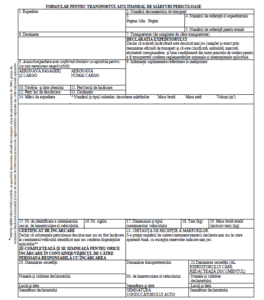
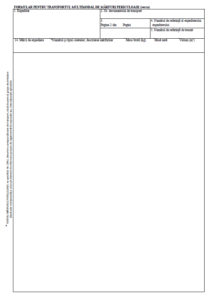
If paper transport documents are used, the consignor of the goods who requests the carriage of dangerous goods by air is obliged to provide the air carrier with two copies of the transport document, signed and duly completed with all the information relating to the dangerous goods.
If the information relating to the carriage of the dangerous goods is provided by EDP or EDI techniques, it must be possible to produce the information as a printed document at any time.
The document may be in any format, provided that it contains all the information required by the ICAO Technical Instructions.
Where dangerous goods and non-dangerous goods are entered in the same document, the dangerous goods must be entered first. The information relating to the dangerous goods must be easy to identify, legible and resistant to weather conditions.
Special provision for dangerous goods packed in excepted quantities
For the carriage of dangerous goods packed in excepted quantities, the transport document must contain the statement “dangerous goods in excepted quantities” and the number of packages.
Particulars that must be shown in the transport document for the air transport of dangerous goods:
-
The proper shipping name, the quantity of the dangerous goods, and the type and number of packages,
-
Additional requirements relating to packages and overpacks, or concerning the loading, positioning, stowage, carriage, handling and unloading of containers,
-
Restrictions on the type of aircraft and information on the route, as well as emergency instructions,
-
Except for radioactive material, the packing instruction and, where applicable, a reference to special provisions A1 or A2,
-
A statement of whether the package or packages are accepted for carriage on passenger or cargo aircraft, or fall under the restrictions for carriage on cargo aircraft only,
-
Whether there are any special handling provisions,
-
The “Q” value rounded to the first decimal place, if the goods are packed in accordance with ICAO TI 3, ch. 4.3.3 (the outer packaging contains different goods), or ch. 4.1.1.9 letter e) (an outer packaging contains different packages).
-
In the case of explosive goods, if the national authority has adapted packing instruction 101, the transport document shall show the distinguishing letters used in international traffic for the country concerned,
-
A certificate or a declaration that the goods are acceptable for carriage, that is, that the dangerous goods are properly packed, labelled and marked, and that they comply with the provisions on their condition and quality for carriage.
In accordance with the requirements laid down by IATA and other regulations, air carriers provide the above information by means of the following documents:
-
-
The dangerous goods declaration,
-
The air waybill,
-
The shipper's declaration,
-
Cargo Manifest,
-
Information for the pilot of the aircraft.
-
Labelling and marking of packages
Data and information that must appear on packages (depending on the type and quantity of the dangerous goods), apart from special situations (e.g. explosive goods, radioactive goods, refrigerated and liquefied gases, dry ice, etc.).
Every package/packaging must be identified, labelled and marked with at least the following:
Approval marking of the packaging/packagings
Each packaging, with the exception of inner packagings, must be marked clearly, legibly and durably with an approval marking.
 The approval marking must be preceded by the UN symbol.
Example:

The proper shipping name of the goods and the UN number of the substance
Each packaging shall be marked with the proper shipping name of the goods, supplemented (where applicable) with the technical name, and with the UN number preceded by the letters “UN”.
Compared with ADR (road transport), this special provision is specifically required in the case of packages that are to be carried by air.
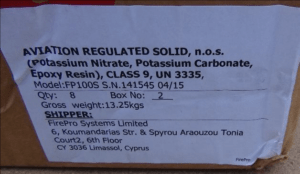
Danger label/labels
Each package/packaging must be labelled with the danger label/labels corresponding to the dangerous goods contained in that packaging.
The labels must have minimum dimensions of 100x100 mm.
If there are subsidiary hazards that must be indicated, those danger labels must be placed next to the danger label indicating the primary hazard.
They must be placed on the packages/packagings in such a way that they are not wholly or partly covered by other information (labels, signs, marks, etc.).
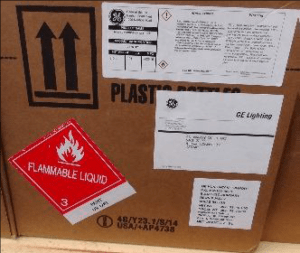
Correctly labelled package
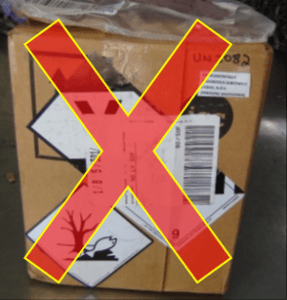
Incorrect labelling
Handling/treatment signs
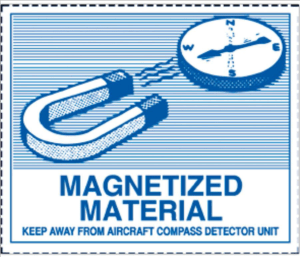
Magnetized material – if the package contains goods with a magnetizing effect, this must be indicated by displaying the “magnetized material” label on the outside of the package.
Carriage by cargo aircraft only – for certain dangerous goods, or depending on the quantity or the method of packing, the ICAO Technical Instructions provide for carriage by cargo aircraft only.
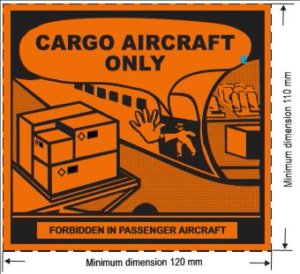
In these situations, the consignor of the goods (manufacturer, logistics centre, etc.) must indicate this applicable special provision by displaying the “cargo aircraft only” sign on the packagings.
Handling mark – apart from this mark, no other arrows may appear on a package that bears a handling mark.
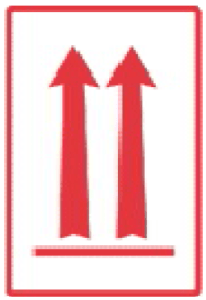
Keep away from heat

Identifying packages packed in limited quantities
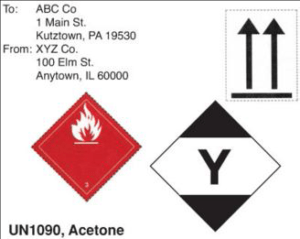
 When dangerous goods are packed in limited quantities and are (also) to be carried by air, the limited quantities symbol is a symbol in addition to all the other signs, labels and marks that must be shown on packages containing dangerous goods.
Example of the marking and labelling of a package containing dangerous goods packed in limited quantities:
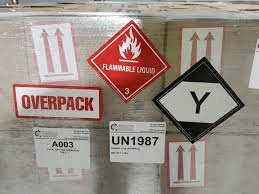
Using overpacks
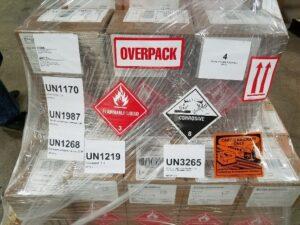
Except where all the information (labels, marks) is visible from the outside of the overpack, each overpack must be labelled and marked with:
-
Danger labels,
-
The UN numbers, preceded by the letters “UN”,
-
The proper shipping names of the goods,
-
Any special provisions shown on the packagings inside the overpack concerning their handling or use,
-
The word: “OVERPACK”.
Domestic and international freight transport – Honexpres
When you have goods to transport, turn with confidence to the freight forwarder Honexpres. We put all our experience at your disposal, together with all the connections we have. In this way, for each ADR or intermodal transport we look for the best conditions, transit times and rates; they are confirmed in the quotation. We are trusted partners for over 300 companies.
Have something similar to move? Request a quote →
Related services