
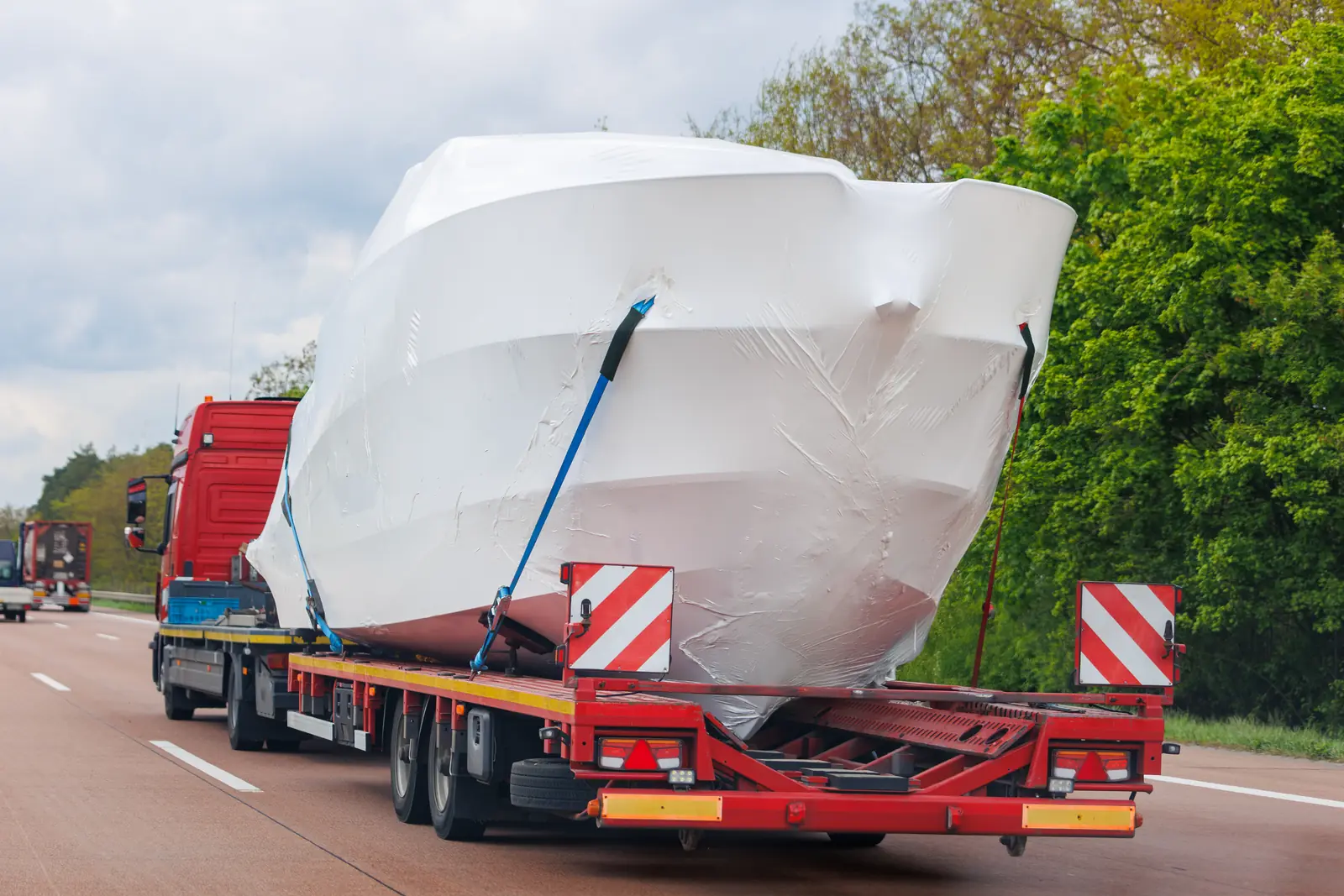
Road transport · oversized · Romania and international
Oversized transport for heavy, bulky and special cargo
We organise oversized transport in Romania and internationally for heavy and bulky goods, machinery and industrial equipment that exceed the permitted dimensions or weights. The HONEXPRES team chooses the vehicle, checks the route and coordinates the permits and, where needed, the escort, with specialised carriers.
- Permits AST permits Via eAST (CNAIR, the Romanian national road company) on national roads, plus the permits of the transit countries.
- Route Route checked Underpasses, bridges, roundabouts and access at loading, checked before departure.
- Escort Escort where required Authorised escort operators and, above certain dimensions, the police.
- Loading From above, from the side or via ramps Crane, forklift or ramps, depending on the lifting points of the cargo.
Dimensions and weight
When a transport becomes oversized: dimensions and weight
A transport becomes oversized when the loaded vehicle exceeds the maximum width, height, length or weights permitted on public roads. It then needs a special permit, a checked route and, sometimes, an escort. Do not start from what the truck costs, but from the real data of the cargo.
-
Width over the limit
The cargo extends sideways beyond the permitted width: a special permit and, above certain values, an escort.
-
Height over the limit
The loaded vehicle exceeds the permitted height: bridges and underpasses matter; sometimes a lower deck helps.
-
Length over the limit
Long items such as beams, poles or pipes: extendable flatbed, permit and checked route.
-
Weight and axle load
The total weight or the axle load exceeds the limit: a different number of axles, a permit and, sometimes, approvals for bridges.
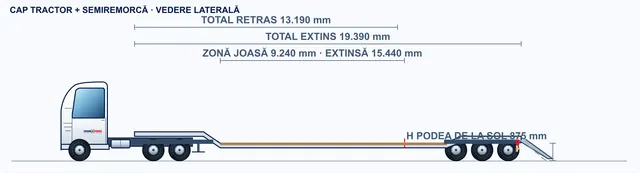
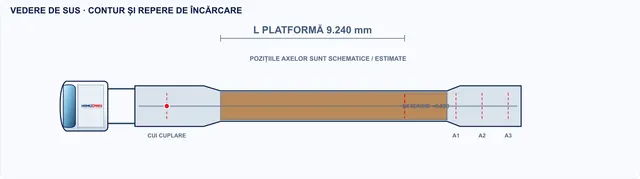
Conventional and oversize configuration, with the real geometry from the library
Two vehicles of the Honexpres library, with their constructive dimensions published by the manufacturer. These are not legal limits: a load becomes oversized through its own dimensions together with those of the vehicle.
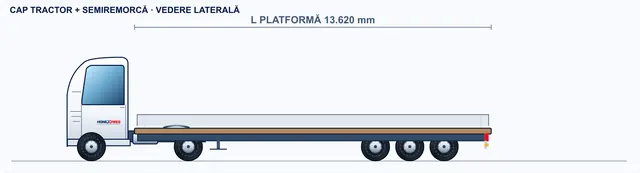
Conventional configuration
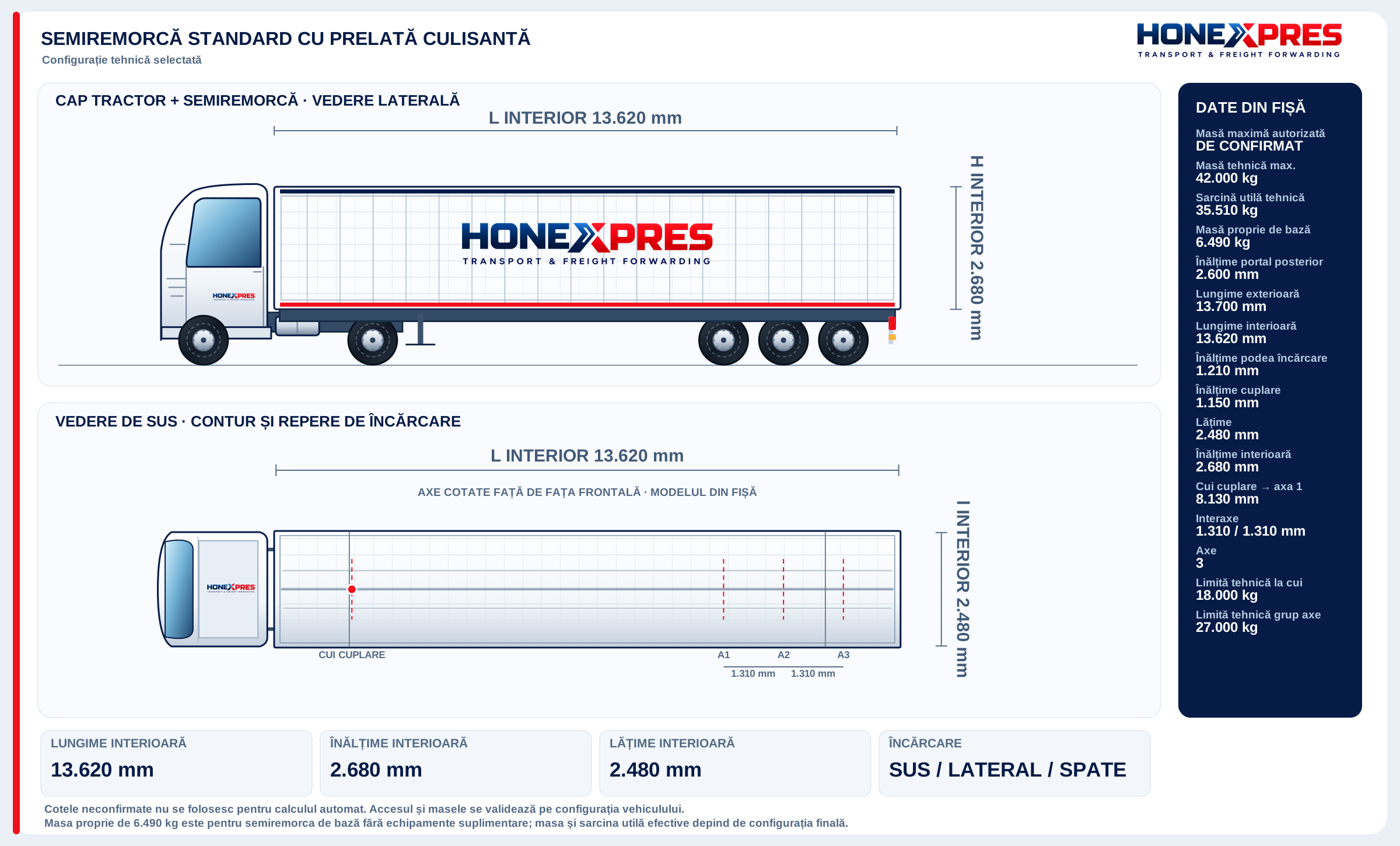
- External length: 13,700 mm
- External width: 2,550 mm
Extendable configuration
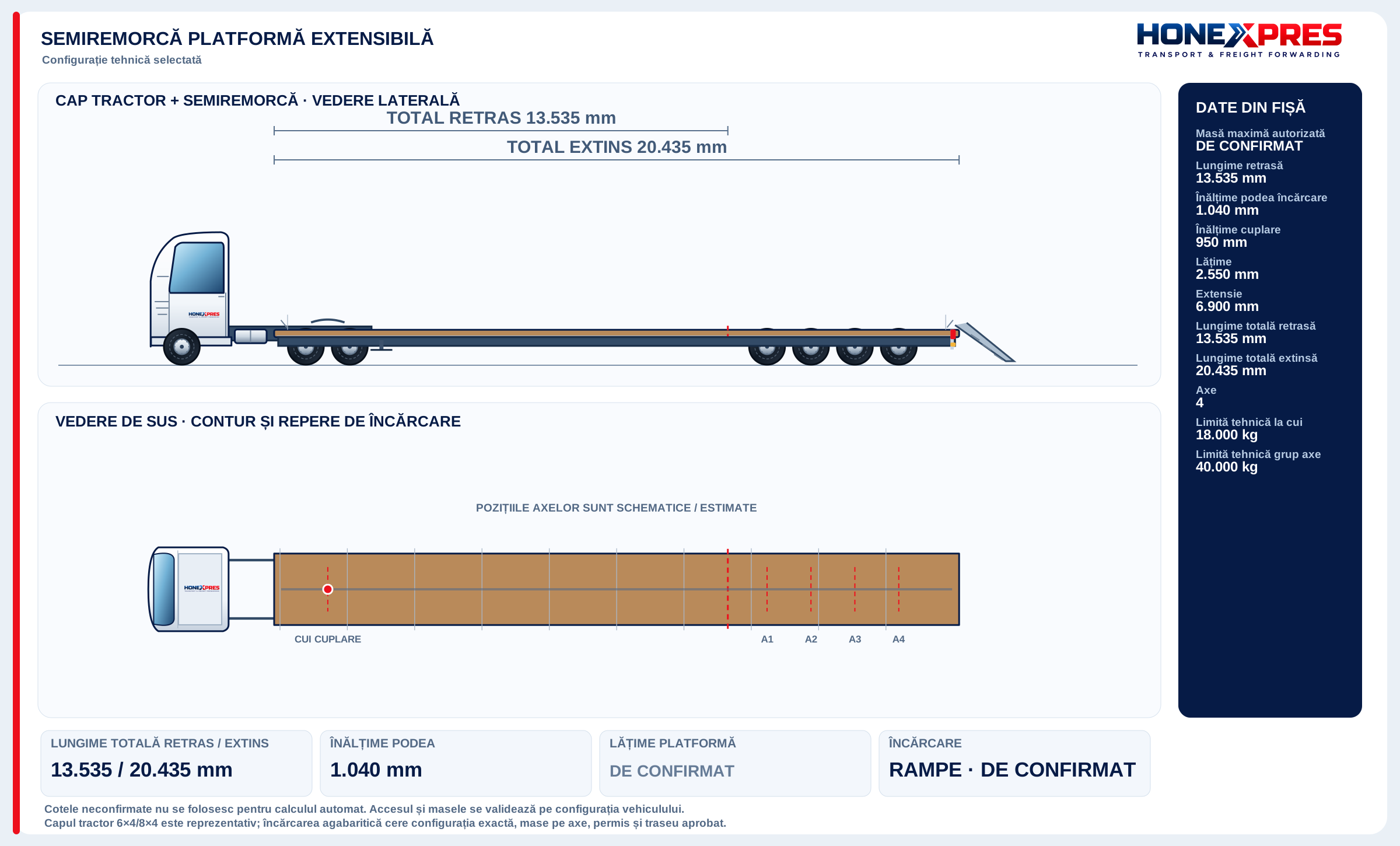
- Total length, retracted: 13,535 mm
- Total length, extended: 20,435 mm
- External width: 2,550 mm
Legal limits. Legal limits of dimensions and mass are not properties of a vehicle: they depend on the country, the road and the permit, and are checked along the route. They are not shown here as a universal rule.
The reference limits are on the vehicle sheets. If you are not sure, send us the dimensions and the weight: we will check. Sometimes dismantling or a lower deck keeps the transport within the permitted dimensions. See the limits on the flatbed sheet
On this page
What we transport
What oversized cargo we transport: heavy, bulky and special
Transporting heavy goods and transporting bulky goods start from the same problem: the cargo does not fit within the limits of a standard truck. The only difference is what exceeds them — weight, width, height or length — and that determines the vehicle, the permit and the route.
-
Heavy
Heavy goods
Transformers, generators, presses, tanks, castings: the weight or the axle load requires vehicles with more axles and, sometimes, a route survey.
-
Bulky
Bulky goods
Silos, modular houses, steel structures, casings, boats: often light, but too wide or too tall for the standard dimensions.
-
Machinery
Machinery
Excavators, bulldozers, combine harvesters, tractors with mounted implements, crawler cranes — with a dedicated page on loading and data.
-
Industrial
Industrial equipment and special loads
Production lines, large machine tools, components for energy and construction, indivisible items delivered for installation on a set date.
Machine on a low platform: which dimensions are compared
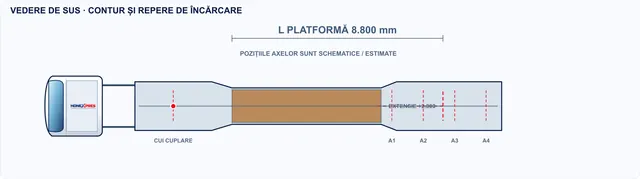
The photo and the technical sheet of the machine tell us its length, width, height and mass. The scheme below shows the empty deck of a semi-trailer with a semi-low platform from the library, with the dimensions that are compared with those of the machine.
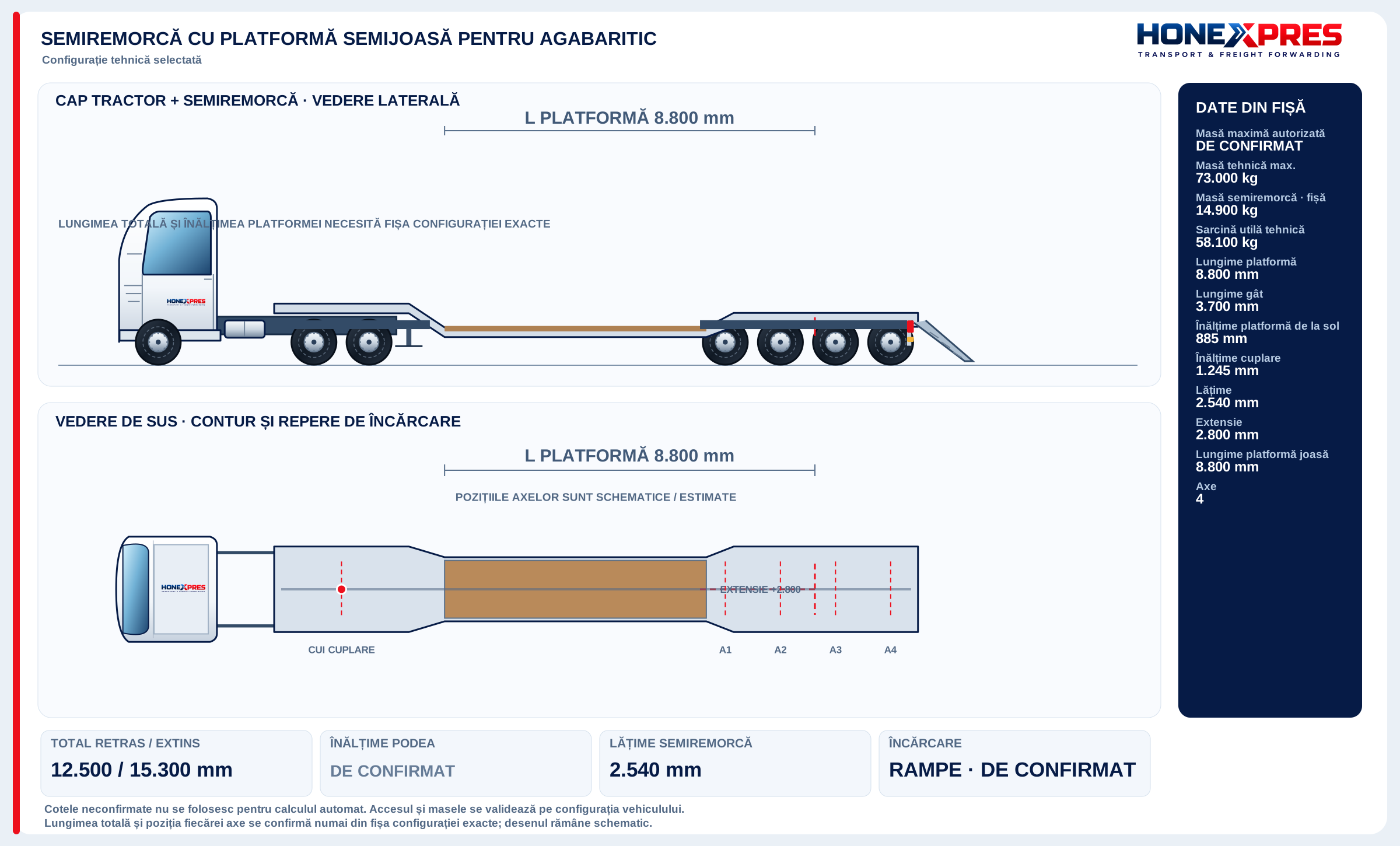
- Platform length
- 8,800 mm Constructive dimension
- External width
- 2,540 mm Constructive dimension
- Loading height
- 885 mm Constructive dimension
- Extension
- 2,800 mm Constructive dimension
- Technical payload
- 58,100 kg Technical payload
Scheme on the geometry of the library, without a drawn load. The technical payload is not the legal mass limit on the road: the permit and the route decide what can actually be carried.
Typical situations
Typical situations in oversized transport
Generic examples, to help you recognise your own situation more easily. They do not describe specific customers or projects: each transport is assessed on its own data.
- An excavator moved between two construction sites — With the boom folded, the machine exceeds the permitted height on a standard flatbed. On a semi-low loader it often fits within the limits or close to them; we check the site access and the ramps.
- Industrial equipment delivered for installation — A press or a transformer leaves the factory on a low bed, with a crane at loading and at unloading. The delivery date is tied to the installation team’s schedule.
- Long beams and structures for construction — Trusses, poles or beams longer than the standard flatbed travel on an extendable flatbed, with a permit for the length and movement within the permitted time windows.
- Agricultural machinery bought in another country — A combine harvester or a tractor with implements crosses several countries: permits in each transit country, and removing the header can reduce the width.
- Tanks, silos or modules — The cargo is light, but very wide or tall. The problem is not the weight but the route: underpasses, bridges, power lines and roundabouts.
- A very heavy indivisible item — The weight requires a vehicle with more axles and a route survey; on some sections an escort and police accompaniment may be needed.
Models of the library for these situations
Machinery
Machinery and equipment that exceed the permitted dimensions
Combine harvesters, large excavators or tractors with mounted implements often exceed the permitted width or height. For machinery we have a dedicated page: how it is loaded (ramp, crane, from the side, from above), what data we ask for (lifting points, operational or non-operational) and which vehicles are used.
Configurations compared
The published dimensions of the library's configurations that have data. A row appears only if at least two configurations publish it.
| Parameter | 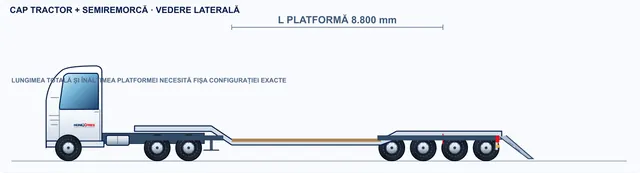 Semi low-loader trailer for oversize cargo | 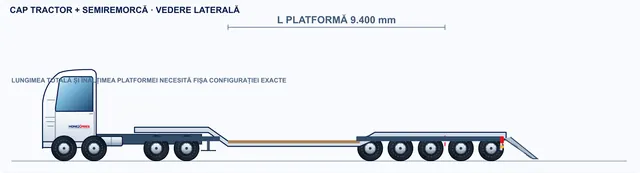 Oversize semi low-loader trailer | 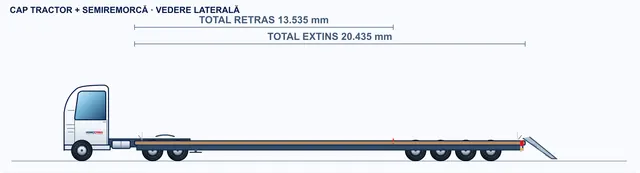 Extendable platform semi-trailer |
|---|---|---|---|
| Platform length | 8,800 mm | 9,400 mm | — |
| Gooseneck length | 3,700 mm | 3,700 mm | — |
| Extension | 2,800 mm | 3,000 mm | 6,900 mm |
| External width | 2,540 mm | 2,740 mm | 2,550 mm |
| Loading height | 885 mm | 850 mm | — |
| Coupling height | 1,245 mm | 1,250 mm | — |
| Technical gross mass | 73,000 kg | 85,000 kg | — |
| Technical payload | 58,100 kg | 67,336 kg | — |
| Number of axles | 4 | 5 | 4 |
3 configurations compared. Manufacturer values, not verified at the source; the exact configuration is confirmed from its sheet before the quote.
Vehicles
Vehicles used
The vehicles belong to the specialised carriers we work with; we choose the type according to the cargo, the dimensions and the weight.
- Flatbed — Items within the permitted dimensions or slightly above them, loaded from above or from the side.
- Semi-low loader — A lowered deck for tall machinery and equipment.
- Low bed — The lowest loading surface, for very heavy and very tall goods; only with a route survey.
- Extendable flatbed — It extends for beams, poles, pipes and long structures.
Loading and unloading
Top, side or ramp loading: cranes and special equipment
The loading method determines the vehicle as much as the dimensions do. We set it before quoting, together with who provides the lifting equipment at each end of the trip.
-
From above
Top loading
With a mobile crane or the overhead crane in the hall, onto an open platform. Lifting is done only at the lifting points, according to the lifting plan.
-
Side
Side loading
With a forklift or a crane, from the side, when there is no room behind the vehicle or the cargo has its gripping points along its length.
-
Ramps
Via ramps
Self-propelled machines drive up the ramps of a semi-low loader or a low bed on their own; those that do not start are pulled up with a winch.
-
Equipment
Cranes and special equipment
Mobile cranes, truck-mounted cranes, winches, rollers or hydraulic skates for moving loads inside the hall. If they are missing at one end, we check whether we can arrange them separately.
Securing is done by the carrier, with chains or straps, at the designated points. After loading, the final dimensions are measured: they must match those in the permit.
Route check
Checking the route before the permit
An oversized transport does not take the shortest road, but the one it fits on. Before the permit application, the route is checked on the map and, for very large cargo, on the ground, through a route survey.
- Clearance height under underpasses, bridges, gantries and power lines
- The load capacity of bridges and culverts for the weight and the axle load
- Turning radii at roundabouts, junctions and in built-up areas
- Roadworks, temporary restrictions and diversions
- Access to the loading and unloading site: gate, site road, terrain
- Parking places along the route, for the periods when travel is not permitted
When an obstacle cannot be avoided, the route survey may propose temporarily removing some signs or guardrails, with the consent of the road administrator.
Local authorisation
Oversized transport from Oradea and the county-seat cities
The CNAIR permit does not cover the national roads inside county-seat municipalities; there, a separate authorisation from the local authority is needed. If loading or unloading takes place in Oradea or in another such city, we take it into account when planning.
International
International oversized transport
For transports leaving or entering Romania, each transit country issues permits under its own rules, with different lead times. The sooner you send us the data, the more scheduling options we have. By sea, oversized items travel on flat rack containers.
Step by step
How we organise an oversized transport, step by step
- Step 1
Technical data and photos
You send us the dimensions to two decimal places, the weight, the number of items, the lifting points, photos or drawings and the loading and unloading sites.
- Step 2
Cargo assessment
We check whether the cargo is indivisible, whether dismantling brings it within the permitted dimensions and which vehicle keeps it as low and as narrow as possible.
- Step 3
Route check
We choose the route it fits on: underpasses, bridges, roundabouts, roadworks, access. For very large cargo, a route survey is carried out on the ground.
- Step 4
Quotation
You receive the quote with the vehicle, the proposed route, the permits and escort required and who provides loading and unloading.
- Step 5
Permits and escort
AST, escort and coordination where needed: the carrier, as the holder, files the applications (AST via eAST in Romania, the permits of the transit countries and the local ones), and the escort is scheduled.
- Step 6
Loading and securing
The cargo is lifted at the designated points or driven up ramps, then secured, and the final dimensions are checked against the permit.
- Step 7
Monitoring the transport
We follow the transport, stay in contact with the carrier and handle situations that arise on the road; we keep you informed at every important stage.
- Step 8
Delivery and unloading
The convoy travels only within the time windows and on the route set in the permit. At the destination, the cargo is unloaded at the designated points, with the equipment agreed in the quote.
- Step 9
Confirmation and final documents
We confirm the delivery and send the transport documents (CMR and related papers) to close the order.
What we need for a quote
Information needed for an oversized transport quote
The exact data determines the vehicle, the permits and the route. If you do not have drawings, photos from several angles help us a lot.
- The length, width and height of the item, in metres, to two decimal places
- The weight of each item and the number of items
- Whether the item can be dismantled or split (permits are granted for indivisible goods)
- The type of cargo: self-propelled machine (make and model), industrial item or structure
- The centre of gravity and the lifting and lashing points, if you know them
- How it is loaded and unloaded: crane, forklift, driving up ramps; who provides the equipment
- Access to the loading and unloading sites (national road, county road, city street, construction site)
- Photos from several angles and technical drawings
- The date window in which the transport can take place
Dimensions to two decimal places: see the frequently asked questions.
Permits and documents
Permits and documents
In Romania, the special transport permit (AST) for national roads and motorways is obtained from CNAIR (the Romanian national road infrastructure company), through the eAST portal; county roads and city streets are the responsibility of other authorities. Each transit country has its own permits. The permit holder is the transport operator; the HONEXPRES team coordinates the technical data and the schedule.
- Special transport permit (AST) For national roads and motorways in Romania; the holder is the transport operator; a copy must be on board.
- Permits from the transit countries Each country issues them under its own rules; the lead times differ.
- Local authorisation For city streets and roads inside county-seat municipalities.
- Route survey or route plan When the restrictions along the route are below the dimensions of the transport.
- CMR consignment note and cargo documents As for any road transport.
The information on permits on this page is indicative; the decision rests with the authorities.
Why do exact dimensions matter?
Special transport permits (AST) are issued on the basis of the declared dimensions and weights. That is why we check the technical data with you before the permits are applied for and paid, to avoid delays and extra costs.
Technical detail: the permit is issued for the declared dimensions and weights of the loaded vehicle; if they do not match reality, the transport can be stopped at a check. If the data changes after payment, the applicable procedure in eAST (an amendment or a new application) is settled with CNAIR. That is why we ask for the dimensions to two decimal places and check them together before the application.
Escort and restrictions
Escort and traffic restrictions
-
Escort
Authorised escort
Above certain dimensions or weights, an authorised escort is mandatory and, sometimes, police accompaniment. Escorts are provided only by authorised operators listed by CNAIR.
-
Police
Police accompaniment when needed
Above certain dimensions or in certain areas, the permit may require police accompaniment. The conditions, including the hours and the road sections, are written in the permit.
-
Time windows
Restrictions and travel time windows
Restrictions at weekends, on public holidays, at night or in bad weather, according to the rules of each country and of the permit.
Permits are generally granted only for indivisible goods; whatever can be dismantled must be dismantled. The time needed to obtain permits differs from country to country and from case to case; we do not promise lead times before the applications have been filed.
Costs
How much an oversized transport costs: what affects the price
There is no single rate per kilometre for oversized transport. The price results from the cargo data and the route; you receive a quote calculated for your transport.
-
01
Cargo and vehicle
The dimensions and weight decide the type of vehicle and the number of axles; the type of trailer and any special equipment also count.
-
02
Route and permits
Permit fees in each country and for each type of road; the length of the route and the detours required; route preparation work (for example temporarily removing some obstacles), including route surveys.
-
03
Escort and traffic conditions
The number of escort vehicles and, possibly, the police; the permitted travel time windows and any additional measures required by the permit.
-
04
Operations and timing
Loading and unloading equipment (mobile crane, ramps, winches, with their operators); handling; waiting for the permitted time windows and the empty return of the special vehicle; dismantling and reassembling some components, when this brings the cargo closer to the permitted dimensions.
How much does freight transport cost in 2026? Prices per kilometre and calculation factors
Related services
Oversized, machinery or a standard truck?
If the cargo fits within the permitted dimensions, a standard transport costs less. Choose the right service or first check which vehicle you need.
-
Machinery transport
Agricultural, construction and industrial machinery: ramp, crane, side or top loading.
-
Road freight
All road options, from general cargo to transports with special requirements.
-
Full truckload (FTL)
Heavy cargo, but within the permitted dimensions: a whole truck just for your goods, without special permits.
-
Which vehicle do I need?
Check the dimensions and see which vehicle fits, before you request a quote.
When does a transport become oversized?
When the loaded vehicle exceeds the maximum dimensions or weights permitted on public roads. The reference limits are on the vehicle sheets, for example on the flatbed sheet. If you are not sure, send us the dimensions and the weight: we will check.
How much does oversized transport cost per km?
There is no single rate per kilometre for oversized transport. The price results from the dimensions and weight, which determine the vehicle and the number of axles, from the permit fees, the escort, the length of the route and the detours required, the loading and unloading equipment and the empty return of the special vehicle. You receive a quote calculated for your transport; see what affects the price.
What permits are needed for an oversized transport?
In Romania, the special transport permit (AST) for national roads and motorways is obtained from CNAIR, through the eAST portal; county roads and city streets are the responsibility of other authorities, and in county-seat municipalities a local authorisation is needed. Each transit country has its own permits. The permit holder is the transport operator; the HONEXPRES team coordinates the technical data and the schedule.
Do I need an escort?
It depends on the width, length, height and weight and on the rules of each country. Above certain dimensions or weights, an authorised escort is mandatory and, sometimes, police accompaniment; the conditions are written in the permit. We establish this together with the carrier, based on your data; escorts are provided only by authorised operators listed by CNAIR.
Do you organise international oversized transport?
Yes. For transports leaving or entering Romania, each transit country issues permits under its own rules, with different lead times; the sooner you send us the data, the more scheduling options we have. By sea, oversized items travel on flat rack containers: see sea freight.
Are you an oversized transport company?
We organise oversized transport with specialised carriers: the vehicles are theirs, and the transport operator is the permit holder. The HONEXPRES team chooses the vehicle, checks the route and coordinates the permits, the escort and the schedule, until unloading. See also how we choose carriers.
Why do you ask for the dimensions to two decimal places?
Because the permit is issued for the declared dimensions and weights. A difference of a few centimetres can mean a different category, a different route or the transport being stopped at a check. In eAST the permit can no longer be changed after payment, and after loading the final dimensions must match those in the permit.
Can oversized transport be avoided?
Sometimes, yes: by dismantling some components or by using a vehicle with a lower deck that keeps the overall height within the limits. We look at the options before applying for permits. If the cargo fits within the permitted dimensions, it travels on a standard truck, for example as a full truckload (FTL), without special permits.
Guides
Useful guides and articles
Guides on oversized cargo: preparing the transport, technical conditions, costs.
-
Oversized freight transport: a guide to shipping oversized goods
Shipping or transporting oversized goods can be more difficult than shipping standard goods.
-
Technical requirements for oversized freight transport
Oversized goods: technical requirements you need to take into account
-
How much does freight transport cost in 2026? Prices per kilometre and calculation factors
How much does freight transport cost in 2026? It is one of the first questions asked by companies that need to deliver pallets, equipment…
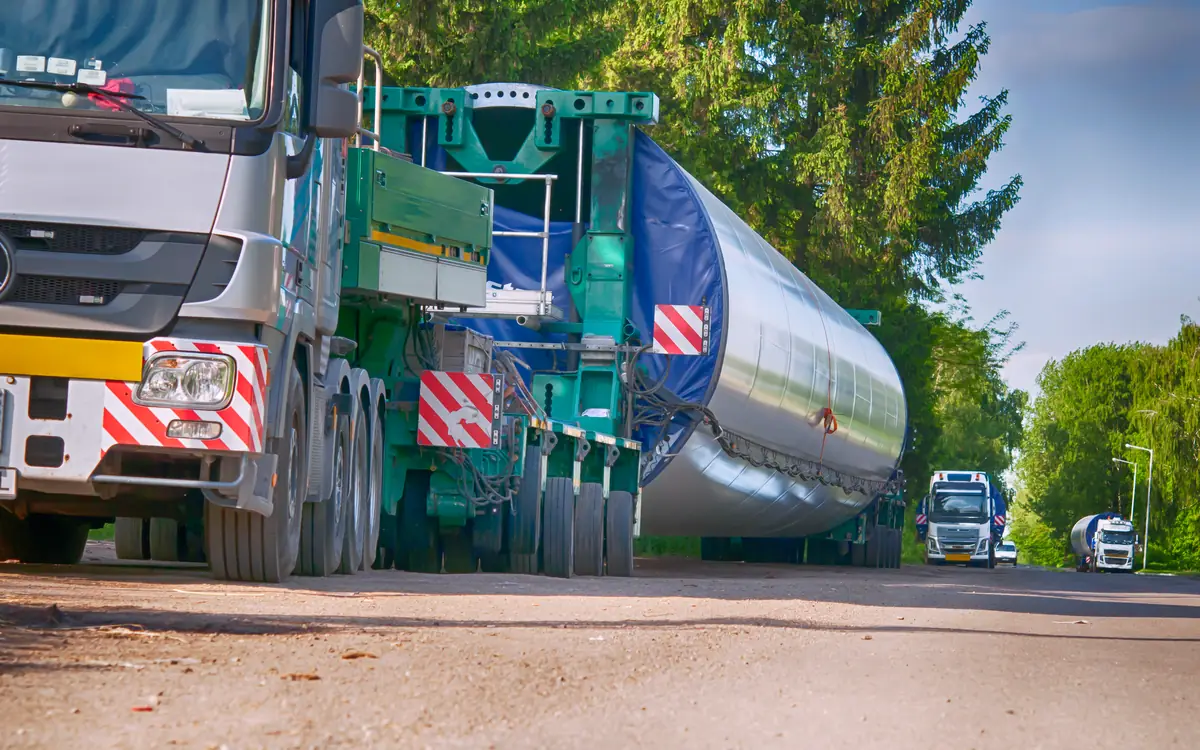
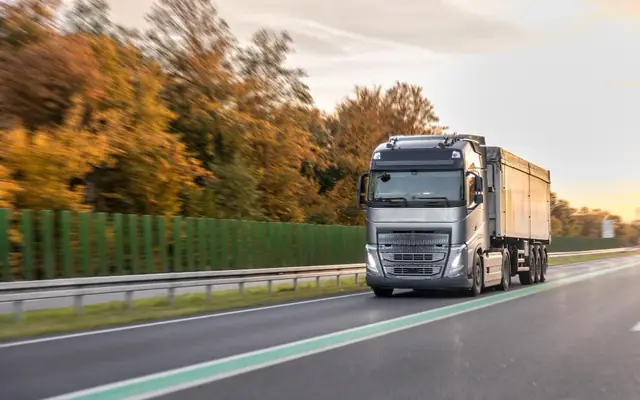
Suitable vehicles
-
Semi low-loader
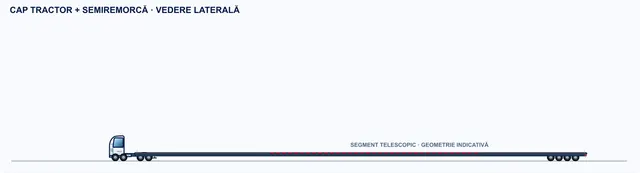
~9 m low deck (UNVERIFIED) · 2.55 m (can be widened to ~3.2 m, with an AST permit)
Indicative Sketch: Semi low-loader trailer for oversize cargo
-
Low-bed / low loader
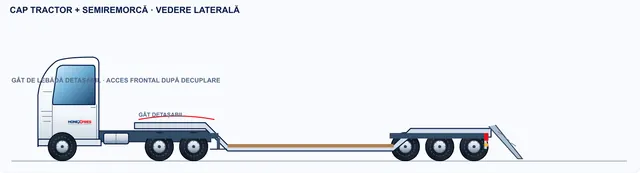
well of 6–14 m, depending on the configuration · 2.55 m (can be widened, with an AST permit) · on request (as a rule with an AST permit)
Visual only Sketch: Extendable low-bed semi-trailer
-
Extendable flatbed (telescopic)
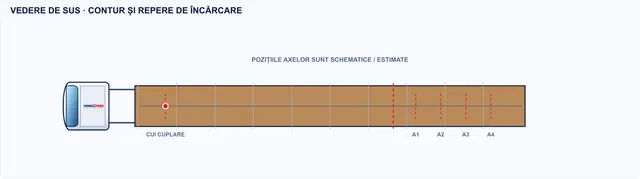
13.6 m closed → ~30 m extended · ~2.5 m
Indicative Sketch: Extendable platform semi-trailer
-
Flatbed semi-trailer 13.6 m
Sketch missing The library has no sketch for this type yet; we do not use another vehicle's drawing.~13.6 m · ~2.5 m · 33 EUR pallets · 24 t
Suitable containers
-
40' Flat Rack
~11.7 m (between the corner posts) · ~2.2 m (between the posts) · ~2.2 m (end walls; ~2.4 m on HC) · n/a · not relevant (OOG cargo) · ~21 t on the road (40 t)
-
20' Flat Rack
~5.6 m (between the corner posts) · ~2.2 m (between the posts) · ~2.2 m (height of the end walls) · n/a (no side walls or roof) · not relevant (OOG cargo) · ~25 t on the road (40 t)
Practical reference values. We confirm the exact dimensions in the quote. Honexpres organises transport with this vehicle, on request.
Quote request
Do you have oversized cargo?
Send the dimensions to two decimal places, the weight and the loading and unloading sites. The HONEXPRES team checks the vehicle, the permits and the route and comes back to you with a quote.
Automatic translation, automatically checked. This page was translated automatically from Romanian and passed the automatic checks for language, terminology, figures and links. If there is any difference, the Romanian version prevails. How we use automatic translation