Sea freight · Guides
The Largest Port in Europe: the Port of Rotterdam and What It Means for Your Cargo
AI Text written with AI assistance and checked by the editorial team. How we work with AI
Article translated automatically from Romanian and checked automatically. If there is any difference, the original prevails. See the original in Romanian · How we use automatic translation
In short
Rotterdam is currently considered the largest port in Europe by cargo volume. Antwerp-Bruges, Hamburg and Valencia complete the ranking. For shippers in Romania, Rotterdam is an alternative to Constanța. The choice depends on the route, transhipments, vessel frequency, inland transport and the place of customs clearance.
Contents
- Which is the largest port in Europe?
- How the size of a port is measured: tonnes, TEU or surface area
- The largest ports in Europe: a qualitative comparison
- The Port of Rotterdam: why it matters so much
- Port of Rotterdam container: the journey of a container through the terminal
- Rotterdam or Constanța? What it means for shippers in Romania
- Factors that change cost and transit time
- Customs: what happens when goods enter the EU through Rotterdam
- Clearance in the port or transit to Romania
- The house bill of lading and the data for the entry summary declaration
- Dangerous goods in containers through European ports
- What to prepare before requesting a quote via Rotterdam or Constanța
- Frequently asked questions
- Which is the largest port in Europe?
- Which are the largest European ports after Rotterdam?
- Why do port rankings differ from one source to another?
- Is it worth bringing a container into Romania through Rotterdam instead of Constanța?
- Where does customs clearance take place if the goods enter the EU through Rotterdam?
- Request a quote for your container
- Official sources consulted
If you ask anyone in logistics which is the largest port in Europe, the answer comes almost automatically: Rotterdam. The Dutch port is consistently cited in first place in Europe by total cargo volume handled. Antwerp and Hamburg are mentioned immediately after it. For a shipper in Romania, the useful question is not just "which is the largest". What matters most is what this means for a container leaving Asia or America that has to reach Cluj, Arad or Bucharest. In this guide we explain how the ports compare, why rankings differ from one source to another, how a container moves through Rotterdam and how this route compares with Constanța.
Which is the largest port in Europe?
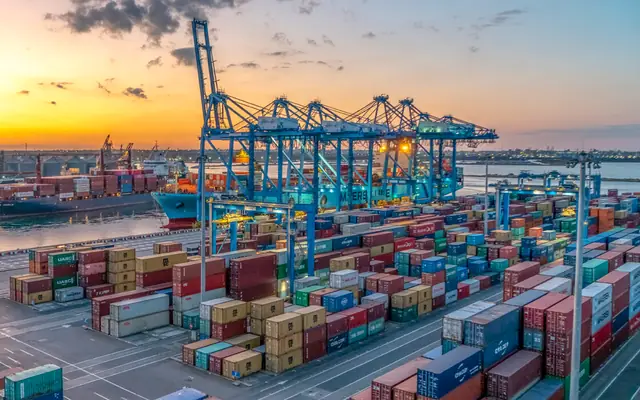
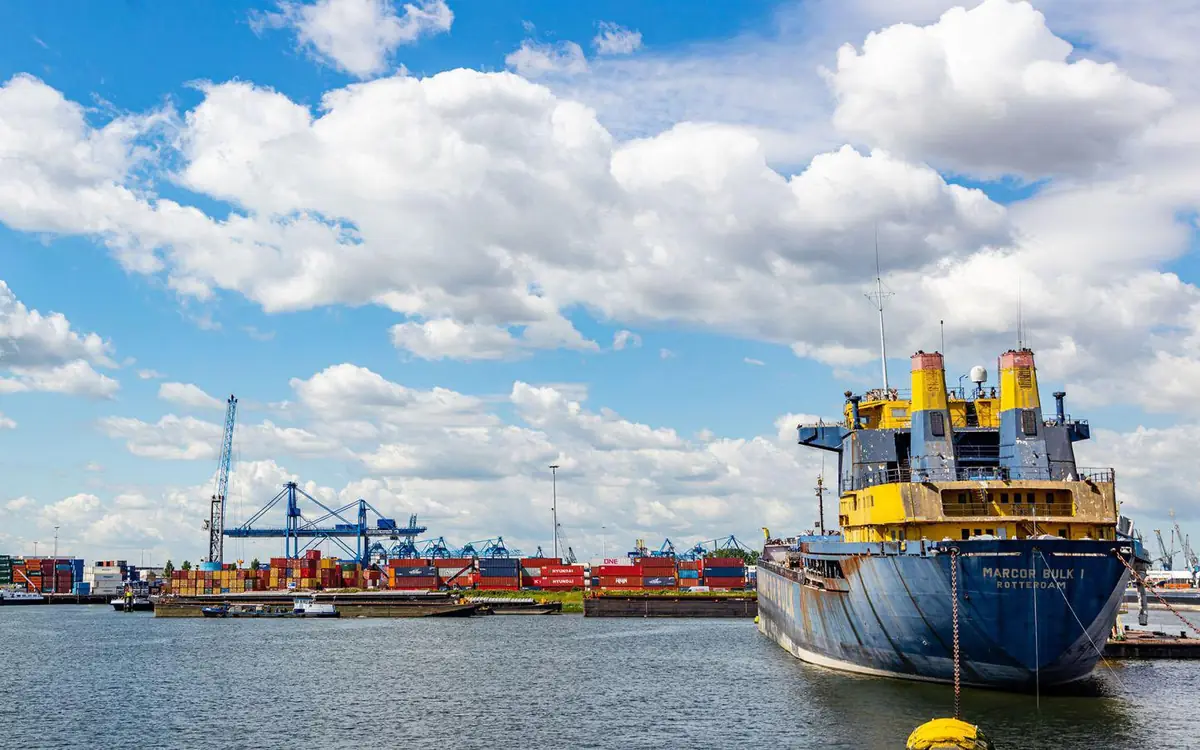
The Port of Rotterdam is generally considered the largest port in Europe. The main criterion is the total quantity of goods loaded and unloaded in a year: liquid bulk, dry bulk, containers and general cargo. It is a seaport with direct access to the North Sea. Behind it lies the Rhine delta, and therefore a natural link to the interior of Europe by river, rail and road.
One detail matters: "the largest" depends on what you measure. A port may lead in total tonnage thanks to oil and bulk. Another may be very close behind in containers. Another may have the largest surface area or the strongest growth in a given year. When you see a ranking, check three things:
- the indicator used: total tonnes, number of containers or value of goods;
- the reference year: rankings change from year to year, especially for containers;
- the source: the official statistics published by port authorities and by Eurostat are the right benchmark, not lists copied from article to article.
That is why we do not give traffic figures in this article. You will find the updated annual volumes in the reports of the Port of Rotterdam Authority and in Eurostat's maritime transport statistics. They are worth consulting directly, especially if you need them for an analysis or a presentation.
How the size of a port is measured: tonnes, TEU or surface area
A ranking of ports is not drawn up by the land area occupied. It is drawn up by the cargo that actually passes through the port in a year. For containerised transport, the standard unit of measurement is the TEU, that is the twenty foot equivalent unit: the equivalent of a 20-foot container [1]. By convention, a 40-foot container counts as two TEU and a 20-foot container as one TEU. This is how ports with a different mix of containers are compared.
For ports with a lot of bulk (crude oil, petroleum products, coal, ore, grain), the relevant indicator remains tonnage. For this reason, a port can appear in different positions in two rankings published in the same year. This is not a contradiction, but a difference of method.
If you want to understand what a 20' or 40' container means in practice, you will find them described by type on our page about sea containers 20, 40, high cube and reefer.
The largest ports in Europe: a qualitative comparison
The list below is not a numbered ranking. It groups the ports that usually appear in the rankings of the largest European ports and describes the role of each. The exact order differs by year and by indicator, so it must be checked with the official sources.
| Port | Country | Sea range | Profile useful for shippers |
|---|---|---|---|
| Rotterdam | The Netherlands | North Sea | Universal port (bulk, containers, ro-ro), with river, rail and road links to Germany and Central Europe |
| Antwerp | Belgium | North Sea | Containers, general cargo; the current traffic profile should be checked with the port authority |
| Hamburg | Germany | North Sea | Containers |
| Bremerhaven | Germany | to be checked with official sources | The traffic profile should be checked with the port authority |
| Le Havre | France | to be checked with official sources | The traffic profile should be checked with the port authority |
| Valencia | Spain | to be checked with official sources | The traffic profile should be checked with the port authority |
| Algeciras | Spain | to be checked with official sources | The traffic profile should be checked with the port authority |
| Piraeus | Greece | to be checked with official sources | The traffic profile should be checked with the port authority |
For cargo arriving in Romania, the ports of northern Europe, Rotterdam included, are usually entry points followed by a long overland journey. For what it means to move a container from one vessel to another, read our guide on transhipment of goods.
The Port of Rotterdam: why it matters so much
The name of the city comes from a dam built on the river Rotte. Over the centuries Rotterdam grew from a fishing settlement into a centre of trade, industry and distribution. The city and the port were heavily destroyed in the Second World War and rebuilt after the war. Today's Rotterdam is largely a modern city and port, built after this reconstruction.
For a shipper, the history matters less than three practical characteristics:
- Direct sea access to the North Sea.
- Extensive hinterland. Containers continue by barge on the Rhine, by train or by truck to Germany, Central Europe and, further on, Eastern Europe.
- All types of cargo: liquid and dry bulk, containers, ro-ro and general cargo (breakbulk). The same port area can therefore handle very diverse cargo.
Port of Rotterdam container: the journey of a container through the terminal
A container discharged at Rotterdam goes through the same stages as in any large terminal. It is discharged from the vessel and temporarily stored in the terminal. It then goes through the customs and release formalities and is handed over to the inland carrier: truck, train or barge. The operational details are explained in our article on operations in a container terminal.
The invoice for a shipment through the port almost always includes a terminal handling fee, known in practice as THC (terminal handling charge) [1]. Its amount depends on the terminal, the shipping line and the type of container. We treat it as a cost factor, not as a fixed value.
To collect the container from the terminal and transport it by road, we arrange runs with partner carriers using container chassis. You will find details on the page about container transport from port and terminal.
Rotterdam or Constanța? What it means for shippers in Romania
For Romanian imports and exports, the reference port usually remains Constanța. It is our port on the Black Sea, and we present its role in Europe separately in the article on the Port of Constanța. Rotterdam becomes a serious option in certain situations:
- the cargo comes from ocean routes that call directly in northern Europe, while a call at Constanța would involve additional transhipments;
- the consignee or the supplier is in western or central Europe anyway, and Romania is only one part of the distribution;
- the aim is to consolidate several European deliveries into a single flow, with subsequent road distribution;
- the frequency of departures or the availability of equipment at a given time favours northern Europe.
There is also an inland navigable link between the North Sea and the Black Sea, via the Rhine, the Main and the Danube. For regular container transport to Romania, however, the practical choice is between the sea route with discharge at Constanța and the route through northern Europe followed by truck or train.
Factors that change cost and transit time
We do not give prices, because they change often and depend on each shipment. What does matter are the factors that make the difference between a route through Rotterdam and one through Constanța:
- Sea freight on the chosen route and the number of transhipments up to the port of discharge.
- Terminal charges (THC) and other port charges at both ends.
- The overland leg. The difference in distance between Rotterdam and the place of delivery in Romania, compared with Constanța and the same place, is paid for in road or rail transport.
- Free time for the container in the terminal and at the consignee. Exceeding it generates waiting-time charges.
- Type of container: 20', 40', high cube, reefer, open top or flat rack, plus the weight of the cargo.
- Place of customs clearance: in the port of entry or at a customs office in Romania, with the goods in transit.
- Delivery deadline and how flexible the customer is about the arrival date.
How an ocean freight quote is built in practice, with FCL or LCL, is explained on the page about sea freight for FCL/LCL containers.
Customs: what happens when goods enter the EU through Rotterdam
From a customs point of view, Rotterdam is a "Union port". Customs legislation defines as such any seaport located in the customs territory of the Union [2]. For goods from outside the EU, the first contact with European customs takes place at the customs office of first entry. This is the office competent for customs supervision at the place where the means of transport arrives in the customs territory of the Union [2]. If the goods arrive by sea at Rotterdam, this office is in the Netherlands, not in Romania.
Clearance in the port or transit to Romania
There are two basic options. The first: the goods are released for free circulation in the Netherlands itself and then travel to Romania as Union goods. The second: the goods are placed under a transit procedure and cleared in Romania. In this case, the customs office of departure is the one where the declaration for placing under the transit procedure is accepted [2]. The customs office of destination is the one where the goods are presented in order to end the procedure [2]. You will find the step-by-step procedure in the guide on external Community transit T1.
For transport by sea there is also a simplification relating to sealing. Means of transport and packages are not sealed if the electronic transport document, used as the declaration for placing under Union transit, contains a reference to the accompanying bill of lading. The exception is where the customs office of departure decides otherwise [3]. The simplification does not apply automatically to every shipment. Check with the competent customs office or with the customs broker whether it is available in your case.
The house bill of lading and the data for the entry summary declaration
In maritime container transport, two levels of documents often appear: the bill of lading issued by the shipping line and the one issued by the freight forwarder. EU customs legislation reflects this structure. The data of the declarations may be provided at the level of the master consignment (master consignment) and at the level of the house consignment (house consignment) [4]. We explain the practical difference in the article House Bill of Lading versus Master Bill of Lading.
There may also be additional contracts of carriage, covered by bills of lading issued by persons other than the carrier. If the person issuing the bill of lading does not make the data required for the entry summary declaration available to its contractual partner, it must provide them directly to the customs office of first entry [5]. The obligation applies from the date set for version 3 of the electronic system, according to the annex to Implementing Decision (EU) 2019/2151 [6]. From the same date, the carrier and any issuer of a bill of lading include in the declaration data information on the identity of the contractual partner that has not provided them with the required data [6].
In short, the information about the cargo must be complete and correct even before the vessel arrives in Europe. The exact application calendar must be checked with the competent customs authority. We organise import, export and transit formalities through the customs services we work with.
Dangerous goods in containers through European ports
If the cargo is dangerous goods, the route through Rotterdam or through Constanța involves additional rules. At sea, the rules specific to maritime transport apply, and for the road leg ADR applies. For multimodal portable tanks that correspond to the definition of "container", ADR also refers to the International Convention for Safe Containers (CSC) of 1972, as subsequently amended [7]. When the cargo is collected from the port by truck, the ADR rules on handling and stowage also apply to the loading and securing of containers, tank-containers and portable tanks on vehicles [8]. The classification of the goods, the documents and the labelling must be clarified before booking on the vessel, not on arrival in port.
What to prepare before requesting a quote via Rotterdam or Constanța
- the port or city of loading and the exact delivery address in Romania (or the reverse, for export);
- the type and number of containers or, for groupage, the number of packages, their dimensions and weight;
- the nature of the goods, the tariff code if you have it and whether the goods are dangerous or require controlled temperature;
- the Incoterms delivery condition agreed with your partner;
- where you want customs clearance: in the port of entry or in Romania;
- the date on which the goods are ready and the deadline by which they must arrive.
With these details we can compare, with partner carriers, a route through northern Europe with one through Constanța. The comparison takes into account costs, transit time and the risk of delays.
Frequently asked questions
Which is the largest port in Europe?
The Port of Rotterdam in the Netherlands is currently considered the largest port in Europe by total cargo volume. For up-to-date figures, consult the statistics published by the Port of Rotterdam Authority and by Eurostat.
Which are the largest European ports after Rotterdam?
The rankings usually include Antwerp, Hamburg, Bremerhaven, Valencia, Algeciras, Piraeus and Le Havre. The order differs depending on the year and on the indicator, tonnes or containers. There is no single ranking valid for all indicators.
Why do port rankings differ from one source to another?
Some rankings use total tonnage, others the number of containers expressed in TEU, that is the equivalent of a 20-foot container [1]. The reference year also differs. A port that is strong in bulk may rank lower in the container ranking and vice versa.
Is it worth bringing a container into Romania through Rotterdam instead of Constanța?
It depends on the vessel's route, the number of transhipments, the place of delivery and the deadline. It is compared case by case.
Where does customs clearance take place if the goods enter the EU through Rotterdam?
The first entry control takes place at the customs office of first entry at the place of arrival in the customs territory of the Union [2]. The goods may be released for free circulation there or may travel under a transit procedure to a customs office of destination in Romania [2].
Request a quote for your container
Do you have cargo passing through Rotterdam, Constanța or another European port? Send us the ports, the type of container and the deadline you want. We arrange the sea leg, the collection from the port and the overland transport to the destination with partner carriers, and we coordinate the customs formalities through our collaborators. Fill in the quote request form and we will come back to you with the route options and the factors that influence the cost.
Official sources consulted
- [1] FIATA – Code of Abbreviations, Part 1 (Terms and Abbreviations), entry TEU
- [2] Delegated Regulation (EU) 2015/2446, Article 1, point 8
- [3] Implementing Regulation (EU) 2015/2447, Article 302, paragraph (2), point (c)
- [4] Implementing Regulation (EU) 2015/2447, Annex B, introductory notes, point 6
- [5] Delegated Regulation (EU) 2015/2446, Article 112, paragraph (1)
- [6] Implementing Regulation (EU) 2015/2447, Article 184, paragraph (1)
- [7] ADR 2025 (ECE/TRANS/352, vol. II), 6.7.1.1
- [8] ADR 2025 (ECE/TRANS/352, vol. II, French version), 7.5.7.4
Have something similar to move? Request a quote →
All guides in Sea freight (18)
Related services