Guides
Transporting a wind turbine blade: how to plan an exceptional transport of blades
AI Text written with AI assistance and checked by the editorial team. How we work with AI
Article translated automatically from Romanian and checked automatically. If there is any difference, the original prevails. See the original in Romanian · How we use automatic translation
In short
A wind turbine blade is a long, fragile and indivisible load. Transporting it requires a suitable trailer, a route survey, a special permit for each country crossed, signage, often an escort and a loading plan. HONEXPRES organises it with specialised partner carriers.
Contents
- Why a wind turbine blade is a special load
- Trailers: extendable, with adapter and blade lifters
- The route survey comes before the permit
- Permits: in Romania and in other countries
- The special transport permit (AST) in Romania
- Declared dimensions and checks
- Italy and the transit countries
- Signage and escort
- Loading, securing and protection
- Project planning: several blades, several convoys
- What the cost depends on
- Frequently asked questions
- Is a wind turbine blade always an exceptional transport?
- Who issues the permit in Romania for very long convoys?
- Can the truck be changed after the permit has been obtained?
- When is a blade lifter necessary?
- What data is needed for a quotation?
- We organise your wind turbine blade transport
- Official sources consulted
Transporting a wind turbine blade is by definition an exceptional transport: the piece is very long, light in relation to its size, delicate on the surface and cannot be divided. To move it by road you need a trailer suited to the geometry of the blade, a route survey carried out before the permits are requested, a special permit for each country crossed, the required signage and, very often, an escort. HONEXPRES, a freight forwarder based in Oradea, does not own a fleet: we organise these transports with specialised partner carriers and coordinate the planning, the documents and the communication between the parties.
This guide does not repeat the general rules on oversized loads, already covered in our guide to the exceptional transport of goods: it concentrates on what makes the transport of wind turbine blades different and on how you can prepare a project that reaches the site without surprises.
Why a wind turbine blade is a special load
Three characteristics shape every choice:
- Length: this is the critical dimension. It determines the type of trailer, the turning radii that can be negotiated, the authority that issues the permit and the mandatory signage.
- Fragility: supports and straps are positioned only at the points indicated by the manufacturer. The leading edge, the trailing edge and the tip must be protected throughout the journey.
- Indivisibility: the blade cannot be dismantled to fit within the usual limits.
The Romanian rules on vehicles with excess weights and/or dimensions define an indivisible load as one which, for the purposes of road transport, cannot be divided into two or more loads without unnecessary cost or risk of damage and which, because of its dimensions or weight, cannot be carried by a vehicle complying with the maximum permitted weights and/or dimensions [1]. How this definition applies to a particular blade, and the consequences for the permit procedure, must be checked with the competent road administrator and against the text in force.
Trailers: extendable, with adapter and blade lifters
The choice of vehicle depends on the blade and the route, not on the carrier's habits. In practice three solutions are considered:
- Extendable trailer: the blade rests on dedicated supports and the platform extends to the required length. The characteristics and use are described in the page on the extendable platform.
- Trailer with root adapter: the blade is fixed at the root by an adapter and supported towards the tip; this configuration changes the way the convoy negotiates bends.
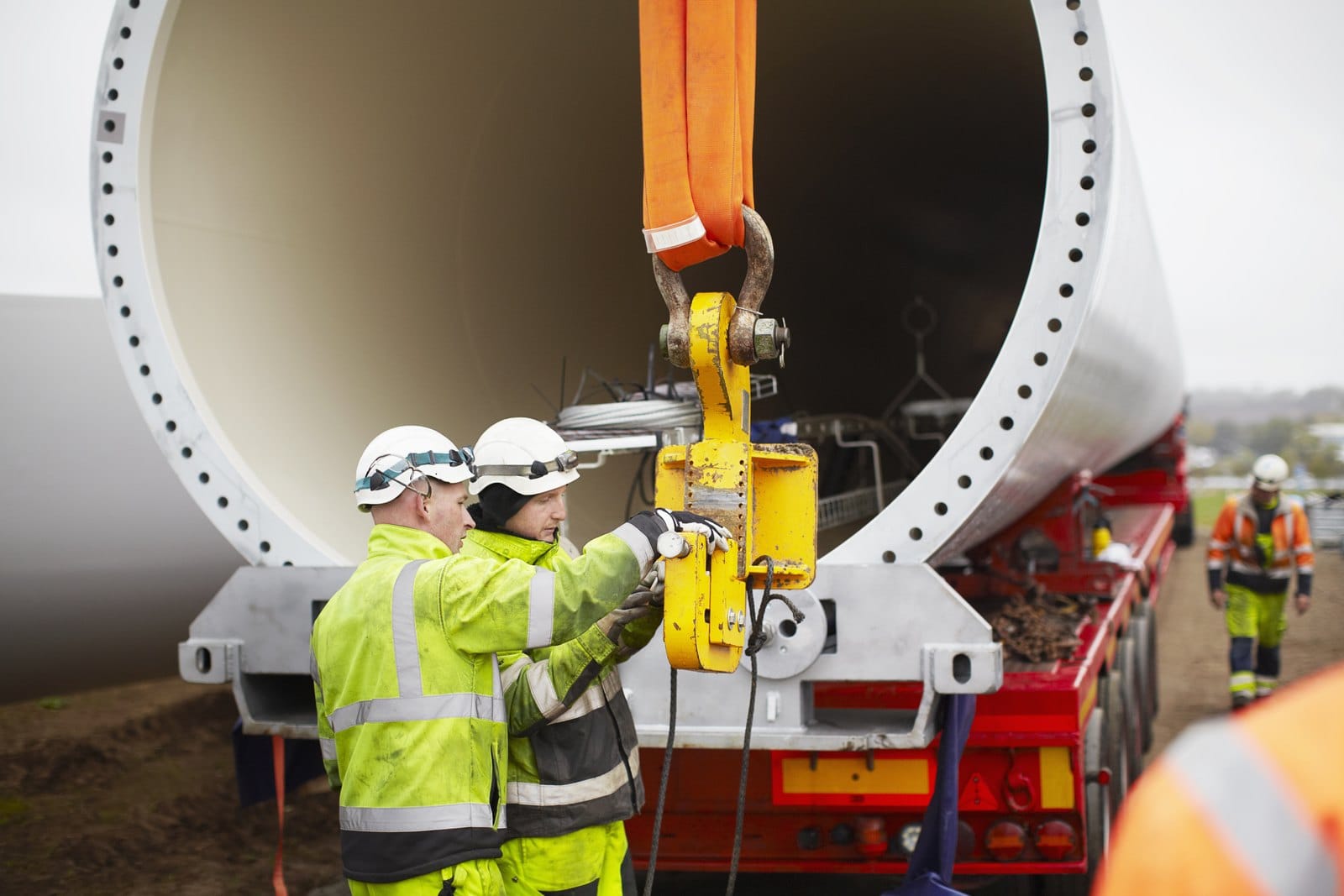
- Blade lifter: a device that raises and tilts the blade to get past tight bends, side obstacles or mountain sections that a horizontal blade could not pass.
A project often combines different solutions: an extendable trailer on the main network and a transfer to a blade lifter in a transfer area close to the site. Every change of vehicle must be planned in advance, because it affects the permits, as explained below. The general technical conditions for vehicles carrying oversized loads are summarised in our article on the technical conditions for exceptional transport.
The route survey comes before the permit
For a wind turbine blade, the route is not chosen with a satnav. The feasibility study, with a field survey of the critical points, must check at least:
- roundabouts, junctions and tight bends, with the rear overhang of the blade sweeping areas outside the carriageway;
- vertical signs, barriers, posts, trees and traffic dividers that have to be temporarily removed or bypassed;
- bridges, overpasses and tunnels, for clearance height and load-bearing capacity;
- gradients and hairpin bends on the final access to the site, where a blade lifter may become necessary;
- waiting areas long enough for the convoy and for the escort vehicles.
For the general criteria for choosing a road route, see our short guide to choosing a route. In the case of blades, the result of the field survey becomes the technical basis of the permit application.
Permits: in Romania and in other countries
The special transport permit (AST) in Romania
In Romania, the movement of vehicles exceeding the maximum permitted weights and/or dimensions on the public road network is governed by the rules approved by Order No 1.236/6.509/126/2018 [1]. The key document is the special transport permit (AST), by which the road administrator sets the route, the traffic conditions and the charges due [1]. The AST is valid for the registration numbers of the vehicles, the technical characteristics, the route, the direction of travel, the period and the conditions imposed [1].
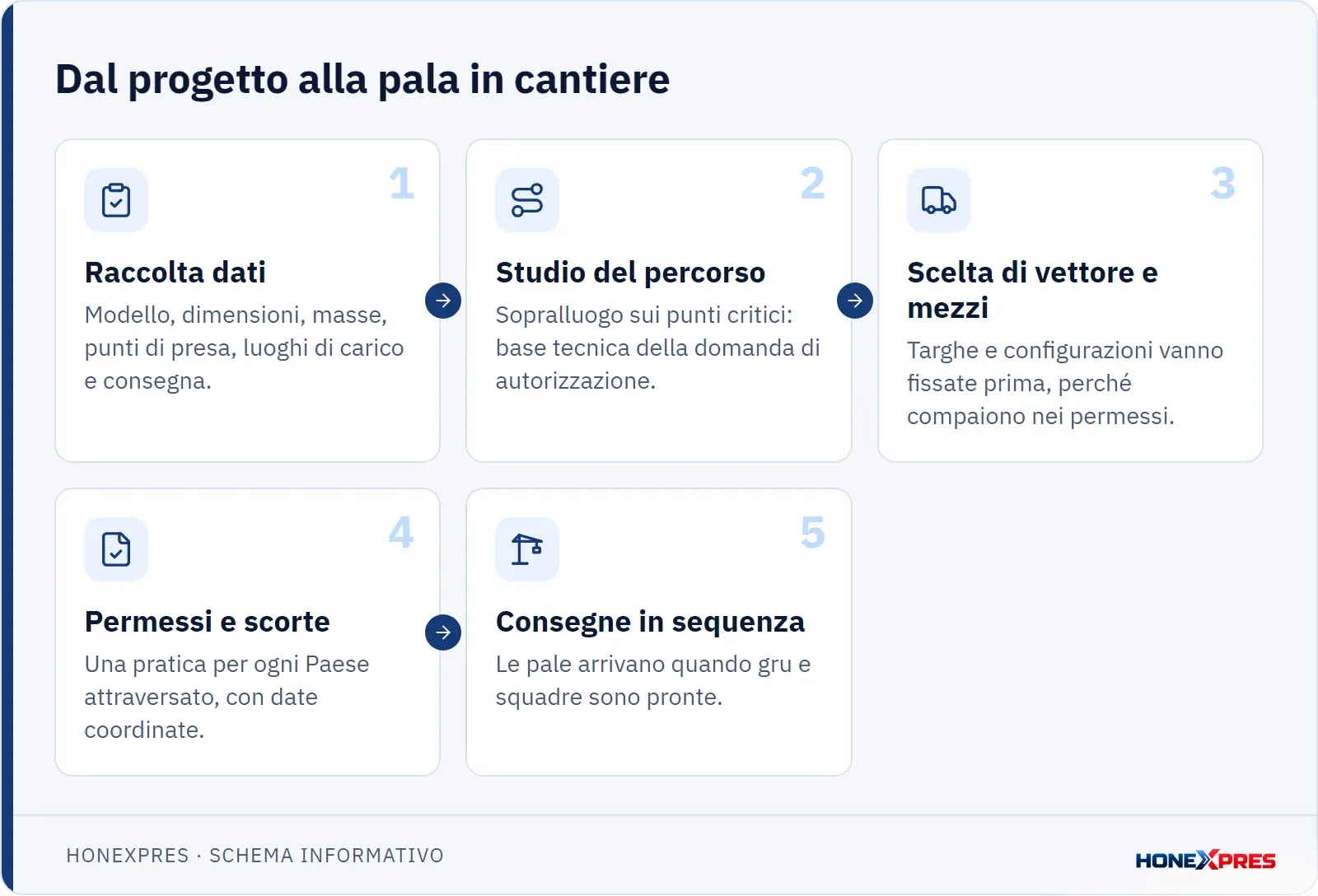
Practical consequence: if the tractor unit, the trailer or the route changes midway through the project, the permit already issued does not automatically cover the new situation. For this reason the carrier, the vehicles and the route must be established before the application.
The authority competent to issue the permit depends on the dimensions. Annex 1 to the same rules sets the competence limits of the CNAIR subunits: for length, 25 m for ACI and SDN and 40 m for DRDP, while CNAIR may authorise any value of weights and dimensions [2]. Above the competence limit of the ACI, it may issue an AST only on the basis of the opinion of the DRDP or, as the case may be, of CNAIR [2]. Which entity is competent for a given convoy depends on its actual dimensions and must be checked with the road administrator.
Declared dimensions and checks
The dimensions of the convoy must be exact. For ASTs issued on request, no tolerances apply when calculating the charges for exceeding dimensions [4]. If a vehicle exceeds the weights or dimensions stated in the AST, a supplementary AST is issued for the values found, with payment of the difference in charges [2]. A dimension underestimated in the application therefore results in a new file and additional costs.
Italy and the transit countries
Each state applies its own rules on weights and dimensions: this is also confirmed by Regulation (EC) No 1072/2009, which, for cabotage, refers to the legislation of the host Member State, including as regards the weight and dimensions of vehicles [5]. For the Italian section (permits, competent entities, technical or police escorts, time slots) the text in force must be checked with the competent Italian authorities; the same applies to every transit country. An international transport of blades therefore requires a permit file for each country, coordinated on the same data.
Signage and escort
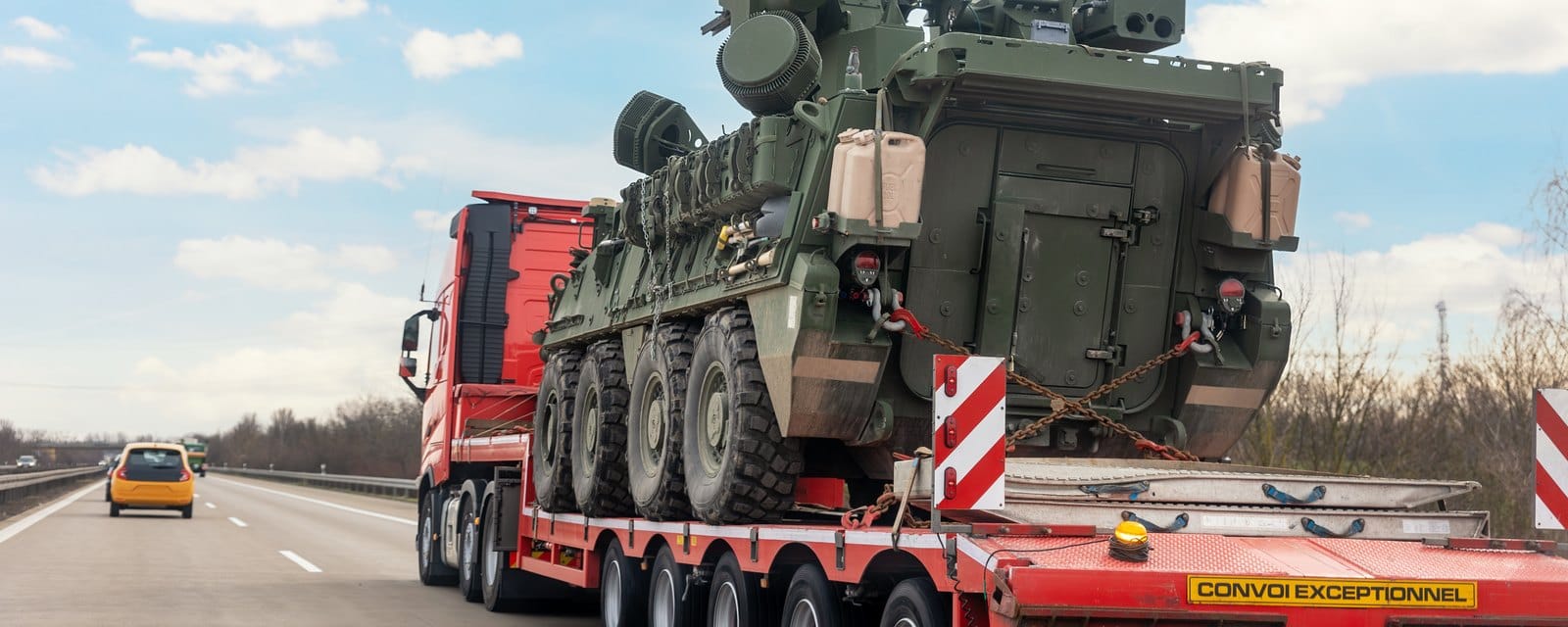
In Romania, a vehicle exceeding the maximum permitted dimensions must carry, on the cab and at the rear of the vehicle or of the load, panels bearing the inscription “EXCEPTIONAL TRANSPORT!” or “ATTENTION! DIMENSIONS EXCEEDED!” [3]. If the length of the vehicle exceeds 35.00 m, the rear panel must bear the inscription “ATTENTION! LONG VEHICLE!” [3]. Two yellow flashing warning lights on the cab, visible from at least 100 m, are also required [3].
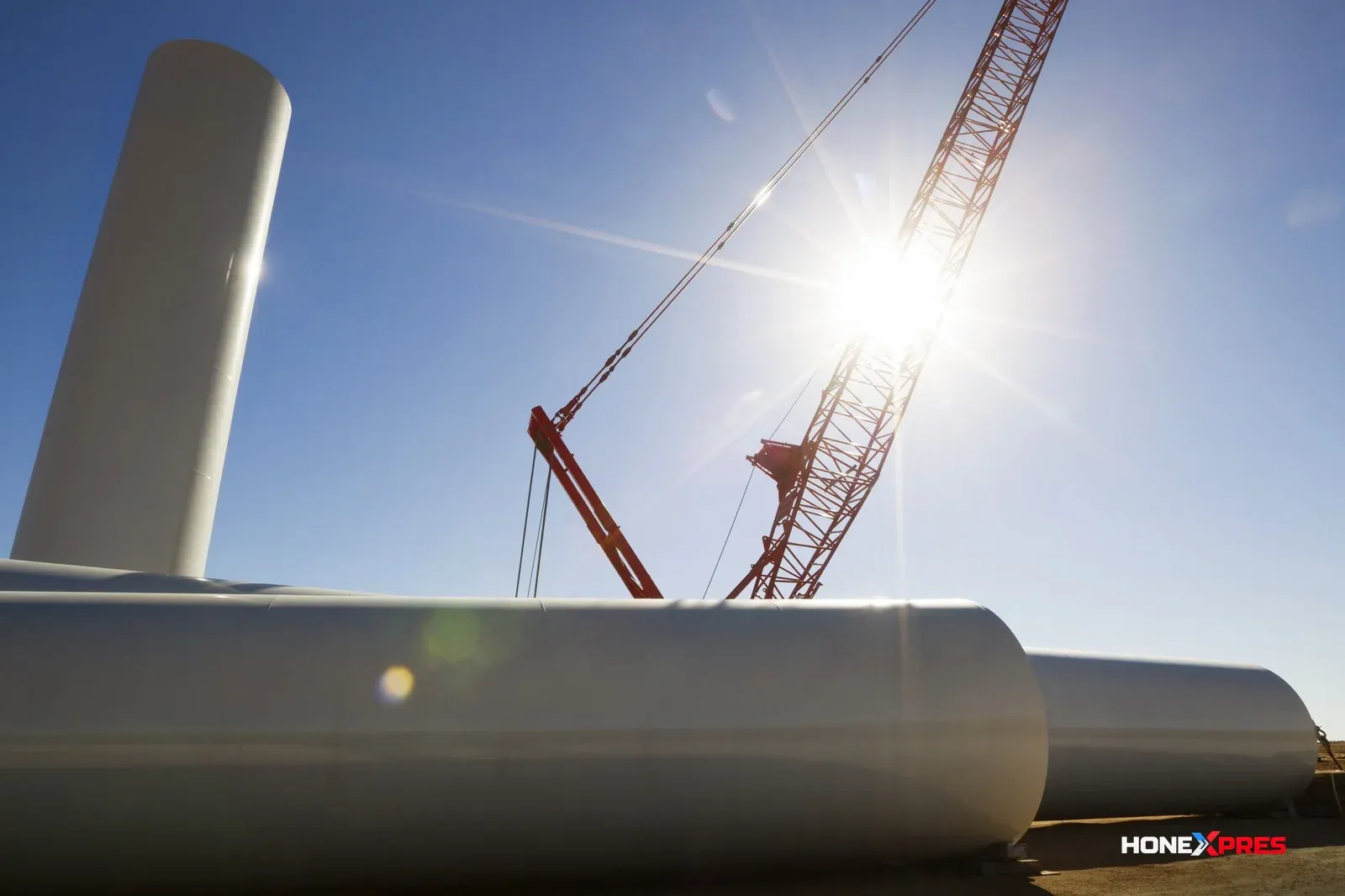
The escort is provided by specialised economic operators, with authorised escort vehicles and specialised personnel [1]. Where an escort is required, the vehicle must have radio sets to stay in contact with the authorised personnel [3]. The traffic conditions are set in the permit [1]; the number of escort vehicles required must be checked with the road administrator, and in Italy and in the other countries the rules on escorts must be checked with the local authorities.
Loading, securing and protection
The most delicate part is not always the road, but loading and unloading. Before the operation you need:
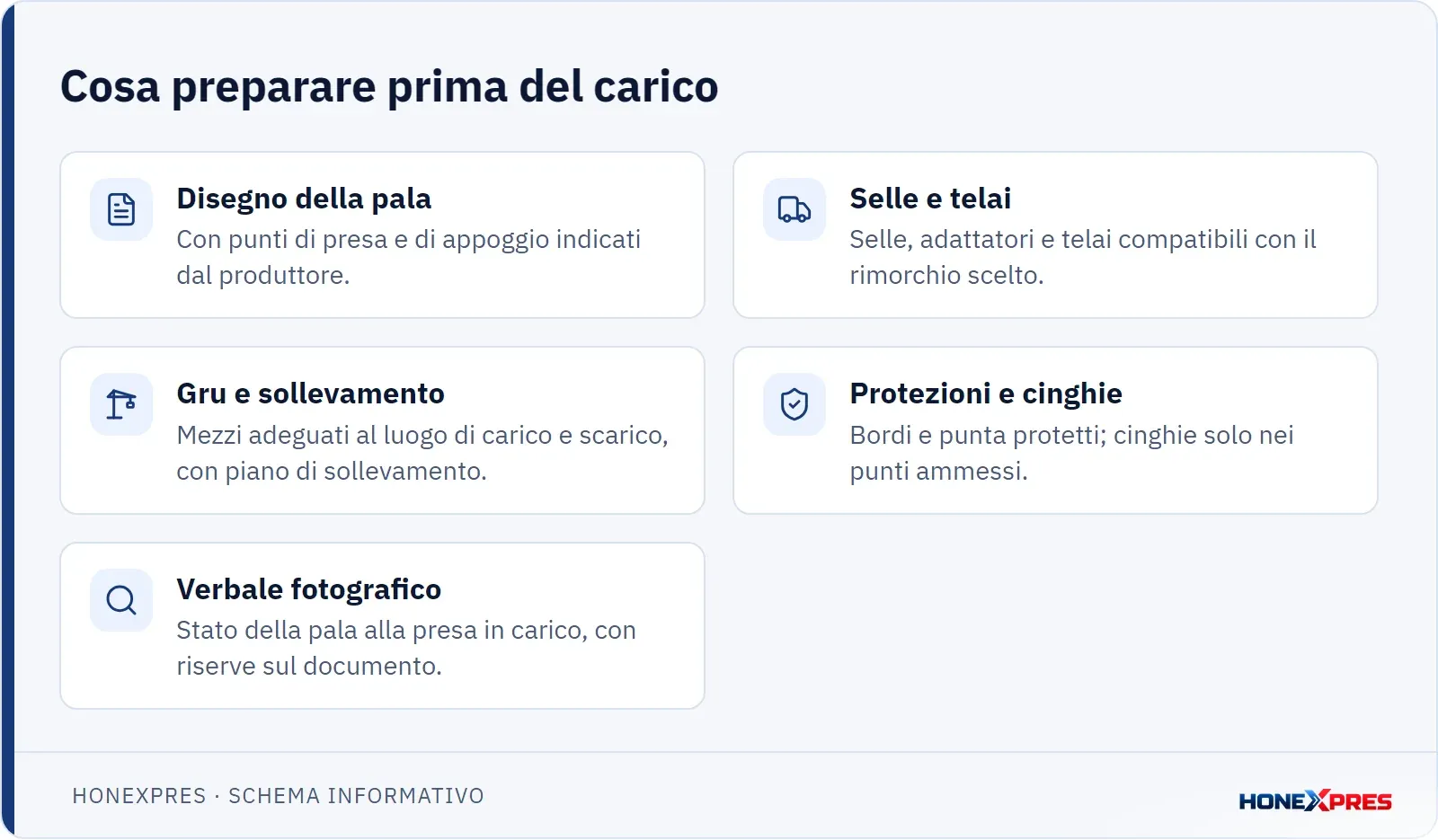
- the drawing of the blade with the lashing and support points indicated by the manufacturer;
- supports, adapters and transport frames compatible with the chosen trailer;
- cranes or lifting equipment suited to the loading and unloading site, with a lifting plan;
- protection for the edges and the tip, with the straps positioned only at the permitted points;
- a photographic report on the condition of the blade at pick-up.
The report and the reservations noted in the transport document are essential in the event of damage. As regards cover, assess the difference between the carrier's liability and cargo cover in our article CMR or CARGO insurance?: for high-value loads such as blades, the choice must be made before departure.
Project planning: several blades, several convoys
A wind farm rarely needs a single blade. Planning the transport of wind turbine blades as a project means:
- Data collection: model, dimensions, weights, lashing points, loading places (factory, port, warehouse) and delivery places.
- Feasibility study and field survey of the route and of any transfer area.
- Choice of the carrier and of the vehicles, establishing the registration numbers and the configurations to be stated in the permits.
- Permits and escorts for each country, with coordinated dates.
- Delivery sequence aligned with the installation: the blades must arrive when the cranes and crews are ready, not earlier, to avoid unnecessary waiting and handling.
- Management of contingencies: road closures, weather conditions, changes to the site schedule.
When the blades arrive by sea, the port section is integrated with sea freight and with any customs formalities.
What the cost depends on
There is no standard price for transporting a wind turbine blade; the cost depends on concrete factors:
- the type of trailer (extendable, with adapter, blade lifter) and the number of convoys;
- the distance and complexity of the route, including work on signage and street furniture;
- the permit charges: in Romania the total adds up the issue charge and those for exceeding weights and dimensions [4], and the distance is calculated in kilometres [4]; if several dimensions are exceeded, the charges are cumulated [4];
- the duration of the permit: for ASTs issued for 30 or 90 days, the calculated total is multiplied by a coefficient of 0.50 [4], which is relevant for projects with several trips;
- the number of escort vehicles and the hours of use;
- cranes and lifting equipment, waiting times at loading and on site;
- formalities in the transit countries and the insurance cover chosen.
Frequently asked questions
Is a wind turbine blade always an exceptional transport?
In practice yes, because its length exceeds the usual limits. In Romania a special transport permit issued by the road administrator is required [1]; in other countries, check the local rules.
Who issues the permit in Romania for very long convoys?
It depends on the dimensions: for length, the CNAIR subunits are competent up to 25 m (ACI, SDN) and 40 m (DRDP); above these limits CNAIR deals with it [2].
Can the truck be changed after the permit has been obtained?
Not freely: the AST is valid for the registration numbers, the technical characteristics, the route, the direction, the period and the conditions stated [1]. Any change must be handled before departure.
When is a blade lifter necessary?
When the route has bends, obstacles or gradients that a horizontal blade cannot overcome. This is established by the route survey; admissibility must be checked with the road administrator.
What data is needed for a quotation?
The drawing and dimensions of the blade, the weight, the lashing points, the loading and delivery addresses, the number of pieces, the time window and the site access conditions. Our article on how to request a quotation lists the useful information.
We organise your wind turbine blade transport
HONEXPRES organises, together with specialised partner carriers, the exceptional transport of wind turbine blades in Romania and in Europe: selection of the vehicle, coordination of the field survey, the permits and the escorts, and planning of the deliveries. You can find the full service on the page exceptional transports. Send us the drawing of the blade, the lashing points, the loading and unloading places and the time window: request a quotation and we will prepare a concrete proposal with our partners.
Official sources consulted
- [1] Rules approved by Order No 1.236/6.509/126/2018 (Romania), art. 2 point 11 – indivisible load
- [2] Rules approved by Order No 1.236/6.509/126/2018 (Romania), Annex 1 – CNAIR competence limits for issuing the AST
- [3] Rules approved by Order No 1.236/6.509/126/2018 (Romania), art. 35 let. a) – warning panels
- [4] Order No 1.836/2018 (Romania), Annex, part 2, let. H) point 5 – no tolerance for ASTs on request
- [5] Regulation (EC) No 1072/2009, art. 9 para. 1 – rules applicable to cabotage
Send us the drawing of the blade, the lashing points, the loading and unloading places and the time window: together with our partner carriers we will prepare a transport proposal.
Have something similar to move? Request a quote →
Related services