Guides
Agricultural machinery transport: how it works, what the price depends on and what we ask for a quote
AI Text written with AI assistance and checked by the editorial team. How we work with AI
Article translated automatically from Romanian and checked automatically. If there is any difference, the original prevails. See the original in Romanian · How we use automatic translation

Illustrative photograph: a red agricultural harvesting machine unloading the crop into a European lorry with a semi-trailer, in a field.
In short
The price of agricultural machinery transport depends on the machine's dimensions and weight, the trailer required, permits for oversized transport, escort, loading and distance. For an exact quote we need the dimensions, weight, photographs, address and time window. HONEXPRES, as a freight forwarder, organises the transport together with partner carriers.
Contents
- How does agricultural machinery transport work through a freight forwarder?
- Tractor transport, combine harvester transport, seed drills and trailers: which vehicle is needed for which machine?
- Tractor transport
- Combine harvester transport
- Seed drills, soil-tillage machinery, sprayers
- Agricultural trailers, balers, smaller machinery
- Oversized transport: when is a permit required and what does it mean in practice?
- The carrier's rights: why does it matter who transports the machine?
- Loading and securing: the riskiest part of the transport
- How does the machine get onto the trailer?
- What should you pay attention to when preparing the machine?
- The location matters too
- Prices for agricultural machinery transport: what does the cost depend on?
- How can the cost be kept within reasonable limits?
- Liability and insurance: what should you pay attention to when transporting machinery?
- What should you provide for the quote request?
- Frequently asked questions
- Can a whole combine harvester be transported together with its header?
- How do I know whether the transport of my tractor will be oversized?
- Who takes care of the permit for oversized transport?
- Why don't I immediately receive a fixed price for the transport of the agricultural machine?
- What is the difference between a freight forwarder and a carrier in machinery transport?
- Request a quote for the transport of an agricultural machine
- Official sources used
A tractor, a combine harvester or a seed drill is not palletised cargo. It will not fit into a tilt trailer, its centre of gravity is high, and it is often wider or taller than a standard road vehicle combination can accommodate. When the machine has to go to a new buyer, to a repair shop, to an exhibition or to another farm, agricultural machinery transport therefore always starts with planning. The right vehicle has to be chosen, it has to be clarified whether a permit is required, loading has to be organised, and all of this has to be coordinated with the loading and unloading locations. In this guide we go through the stages of the process, the factors that make up the price of agricultural machinery transport and the data that is worth providing with your very first request.
HONEXPRES is a freight forwarder based in Oradea. We do not have our own fleet: we organise the transport together with partner carriers, depending on the characteristics of the machine and of the route. Our machinery transport service covers agricultural, construction and industrial machinery alike.
How does agricultural machinery transport work through a freight forwarder?
The freight forwarder organises the transport, while the road haulage itself is performed by an authorised carrier. For the customer this means a single point of contact, and it makes it possible to choose the vehicle that suits the machine rather than the one that happens to be available at the time. The typical stages of the process:
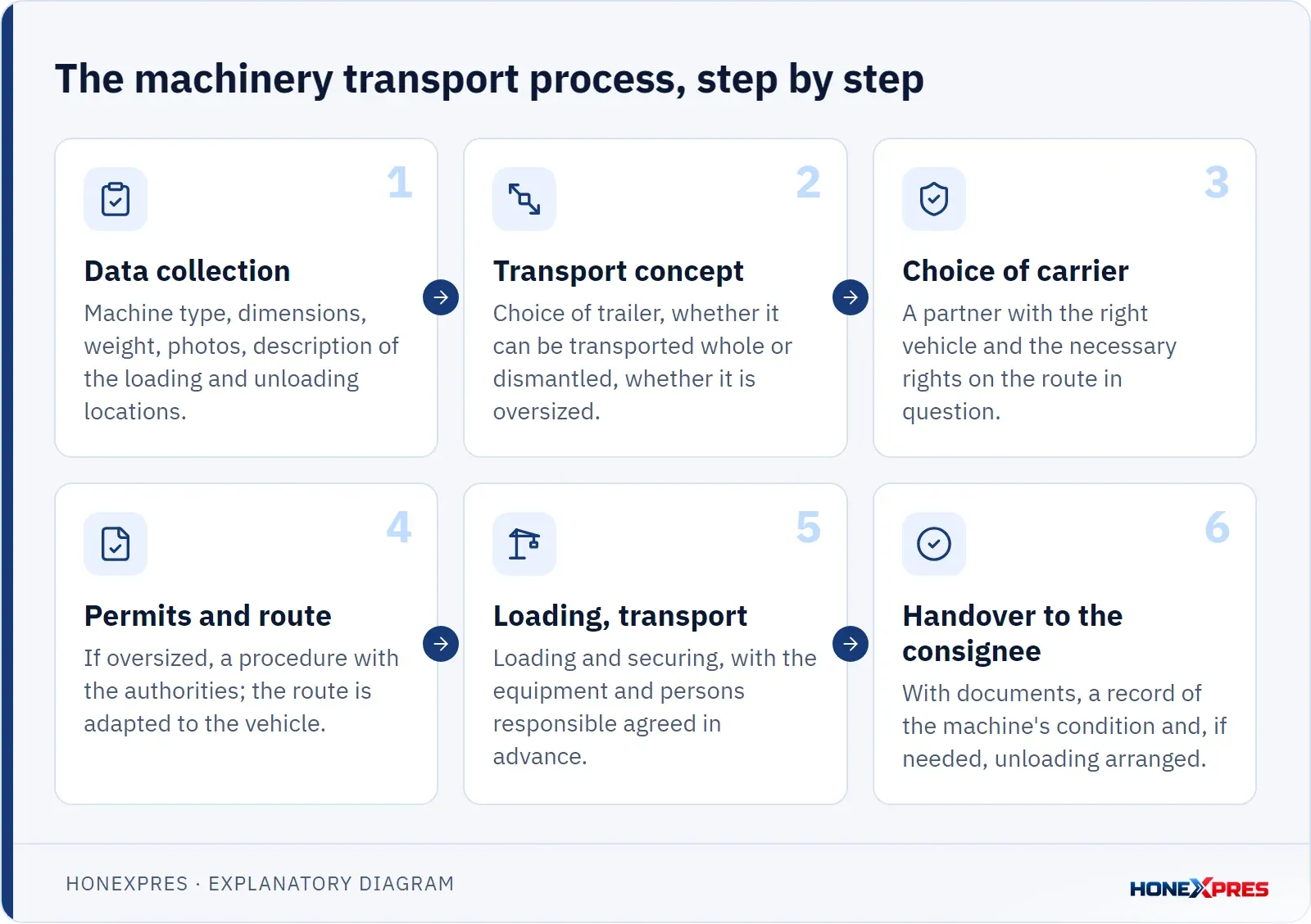
- Data collection. The exact type of the machine, its dimensions, weight and photographs, as well as a description of the loading and unloading locations.
- Transport concept. Which trailer is required, and whether the machine can be transported whole or some parts have to be dismantled. It is also at this point that it is determined whether the load will be oversized.
- Choice of carrier. We look for a partner that has the right vehicle and the necessary rights on the route in question.
- Permits and route. In the case of oversized transport we have to apply to the competent authorities of the countries involved, and the route has to be adapted to the vehicle.
- Loading, securing, transport. With the loading equipment and the persons responsible agreed in advance.
- Handover to the consignee. With documents, with a record of the condition of the machine and, if needed, with unloading arranged.
It is worth knowing that the parties in the contracting chain are not indifferent to the carrier's lawful operation either. Under Article 14a of Regulation (EC) No 1072/2009, as amended by Regulation (EU) 2020/1055, Member States lay down penalties for consignors, freight forwarders, contractors and subcontractors if they knew or should have known that the transport service ordered involves an infringement of the law [2]. That is why we check our partners' rights before placing an order.
Tractor transport, combine harvester transport, seed drills and trailers: which vehicle is needed for which machine?
The choice of vehicle depends on the dimensions, the weight and the construction of the machine. The overview below is intended as a starting point. In each case the final decision results from the actual data of the machine and from the carrier's verification.
Tractor transport
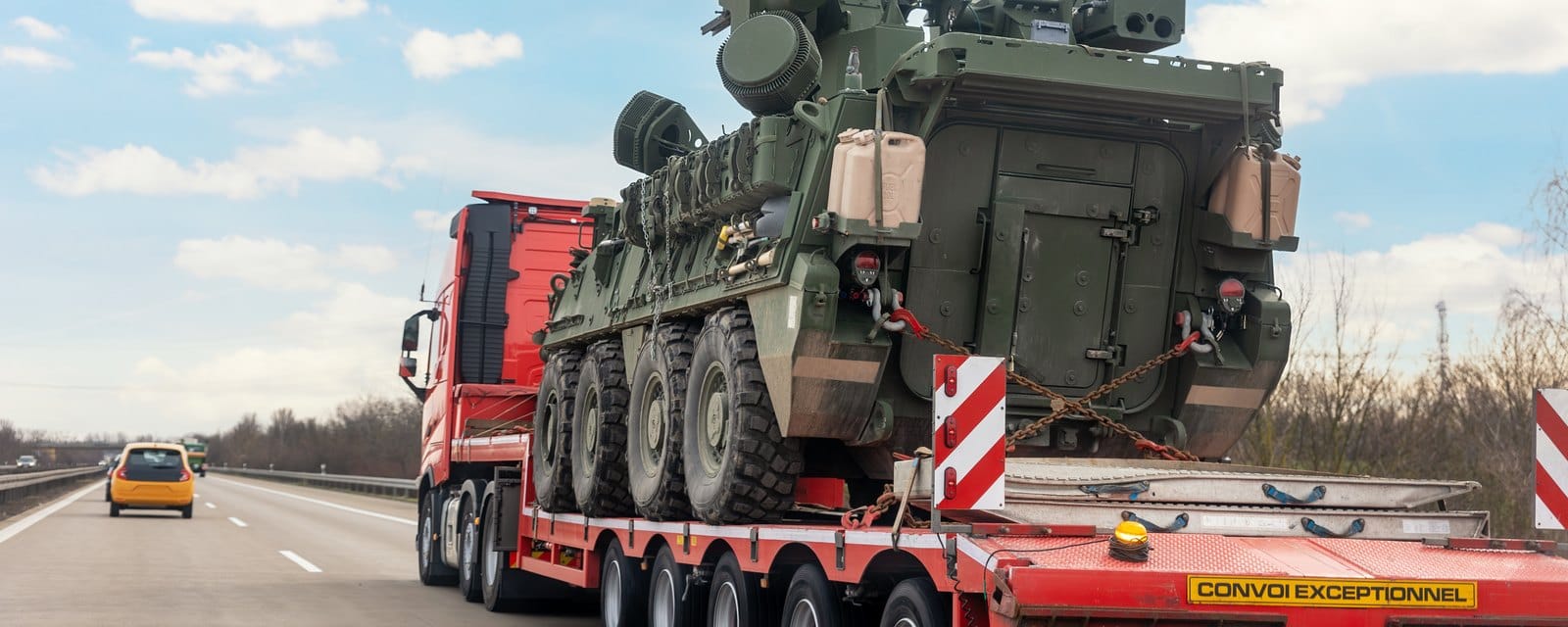
Small and medium-sized tractors usually travel on flatbed or semi-low loader trailers, driven up the ramp under their own power. With high-power tractors, with wide tyres or twin wheels, the width and height can quickly exceed the usual limits. In such cases a semi-low loader trailer or a low-loader solution may be considered, because a lower loading surface reduces the overall height. Removing twin wheels or certain attachments (front loader, weights, mounted implement) often decides whether the transport will be oversized or not.
Combine harvester transport
The combine harvester is one of the most complex tasks. The machine is large, tall and heavy, and the header is itself a long load. In practice, the header is often transported separately, on its own trolley or on a separate trailer. The conditions for this are always determined by the machine concerned and by the manufacturer's instructions. Which vehicle is required (for example a low-loader trailer (low-bed)), whether the transport is considered oversized and whether a permit is required is determined on the basis of the actual dimensions of the machine and the current requirements of the competent authorities of the countries involved.
Seed drills, soil-tillage machinery, sprayers
Seed drills and soil-tillage implements, in the transport position (folded), often fit on a flatbed trailer. In the unfolded or non-foldable version, however, their width requires special attention. With sprayers, securing the spray boom and checking that the tank has been emptied are part of the operations before loading.
Agricultural trailers, balers, smaller machinery
These are usually transported on flatbed or extendable flatbed trailers, sometimes several units on a single vehicle combination. If several small machines are transported at the same time, the loading plan (order, weight distribution) is at least as important as the type of vehicle.
| Machine | Typical vehicle type | Points requiring particular attention |
|---|---|---|
| Small and medium-sized tractor | Flatbed or semi-low loader trailer | Loading ramp, securing of wheels, attachments |
| Large tractor | Semi-low loader or low-loader trailer | Width (twin wheels), height, permit |
| Combine harvester | Low-loader trailer, header often separate | Exceeded dimensions, route, escort, unloading |
| Seed drill, soil-tillage machine | Flatbed or semi-low loader trailer | Folded state, protruding parts |
| Agricultural trailer, baler | Flatbed or extendable flatbed trailer | Number of units, weight distribution, securing points |
Oversized transport: when is a permit required and what does it mean in practice?
If the dimensions or the weight of the loaded vehicle exceed the generally permitted values in the country concerned, the transport requires a special transport permit. Conditions may also be attached in this case: a specified route, a determined period, an escort vehicle. Where exactly these limits lie, how the permit is applied for and how long it takes to process the application differ from one country to another and may change. That is why we do not give figures in this article: for each specific transport, the current requirements of the competent road authority or road manager of the country concerned must be taken into account.
In practice, the planning of an oversized transport of agricultural machinery looks like this:
- Recording the dimensions and weight in the transport position, both without and with the removable parts.
- Checking whether the excess dimensions can be reduced. This may mean removing the header, taking off the twin wheel or choosing a trailer with a lower loading surface. What is oversized when whole is sometimes no longer oversized when dismantled.
- Checking the route. Bridges, overpasses, roundabouts, narrow sections through villages, as well as the accessibility of the loading and unloading locations.
- Obtaining permits in every country involved. In the case of an international transport this may mean several authorities, with different conditions.
- Escort and time restrictions, if the permit provides for them.
You can read more about the technical aspects of oversized transport in our article on the technical conditions for transporting oversized loads. If your machine is definitely oversized, you will also find information on the page about organising oversized transport.
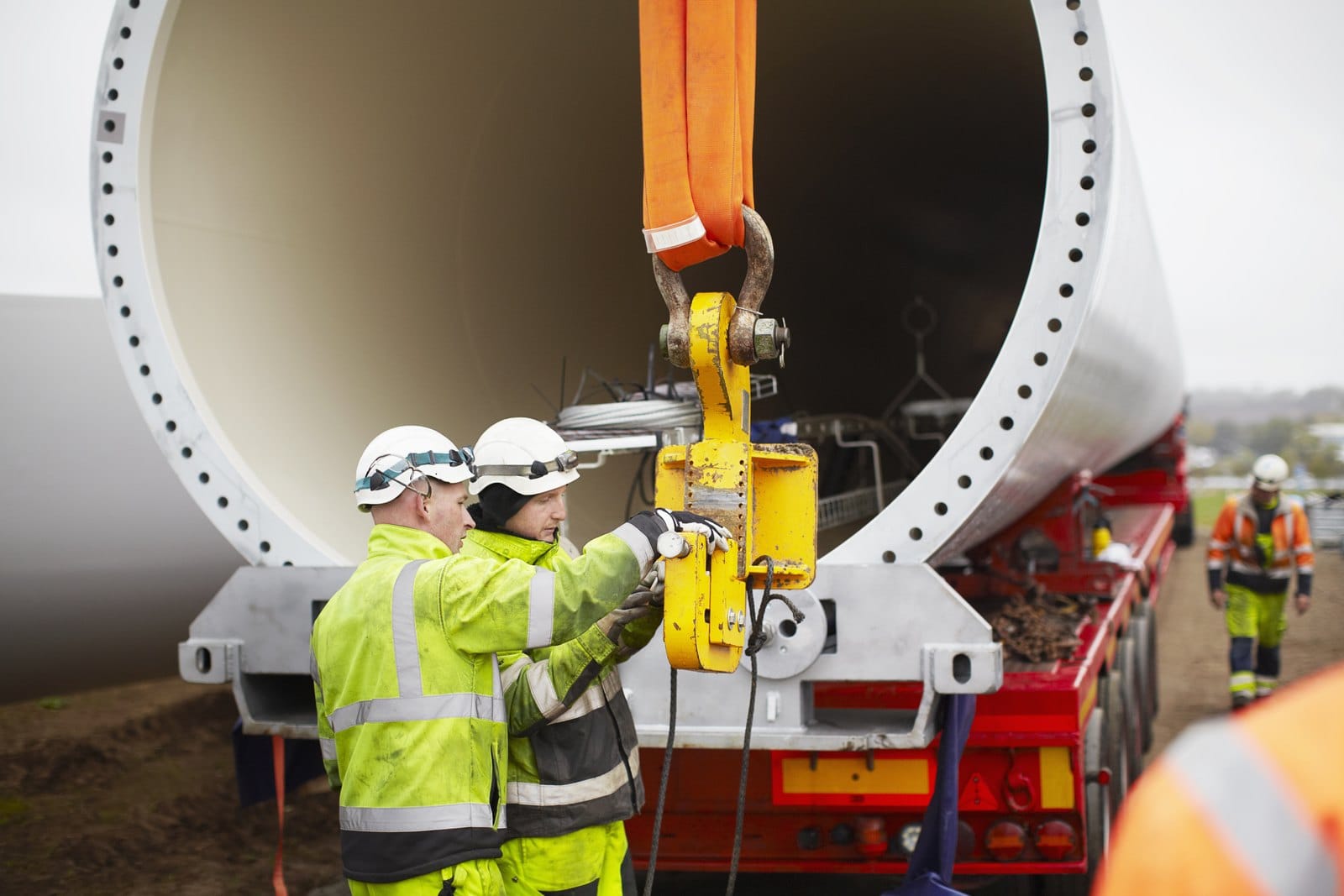
Practical tip: do not give only the dimensions from the technical documentation, but also the condition in which the machine will arrive on the trailer. Wheels fitted, attachments, a beacon or an aerial mounted on the cab: these are differences of a few centimetres, and often they are precisely what decides whether a permit is required.
The carrier's rights: why does it matter who transports the machine?
In the case of an international transport, for example from Romania to Hungary or vice versa, the carrier must hold a Community licence. According to the recital of Regulation (EC) No 1072/2009, international road haulage of goods should be subject to the holding of a Community licence [1]. The same regulation also provides that the carrier must carry on board each vehicle a certified true copy of the Community licence, so that checks can proceed without difficulty [1].
In Romania, the Community licence and its certified true copies are requested by the transport undertaking from the Autoritatea Rutieră Română (A.R.R.) [3]. The national electronic register contains, among other things, the number and series of the certified true copies, as well as the registration number of the vehicles for which the copies were issued [4]. Regulation (EU) 2016/403 separately mentions, among the groups of infringements, the carriage of goods without a valid Community licence [5].
In the case of domestic transport, a situation may arise in which the transport is performed by a carrier established in another Member State. This is called cabotage: a carrier that is not resident in the host Member State temporarily performs domestic transport there [6]. Under Union rules, this is permitted as long as it does not lead to a permanent or continuous activity in the Member State concerned [6]. The detailed limits must be checked in the current provisions. As a freight forwarder, we take these aspects into account when choosing the carrier, bearing in mind also that the parties in the contracting chain may be held liable [2].
Loading and securing: the riskiest part of the transport
Most problems arise not during the journey, but during loading and unloading or as a result of inadequate securing. The specific method of securing is determined by the carrier and the driver, on the basis of the vehicle, the machine and the applicable requirements. The customer, on the other hand, has to clarify many matters in good time.
How does the machine get onto the trailer?
- Under its own power, up the ramp. This is the most common method for tractors and self-propelled machinery. The condition is that the machine is in working order and that someone is available to drive it up professionally.
- With a crane or loading machine. This is necessary for machines that are not in working order and for towed implements. It has to be clarified in advance who provides the crane and whether the machine has lifting points.
- With a winch. If the trailer has one and the machine can be rolled.
What should you pay attention to when preparing the machine?
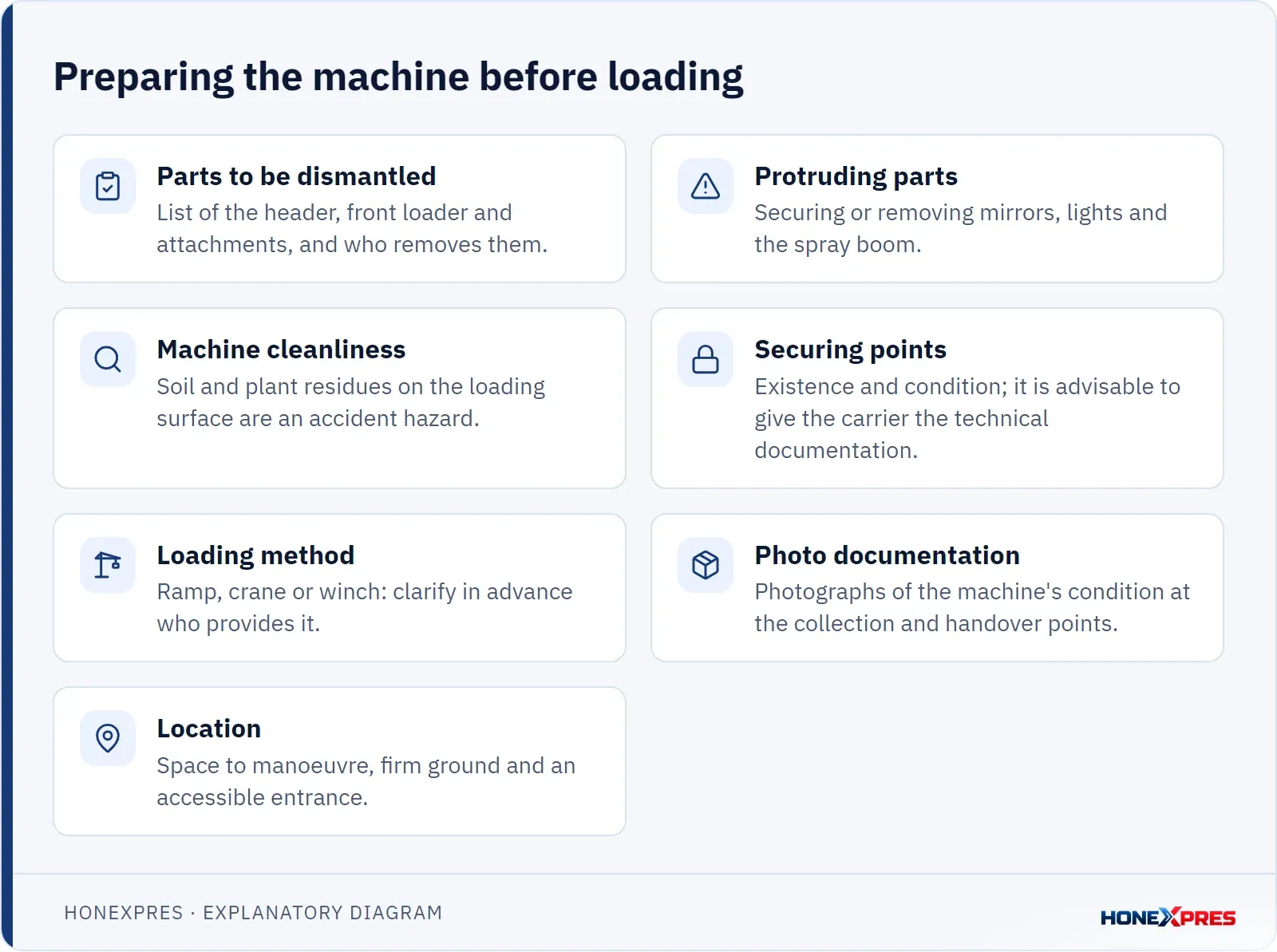
- The list of parts that have to be dismantled (header, front loader, attachments) and who removes and refits them.
- Securing or removing parts that protrude, are loosely fixed or are vulnerable: mirrors, lights, spray boom, equipment outside the cab.
- The cleanliness of the machine. Residues of soil and plants on the loading surface present an accident hazard, and in the case of a cross-border transport they may also raise inspection issues. The latter is worth clarifying with the competent authority.
- The existence and condition of the securing points. If the manufacturer has specified securing points, it is advisable to make the technical documentation available to the carrier.
- Documenting the condition of the machine with photographs before loading, at the collection and handover points.
The location matters too
A low-loader combination needs space for manoeuvring and turning, firm ground for loading and an entrance where it will not get stuck. On isolated farms, in farm yards and on dirt roads this cannot be taken for granted. If the location cannot be reached with a heavy combination, it may be necessary to take the machine to a nearby point with a solid surface. The road rules for such a movement must be checked on site.
Prices for agricultural machinery transport: what does the cost depend on?
Prices for agricultural machinery transport cannot be read from a general table. Two transports over the same distance can differ significantly if one of the machines can be transported whole, while the other can only be transported with a special transport permit and an escort. For this reason we do not publish a price list. The cost is determined by the following factors:
| Cost factor | Why does it matter? |
|---|---|
| Dimensions and weight of the machine | These determine the type of vehicle and whether the transport is oversized. |
| Trailer required | The type of vehicle (for example a low-loader or semi-low loader trailer) also influences the rate; the specific effect results from the partner's quote requested for the transport concerned. |
| Permits | Obtaining the permit for oversized transport is a separate procedure in each country and involves a separate cost. |
| Escort | If the permit provides for an escort vehicle, it forms part of the cost of the transport. |
| Distance and route | A detour imposed by the exceeded dimensions or by a low bridge increases the number of kilometres and the time. |
| Loading | Crane, loading machine, mechanics, removal and refitting of the header or other parts. |
| Scheduling | Urgent transport, seasonal peak period, waiting on site. |
| Empty return | If the special vehicle does not get a load on the return journey after unloading, this may be reflected in the rate. |
| Documents and customs formalities | For export or import outside the EU, customs formalities also arise. |
| Insurance | Cargo insurance adapted to the value of the machine may be a separate cost item. |
If you are interested more generally in how the rate for a road transport is formed, our article on the factors in calculating freight rates is a good starting point. For routes outside the EU, handling customs formalities is part of the planning.
How can the cost be kept within reasonable limits?
- With exact data. A vehicle or permit requirement that changes later because of estimated dimensions is the most expensive mistake.
- With a flexible time window. If the machine can leave with a margin of a few days, it is easier to find the suitable vehicle and route.
- With dismantling, where possible. If removing an attachment takes the machine out of the oversized category, the cost of the permit and of the escort may be eliminated.
- With a prepared location. A machine prepared for loading and an accessible location reduce waiting time.
Liability and insurance: what should you pay attention to when transporting machinery?
The value of a combine harvester or of a new tractor can far exceed what can be obtained as compensation under the carrier's liability rules. The liability of the carrier and of the freight forwarder is usually limited. The 1992 standard conditions of the FIATA multimodal transport document (FBL) provide, for example, that if the contract does not include a sea or inland waterway leg, the freight forwarder's liability is limited to a maximum amount per kilogram of gross weight of the goods lost or damaged [7]. In the case of high-value machinery that is costly in relation to its weight, this compensation may represent a fraction of the actual loss.
That is why, for high-value machinery, a separate cargo insurance (CARGO) is worth considering. HONEXPRES does not offer its own insurance, but when organising the transport we draw your attention to this issue. The differences are explained in our article comparing CMR insurance with CARGO insurance.
What should you provide for the quote request?
The more complete the first request, the more quickly and accurately the transport can be planned. The list below covers what we always ask for in the case of the transport of agricultural machinery:
- The manufacturer, type and year of manufacture of the machine. Many technical data can be traced from the type.
- Dimensions in the transport position: length, width, height. If there are removable parts, both with and without them.
- Weight (according to the technical documentation or the registration certificate) and, if applicable, the weight of the attachments separately.
- Operating condition: whether it can be driven up under its own power or a crane or winch is needed.
- Photographs of the machine from several sides and, if possible, of the loading and unloading locations.
- Loading and unloading address, with a description of access (surface, gate, possibility to turn).
- Who loads and who unloads, and whether loading equipment is available on site.
- The desired date or time window and how flexible it is.
- The route: domestic, within the EU or outside the EU. In the latter case, because of customs formalities, the details of the consignor and of the consignee are also needed.
- The value of the machine, if you also wish to consider insurance.
- Special requests: several machines in one transport, separate header, agreed handover time.
From these data we draw up the transport plan together with our partner carriers. We determine the type of vehicle, assess any permit requirement and the route, and then send the quote. If any data is missing, we will ask you, because a quote based on incomplete information often changes in practice.
Frequently asked questions
Can a whole combine harvester be transported together with its header?
This depends on the dimensions of the machine and on the manufacturer's instructions. The header is often transported separately, because together the load would be too wide or too long. Before a decision is made, the exact dimensions and the requirements of the countries involved must be compared.
How do I know whether the transport of my tractor will be oversized?
From the dimensions and weight of the machine measured in the transport position, together with the height of the trailer's loading surface. The limit values are set by the current rules of the competent authority of the country concerned. If you provide us with the exact data, we check this during planning.
Who takes care of the permit for oversized transport?
We determine how the permit is obtained, as part of organising the transport, together with our partner carriers. The procedure has to be carried out with the competent authorities of the countries involved, according to their conditions in force at the time.
Why don't I immediately receive a fixed price for the transport of the agricultural machine?
Because the price depends on the size of the machine, the vehicle required, any permits, the escort, the loading and the route. These can only be assessed once the specific data is known. On the basis of exact data we provide a well-founded quote.
What is the difference between a freight forwarder and a carrier in machinery transport?
The carrier performs the transport with its own vehicle. The freight forwarder, such as HONEXPRES, organises the transport: it chooses the suitable partner and vehicle, coordinates the loading and the documents and accompanies the order as a single point of contact.
Request a quote for the transport of an agricultural machine
Whether it is a tractor, a combine harvester or several smaller machines, a good transport starts with exact data. Send us the type of the machine, its dimensions and weight, a few photographs, as well as the loading and unloading locations and the desired date. On this basis we plan the transport together with our partner carriers and prepare the quote. You can provide the data on our quote request page.
Official sources used
- [1] Regulation (EC) No 1072/2009 on common rules for access to the international road haulage market, recital (9)
- [2] Regulation (EC) No 1072/2009, Article 14a (Liability), introduced by Regulation (EU) 2020/1055
- [3] Order No 980/2011 of the Romanian Minister of Transport (ORDIN nr. 980/2011), methodological norms, art. 21 para. (1)
- [4] Order No 980/2011 of the Romanian Minister of Transport (ORDIN nr. 980/2011), methodological norms, art. 4 point e)
- [5] Commission Regulation (EU) 2016/403, Annex I, point 10 – categories of infringements of Regulation (EC) No 1072/2009, row 1 (art. 3)
- [6] Regulation (EU) 2020/1055, recital (20) – the concept of cabotage
- [7] FIATA multimodal transport document (FBL) standard conditions (1992), clause 8.9 – limitation of liability where there is no sea or inland waterway leg
Send us the type of the machine, its dimensions, its weight and the loading and unloading locations, and together with our partner carriers we will draw up the transport plan and the quote.
Have something similar to move? Request a quote →
Related services