Guides
Permit for oversized transport: what is it needed for, who issues it and how does the application work?
AI Text written with AI assistance and checked by the editorial team. How we work with AI
Article translated automatically from Romanian and checked automatically. If there is any difference, the original prevails. See the original in Romanian · How we use automatic translation

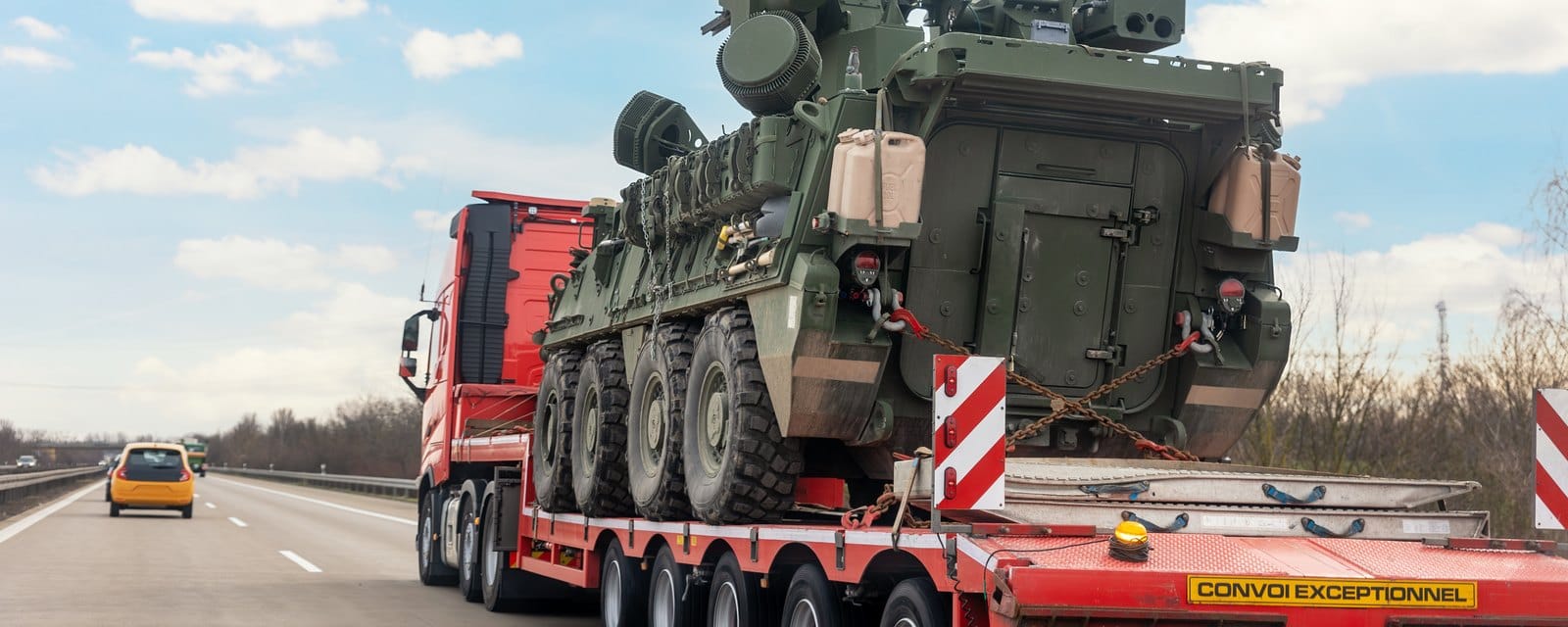
Illustrative photograph: long concrete beams lifted by crane onto a multi-axle low-bed semi-trailer.
In short
If a vehicle together with its load exceeds the permitted weights or dimensions, a special permit is required from each country traversed. It specifies the route, the period, the conditions imposed and the fees, and is valid only for the vehicles named. Competence and procedure are regulated by each country individually. Clarify them before booking.
Contents
- Why is a special transport permit needed?
- Indivisible load – the key concept
- What exactly does the permit specify?
- Who issues the permit for oversized transport?
- How do you apply for the permit for oversized transport: what data is required?
- The procedure in six steps
- The driver also needs a qualification
- What does a permit cost? Cost factors
- The customs aspect for routes through third countries
- The role of the freight forwarder
- Frequently asked questions about the permit for oversized transport
- Is a permit from one country also valid in the neighbouring country?
- Can the carrier use a different vehicle at short notice?
- How long does issuing take?
- Does every large load need a permit?
- Who provides the escort vehicles?
- Request an oversized transport
- Official sources consulted
In brief: You need a permit for oversized transport whenever the vehicle and its load exceed the weights or dimensions permitted on public roads. It is issued by a state authority of the country concerned. It states the route, the period, the conditions imposed and the fees. It is valid only for the vehicles named in it. What the authority is called, which forms it requires and how long the procedure takes is determined by each country individually. This article explains what such a permit specifies in terms of content and which data you should prepare. It also shows where the consignor has to contribute and where the freight forwarder takes over the work.
The procedure in Romania serves as the example, because it is described precisely in a published regulation. For many transports between Romania and the German-speaking region, it is also part of the route. For Germany, Austria and Switzerland we deliberately do not cite statutory articles, limit values or time limits. Please enquire about these with the competent authority there.
Why is a special transport permit needed?
For normal road traffic, each country sets maximum permitted weights, maximum axle loads and maximum permitted dimensions. Transformers, construction machinery, bridge girders or silos often cannot be transported within these limits. In that case, the transport needs a derogation in the form of a permit.
The Romanian regulation describes this case as follows: it governs the authorisation and conduct of the circulation of road vehicles whose weights and/or dimensions exceed the maximum values laid down in Ordonanța Guvernului nr. 43/1997 privind regimul drumurilor (Government Ordinance No 43/1997 on the road regime). [1] The rules apply to the public road network of Romania. [1] A Romanian permit therefore covers only the section of the route in Romania. For the other countries along the route, the national procedure applies in each case.
Indivisible load – the key concept
The concept of the indivisible load is essential. This means a load which, for road transport, cannot be divided into two or more loads without unnecessary costs or risk of damage. [1] In addition, because of its dimensions or mass, the load cannot be transported in such a way that the vehicle complies with the permitted weights and dimensions. [1]
In practice this means: before applying, check honestly whether the load can be dismantled, for example by removing detachable parts, booms or cabs. If you can dismantle it, you may not need a permit at all, or the load may fall into a less complex category. Whether a load is regarded as indivisible in a specific case is decided by the competent authority under its national law.
What exactly does the permit specify?
The definition of the "special transport permit" in the Romanian regulation shows what such a permit normally contains. It is the document by which the road administrator specifies the following: the route to be travelled, the conditions for circulation with exceeded weights or dimensions, and the fees payable. [1] It is valid for the registration numbers of the vehicles, their technical characteristics, the route, the direction of travel, the period and the circulation conditions imposed. [1]
Three practical consequences follow from this:
- The route is prescribed. You do not choose the route freely. Bridges, underpasses, roundabouts or roadworks can require detours considerably longer than the usual route of a lorry.
- The vehicles must be determined before the application. The permit is tied to the registration numbers. [1] If the carrier changes the tractor unit or the semi-trailer at short notice, the data no longer match.
- The period and the direction are fixed. If the pick-up of the goods is postponed beyond the authorised period, the permit must be checked and, if necessary, applied for again. For the return journey in the opposite direction, separate data apply.
Who issues the permit for oversized transport?
In Romania, the road administrator concerned specifies the route, the conditions and the fees. [1] The regulation also starts from the premise that several authorities are involved in authorisation and escorting. The training of drivers expressly includes the topic "authorities with responsibilities in the authorisation and escorting of oversized transports". [4]
For an oversized transport permit in Germany, in Austria and for a heavy-load transport permit in Switzerland, separate competences, application channels and fees apply in each case. These are not presented in detail in this article. Before the first transport, you should clarify the following with the authority responsible for road traffic or roads in the country concerned:
- who is entitled to submit the application,
- by what means the application is submitted,
- what processing time has to be allowed for.
You should also enquire there about fees and about the rules applicable to escort vehicles and to travel hours.
How do you apply for the permit for oversized transport: what data is required?
The exact forms differ from country to country. From the content of the permit, however, it is possible to deduce what data must be available in any case. The more complete and precise it is, the fewer additional questions arise.
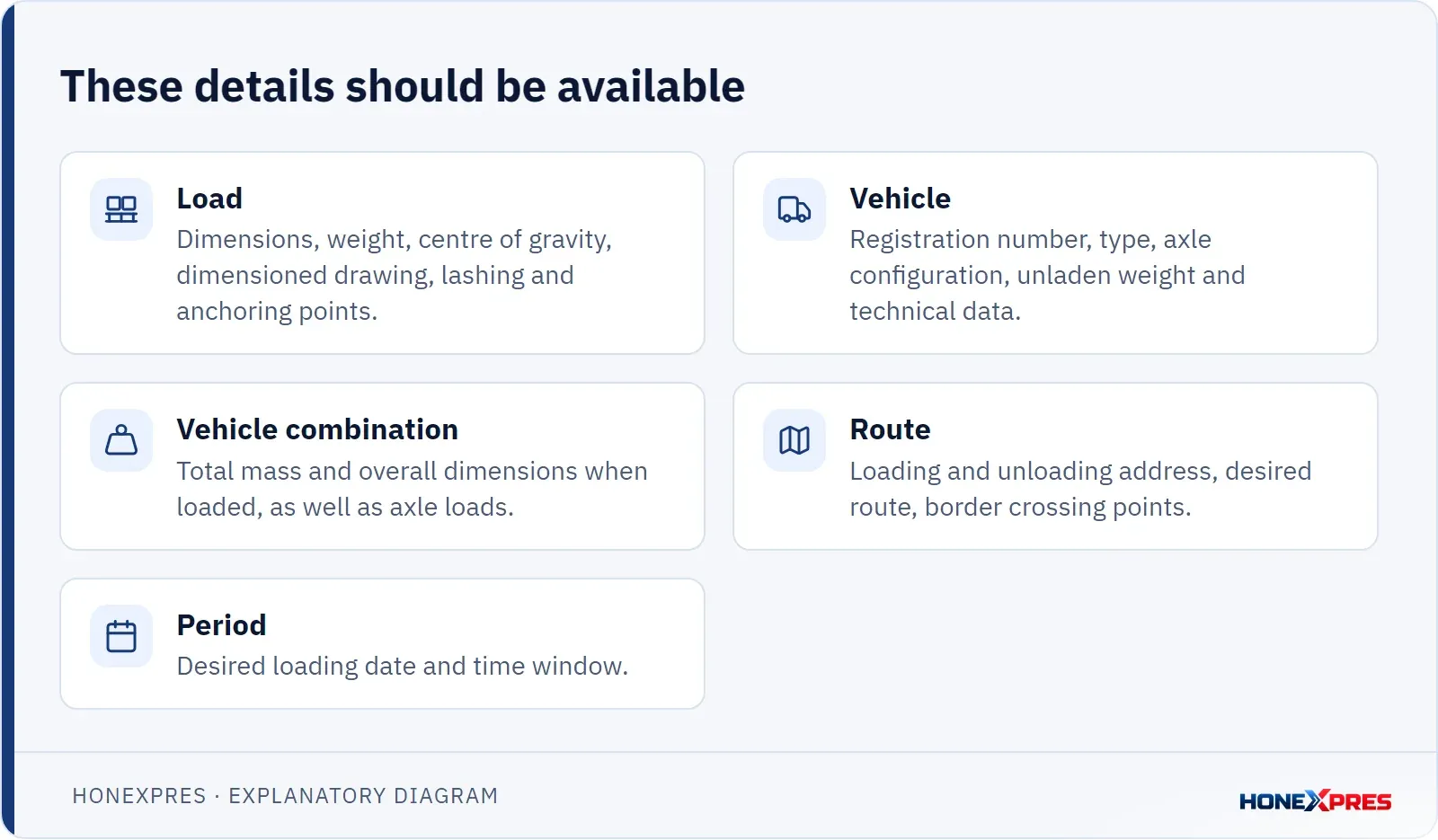
| Area | What you should provide | Why |
|---|---|---|
| Load | Length, width, height, weight, centre of gravity, dimensioned drawing, lashing and anchoring points | Basis for the choice of vehicle, the axle loads and the overall dimensions |
| Vehicle | Registration number, type, axle configuration, unladen weight, technical data | The permit is valid for the registration number and the technical characteristics |
| Vehicle combination | Total mass and overall dimensions when loaded, axle loads | Basis for the weight and dimension data in the application |
| Route | Loading and unloading address, desired route, border crossing points | The route and the direction of travel are authorised |
| Period | Desired loading date and time window | The permit is valid for a specific period |
Two concepts from the Romanian regulation help in preparing the data correctly. Firstly, the axle configuration is stated in a fixed notation. "AnSm" stands, for example, for a tractor unit with "n" axles pulling a semi-trailer with "m" axles. [1] Secondly, the total mass comprises more than the vehicle and the load: it is the combined mass of the towing vehicle, the trailers or semi-trailers towed, the load, the securing equipment and the load spreader. [1] Anyone who states only "machine 40 t" therefore provides too little. Anchoring equipment, support structures and the load spreader are part of the calculation.
Which vehicle types are possible for which load is shown in our presentations of the low-bed semi-trailer, the semi-low semi-trailer and the telescopic platform for long loads. Vehicle requirements such as marking, lighting and load securing are covered in the article on technical requirements for oversized transports.
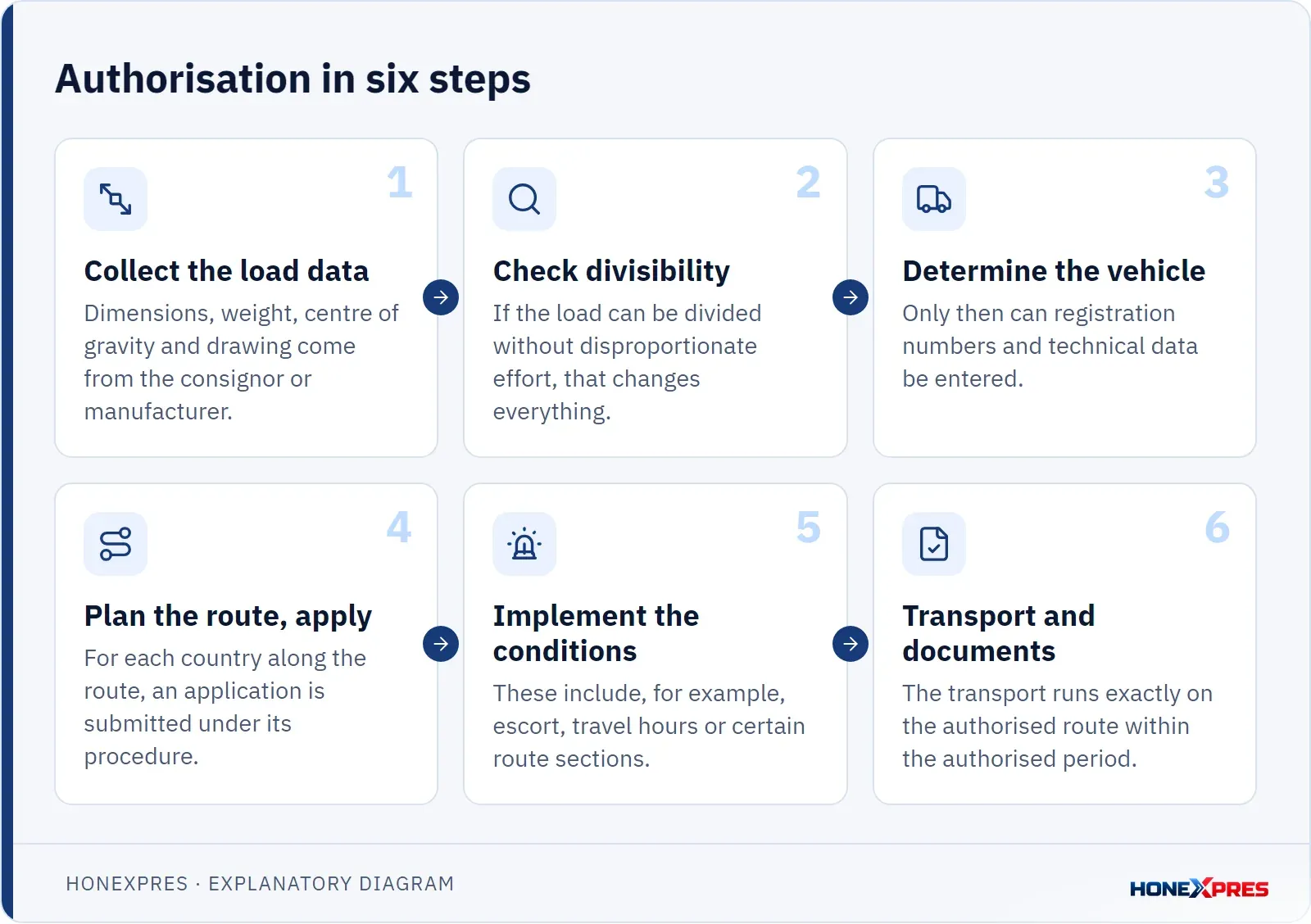
The procedure in six steps
- Collecting the load data. The dimensions, weight, centre of gravity and drawing are provided by the consignor or the manufacturer. Estimated values later lead to incorrect applications.
- Checking whether dismantling is possible. If the load can be divided without disproportionate effort, this fundamentally changes the starting situation (see indivisible load).
- Determining the vehicle. Only once the carrier and its specific vehicles have been determined can the registration numbers and technical data be entered in the application.
- Preliminary route planning and submission of applications. For each country along the route, an application is submitted under its procedure. The authority may prescribe a different route from the one requested.
- Implementing the conditions imposed. These include, for example, escort, travel hours or certain route sections. In Romania, escorting is provided by specialised undertakings with authorised escort vehicles and specialist staff. [1]
- Carrying out the transport and documents. The transport runs exactly on the authorised route, within the authorised period. If anything deviates, for example the date, the vehicle or a dimension, it must be clarified before departure whether the permit is still valid.
The driver also needs a qualification
In addition to the permit for the vehicle, there are requirements concerning the person at the wheel. Drivers who drive authorised vehicles with exceeded weights or dimensions in Romania need an "oversized transport certificate". [2] The prerequisite for this is proof of the driver's qualification (CPC or CPI) for the carriage of goods. [2] The certificate is valid for five years and is issued on request by the Autoritatea Rutieră Română A.R.R. [3] The content of the training also includes the prescribed routes, the procedures depending on the degree of excess, and international oversized transport. [4] Whether and which comparable proofs are required in other countries, please enquire with the authority there.
What does a permit cost? Cost factors
We do not state prices here, as they depend on the country, the route and the specific case. In Romania, the fees payable are specified in the permit itself. [1] The following factors matter in particular for the total costs of an oversized transport:
- Degree of excess: the more the dimensions or weight exceed the limits, the more complex the procedures and conditions imposed generally become. Which procedures apply in the specific case, please enquire with the competent authority.
- Number of countries: each route section may require its own permit, with its own fees.
- Prescribed route: detours lengthen the driving time and the number of kilometres.
- Escort: escort vehicles and specialist staff form a separate cost block.
- Special vehicle: low-bed and telescopic semi-trailers are available less often than standard semi-trailers. The positioning run to the loading point and the empty kilometres are included in the calculation.
- Time restrictions and waiting times: the time conditions of the permit or waiting for permits tie up the vehicle and the staff.
- Rescheduling: a change of vehicle or date may require a new permit.
The customs aspect for routes through third countries
If the route passes through a third country and the transport takes place under a TIR Carnet, the TIR Convention contains its own provisions for heavy or bulky goods. According to these, the transport may be carried out with unsealed vehicles or containers if the customs authority at the departure point so decides. [5] The condition is that the goods can be easily identified from the description. [5] The road permit is not replaced by this: the customs regime and road law are separate procedures. More in the article on the TIR Convention.
The role of the freight forwarder
HONEXPRES is a freight forwarder based in Oradea and does not own a fleet of vehicles. We organise oversized transports with specialised partner carriers. The permit is valid for the registration numbers of the vehicles used. [1] Who may submit the application in the country concerned, please clarify with the competent authority there. Our task is to bring the individual steps together:
- We check whether the data on your load is complete before it goes into an application.
- We select a partner with a vehicle suited to the load.
- We coordinate the route, the time window, the escort and the situation at loading and unloading with all participants.
- We coordinate the deadlines when several countries, and therefore several permits, are involved.
What you contribute as the consignor: correct dimensions and weights, a dimensioned drawing, information about the loading and unloading location (access, crane, ground) and a realistic time frame. A general guide to shipping oversized goods is provided by our guide to oversized transports. You will find our range of services on the page Oversized transport, and for construction and industrial machinery also at Machinery transport.
Frequently asked questions about the permit for oversized transport
Is a permit from one country also valid in the neighbouring country?
You should not assume so. The Romanian rules apply, for example, to the public road network of Romania. [1] For each route section in another country, clarify the procedure there with the competent authority.
Can the carrier use a different vehicle at short notice?
Not without further formalities. The permit is valid for the registration numbers and technical characteristics of the vehicles named. [1] A change of vehicle must therefore be clarified with the authority before departure.
How long does issuing take?
There is no uniform answer. The processing time depends on the country, the route and the extent of the excess. Ask the competent authority and plan a safety margin, especially where there are several transit countries.
Does every large load need a permit?
No. What is decisive is whether the vehicle and the load together exceed the permitted weights or dimensions. One reason for this is the indivisible load, which cannot be divided without unnecessary costs or risk of damage. [1] The limit values themselves are set by the country concerned.
Who provides the escort vehicles?
This depends on the conditions imposed by the permit and on national law. In Romania, escorting is provided by specialised undertakings with authorised escort vehicles and specialist staff. [1] As a freight forwarder, we organise the escort together with the transport.
Request an oversized transport
Are you planning a transport with excess dimensions or weight from, to or through Romania? Send us the dimensions, the weight, the dimensioned drawing, the loading and unloading location and the desired date. We organise the transport together with our partner carriers and coordinate the authorisation steps for each country. Request a quote now.
Official sources consulted
- [1] Rules on the authorisation and conduct of the circulation of road vehicles with exceeded weights and/or dimensions, approved by Order No 1.236/6.509/126/2018 (Romania), title
- [2] Rules of 11 November 2015 on the training and certification of drivers in oversized transport, Annex 5 to Order No 1.214/2015 (Romania), art. 1 para. (1)
- [3] Rules of 11 November 2015, Annex 5 to Order No 1.214/2015 (Romania), art. 4 para. (6)
- [4] Rules of 11 November 2015, Annex 5a to Order No 1.214/2015 (Romania), training programme, field "Documents and authorisation of oversized transports"
- [5] Customs Convention on the International Transport of Goods under Cover of TIR Carnets (TIR Convention of 1975), art. 29 para. (2), published in Romania by Decree No 420/1979
Send us the dimensions, weight and route of your load. Together with our partner carriers, we organise the oversized transport, including the permits.
Have something similar to move? Request a quote →
Related services