ADR dangerous goods by road · Guides
Conditions for the carriage of dangerous goods for the CARRIER
Article translated automatically from Romanian and checked automatically. If there is any difference, the original prevails. See the original in Romanian · How we use automatic translation

In short
For the carriage of dangerous goods (which cannot be carried wholly or partly exempt from the provisions of the ADR Agreement) by transport operators or transport undertakings, certain conditions must be met.
Contents
- Conditions for the carriage of dangerous goods
- Basic conditions for the carriage of dangerous goods as a CARRIER
- 1. A transport operator registered with the Autoritatea Rutieră Română (ARR) in order to prove that it meets the conditions required to carry dangerous goods
- 2. Drivers must hold the ADR certificate of professional competence
- 3. The transport unit must be:
- 4. The special documents required for the transport of dangerous goods
- 5. A yellow “rotating beacon”
For the carriage of dangerous goods (which cannot be carried wholly or partly exempt from the provisions of the ADR Agreement) by transport operators or transport undertakings, certain conditions must be met.
Conditions for the carriage of dangerous goods
-
A transport operator registered with the Autoritatea Rutieră Română (the Romanian Road Authority) in order to prove that it meets the conditions required to carry dangerous goods,
-
The driver entrusted with the carriage of the dangerous goods must hold an ADR certificate of professional competence,
-
The transport unit must be:
-
suitable for the carriage of dangerous goods,
-
fitted with general and personal protective equipment,
-
fitted with a fire extinguisher/fire extinguishers,
-
fitted with reflective orange-coloured plates, placards and special marks, as applicable.
-
-
The special documents required for the transport of dangerous goods,
-
A yellow “rotating beacon”.
Basic conditions for the carriage of dangerous goods as a CARRIER
Below, we describe each condition in detail.
1. A transport operator registered with the Autoritatea Rutieră Română (ARR) in order to prove that it meets the conditions required to carry dangerous goods
General conditions:
In order for the transport operator to be registered with the ARR as a carrier (also) of dangerous goods, the transport operator must appoint at least one ADR safety adviser who holds a certificate of professional competence appropriate to the goods that are to be carried by the carrier.
For a safety adviser to be appointed at a transport operator, he or she must be an employee of the company (regardless of the position held and of the COR occupation code under which he or she is employed by the company).
If the undertaking does not have a person qualified for this activity, it may also turn to an external specialist. (For more details, contact the freight forwarder HONEXPRES).
The drivers entrusted with the carriage must hold an ADR certificate of professional competence appropriate to the vehicle driven and to the goods carried (more details in section 4.).
Motor vehicles towing a tank trailer or tank semi-trailer, or the vehicles used for the carriage of explosive goods (Class 1), and tank trailers or tank semi-trailers must be approved by RAR.
The specialised superstructure for the carriage of gas cylinders must be inspected by a specialised and designated institution, for example:
-
ADR Inspect http://www.adrinspect.ro/
-
ATMP Inspect https://atmpinspect.ro/
-
IPROCHIM https://iprochim.ro/
For the carriage of radioactive goods, a transport authorisation must be obtained from CNCAN – Comisia Națională pentru Controlul Activităților Nucleare (the National Commission for Nuclear Activities Control).
The documents that must be submitted to the ARR Agency to which you belong in order to register the company as a carrier of dangerous goods as well are:
-
Proof of employment and the Decision of appointment for the ADR safety adviser,
-
Proof of recognition of the safety adviser's vocational training certificate, where it was issued by the authorities of an EU Member State other than RO, of the European Economic Area or of the Swiss Confederation,
-
The list of drivers who will carry out road transport of dangerous goods,
-
The driver's vocational training certificate, specific to the dangerous goods that will be carried, where it was issued in one of the signatory states of the ADR Agreement,
-
The certificate of approval issued by RAR, for vehicles that require approval,
-
The technical inspection certificate in the case of specialised superstructures for the carriage of receptacles containing liquefied gases or other dangerous goods,
-
An authorisation issued by CNCAN, for vehicles carrying dangerous goods of Class 7 radioactive.
2. Drivers must hold the ADR certificate of professional competence
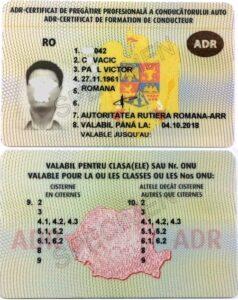
The drivers' ADR certificate of professional competence is made up of:
- The professional qualification for the carriage of dangerous goods of classes 2, 3, 4.1, 4.2, 4.3, 5.1, 5.2, 6.1, 6.2, 8, 9, other than in tanks, which is also known among drivers as the “ADR PACKAGES certificate”, and
- The specialisations*:
– Tanks
– Class 1 – Carriage of Explosive substances
– Class 7 – Carriage of Radioactive substances
*The specialisations can be obtained only after the basic qualification has been obtained.
3. The transport unit must be:
a. suitable for the carriage of dangerous goods
For the carriage of dangerous goods in tanks and in the case of explosive substances, the vehicles must be approved by the Registrul Auto Român – RAR (the Romanian Automotive Register).
The vehicles used for the carriage of dangerous goods in tanks must be of type AT and FL, and those for the carriage of explosive goods of type EXII and EXIII.
- “
FL vehicle” means:
- a vehicle intended for the carriage of liquids having a flash-point of not more than 60ºC (with the exception of diesel fuel complying with standard EN 590:2013 + A1:2017, gas oil and heating oil (light) – UN No. 1202 – with a flash-point as specified in standard EN 590:2013 + A1:2017), in fixed tanks or demountable tanks with a capacity exceeding 1 m3, or in tank-containers or portable tanks with an individual capacity exceeding 3 m3; or
- a vehicle intended for the carriage of flammable gases in fixed tanks or demountable tanks with a capacity exceeding 1 m3, or in tank-containers, portable tanks or MEGCs with an individual capacity exceeding 3 m3;
- a battery-vehicle with a capacity exceeding 1 m3, intended for the carriage of flammable gases; or
- a vehicle intended for the carriage of hydrogen peroxide, stabilized or in stabilized aqueous solution containing more than 60% hydrogen peroxide (Class 5.1, UN No. 2015), in fixed tanks or demountable tanks with a capacity exceeding 1 m3, or in tank-containers or portable tanks with an individual capacity exceeding 3 m3;
-
AT vehicle” means:
-
a vehicle, other than an EX/III or FL vehicle or a MEMU, intended for the carriage of dangerous substances in fixed tanks or demountable tanks with a capacity exceeding 1 m3, or in tank-containers, portable tanks or MEGCs with an individual capacity exceeding 3 m3; or
-
a battery-vehicle with a total capacity exceeding 1 m3, other than an FL vehicle.
-
“EX/II vehicle” or “EX/III vehicle” means a vehicle intended for the carriage of explosive substances or articles (Class 1);
b. fitted with general and personal protective equipment
All transport units must carry the following equipment on board:
-
for each vehicle, a wheel chock of a size suited to the maximum mass of the vehicle and to the diameter of the wheels,
-
two self-standing warning signs (reflective triangle, reflective cone or flashing lamp),
-
eye rinsing liquid (not required when explosive goods or gases are carried).
For each member of the vehicle crew:
-
a high-visibility vest,
-
a portable torch
-
a pair of protective gloves and
-
eye protection.
Additional equipment for certain classes:
-
an emergency escape mask for each member of the vehicle crew when goods identified by danger labels 2.3 or 6.1 are carried,
-
for dangerous goods with danger labels 3, 4.1, 4.3, 8 and 9:
-
A shovel,
-
A drain seal,
-
A collecting container,
-
c. fitted with a fire extinguisher/fire extinguishers
Transport units must be fitted with portable fire extinguishers suitable for fire classes A, B and C, depending on the maximum permissible mass of the transport unit:
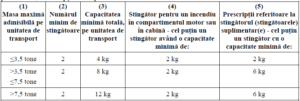
Transport units intended for dangerous goods in accordance with 1.1.3.6, that is, under 1000 points, must be fitted with one portable fire extinguisher for fire classes A, B and C, with a minimum capacity of 2 kg of dry powder (or an equivalent capacity for another acceptable extinguishing agent), suitable for fighting a fire in the engine or in the cab of the transport unit.
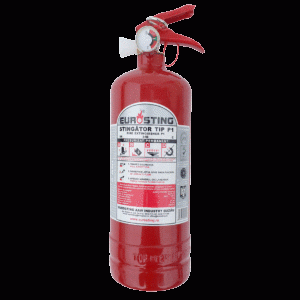
Portable fire extinguishers:
-
must be fitted with a seal which makes it possible to verify that they have not been used,
-
must be installed on the transport unit in such a way that they are easily accessible to the vehicle crew,
-
must be protected against the effects of the weather so that their operational capability is not affected,
-
during carriage, the expiry date (after the first inspection it is 1 year under the national rules) must not have passed.
d. fitted with reflective orange-coloured plates, placards and special marks, as applicable.
Reflective orange-coloured plates:
-
blank, for any carriage of dangerous goods in packages

- with numbers, for the carriage of dangerous goods in tanks, tank-containers or in bulk
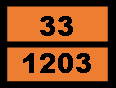
Example:

The dimensions of the orange-coloured plates are 40x30 cm with a black border of 15 mm. If there is not enough room for this size, the dimensions of the plate may be reduced to 30×12 cm with a black border of 10 mm.
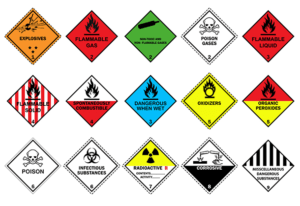
Placards and special marks are used for the carriage of dangerous goods in containers, tank-containers, tank-vehicles, battery-vehicles, bulk containers and vehicles for goods in bulk, and for packaged goods only if goods of classes 1 (explosives) and 7 (radioactive ) are carried.
Models of placards (the minimum dimensions are 250 mm x 250 mm):
Special marks:
- elevated temperature (minimum dimensions 250 x 250 x 250 mm)

- environmentally hazardous (minimum dimensions 250 x 250 mm)

4. The special documents required for the transport of dangerous goods
-
ADR vocational training certificate for the driver,
-
The CMR consignment note, completed with the data and information relating to the dangerous goods,
-
Certificate of approval – for the carriage of dangerous goods in tanks or for the carriage of explosive substances,
-
The container or vehicle packing certificate – for combined transport (with sea or air transport),
-
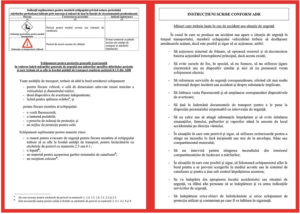
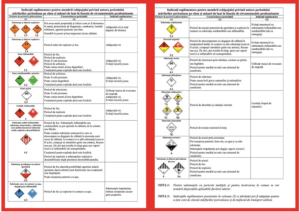
Instructions in writing in accordance with ADR:
-
They must be provided by the carrier to the members of the vehicle crew,
-
They must be on board the transport unit in the language(s) that each member can read and understand before the start of the journey,
-
The instructions in writing must correspond to the following four-page model as regards both their form and their contents.
-
5. A yellow “rotating beacon”
In accordance with Art.69 of OUG 195/2002, motor vehicles carrying dangerous goods must be fitted with the special yellow warning signals, and their drivers must keep them switched on for the entire time they are travelling on the public road.
We hope you find all this information useful. Whenever you need domestic and international freight transport, Honexpres is at your disposal!
Photo source: https://chemical.chemlinked.com/
Have something similar to move? Request a quote →
All guides in ADR dangerous goods by road (22)
Related services