Guides
Special heavy-load transport: from taking over the goods to the quote
AI Text written with AI assistance and checked by the editorial team. How we work with AI
Article translated automatically from Romanian and checked automatically. If there is any difference, the original prevails. See the original in Romanian · How we use automatic translation
In short
In special heavy-load transport, the exact data of the load, the right special vehicle and the permit in each country along the route decide feasibility and costs. In Romania, a special transport permit (AST) is required for this. With dimensions, weight, centre of gravity and photos supplied, you receive a solid quote sooner.
Contents
- When is a transport a heavy-load transport or a special transport?
- Typical goods in heavy-load and special transport
- Vehicles: which design for which load?
- Permits: the example of Romania
- Axle loads and transport project
- Escort and driver qualification
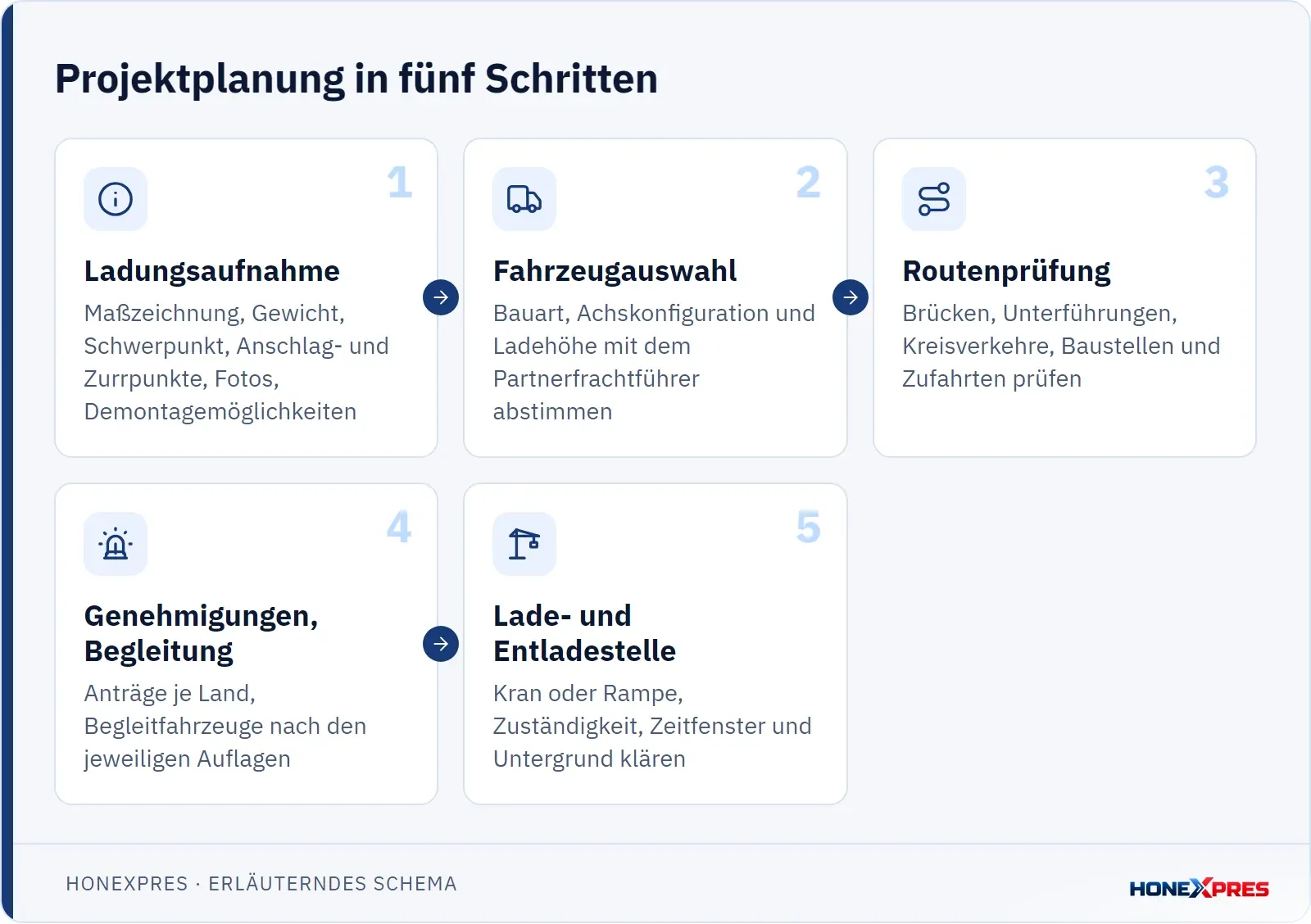
- Project planning in five steps
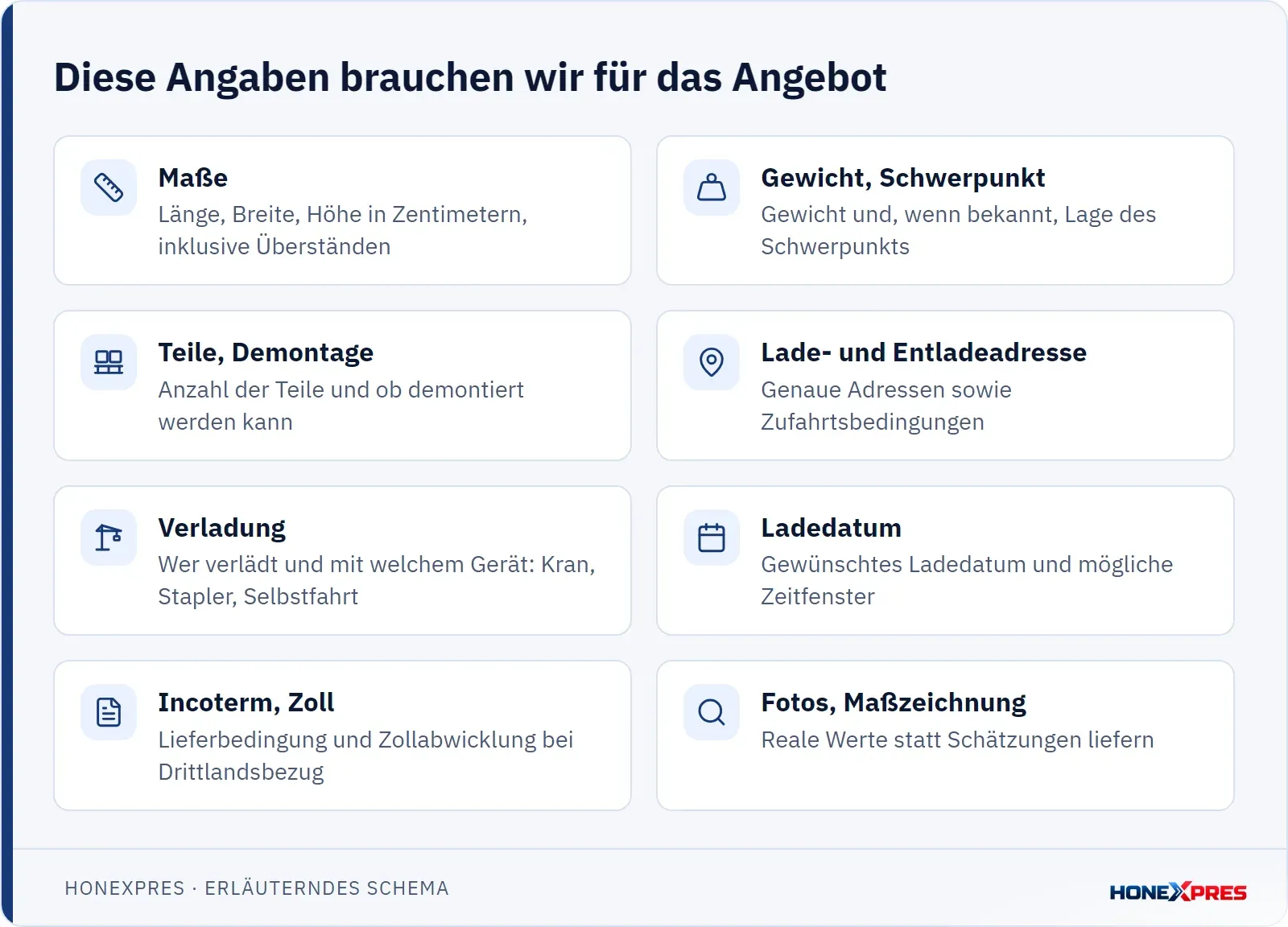
- What data we need for a solid quote
- Cost factors instead of a price list
- Load securing and mixed loads with dangerous goods
- Frequently asked questions
- Is a dismantled machine still considered an indivisible load?
- Can I also load other goods on the special vehicle?
- What happens if the vehicle changes at short notice?
- Do the Romanian limits also apply in Switzerland or Germany?
- Does HONEXPRES carry out the transport with its own vehicles?
- Request a special heavy-load transport
- Official sources consulted
In special heavy-load transport, three things decide feasibility and costs: the exact data of the load, the right special vehicle and the permits required for the route. If you send the dimensions, weight, centre of gravity and lashing points early and in full, you receive a solid quote sooner and avoid last-minute re-planning shortly before the loading date. As a freight forwarder based in Oradea, we organise such transports together with specialised partner carriers. From the consignor's perspective, this article shows how a project is structured and what information we need for it.
When is a transport a heavy-load transport or a special transport?
One speaks of a heavy-load transport or a special transport when the vehicle and the load exceed the permitted weights or dimensions. The limits and procedures are set by each country for its own road network. For Romania, this is regulated by Ordonanța Guvernului nr. 43/1997 privind regimul drumurilor (Government Ordinance No 43/1997 on the road regime). The Ordinance prohibits, on public roads, the circulation of vehicles that exceed the maximum permitted total weight, the maximum permitted axle loads or the maximum permitted dimensions, regardless of whether they are registered in Romania or in another state. [1]
A central notion is the indivisible load. This means a load which, for road transport, cannot be divided into two or more parts without unnecessary costs or a risk of damage. [2] For consignors of machinery, one rule in the Romanian implementing norms is particularly important: according to it, machinery is considered indivisible goods, even if it is transported with components dismantled. [3]
In Romania, a permit can also be issued for divisible loads, but only under certain conditions that must be met cumulatively. According to Government Ordinance No 43/1997, these include, among others, a maximum limit for exceeding the maximum permitted total weight; this provision has been amended. [1] You must check the limit value currently in force, the other conditions concerning dimensions and axle loads, and the current text of the regulation yourself, before planning, in the legal text in force or with the competent authority. In practice, this means that if a load can reasonably be divided, a normal transport is often the simpler solution.
Typical goods in heavy-load and special transport
- Machinery: construction, agricultural and industrial machinery, presses, machine tools, cranes. For construction machinery, the cab, the boom or the tracks often determine the critical height or width. You can find more information on our dedicated page on machinery transport.
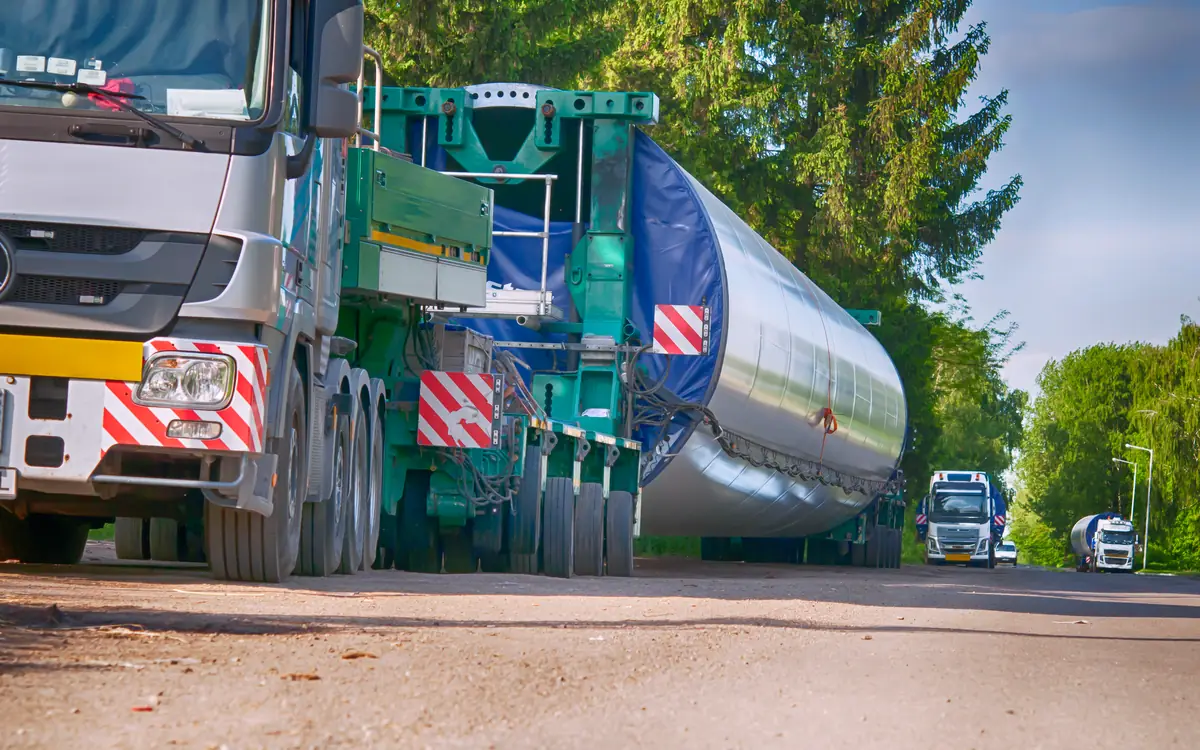
- Plant and plant components: transformers, turbine casings, steel-construction parts, production lines in modules. Here it must be clarified in good time whether dismantling is reasonable or whether the unit has to be transported as a whole.
- Vessels: silos, tanks, pressure vessels, heat exchangers. Relative to their volume they are often light, but very wide or tall. The diameter and the support points matter more here than the weight.
- Long goods: beams, pipes, precast elements for which length, not mass, is the issue.
Vehicles: which design for which load?
The choice of vehicle follows from the critical dimension of the load. Weight, height, length and width each require different solutions. Depending on the task, our partner carriers use, among others, the following designs:
| Vehicle type | Particularly suitable for | What to look out for |
|---|---|---|
| Low-bed semi-trailer | tall and heavy machinery, transformers | ground clearance, driving on and off, loading by crane or ramp |
| Semi-low semi-trailer | construction machinery, plant components of medium height | loading height and distribution of the load across the axles |
| Telescopic platform | long beams, pipes, precast elements | length when extended |
For telescopic vehicles, according to the Romanian implementing norms, the maximum dimension when extended is considered a construction dimension of the vehicle. [3] Romanian permits also describe the vehicle combination by axle configuration. Thus, for example, "AnSm" means a tractor unit with "n" axles pulling a semi-trailer with "m" axles. [2] For this reason, for your load we always also clarify with our partners the number of axles of the suitable combination. You will find technical details on vehicles and load securing in the article Technical requirements for heavy transports.
Permits: the example of Romania
In Romania, a vehicle with excess dimensions or weight may circulate only with a special transport permit issued in advance, the autorizația specială de transport (AST). [1] Through the AST, the road administrator sets the route, the traffic conditions and the fees payable. [1] It is issued by the administrator of the road on which the vehicle travels. [1]
The AST is closely tied to the data submitted in the application. It is valid only for the registration numbers entered, the technical characteristics, the route, the direction of travel, the period and the traffic conditions set. [1] If the vehicle, the dimensions or the date change, the existing permit may no longer cover the transport. For this reason, the data of the load should be established before the application.
The implementing norms are contained in Ordinul nr. 1.236/6.509/126/2018 (Order No 1.236/6.509/126/2018), published in Monitorul Oficial al României (Official Gazette of Romania) No 48 of 18 January 2019. [4] The consolidated version available to us was valid until 19 October 2024. [4] The values from these norms mentioned in this article reflect the situation in that version; always check the limits and procedures in the text currently in force.
Other countries: The Romanian norms regulate traffic on Romania's public road network. [2] For Switzerland, Germany, Austria, Hungary or other transit countries, the regulations there apply. You can obtain the binding limits, application procedures and conditions imposed from the competent authority in each case, or we clarify them together with our partners as part of the project planning.
Axle loads and transport project
In the version of the Romanian norms mentioned, the axle load that can be authorised may exceed the permitted axle load only to a limited extent: by at most 3.5 tonnes for a single axle, by 6.0 tonnes for a double (tandem) axle and by 7.0 tonnes for a triple (tridem) axle. [3] Beyond these limits, an AST can be issued for indivisible goods when the axle loads cannot technically be complied with; the basis is then a transport project. [3] For very heavy single pieces, the transport thus becomes an engineering project, with load distribution, sizing of the vehicle and verification of the route.
Escort and driver qualification
In Romania, the escorting of vehicles with excess dimensions is provided by specialised companies with authorised escort vehicles and trained personnel. [2] For drivers there is a certificate for oversized transports, issued by the Romanian road authority A.R.R. [5] The corresponding training covers, among other things, loading, axle loads, the centre of gravity and the stability of the vehicle. [5] For you, as the consignor, this means that what is decisive is a carrier equipped and qualified for this type of transport, not just any available vehicle.
Project planning in five steps
- Taking over the load details: drawing with dimensions, weight, centre of gravity, lashing and anchoring points, photos and, where applicable, dismantling options.
- Choice of vehicle: design, axle configuration and loading height, agreed with the partner carrier.
- Route check: bridges, underpasses, roundabouts, roadworks, access routes to the loading and unloading site.
- Permits and escort: applications in accordance with the regulations of each country involved, escort vehicles in accordance with the respective conditions.
- Loading and unloading site: crane or ramp, responsibility for lifting and securing, time windows, ground.
Who organises and pays for the crane, the loading and the unloading should be settled already in the sales contract. Incoterms determine which party is responsible for organising and paying for the transport, including ancillary services such as loading and unloading. [6] You will find an overview on our page about Incoterms® 2020.
What data we need for a solid quote
- the length, width and height of the load in centimetres, including protruding parts such as mirrors, arms or flanges
- the weight and, if known, the position of the centre of gravity
- the number of pieces and whether it can be dismantled
- the exact loading and unloading address, and the access conditions
- who loads and with what equipment (crane, forklift, the machine drives on by itself)
- the desired loading date and any possible time windows
- the delivery term (Incoterms) and any customs formalities in the case of a link with third countries
- photos and a drawing with dimensions
Estimated dimensions are risky, because the calculation is made with real values. In the Romanian tariff scheme, the real mass is decisive, established on the basis of documents or by weighing. [7] Likewise, the real dimensions are established on the basis of documents or by measurement. [7] If reality differs from the data provided, the permit, the vehicle and the calculation may need to be checked again.
Cost factors instead of a price list
For special transports there is no flat price per kilometre. The price depends on the following factors:
- Degree of excess: In the Romanian tariff scheme, excesses of the total weight, of the axle loads, and of the length, width and height are each calculated separately and according to distance. [7]
- Distance and route: Detours because of bridges or narrow areas lengthen the journey.
- The vehicle and the number of axles: Special vehicles are less readily available than standard semi-trailers.
- Escort: the number and type of escort vehicles, depending on the conditions imposed.
- The permits in each country and the effort involved.
- Lifting equipment and waiting times at the loading and unloading site.
- Empty runs of the special vehicle to the loading site.
The general cost factors in road freight transport are explained in the article How much does freight transport cost in 2026?.
Load securing and mixed loads with dangerous goods
Some machinery is transported together with dangerous goods, for example with operating materials or spare parts in packages. In this case, ADR 2025 requires at 7.5.7.1 that all goods be firmly secured, including heavy machinery or crates, so that no dangerous goods are released. [8] The requirements are considered met if the load is secured in accordance with the standard EN 12195-1:2010. [8] We clarify beforehand, as part of our offer for ADR dangerous goods transport, whether and how such goods can be transported together. For high-value loads it is also worth considering whether CARGO insurance is advisable.
Frequently asked questions
Is a dismantled machine still considered an indivisible load?
According to the Romanian implementing norms, yes: machinery is considered indivisible goods, even if some components are dismantled. [3] Check the current version with the competent authority, as well as the classification in other countries.
Can I also load other goods on the special vehicle?
In Romania, an additional load alongside the indivisible load is possible only under the conditions set in the implementing norms. Since the legal situation may have changed, we clarify each additional load beforehand on the basis of the current regulations and the specific permit.
What happens if the vehicle changes at short notice?
The Romanian AST is valid only for the registration numbers, technical characteristics, route and periods entered. [1] If the vehicle changes, the permit must therefore be checked and, where applicable, applied for again.
Do the Romanian limits also apply in Switzerland or Germany?
The Romanian norms regulate Romania's public road network. [2] For other countries, their own regulations apply; binding information is provided by the competent national authorities.
Does HONEXPRES carry out the transport with its own vehicles?
No. We are a freight forwarder without our own fleet. We plan and coordinate the transport and work with specialised partner carriers that have suitable vehicles.
Request a special heavy-load transport
Are you planning a heavy-load transport or a special transport for a machine, a plant component or a vessel? Send us the dimensions, weight, photos, loading and unloading site and the desired date. Together with our partners, we check the vehicle, the route and whether permits are required. You will find details of our range of services at Heavy transport in Romania and internationally. You can send your request directly via the Request a quote form.
Official sources consulted
- [1] Ordonanța Guvernului nr. 43/1997 privind regimul drumurilor (Government Ordinance No 43/1997 on the road regime), art. 41 para. 1
- [2] Norms implementing Order No 1.236/6.509/126/2018, art. 2 point 11 (indivisible load)
- [3] Norms implementing Order No 1.236/6.509/126/2018, art. 11 para. 2
- [4] Order No 1.236/6.509/126/2018, introductory notes (publication)
- [5] Order No 1.214/2015, norms on the training of drivers for oversized transports, art. 6 para. 8
- [6] INCOTERMS 2020, introduction (key aspects of the rules)
- [7] Order No 1.836/2018, tariff table, legend (real mass)
- [8] ADR 2025, 7.5.7.1 (handling and stowage)
Send us the dimensions, weight and photos of your load, and together with specialised partner carriers we will organise a quote for your special heavy-load transport.
Have something similar to move? Request a quote →
Related services