Guides
EORI Code: What It Is, Who Needs One and How to Use It in Customs
AI Text written with AI assistance and checked by the editorial team. How we work with AI
Article translated automatically from Romanian and checked automatically. If there is any difference, the original prevails. See the original in Romanian · How we use automatic translation
In short
The EORI code is the registration and identification number of economic operators in their dealings with customs. Each person has a single EORI number, made up of the country code and a national identifier. The number appears in customs declarations. It is assigned by the competent customs authority; the procedure and any costs should be checked with the customs authority.
Contents
- What the EORI code is
- EORI number format: what a valid code looks like
- Frequent format mistakes
- What data the EORI registration contains
- Who needs an EORI number
- The EORI code in customs: where it appears in declarations
- On import
- On export
- In summary declarations and in transit
- How to obtain an EORI code in Romania
- Free EORI code? What you can state with certainty
- Validity, changes and deletion of the registration
- How the EORI code relates to the rest of the transport documentation
- The role of a freight forwarder
- Frequently asked questions about the EORI code
- Can I have several EORI codes for my company?
- How many characters does an EORI number have?
- Is the EORI code the same as the VAT code?
- What happens if the exporter does not have an EORI code?
- Does the customs broker use my EORI code or its own?
- Does the EORI code expire?
- Preparing an import or export operation?
- Official sources consulted
Your first import from China, your first delivery to a customer in Switzerland or the United Kingdom, and your customs broker asks you for the “EORI code”. For many companies this is the first encounter with this number, and it usually comes up just when the goods have to leave or be cleared. The guide below explains what the EORI code is, what a valid EORI number looks like, what data the registration contains, where it appears in customs declarations and what to check before applying for an EORI code in Romania. The explanations are based on the Union Customs Code and the regulations supplementing it. Where the official texts do not cover a detail of national procedure, we refer you to the competent source.
What the EORI code is
EORI stands for the registration and identification number of economic operators, that is, the identifier used by customs authorities in their dealings with companies and persons carrying out customs operations [1]. The applicable rules are found in Regulation (EU) No 952/2013 (the Union Customs Code), in Delegated Regulation (EU) 2015/2446 and in Implementing Regulation (EU) 2015/2447. The latter starts from the idea that each economic operator must have a single EORI number and that clear rules are needed on the customs authority competent to assign it [2].
The principle is stated explicitly: each person is assigned a single EORI number [3]. Your company therefore does not have one EORI code for import and another for export, nor one for each customs office. The same number identifies you in all customs operations.
EORI data are stored and exchanged between administrations through a common electronic system, called the “EORI system” [3]. Through this system, the competent customs authority makes information available every time it assigns a new number or when the data of an existing registration change [3]. A number assigned in one Member State can thus also be known to the customs authorities of another Member State.
EORI number format: what a valid code looks like
The structure of the number is set out in Annex 12-01 to Implementing Regulation (EU) 2015/2447 [3]. The EORI number has two fields: the Member State identifier, that is, the country code, and an identifier that is unique within that Member State [4].
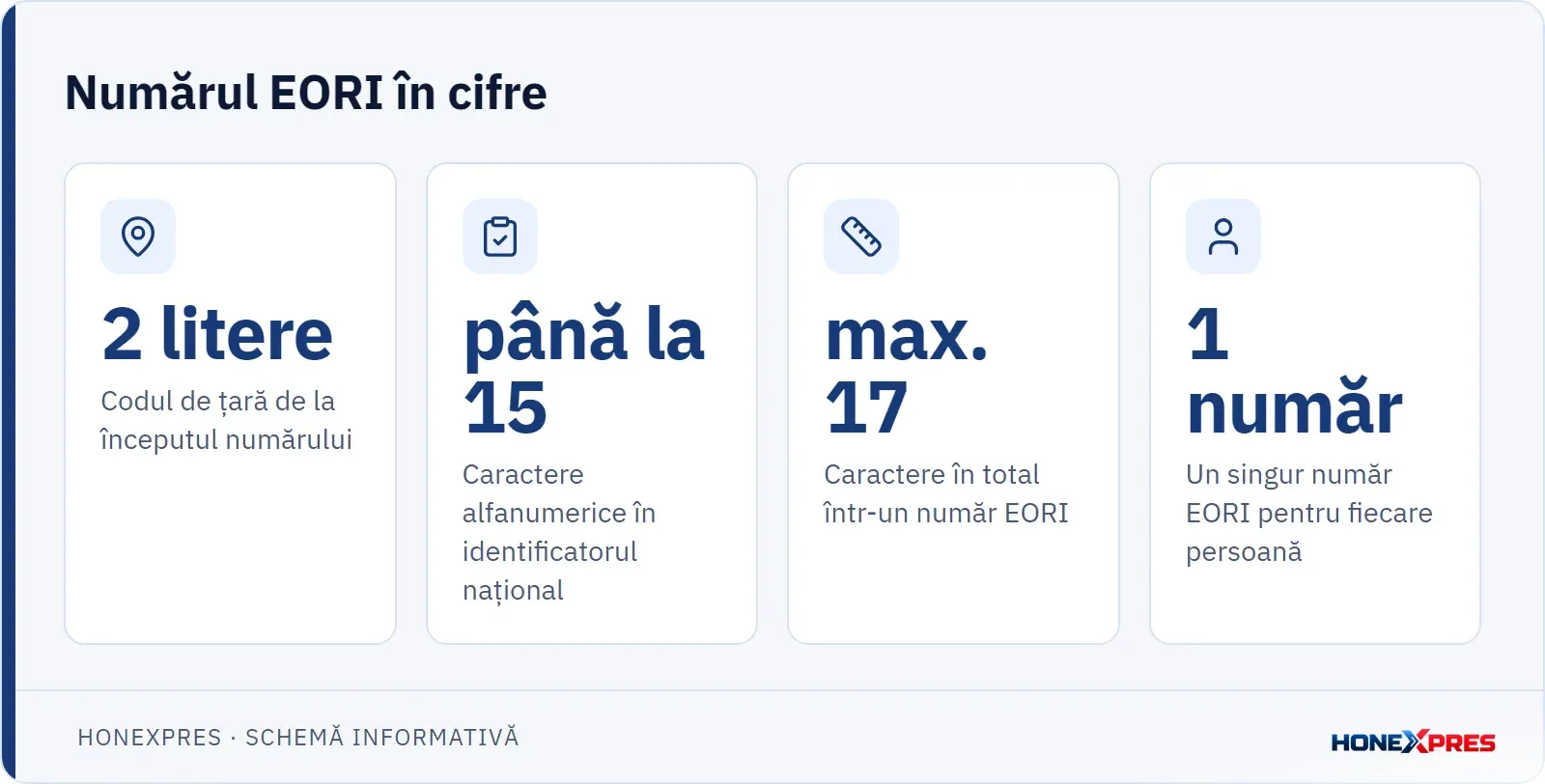
| Field | Content | Format | What it means in practice |
|---|---|---|---|
| 1 | Member State identifier (country code) | a2 | Exactly 2 letters |
| 2 | Identifier unique within a Member State | an..15 | Up to 15 alphanumeric characters |
The country code is based on the ISO alpha-2 codes, insofar as these are compatible with the country nomenclature used in Union statistics [5]. In the notation used in the regulation, the two dots (“..”) show that the element does not have a fixed length and can have up to the number of characters indicated [4]. In total, an EORI number has at most 17 characters: 2 letters for the country and up to 15 characters for the national identifier.
How the national part is formed is determined by the customs authority. Do not assume that a particular combination is correct just because “that is how it is usually done”. Use the exact number from the decision or confirmation you received.
Frequent format mistakes
- Missing country prefix: only the numeric part is sent, without the two letters at the start.
- Spaces, full stops or hyphens inserted for readability. In electronic systems, these can make the number unrecognisable.
- Confusion with the VAT code. The two are distinct data elements in the EORI registration, even if for some companies they may look alike.
- Using the number of another entity in the group, for example that of the parent company, although the importer on the invoice is a different company.
What data the EORI registration contains
Annex 12-01 to Delegated Regulation (EU) 2015/2446 establishes the common data set for the registration of economic operators and other persons. Some data are marked “A”, meaning mandatory and required by every Member State. Others are marked “B”, meaning optional, and each Member State decides whether to request them [6].
| Data element | Status | Notes |
|---|---|---|
| EORI number | A | The identifier itself |
| Full name of the person | A | The name in the trade register or the name in the identity document |
| Address of establishment/residence | A | The full address, including the country code |
| Establishment in the customs territory of the Union | A | Used only for operators domiciled in a third country |
| VAT identification number(s) | A | If they have been assigned |
| Legal status, contact details, date of establishment, type of person, main activity | B | As decided by the Member State |
| Unique identification number granted by a third country | B | For persons not established in the EU |
| Consent to disclosure of certain data | A | It is indicated whether consent has been given or not |
| Short name | A | — |
| Start date and expiry date of the EORI number | A | The validity period of the registration |
For economic operators entered in the business register, the registered name is the legal name in the trade register of the country of establishment [6]. For natural persons, the name used is the one in the valid travel document or in the national population register of the State of residence [6]. It is therefore important that the name on invoices, in contracts and in declarations matches the one in the trade register.
The VAT code is entered in the registration if it has been assigned by the Member States [6]. The main economic activity is expressed by the NACE code at 4-digit level, as it appears in the trade register [5]. The “type of person” field distinguishes between a natural person, a legal person and an association of persons without legal personality but recognised as having the capacity to perform legal acts [5].
Who needs an EORI number
The most useful way to answer this question is to follow the roles in which the EORI number actually appears in customs documents. In the detailed rules on the data elements of declarations, the EORI number appears for the exporter, the declarant or representative, the consignee, the person lodging the summary declaration and, in certain situations, the carrier [8] [9] [10].
- The exporter, that is, the company that declares the goods for export or on whose behalf the declaration is made. The EORI number is indicated against its name [8].
- The declarant or customs representative, when this is a person other than the exporter or the consignee. Its identification is made by means of the EORI number [9]. A customs broker therefore has its own EORI code, separate from that of the client.
- The importer, whose identification appears in the import customs declaration under the element “Importer – Identification number” [11].
- The person lodging the entry or exit summary declaration. This person is identified by the EORI number, without name and address [8].
- The carrier, in certain cases. For example, the carrier’s EORI number is indicated if the carrier is connected to the customs system and wishes to receive the notifications provided for in the regulation [10].
EORI registration may also concern persons who are not established in the customs territory of the Union. For these, the data set includes a dedicated field for establishment in the Union and one for the identification number granted by a third country for customs purposes [6]. For natural persons there is a separate code in the “type of person” field [5].
The exact list of those required to register, with the exceptions and special cases, is not detailed here. If you are not sure whether your company falls into this category, consult the current text of Union customs legislation or the customs authority. A customs broker can help you clarify the situation before the first operation.
The EORI code in customs: where it appears in declarations
For anyone searching for “EORI code customs”, the practical side is this: the number is not a stand-alone document, but an identification data element entered in the electronic messages sent to the customs authority.
On import
In Romania, import declarations are drawn up in the National Import System. The technical rules for the use of this system define EORI as the registration and identification number of economic operators [1]. The import customs declaration is drawn up electronically and contains the data elements provided for in Annex B to Delegated Regulation (EU) 2015/2446 [1]. The formats and codes of these elements are set out in Implementing Regulation (EU) 2015/2447 [7].
A concrete example shows why the correct number matters. For the deferral of VAT payment in customs by an importer holding an authorisation for entry in the declarant’s records (EIR), the technical rules require, among other things, that the EORI number be entered in the data element “Importer – Identification number” [11]. One of the cumulative conditions is that the importer’s EORI number be the same as the declarant’s [11]. A mismatch at this level may mean that the facility does not apply. You will find more on the import document in the guide on the import customs declaration.
On export
In the rules on the data elements of the export declaration, the EORI number is indicated against the exporter [8]. The same rules provide that, if the exporter does not have an EORI number, the customs administration may assign it an ad hoc number for that declaration [8]. The provision appears in the transitional rules of Delegated Regulation (EU) 2016/341. Do not rely on it as a routine solution. Check whether it still applies and, more simply, obtain the EORI number before the first shipment. The general steps of an operation are described in the article on customs formalities for import and export.
In summary declarations and in transit
For several parties in entry summary declarations, such as the consignee, the consignor or the party to be notified, the rule is the same. The EORI number is used when the person lodging the declaration has it. Otherwise, the full name and address are indicated [9]. If the EORI number is used, the name and address are no longer provided [9]. A correct EORI number, communicated in good time to the carrier or agent, therefore simplifies the data circulating through the system. For transit operations, see also the guide on external Community transit T1.
How to obtain an EORI code in Romania
The EORI number is assigned by the competent customs authority, and Union regulations require clear rules on the authority that makes this assignment [2]. After assignment, the data are uploaded to the common EORI system [3].
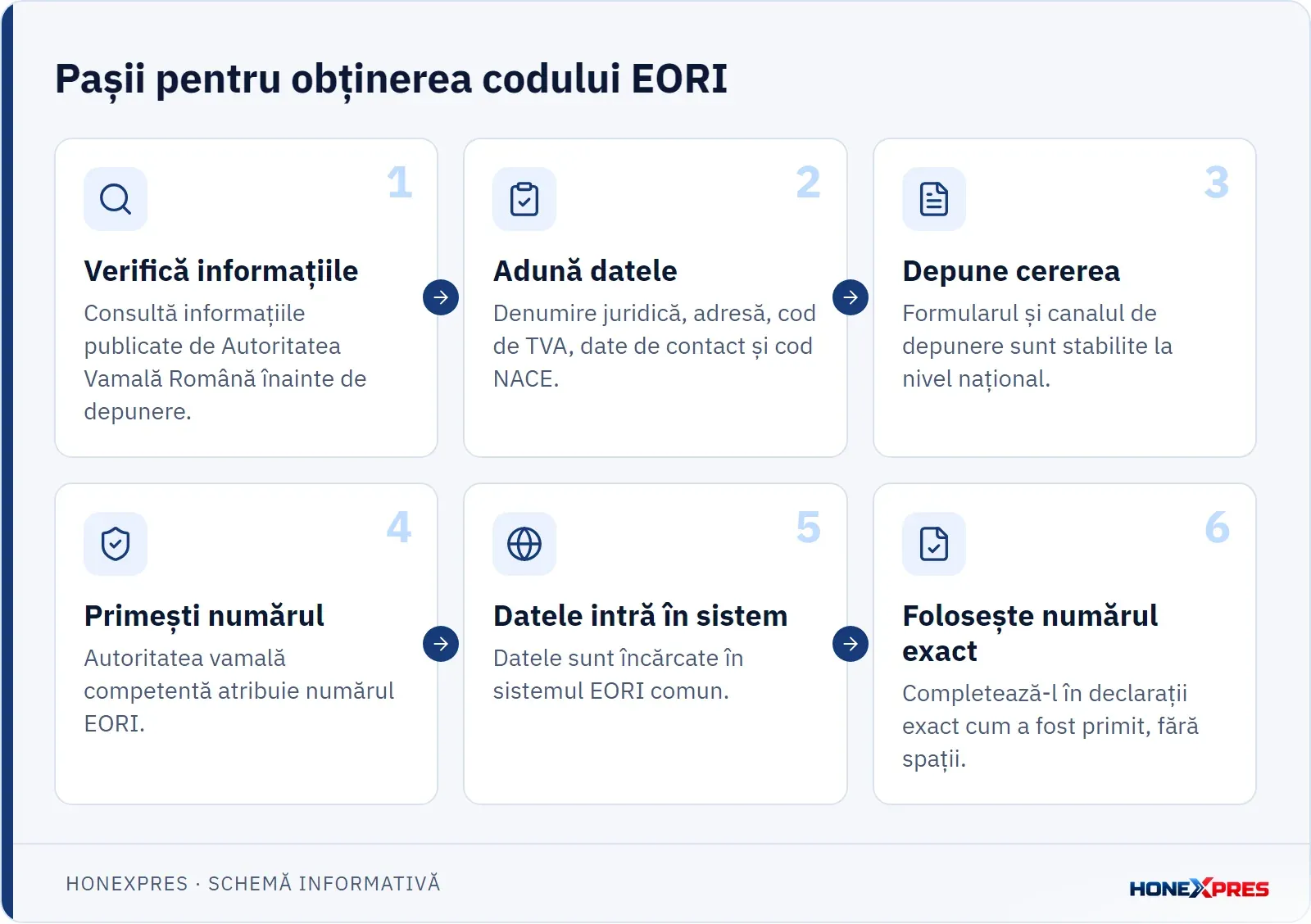
The form, the submission channel (online or at the counter), the accompanying documents and the processing time are set at national level. We do not describe them in detail here, because they may change. Before submitting, consult the information published by the Autoritatea Vamală Română (the Romanian Customs Authority). As preparation, you can gather in advance the data that will be requested in any case, according to the common set in Annex 12-01:
- The exact legal name, as it appears in the trade register [6].
- The full address of establishment, including the country code [6].
- The VAT registration code, if the company has one [6].
- Contact details: contact person, address, telephone or e-mail [6].
- The NACE code of the main activity, at 4-digit level [5].
- The option on publication of data: whether you agree to the EORI number, name and address being published [6].
The last item is recorded as the option “to be published” or “not to be published” [5]. You should check with the customs authority what practical effects each option has.
Planning tip: do not leave the application until the last minute. If the goods have already arrived at the port or the customs office, the lack of the number can block the lodging of the declaration. In the meantime, waiting or storage costs may arise, which are not related to transport but to the delay.
Free EORI code? What you can state with certainty
“Free EORI code” is one of the most frequent searches. The cautious answer: the Union regulations analysed here govern the assignment, uniqueness, format and data of the registration, but contain no provisions on an assignment fee. Whether the procedure in Romania involves any cost or not should be checked directly with the Autoritatea Vamală Română.
On the other hand, consultancy firms may offer, for a fee, the service of completing and submitting the application on your behalf. This is an assistance service, not a fee for the EORI number itself. Before paying for “obtaining the EORI code”, ask what exactly you will receive and check whether you can submit the application yourself.
Validity, changes and deletion of the registration
The EORI registration contains a start date and an expiry date of the validity of the number, both mandatory elements [6]. Dates are stored in year-month-day format [4]. If the company’s data change (registered office, name, VAT code), the customs authority makes the changes available through the EORI system [3]. It is in your interest to communicate them, so that declarations are not rejected for inconsistencies.
Even after the number expires, the registration does not disappear immediately: it can be removed only 10 years after the expiry date [6]. Reactivation or the assignment of a new number to the same person should be clarified with the customs authority, bearing in mind the rule of a single EORI number per person [3].
How the EORI code relates to the rest of the transport documentation
The EORI number does not replace commercial and transport documents, but supplements them. For clearance without delays, the data must be consistent across all documents:
- The commercial invoice: the name and address of the exporter or importer identical to those in the trade register and in the EORI registration.
- The transport document (CMR, bill of lading, AWB): the parties named must match those in the customs declaration. For bills of lading “to order, endorsed in blank”, special rules apply to the consignee and to the party to be notified [10]. You will find details on this document in the article on the bill of lading.
- The Incoterms rule chosen: it shows who handles export and import formalities and, implicitly, whose EORI number appears in each declaration. See also the Incoterms guide.
For the specialist terms used in customs and freight forwarding, you can also consult the glossary of transport, freight forwarding and customs.
The role of a freight forwarder
HONEXPRES is a freight forwarder. We organise shipments together with partner carriers and coordinate, through customs brokers, import, export and transit formalities. We do not assign EORI codes and we do not submit EORI registration applications. What we can do is tell clients, before loading, what identification data must be prepared, whose EORI number will appear in the declaration and what must be checked on the invoice and on the transport document. You will find more on this at the customs services we organise.
Frequently asked questions about the EORI code
Can I have several EORI codes for my company?
No. Each person is assigned a single EORI number [3]. The same number is used for all customs operations, regardless of the Member State in which the declaration is lodged.
How many characters does an EORI number have?
At most 17: two letters for the Member State code and up to 15 alphanumeric characters for the national identifier [4] [5].
Is the EORI code the same as the VAT code?
No. The VAT code is a separate data element of the EORI registration, completed if it has been assigned [6]. The two numbers may look alike, but they have different roles and must not be confused in declarations.
What happens if the exporter does not have an EORI code?
The transitional rules on the export declaration provided that the customs administration may assign an ad hoc number for that declaration [8]. However, check whether this possibility currently applies and do not rely on it. The safe option is to obtain the EORI number before the first operation.
Does the customs broker use my EORI code or its own?
Both, in different boxes. The declarant or representative is identified by its own EORI number [9], while the importer or exporter is identified by its number. For some facilities, such as the deferral of VAT payment under the EIR scheme, the national rules require specific conditions on the match between these numbers [11].
Does the EORI code expire?
The registration has a start date and an expiry date of validity [6]. After expiry, the data can be removed from the system only after 10 years [6]. The status of a specific number should be checked with the customs authority.
Preparing an import or export operation?
If you have the EORI code and want to organise a non-EU shipment by road, sea or air, send us the details of the goods, the route and the Incoterms condition. We will tell you what information must be prepared for clearance and organise the transport with our partners. Request a transport quote, and we will come back to you with the solution suited to your goods.
Official sources consulted
- [1] Ordinul nr. 2.478/2025 pentru aprobarea Normelor tehnice de utilizare a Sistemului național de import (Order No 2,478/2025 approving the Technical Rules for the use of the National Import System), art. 4 point (e)
- [2] Implementing Regulation (EU) 2015/2447, recital (5)
- [3] Implementing Regulation (EU) 2015/2447, art. 7(2)
- [4] Implementing Regulation (EU) 2015/2447, Annex 12-01, Title II, code 1 “EORI number”
- [5] Implementing Regulation (EU) 2015/2447, Annex 12-01, Title II, code 1 “EORI number”
- [6] Delegated Regulation (EU) 2015/2446, Annex 12-01, Title I, Chapter 2, Section 2
- [7] Delegated Regulation (EU) 2015/2446, Annex B, Title I, Chapter 1, Note 14
- [8] Delegated Regulation (EU) 2016/341 (transitional rules), Annex 9 – explanatory notes, element “Consignor/exporter”
- [9] Delegated Regulation (EU) 2016/341 (transitional rules), Annex 9 – explanatory notes, element “Declarant/representative”
- [10] Delegated Regulation (EU) 2016/341 (transitional rules), Annex 9 – explanatory notes, element “Carrier”
- [11] Ordinul nr. 2.478/2025 (Order No 2,478/2025), Technical Rules for the use of the National Import System, art. 73(1)
Do you have a non-EU import or export and want to know what customs data must be prepared? Send us the details of the shipment and we will organise everything with our partners.
Have something similar to move? Request a quote →
Related services