Customs procedures · Legislation and customs
The customs procedure for T1 external Community transit
Article translated automatically from Romanian and checked automatically. If there is any difference, the original prevails. See the original in Romanian · How we use automatic translation

In short
Customs transit is a procedure under which goods are carried, under customs control, between two points of a customs territory through another customs territory. When we talk about transit in the European Union, there are two types of procedure – T2 internal transit procedures and T1 external transit procedures. How is the T1 external transit declaration used?
Contents
Customs transit is a procedure under which goods are carried, under customs control, between two points of a customs territory through another customs territory. When we talk about transit in the European Union, there are two types of procedure – T2 internal transit procedures and T1 external transit procedures. How is the T1 external transit declaration used? Find out everything from this Honexpres article!
The T1 transit procedure
So, T1 customs documents represent one type of transit procedure. This type of transit ensures that non-Community goods are carried without import duties in the EU, the EFTA states and other agreed areas. These duties are not due until the goods arrive in the country of destination.
The most important thing to understand about the T1 procedure is that it is used mainly for import goods from outside the EU. This means that the goods were not manufactured in the EU but are to be carried across national borders within Europe. Transport through a third country of transit is also possible with the T1 document.
The T1 transit procedure is started at the customs office of the place of departure. Certain details are needed to apply for and create this document: information about the consignor and the consignee, the number of packages and their total weight, the number of labels, the customs tariff, etc. In this way the goods can be tracked throughout the transport.
After registration with customs, you have seven days to present your goods at the customs office concerned. Here the goods will be examined, and the consignor and the consignee will be identified. For the T1 transit procedure you will also have to leave a deposit by way of guarantee. This deposit should cover the estimated costs of the import duties due in the country of destination. You can cover this guarantee deposit in cash, by certain commercial documents or by a surety. If you work with a customs broker, the broker will take care of the deposit, making your task easier.
There are also certain simplified procedures, but these are acceptable only for authorised consignors or consignees. During customs clearance in the country of destination, the T1 transit procedure will be closed. After the goods have been presented at the customs office of destination, you will receive a dispatch note and a security note. The goods can then be released for free circulation.
Obtaining the T1 transit declaration
To obtain a T1 transit declaration, you must present documents such as:
- the commercial invoice or pro forma invoice for the goods carried,
- the packing list of the goods,
- the transport document (CMR),
- confirmation of the export authorisation,
- the certificate of origin of the goods and other certificates, where applicable.
The T1 transit declaration is lodged at the customs office of departure in electronic form or, in specific cases, on paper. Once it has been accepted, an MRN reference number (Master Reference Number) is generated in the NCTS customs system (New Computerized Transit System) .
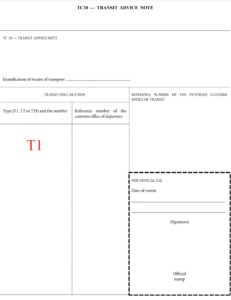
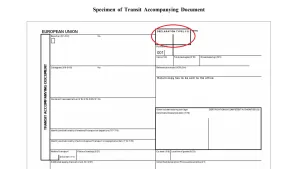
Once the goods have been released for transit, the customs system generates a TAD (Transit Accompanying Document) and a List of Items carried. In the box “Declaration type (1/3)”, the transit code T1 must be entered. The TAD (and sometimes the List of Items) must accompany the goods to the office of destination.
Below we show a specimen of the TAD accompanying document for the goods:
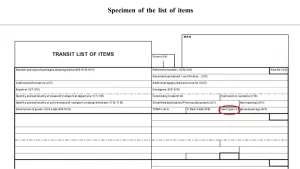
The List of Items (LoI – List of Items) is a customs document that accompanies the TAD. This customs document indicates the type of goods. At the top of the form, in the box “Declaration type (1/3)”, the code T1 is entered once again. Here is a specimen LoI document below:
Complete transport – from consignor to consignee
When you need a professional freight forwarder to take care of your complete transport, with everything the customs procedures involve, from the consignor to the consignee, choose Honexpres! We have a trained and experienced team to handle your entire transport, plus the logistics resources and connections needed to make sure you benefit from the best transit times and the friendliest rate.
Honexpres – the ideal choice for organising a domestic or international transport!
Have something similar to move? Request a quote →
All guides in Customs procedures (6)
Related services