Guides
Special transport vehicles: which vehicle to choose, which permits matter and how to request a quote
AI Text written with AI assistance and checked by the editorial team. How we work with AI
Article translated automatically from Romanian and checked automatically. If there is any difference, the original prevails. See the original in Romanian · How we use automatic translation

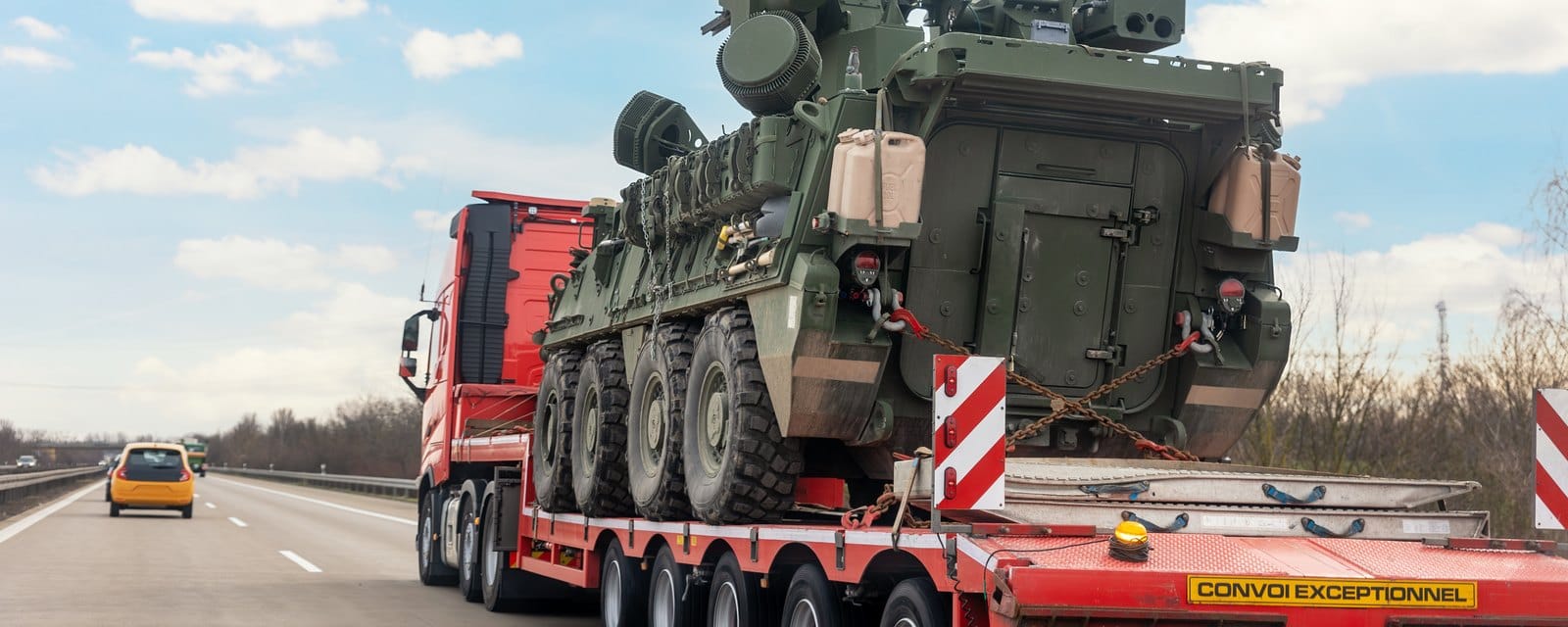
Illustrative photo: DAF tractor unit with a lowered semi-trailer (low bed) for oversized transport, travelling on a national road int.
In short
Special transport vehicles are vehicles and trailers built or equipped for goods that a standard lorry cannot carry: heavy machinery, long items, bulk liquids, temperature-controlled goods. The choice starts from the dimensions and weight of the goods. For a quote, you send dimensions, weight, loading and unloading points and handling requirements.
Contents
- What “special transport vehicles” means in practice
- The main types of special freight vehicles
- Low bed (well-type trailer)
- Semi-low loader
- Extendable platforms and trailers
- Flatbed and trailers for specific goods
- Tankers
- Refrigerated vehicles
- Crane trucks (self-loading trucks)
- Indicative table: which vehicle for which goods
- Weight and dimension limits: why there are no figures in this article
- Permits and documents that matter for special transport vehicles
- Oversized transport: vehicle, driver, route
- Tankers and vehicles for dangerous goods
- Documents for any transport for hire or reward
- Load securing
- What influences the cost of a transport with special vehicles
- How to request a quote for special transport vehicles
- What HONEXPRES does and does not do
- Frequently asked questions
- How do I know whether my goods require a special vehicle or fit on an ordinary platform?
- Who deals with the permits: me or the carrier?
- Can a tanker carry any dangerous liquid?
- Can I send a machine on a crane truck instead of a low bed?
- How long does it take to organise an oversized transport?
- Request a quote for your special transport
- Official sources consulted
An excavator, a transformer, a very long steel beam, a bulk liquid or a consignment that must be kept at a controlled temperature cannot be loaded into an ordinary curtain-sider semi-trailer. For these there are special transport vehicles: vehicles and trailers built or equipped for a specific type of load. If you choose the wrong vehicle, the result can be stops at roadside checks, refused loading, damaged goods or a quote that has to be redone from scratch. In the guide below we explain which types of special freight vehicles exist, when each is used, which documents and permits matter and what information you need to send for an accurate quote. HONEXPRES, a freight forwarder based in Oradea, has no fleet of its own. We organise these transports with partner carriers that own the right equipment.
What “special transport vehicles” means in practice
Romanian road legislation does not use a single category called “special transport”. It defines road vehicles and classifies transport operations by the nature of the goods. Ordinața Guvernului nr. 27/2011 privind transporturile (Government Ordinance No 27/2011 on transport) defines a trailer as a road vehicle without an engine, built to be towed by a motor vehicle. A semi-trailer is defined as a towed vehicle coupled to a tractor unit in such a way that a significant vertical force is exerted on the latter [1]. The same ordinance divides road freight transport into several types: general goods, perishable goods, dangerous goods and waste, waste, live animals and oversized transport [2].
This classification gives rise to three families of needs that usually call for special equipment:
- the goods exceed the permitted weights or dimensions, i.e. oversized transport, defined as road transport carried out in excess of the maximum permitted weights and/or dimensions [1];
- dangerous goods carried as liquid or gas in bulk, which travel in tanks subject to the ADR rules;
- perishable goods, which require temperature-controlled vehicles.
To these are added vehicles with their own loading equipment, for example crane trucks, and those adapted to specific goods: steel coils, cars, light bulk materials.
The main types of special freight vehicles
For each type of vehicle described below, the usable dimensions and indicative payloads are given in the data sheets in our Truck and semi-trailer types section. There you can compare them directly with the dimensions of your goods. In this article we do not repeat the figures, because they differ from one vehicle model to another and must be confirmed for each specific unit.
Low bed (well-type trailer)
A low bed has its loading platform lowered very close to the ground, usually with a well between the gooseneck and the axle assembly. The gain in height makes it possible to carry tall, heavy machinery: excavators, bulldozers, crawler cranes, industrial equipment. Use it when the total height of the goods loaded on the vehicle would exceed the limit permitted on an ordinary platform, or when the concentrated weight requires more axles. You will find technical details in the data sheet Low bed (well-type trailer).
Semi-low loader
A semi-low loader has a lower platform than a standard semi-trailer, but without the deep well of a low bed. It suits medium-sized machinery, agricultural machines and equipment that drives up on its own ramps. In many cases it is the middle solution: the goods do not fit within the loading gauge of a standard platform, but do not justify a low bed either.
Extendable platforms and trailers
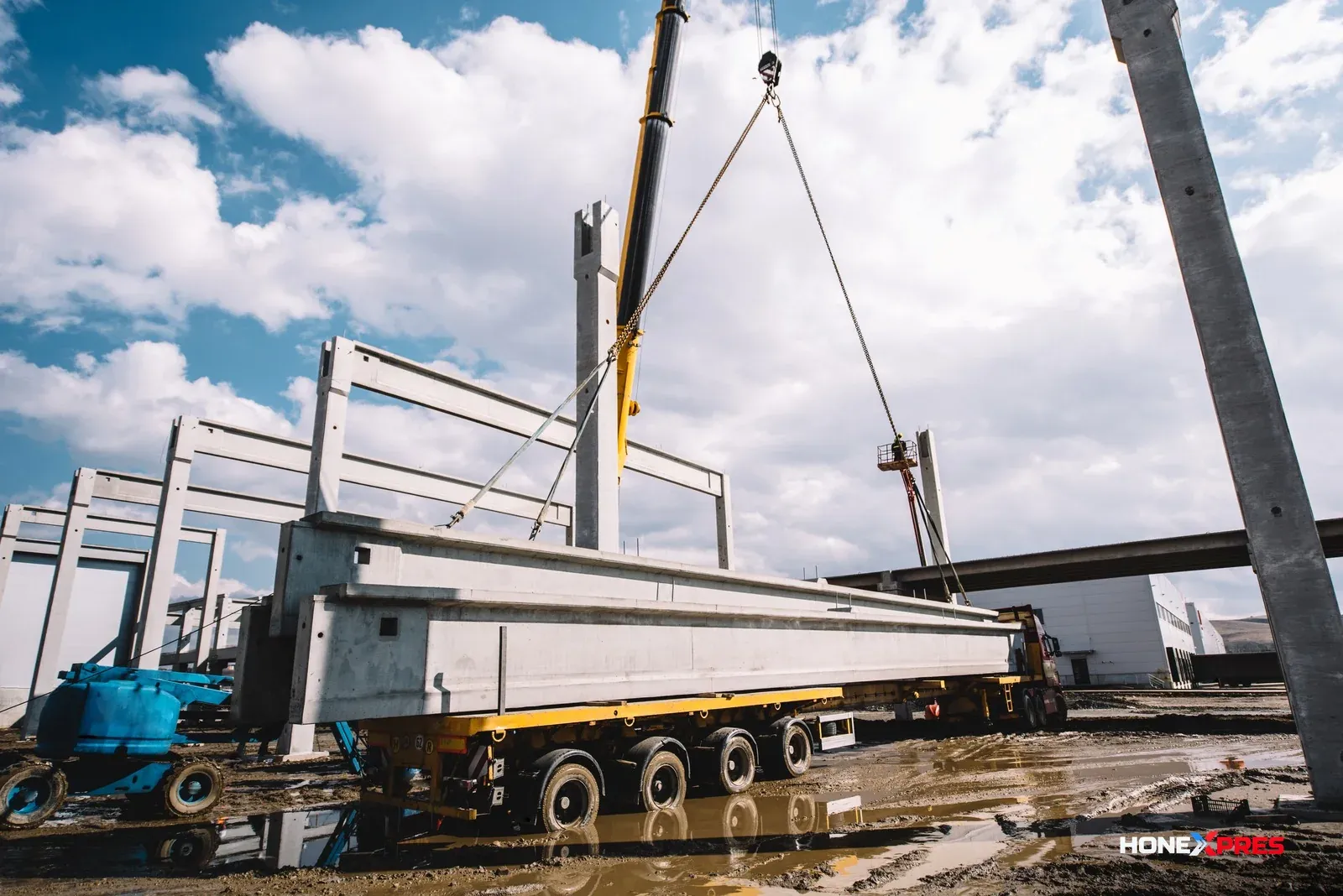
Extendable trailers can increase their length to carry long items: beams, poles, precast elements, pipes, blades or structural sections. The official training programme for oversized-transport drivers explicitly mentions, among the special systems of these vehicles, the steering, suspension and towing systems and the systems for adjusting the length of the vehicle [4]. For long loads it also matters how the weight is distributed along the length and how far the goods project at the front or rear. See the data sheet Extendable platform.
Flatbed and trailers for specific goods
The open flatbed is the basis of many special transports that do not exceed the loading gauge: steel sections, structures, industrial packaging loaded from above or from the side. For goods with an unusual shape there are dedicated trailers: the semi-trailer for steel coils, with a trough in the floor; the car transporter for cars and vans; the walking-floor semi-trailer for light bulk and biomass. Whether a particular transport with these trailers requires additional permits is checked with the competent authority in each case. These trailers do, however, reduce the risk of damage and loading time.
Tankers
Tankers carry liquids, gases, powders or granules. For dangerous goods, ADR 2025 specifies that the provisions of Chapter 4.3 apply to fixed tanks (tank vehicles), demountable tanks and tank containers used for gaseous, liquid, powdery or granular substances [6]. Not every tank can take every product. A substance subject to ADR may be carried in a tank only if a tank code is provided in column (12) of Table A in Chapter 3.2 [6]. The vehicle's approval certificate states which dangerous goods are authorised. Only substances that do not risk reacting dangerously with the materials of the shell, the gaskets and the equipment may be carried [7]. You will find more about equipment in the data sheet ADR tanker.
Refrigerated vehicles
Refrigerated semi-trailers (reefers) maintain a set temperature range throughout the transport. You use them for food, pharmaceutical products or any temperature-sensitive goods. The carriage of perishable goods is a distinct type of road transport in Government Ordinance No 27/2011 [2]. For the approval requirements for vehicles intended for perishable products, read our article on approval for the transport of perishable products and check the text in force with the competent authority.
Crane trucks (self-loading trucks)
A truck with a loading arm mounted on the chassis lifts the goods itself from the ground or from a ramp. You choose it when there is no forklift, overhead crane or crane at the loading or unloading point: building sites, deliveries of construction materials, equipment relocations in places without facilities. The lifting capacity decreases with the distance the arm extends. That is why the carrier needs the weight of the item and the distance at which it has to be placed. The requirements for inspecting lifting equipment and for operator qualification are confirmed with the carrier and with the competent authority.
Indicative table: which vehicle for which goods
| Goods | Starting vehicle | What to check before ordering |
|---|---|---|
| Tracked construction machine, tall and heavy | Low bed | Total height on the vehicle, weight, lashing points, access to the loading site |
| Medium-sized agricultural or industrial machinery | Semi-low loader | Width, height, whether it drives up on its own ramp |
| Beams, poles, long precast elements | Extendable platform | Total length, support points, projection at the front or rear |
| Steel coils | Coil semi-trailer | Weight per coil, diameter, positioning in the trough |
| Dangerous liquids or powders in bulk | ADR tanker | UN number, required tank code, the vehicle's approval certificate |
| Food, temperature-sensitive products | Refrigerated semi-trailer | Temperature range, pre-cooling, approval documents |
| Materials delivered where no unloading equipment is available | Crane truck | Weight of the item, unloading distance, space for stabilisers |
Weight and dimension limits: why there are no figures in this article
The question “up to what size can I transport without a permit?” has an answer that depends on several factors: the type of vehicle, the axle configuration, the category of road and the country the transport passes through. The official training programme for oversized transport covers together the classification of roads, the maximum permitted dimensions and weights on the road network and the mandatory routes. It also covers the procedures applied depending on the degree to which the permitted limits are exceeded, and the penalties [4]. In other words, the same object can be ordinary transport on one vehicle and oversized transport on another.
What you can do in practice:
- compare the dimensions and weight of your goods with the vehicle data sheet in our resources;
- add the height of the platform to the height of the goods: what counts is the total height, not just that of the object;
- check the limits in force for each country along the route, with the competent authority or the road administrator;
- for technical details on oversized loads, read the technical conditions for the transport of oversized loads.
Permits and documents that matter for special transport vehicles
Oversized transport: vehicle, driver, route
In Romania, drivers of vehicles registered in the country that exceed the permitted weights and/or dimensions must hold a certificate for oversized transport [3]. The certificate can be obtained only if the driver already holds the CPC or CPI certificate for the carriage of goods [3]. Only candidates with a valid category CE driving licence can enrol on the training course [3]. Certificates for oversized transport are issued by the Autoritatea Rutieră Română – A.R.R. [4].
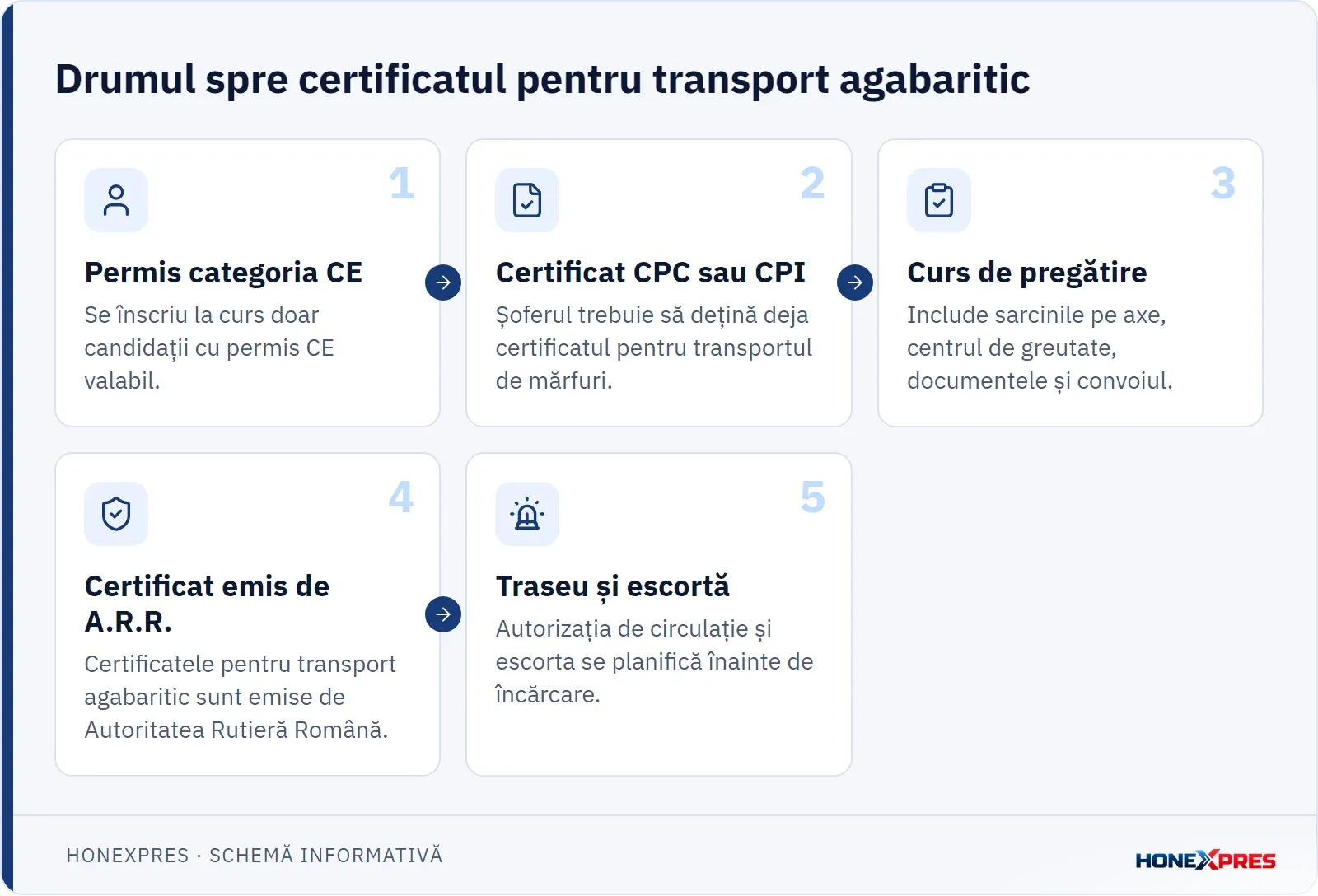
The content of the training shows what such a transport involves. The programme covers choosing the vehicle according to the load, the indivisible load, axle loads, the centre of gravity and stability during loading and unloading [4]. It also includes the specific documents, the authorities responsible for authorising and escorting oversized transports and international oversized transport [4]. Under driving, it covers the convoy and communication with the escort crews [4].
For you, as the shipper, the practical conclusion is this: the route is determined by authorisation, not just by distance. The escort, if required, and the movement permit are planned before loading. The exact requirements, the issuing body of the permit and the deadlines are checked with the competent authority for each state along the route. You will find details on how we organise these transports on the page Oversized transport.
Tankers and vehicles for dangerous goods
ADR vehicles in categories EX/II, EX/III, FL and AT, as well as MEMU units, undergo an annual technical inspection in the country of registration [8]. Their conformity is attested by an ADR approval certificate issued by the competent authority of the country of registration [8]. At a roadside check, among other things, the vehicle's approval certificate is checked, together with whether the vehicle is authorised for the goods being carried [9]. That is why, for any tanker order, the carrier needs the UN number and the exact name of the product before confirming the vehicle.
Documents for any transport for hire or reward
No matter how special the vehicle is, road transport for hire or reward is carried out on the basis of the Community licence. For the entire duration of the transport, the certified true copy of the licence, the transport document and the other documents specific to the type of transport must be on board [5]. When we choose a partner carrier for a special vehicle, we check both the basic documents and the specific ones: the approval certificate, the driver's certificate, the route permits.
Load securing
Heavy and bulky goods pose serious securing problems. Training for oversized transport includes the special systems for blocking, securing and protecting the load, as well as the signalling of the transport [4]. For packaged dangerous goods, ADR 2025 considers the securing requirement fulfilled when the load is secured in accordance with standard EN 12195-1:2010 [10]. As the shipper, you help a great deal if you indicate the lashing and lifting points of the goods and whether there are parts that cannot take the tension of straps or chains.
What influences the cost of a transport with special vehicles
We do not publish prices, because two apparently identical transports can have very different costs. The factors that matter most are:
- the type of vehicle: the special equipment required by the goods (for example a low bed or an extendable trailer) instead of a standard flatbed;
- the degree to which the limits are exceeded: permits, any escort and the mandatory route depend on it;
- the actual route: detours imposed by bridges, tunnels or restrictions can lengthen the journey compared with the shortest route;
- the number of countries in transit: each state has its own authorisation procedures;
- loading and unloading: whether a crane, a crane truck or extra time at the ramp is needed;
- waiting times and movement windows imposed on some oversized transports;
- empty running made by the special vehicle to the loading point or on the return;
- the requirements of the goods: controlled temperature, cleaning or a cleaning certificate for tankers, additional protection.
How to request a quote for special transport vehicles
An accurate quote starts from accurate data. Here is what you need to send us:
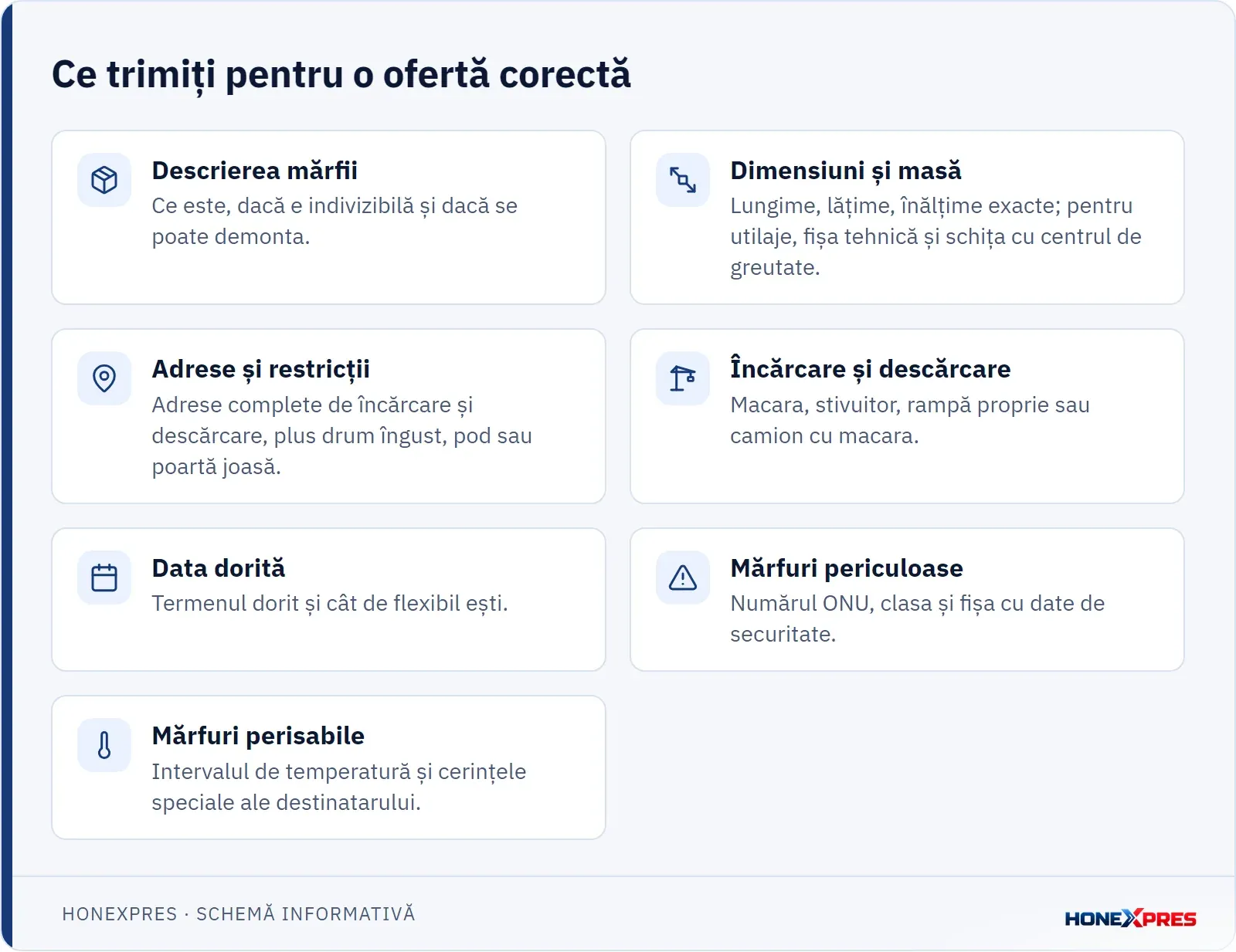
- Description of the goods: what they are, whether they are indivisible, whether they can be dismantled.
- The exact dimensions (length, width, height) and weight. For machinery, the manufacturer's data sheet and a sketch showing the centre of gravity help.
- The full addresses for loading and unloading and any access restrictions: narrow road, bridge, low gate, unpaved ground.
- How loading and unloading are done: by crane, by forklift, on its own ramp, or whether a crane truck is needed.
- The desired date and how flexible you are on timing.
- For dangerous goods: the UN number, the class and the safety data sheet.
- For perishable goods: the temperature range and the special requirements of the consignee.
- The commercial and customs documents, if the transport leaves the European Union.
For a complete model request, see also the guide How to request a freight transport quote. The form on the page Request a quote allows you to send this data directly.
What HONEXPRES does and does not do
Government Ordinance No 27/2011 classifies intermediation in the carriage of goods for hire or reward as an activity ancillary to road transport [2]. HONEXPRES works in exactly this role. We analyse the goods and propose the type of vehicle. We look for the partner carrier that has the vehicle, the certified driver and the necessary documents. We then coordinate the loading, the route and the delivery. We do not have our own trucks, trailers or tankers and we do not offer a cargo insurance policy ourselves. To cover the risks, we discuss with you the options available through the carriers' insurers or through separate insurance. We do not promise fixed deadlines before we have confirmation of the vehicle and, where applicable, of the permits.
Frequently asked questions
How do I know whether my goods require a special vehicle or fit on an ordinary platform?
Compare the dimensions and weight of the goods, plus the height of the platform, with the vehicle data sheets and with the limits in force along the route. If the transport exceeds the maximum permitted weights and/or dimensions, it is oversized transport [1]. If you are not sure, send us the data and we will check the options.
Who deals with the permits: me or the carrier?
Who actually submits the permit applications is established through the order, depending on the route and the countries. The technical data of the goods must, however, come from you, because the permits are requested on the basis of it. What relates to the vehicle and the driver, for example the certificate for oversized transport, is the carrier's obligation [3].
Can a tanker carry any dangerous liquid?
No. The product must have been assigned a compatible tank code in ADR [6]. The vehicle's approval certificate indicates which goods are permitted and excludes substances that can react dangerously with the materials of the shell [7].
Can I send a machine on a crane truck instead of a low bed?
Sometimes yes, if the machine is small and light and the truck's arm can lift it at the required distance. For heavy or tall machinery, the low bed or the semi-low loader are the usual choices, and unloading is done with a ramp or with a separate crane. The decision is made on the basis of the actual weight and dimensions.
How long does it take to organise an oversized transport?
The duration depends on the availability of the vehicle, on the authorisation procedures in each country and on any escort. That is why we do not give a standard deadline. The earlier you send the complete data, the more room we have for planning.
Request a quote for your special transport
Do you have a machine, a long item, a bulk liquid or goods at a controlled temperature? Send us the dimensions, the weight, the addresses and the loading method. We organise the right special vehicle with partner carriers and explain which permits are needed along the route. Fill in the form on the page Request a freight transport quote.
Official sources consulted
- [1] Ordonanța Guvernului nr. 27/2011 privind transporturile (Government Ordinance No 27/2011 on transport), art. 3 pct. 43
- [2] Ordonanța Guvernului nr. 27/2011 privind transporturile (Government Ordinance No 27/2011 on transport), art. 4 pct. II.1
- [3] Ordinul ministrului transporturilor nr. 1.214/2015 (Order of the Minister of Transport No 1,214/2015), Anexa nr. 5, art. 1 alin. (1)
- [4] Ordinul ministrului transporturilor nr. 1.214/2015 (Order of the Minister of Transport No 1,214/2015), Anexa nr. 5, art. 6 alin. (8)
- [5] Ordinul ministrului transporturilor nr. 980/2011 (Order of the Minister of Transport No 980/2011, methodological norms for applying Government Ordinance No 27/2011), art. 19
- [6] ADR 2025, section 4.3.1.2
- [7] ADR 2025, 9.1.3.5 – Model of approval certificate, item 10
- [8] ADR 2025, 9.1.2.3 – Annual technical inspection
- [9] Hotărârea Guvernului nr. 1.175/2007 (Government Decision No 1,175/2007), annex – checklist for checks on the transport of dangerous goods, items 16 and 19
- [10] ADR 2025, 7.5.7.1 – Handling and stowage
Send us the dimensions, weight and route of your goods, and we will organise the right special vehicle with partner carriers.
Have something similar to move? Request a quote →
Related services