Guides
Oversized transport Austria: how we organise special transports to and through Austria
AI Text written with AI assistance and checked by the editorial team. How we work with AI
Article translated automatically from Romanian and checked automatically. If there is any difference, the original prevails. See the original in Romanian · How we use automatic translation
In short
An oversized transport to Austria requires a check for each country: Romania, the transit countries and Austria each set their own limits for dimensions and weight. We check the cargo, the vehicle and the route, and organise permits and escort together with partner companies. Costs depend mainly on the excess, the route, the escort and the schedule.
Contents
- Who does what in a special transport to Austria?
- Permits: checking country by country
- Romania: the country of departure, with its own procedure
- Transit countries and Austria
- Documents on board
- Route and escort: the actual planning work
- Transports within Austria: beware of cabotage
- Cost factors instead of a flat price
- What we need for a quotation
- Frequently asked questions about oversized transport to Austria
- Is a permit from Romania enough for the entire route?
- How long does authorisation in Austria take?
- Do I always need an escort vehicle?
- Can the cargo be dismantled to reduce costs?
- What happens if the actual dimensions differ from those in the application?
- Quotation for your oversized transport to Austria
- Official sources consulted
An oversized transport to Austria does not mean a single permit, but a series of checks: every country on the route sets its own limits for dimensions and weights, and every excess must be cleared in each country where the vehicle travels. As a freight forwarder based in Oradea, we organise such special transports together with specialised partner companies. We check the cargo, the vehicle and the route, obtain the necessary permits together with the carrying company, and coordinate the escort and the schedule. This article shows what matters in practice for an oversized transport to Austria and what information we need for a sound quotation.
Who does what in a special transport to Austria?
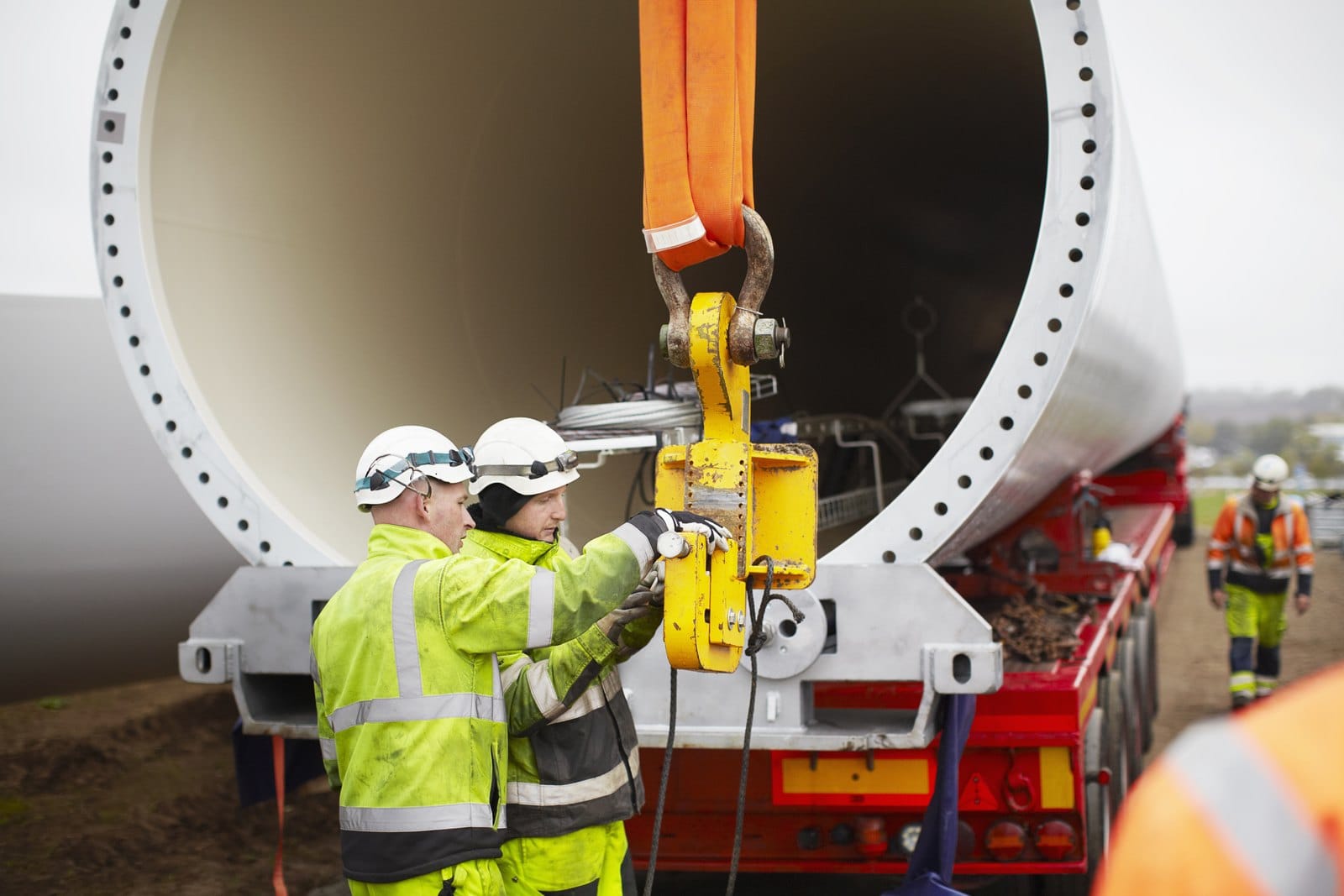
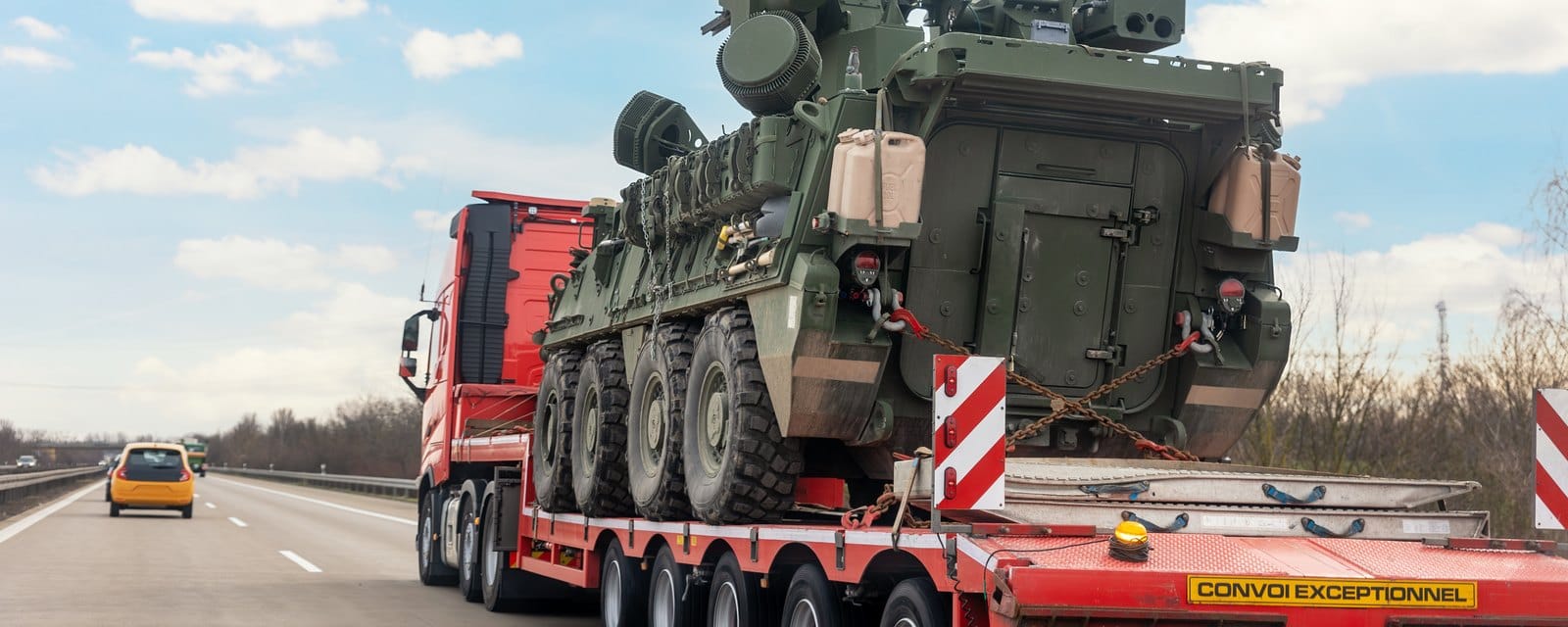
HONEXPRES does not own a fleet of vehicles. We plan and coordinate, and the transport is carried out by partner companies with suitable equipment, for example low-bed semi-trailers, semi-low loader semi-trailers or telescopic trailers for long loads. For you, as the consignor, this means a single contact person for planning, permits, escort and documents. At the same time, you also bear part of the responsibility.
According to the recitals of Regulation (EU) 2020/1055, Member States should provide for clear rules on penalties that also apply to consignors and freight forwarders where they knew or should have known about infringements of the market access rules; how this is transposed in each country must be checked in the national legislation in force [1]. In Romania, where infringements are established, the control authorities also examine the joint liability of all participants in the transport chain, including consignors and freight forwarders [2]. Correct data on dimensions and weight are therefore not a formality, but the basis of every permit.
Permits: checking country by country
The permitted dimensions and weights are not the same throughout Europe. Even for domestic transport operations carried out by foreign companies, the legislation of the host state applies under Regulation (EC) No 1072/2009, including as regards vehicle weights and dimensions [3]. The Regulation specifies that the host state's limit values for domestic transport may not be exceeded [3]. For planning purposes, this means that Romania, the transit countries and Austria are each analysed separately.
Romania: the country of departure, with its own procedure
In Romania, the permitted total weights, axle loads and dimensions for each road category are set out in annexes 2 and 3 of Government Ordinance No 43/1997 on the road regime (Ordonanța Guvernului nr. 43/1997 privind regimul drumurilor) [4]. For excesses on national roads, the system works with a special transport permit (AST) and additional road-use charges, collected by the national road infrastructure company C.N.A.I.R. [5]. Which institution issues the AST is clarified case by case with the competent authority.
The driver also needs a special qualification: anyone driving in Romania vehicles registered with exceeded weights or dimensions must hold an attestation for oversized transports [6]. The prerequisite for this is the driver's certificate of professional competence (CPC) for the carriage of goods [6]. When selecting the partner company, we also check these aspects.
Transit countries and Austria
The EU rules on access to the international road haulage market apply expressly also in the territory of a Member State of transit [7]. Which rules apply to the authorisation of the excess itself must be checked each time with the competent authorities and in the legal text in force in the country concerned. Which Austrian authority is competent, what lead time is required and which conditions apply, for example escort vehicles, time windows for driving or driving bans, we clarify for each order, with up-to-date information, with the partner company and with the authorities. We deliberately do not state fixed lead times or limit values here: they depend on the route, the cargo and the applicable legislation. The same applies to transit countries such as Hungary on the route from Oradea.
Documents on board
Under Romanian legislation, a company performing commercial international road carriage of goods must carry on board, among other things, the certified copy of the Community licence and the transport document [8]. The CMR consignment note is regarded as the transport document [8]. In addition, there are the special permits of each country concerned. How to complete a CMR correctly is shown in the CMR examples.
Route and escort: the actual planning work
In a special transport, the route is not determined by the shortest path, but by what the cargo can actually pass. Among other things, we clarify with the partner company:
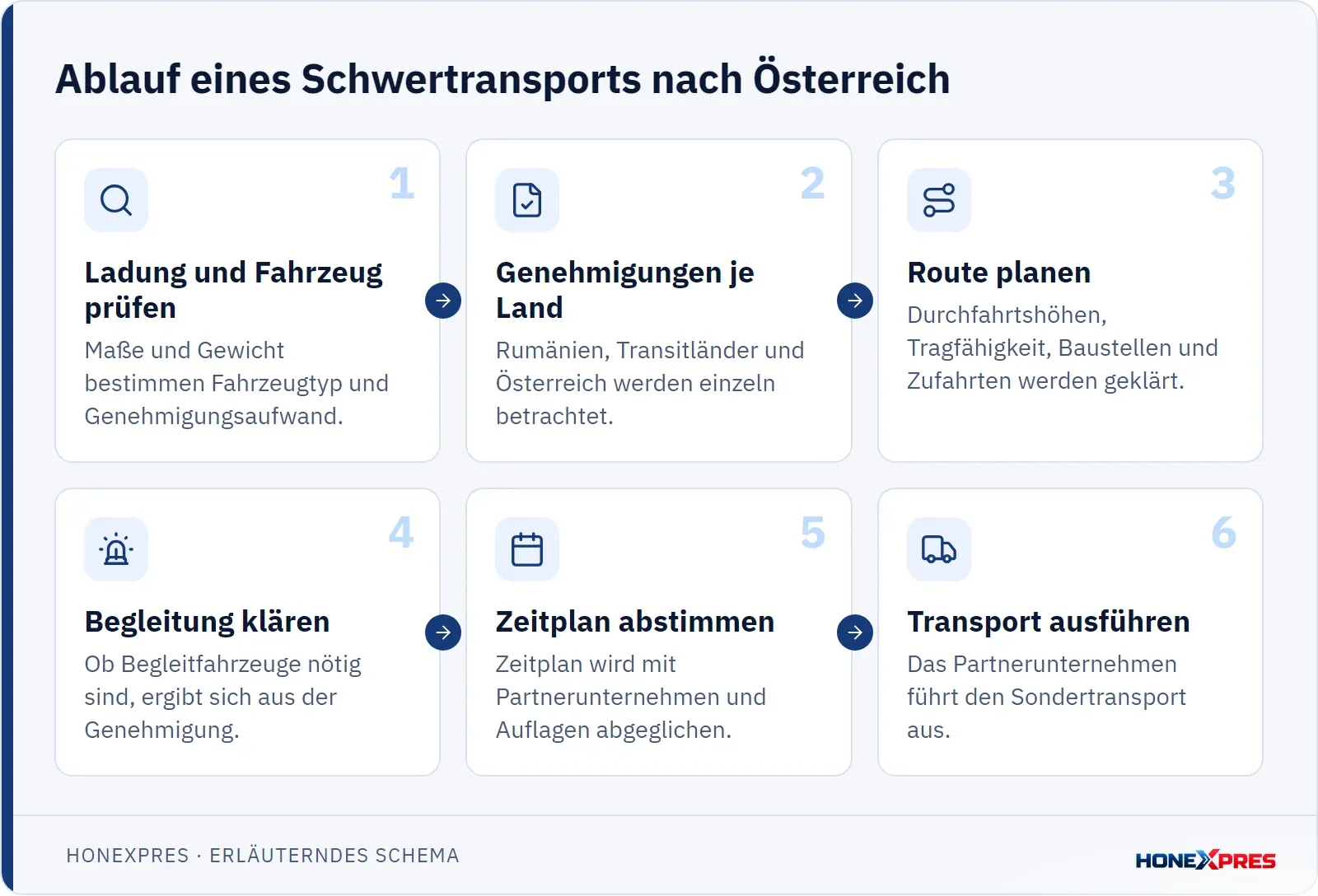
- Clearance heights and widths: bridges, underpasses, toll points, roundabouts.
- Load-bearing capacity: bridges and road sections with weight restrictions.
- Roadworks: narrowed lanes can block an otherwise suitable route.
- Access for loading and unloading: access gates, turning radii, ground conditions, space for a crane or ramp.
- Escort: whether escort vehicles or escort by the authorities are required, and in which country, follows from the respective permit.
The earlier the exact dimensions are known, the fewer re-plans are needed. You will find technical details on vehicles and load securing in the article Technical requirements for oversized transports.
Transports within Austria: beware of cabotage
Some projects include a leg within Austria, for example from the port or from an intermediate warehouse to the construction site. If a foreign company carries out this domestic transport, it is cabotage. Up to three cabotage operations are permitted following an international transport to the host state [9]. The last unloading must take place within seven days of the unloading of the goods from the international transport [9]. After that, no cabotage may be carried out with the same vehicle in the same Member State for four days [10]. By contrast, simple transit through a Member State, without loading or unloading, is not considered a posting of the driver [11]. We take this into account when selecting the partner company and planning the use of vehicles.

Cost factors instead of a flat price
For a special transport there is no sensible list price. The Romanian example shows how much the excess matters: the additional charges for national roads are calculated according to the size of the excess and the distance travelled, for example in the case of width [5]. The basis is the actual weight, established from documents or by weighing [5]. Similar mechanisms may exist in other countries; we check their amount separately for each route.
| Factor | Why it affects the price |
|---|---|
| Dimensions and weight | Determine the type of vehicle, the permit effort and any charges in each country. |
| Axle loads | High axle loads may require more axles or a different vehicle. |
| Route and number of countries | Each country means its own procedure; detours lengthen the transport. |
| Escort | Escort vehicles or escort by the authorities are added depending on the conditions imposed. |
| Time window | Restrictions at night or at weekends can cause waiting times. |
| Loading and unloading | A crane, ramp or dismantling changes the effort and the planning. |
| Empty runs | Special vehicles are less readily available; the journey to the loading point and the return trip are also taken into account. |
Whether additional cargo insurance is advisable is something you should clarify early in the case of high-value machinery. You will find an overview in the article CMR or CARGO insurance?
What we need for a quotation
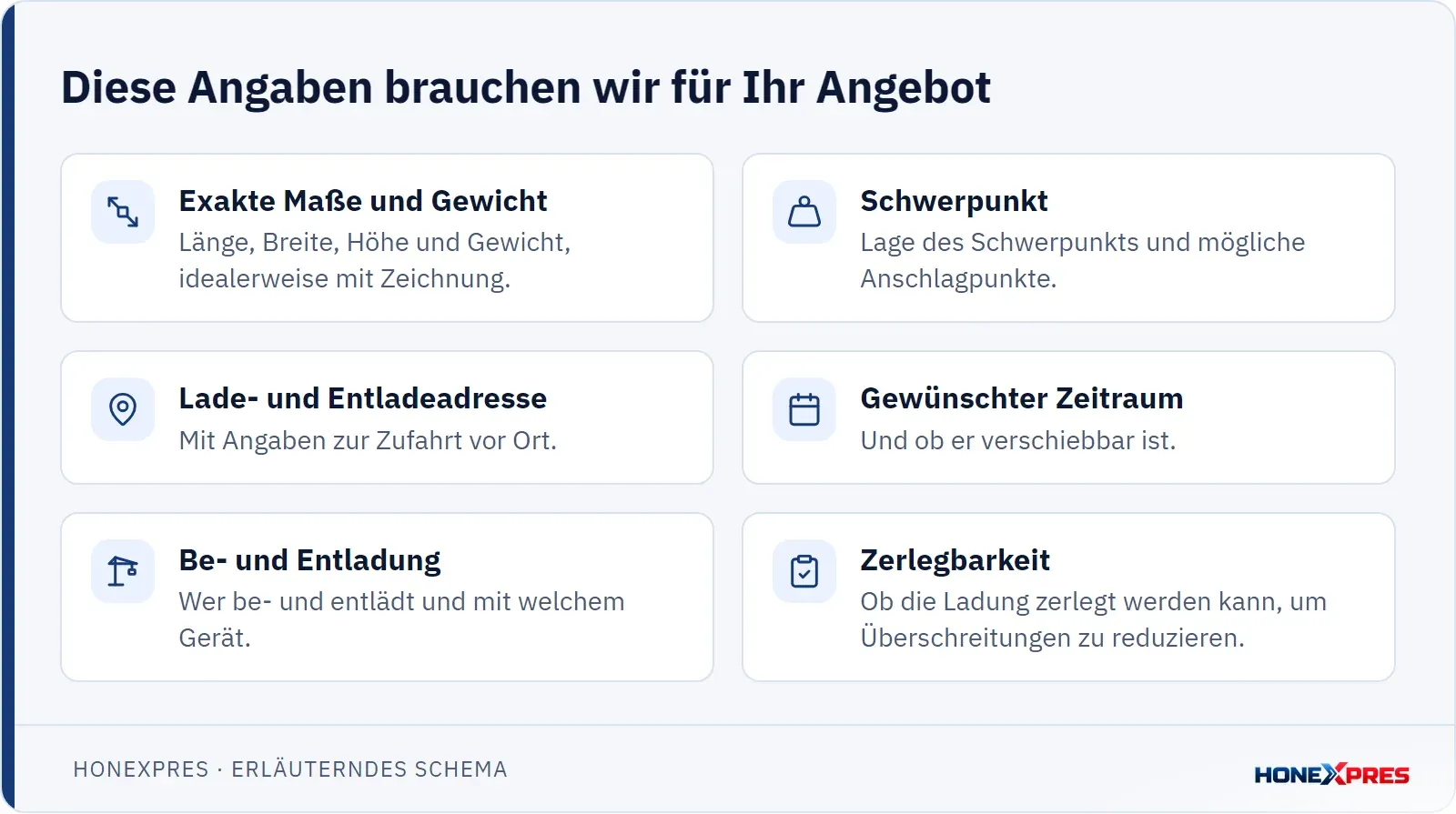
- Exact dimensions (length, width, height) and weight, ideally with a drawing
- Position of the centre of gravity and any lashing points
- Loading and unloading addresses, with access information
- Desired period and whether it can be shifted
- Who loads and unloads, and with what equipment
- Whether the cargo can be dismantled to reduce the excesses
You will find an overview of our services for oversized and heavy goods on the page Oversized transport, and for construction and industrial machinery on the page Machinery transport.
Frequently asked questions about oversized transport to Austria
Is a permit from Romania enough for the entire route?
No. Limit values and procedures are regulated at national level. Each country through which the transport passes is analysed separately.
How long does authorisation in Austria take?
It depends on the cargo, the route and the authority. We do not state flat lead times, but clarify the situation with up-to-date information, on request, with the partner company and with the competent authority.
Do I always need an escort vehicle?
Not necessarily. Whether and where an escort is required follows from the conditions imposed by the respective permit and may differ from one country to another.
Can the cargo be dismantled to reduce costs?
It is often worth checking. Even a smaller width or height can change the choice of vehicle, the route and the permit effort.
What happens if the actual dimensions differ from those in the application?
Permits are valid for the data stated. Deviations can lead to inspections, delays or new applications. Please therefore provide us with measured values, not estimates.
Quotation for your oversized transport to Austria
Send us the dimensions, the weight, the loading and unloading locations and the desired deadline. We check feasibility together with our partner companies and come back to you with a concrete proposal. Request a quotation now.
Official sources consulted
- [1] Regulation (EU) 2020/1055, recital 24
- [2] Romanian Government Ordinance No 12/2022, art. II (amendment), para. (5)
- [3] Regulation (EC) No 1072/2009, art. 9 para. (1) point (b)
- [4] Romanian Government Ordinance No 43/1997 on the road regime, art. 40 para. (2)
- [5] Romanian Order No 1,836/2018, annex, part 1, legend
- [6] Romanian Order No 1,214/2015, annex 5, art. 1 para. (1)
- [7] Regulation (EC) No 1072/2009, recital 3
- [8] Romanian Order No 980/2011, methodological norms, art. 43 para. (1)
- [9] Regulation (EC) No 1072/2009, art. 8 para. (2) first subparagraph
- [10] Regulation (EU) 2020/1055, art. 2 point 4 (a) (new art. 8 para. (2a) of Regulation (EC) No 1072/2009)
- [11] Directive (EU) 2020/1057, recital 11
Send us the dimensions, the weight and the loading and unloading locations, and together with our partner companies we will check your oversized transport to Austria.
Have something similar to move? Request a quote →
Related services