Guides
ADR 1.1.3.6 points calculator: how to check the 1,000 threshold step by step
AI Text written with AI assistance and checked by the editorial team. How we work with AI
Article translated automatically from Romanian and checked automatically. If there is any difference, the original prevails. See the original in Romanian · How we use automatic translation
In short
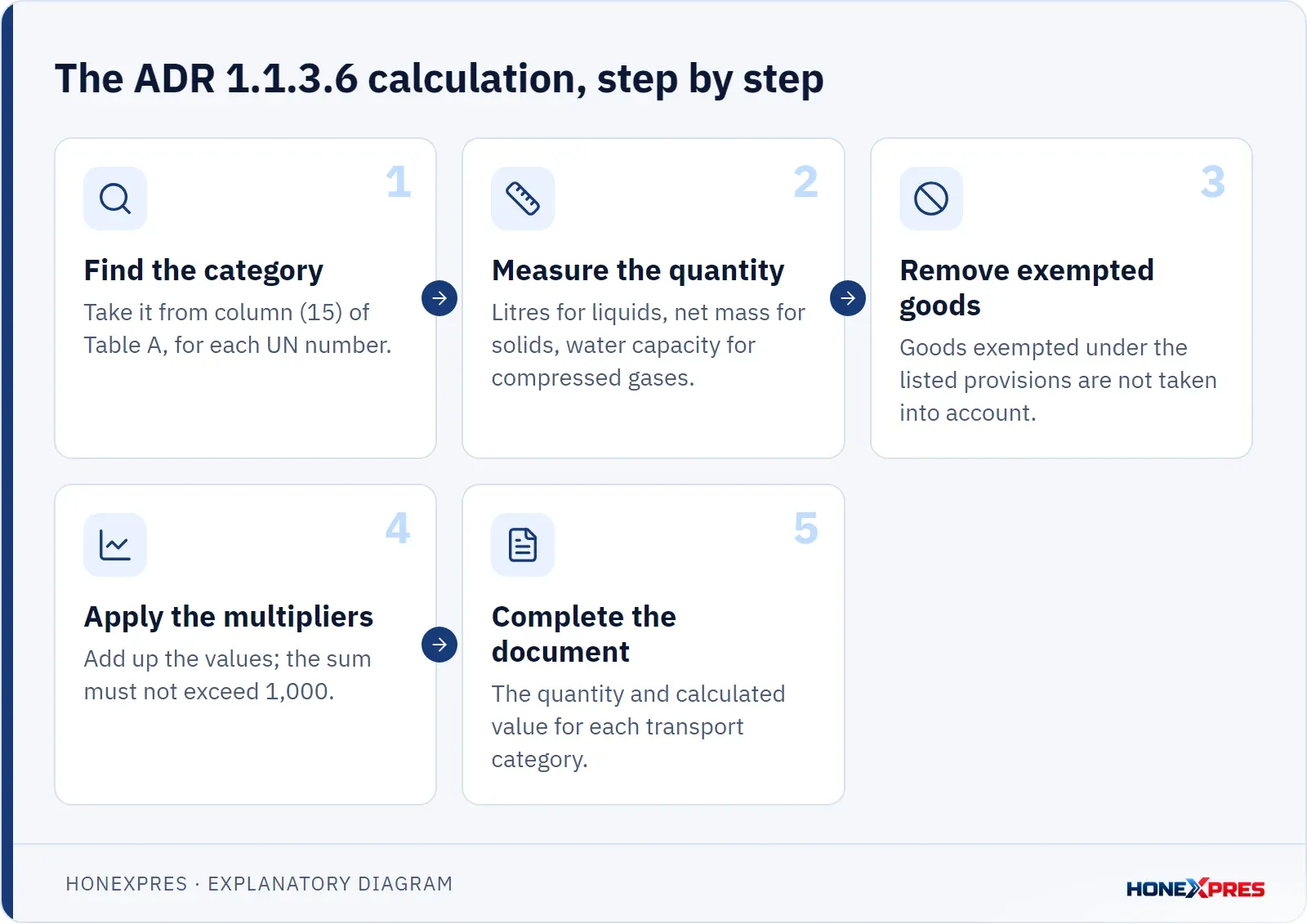
Each item of goods is assigned a transport category in column (15) of Table A. The quantity in category 1 is multiplied by 50 (by 20 for the UN numbers in note a), that in category 2 by 3 and that in category 3 by 1. If the sum does not exceed 1,000, the 1.1.3.6 exemption can be applied to the transport unit.
Contents
- In brief: what the points calculation actually checks
- Step 1: find the transport category of each item of goods
- Common pitfalls when allocating the category
- Step 2: measure the quantity in the correct unit
- Step 3: remove from the calculation what is already exempted
- Step 4: apply the multipliers and add up
- Calculation examples
- Example 1: a single category
- Example 2: a mixed load that fits within the limit
- Example 3: the same load, with 50 litres more
- Example 4: category 1 uses up the budget quickly
- Example 5: compressed gas cylinders
- Example 6: the class 6.1, packing group III trap
- Step 5: enter the calculation in the transport document
- What the result of the calculation means in practice
- Note on rail transport (RID)
- Quick checklist
- Frequently asked questions
- What does the “1,000-point exemption” mean?
- Are category 4 goods added to the points?
- Do I calculate with gross mass or net mass?
- Can I apply 1.1.3.6 to a tank?
- What happens if I have a single category 0 product?
- Does the online calculator replace checking in ADR?
- We organise the transport of your ADR load
- Official sources consulted
The quantity exemption under ADR 1.1.3.6 depends on a simple calculation. Many consignors nonetheless get it wrong, and the error is only discovered at a roadside check. This guide does not go over the theory of the exemption, which is explained in the article ADR 1.1.3.6: the quantity exemption explained. Here we deal strictly with the practical side: where you take the transport category from, in which unit you measure the quantity, which multiplier you apply and how you check whether you have exceeded the threshold of 1,000 points. The values and rules below come from ADR 2025 (ECE/TRANS/352, volume I).
In brief: what the points calculation actually checks
ADR allows dangerous goods carried in packages on a single transport unit to be exempted from a number of provisions. The condition is that the weighted sum of the quantities does not exceed the value laid down in 1.1.3.6.3 or the value calculated in accordance with 1.1.3.6.4 [2]. For a single transport category, the limit in column (3) of the table in 1.1.3.6.3 applies. For several categories on the same transport unit, the formula with multipliers applies [2]. According to note b below the table, the maximum total quantity for each category corresponds to a calculated value of “1,000” [3]; in practice this matters for categories 1, 2 and 3, because category 0 has a limit of 0 and category 4 is unlimited [4].
The exemption applies only to carriage in packages [2]. The calculation below does not help you for tanks and bulk, for which the applicable ADR provisions must be read separately.
Step 1: find the transport category of each item of goods
The transport category is not something to be inferred “from experience”. It is indicated for each UN number in column (15) of Table A in chapter 3.2 [1]. There are five categories: 0, 1, 2, 3 and 4 [1]. If you have doubts about the class or the packing group, check the classification first. Our guide to ADR classes helps you with that first filter.
The table in 1.1.3.6.3 explains the logic of the allocation. Below is an indicative summary, but the exact category is always taken from Table A for the UN number concerned:
| Category | What falls under it, in principle | Maximum quantity if it is the only category on board | Multiplier in the mixed formula |
|---|---|---|---|
| 0 | Goods expressly listed (e.g. class 1: 1.1A/1.1L/1.2L/1.3L and UN 0190; class 4.2 packing group I) | 0 | the exemption cannot be used |
| 1 | Packing group I, if not in category 0, plus certain listed entries | 20 | × 50 (× 20 for the UN numbers in note a) |
| 2 | Packing group II, if not in categories 0, 1 or 4, plus listed entries | 333 | × 3 |
| 3 | Packing group III, if not in categories 0, 2 or 4, plus listed entries | 1,000 | × 1 |
| 4 | E.g. class 1: 1.4S; uncleaned empty packagings (except those in category 0) | unlimited | not included in the sum |
The values in column (3) are 0 for category 0 [4], 20 for category 1 [4], 333 for category 2 [4], 1,000 for category 3 [4] and unlimited for category 4 [4]. The limits for categories 1, 2 and 3 are the equivalent of the same calculated value of 1,000 [3]. It is easy to see: 20 × 50 = 1,000, and 333 × 3 = 999.
Common pitfalls when allocating the category
- The packing group alone does not decide the category. Class 6.1 is a classic example: substances in packing group III are placed in category 2, not category 3 [4]. A toxic substance in PG III therefore weighs three times as much in the calculation as a flammable liquid in PG III.
- Aerosols and gases follow their group. Aerosols of group F are in category 2 [4], while those of groups A and O are in category 3 [4]. Aerosols of groups C, CO, FC, T, TF, TC, TO, TFC and TOC are in category 1 [4].
- Uncleaned empty packagings have their own rule. Those that have contained substances of category 0 remain in category 0 [2]. All the others go into category 4 [2]. For more details on this type of goods, see the article on the transport of uncleaned empty packagings.
- Special provisions can change the category. For example, according to special provision 671, for kits the transport category is determined by the packing group [5]. Kits containing only goods with no assigned packing group fall into category 2 [5]. Always read column (6) of Table A for the UN number concerned as well.
Step 2: measure the quantity in the correct unit
This is where most errors occur. The multiplier is applied to a quantity as defined by ADR, not to the gross mass shown on the delivery note. For the calculation, “maximum total quantity per transport unit” means:
- articles: the total mass in kilograms of the articles without their packagings. For class 1, the net mass of the explosive substance is used [6];
- solids, liquefied gases, refrigerated liquefied gases and dissolved gases: the net mass in kilograms [6];
- liquids: the total quantity of dangerous goods contained, in litres [6];
- compressed gases, adsorbed gases and chemicals under pressure: the water capacity of the receptacle, in litres [6];
- dangerous goods contained in machinery or equipment specified in ADR: the total quantity of dangerous goods inside, in kilograms or litres, as appropriate [6].
The practical consequence: for a liquid, do not multiply the gross kilograms of the pallet, but the litres of product. For compressed gas cylinders, what matters is not how much the gas weighs, but the water capacity of the cylinder. If you use the gross mass “to be on the safe side”, the result is overestimated. You could thus lose an exemption to which you are entitled.
Step 3: remove from the calculation what is already exempted
Not everything dangerous in the lorry goes into the sum. Goods exempted under 1.1.3.1 (a) and (d)–(f), 1.1.3.2–1.1.3.5, 1.1.3.7, 1.1.3.9 and 1.1.3.10 are not taken into account [6]. If part of the load benefits from another exemption, for example packing in limited quantities, check in the current ADR text whether that exemption falls within the references above. Only after this check do you remove it from the calculation.
Step 4: apply the multipliers and add up
If goods of different categories are on board, ADR 1.1.3.6.4 requires that the sum of the following values does not exceed 1,000:
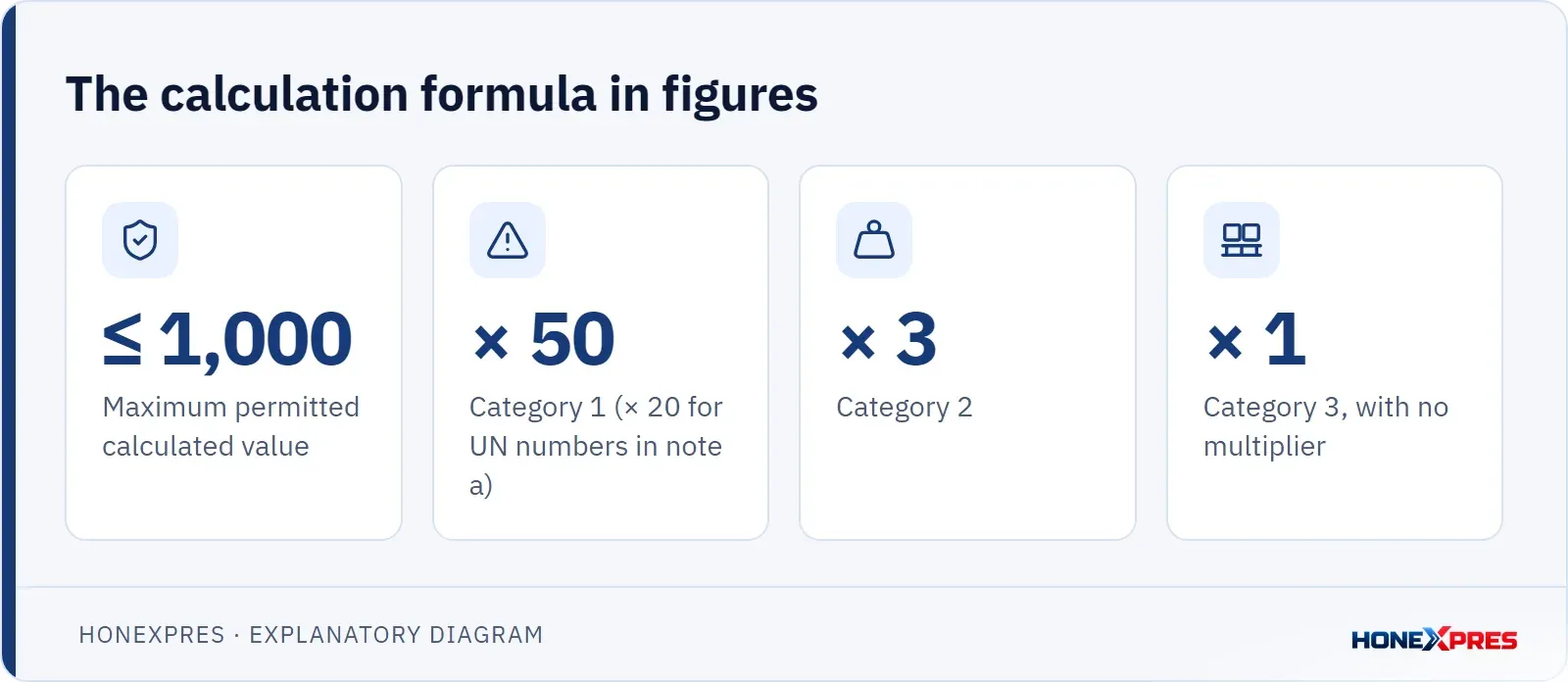
- the quantity in category 1 multiplied by 50 [6];
- the quantity in category 1 that appears in note a below the table in 1.1.3.6.3, multiplied by 20 [6];
- the quantity in category 2 multiplied by 3 [6];
- the quantity in category 3, with no multiplier [6].
The result must not exceed a calculated value of 1,000 [6]. Note a covers UN numbers 0081, 0082, 0084, 0241, 0331, 0332, 0482, 1005 and 1017, for which the maximum quantity per transport unit is 50 kg [3]. This is where the multiplier 20 comes from, since 50 × 20 = 1,000.
Category 4 does not appear in the formula, because the formula lists only categories 1, 2 and 3 [6]. Category 0 has no multiplier, because its limit is 0 [4]. Consequently, any quantity in category 0 makes the exemption inapplicable for those goods.
The formula, written compactly:
Points = (cat. 1 × 50) + (cat. 1 from note a × 20) + (cat. 2 × 3) + (cat. 3 × 1) ≤ 1,000
If you prefer not to do the calculation by hand, use the ADR calculator for the 1.1.3.6 exemption, LQ and EQ on our website. Steps 1–3, however, remain your responsibility: the calculator does not know which category the product has, nor whether you have entered litres or gross kilograms.
Calculation examples
The examples use generic goods. The categories are deduced from the rules of the table in 1.1.3.6.3. In practice, confirm the category of each UN number in column (15) of Table A.
Example 1: a single category
You are carrying 900 litres of class 3 flammable liquid, packing group III, which is not listed in categories 0, 2 or 4. The goods fall into category 3 [4]. The limit in column (3) is 1,000, and 900 ≤ 1,000, so the quantity condition is met. Had it been the same liquid but in packing group II (category 2), the limit would have been 333 litres [4].
Example 2: a mixed load that fits within the limit
| Goods | Category | Quantity | Multiplier | Points |
|---|---|---|---|---|
| Flammable liquid, PG II | 2 | 200 l | × 3 | 600 |
| Corrosive solid, PG III | 3 | 300 kg net | × 1 | 300 |
| Class 1 articles, 1.4S | 4 | any quantity | not added | 0 |
| Total | 900 | |||
900 ≤ 1,000, so the condition is met. Class 1 articles of division 1.4S are in category 4 [4] and do not affect the sum.
Example 3: the same load, with 50 litres more
If the category 2 liquid rises to 250 l, the points become 250 × 3 + 300 = 1,050. The threshold is exceeded, and the 1.1.3.6 exemption can no longer be applied to the transport unit. The practical options are to reduce the quantity, to split the goods between two transport units or to carry everything fully under the ADR regime. Note that an increase of only 50 litres added 150 points. Category 2 quantities must be monitored closely.
Example 4: category 1 uses up the budget quickly
| Goods | Category | Quantity | Multiplier | Points |
|---|---|---|---|---|
| PG I substance (not in category 0) | 1 | 10 kg net | × 50 | 500 |
| Aerosols, group F | 2 | 100 kg net* | × 3 | 300 |
| Corrosive substance PG III | 3 | 150 l | × 1 | 150 |
| Total | 950 | |||
* For aerosols, check in the current ADR text the unit of measurement applicable to the type of product. The figure is used here only to illustrate the calculation.
The total of 950 is within the limit, but the remaining margin is small. A further 2 kg of category 1 goods (2 × 50 = 100) would bring the total to 1,050.
Example 5: compressed gas cylinders
Assume 12 cylinders of compressed gas of group A, each with a water capacity of 50 litres. The value is hypothetical: take it from the cylinder or from its documentation. Gases of groups A and O are in category 3 [4]. The relevant quantity is the water capacity of the receptacles [6], i.e. 12 × 50 = 600 l, so 600 points. If you add 150 l of PG II flammable liquid (category 2) in the same lorry, the result is 150 × 3 = 450. The total of 1,050 exceeds the threshold.
Example 6: the class 6.1, packing group III trap
A consignor loads 200 kg net of toxic solid of packing group III and assumes that “PG III means multiplier 1”. In reality, class 6.1 PG III substances are in category 2 [4]. The correct calculation is 200 × 3 = 600 points, not 200. With another 450 l of category 3 liquid on board, the real total is 1,050, so above the threshold, although the wrong calculation would have shown 650.
Step 5: enter the calculation in the transport document
The calculation does not stay only in your office. If 1.1.3.6 is intended to be applied, the transport document must indicate the total quantity and the calculated value for each transport category [7]. Concretely, for example 2 the quantity and value for category 2 (200 l and 600 respectively) would appear, together with the quantity and value for category 3 (300 kg and 300 respectively). You will find details on the other entries in the guide to completing the transport document from an ADR point of view.
The tunnel restriction code does not disappear from the document just because you apply the exemption. It remains a separate entry in the description of the goods [7]. For route planning, see also the article on tunnel restrictions.
What the result of the calculation means in practice
If the sum is within the limit, the packages may be carried without applying the provisions listed in 1.1.3.6.2: chapter 1.10 (with exceptions), chapter 5.3, section 5.4.3, chapter 7.2 (except V5 and V8), CV1, Part 8 (with the exceptions listed) and Part 9 [2]. “Exempted” does not, however, mean “outside ADR”. Some provisions remain applicable, for example those of Part 8 listed explicitly (8.1.2.1 (a), 8.1.4.2–8.1.4.5, 8.2.3, 8.3.3–8.3.5, chapter 8.4 and certain S provisions) [2]. For high-consequence dangerous goods of class 1, chapter 1.10 continues to apply [2]. What remains mandatory for the carrier and the driver is explained in the main article on the quantity exemption. We do not repeat the list here.
For you as a consignor, the result of the calculation also matters when organising the transport, because it shows whether the 1.1.3.6 exemptions can be used or whether the transport is carried out fully under the ADR regime. Check in the current ADR text which specific requirements remain applicable to the vehicle and the carrier in each case. All of this can affect the cost. A calculation done correctly before the quote request avoids last-minute rescheduling.
Note on rail transport (RID)
RID 2025 uses the same logic of multipliers, but relates it to the wagon or large container, not to the road transport unit. If the goods move from lorry to train, repeat the check according to the RID text.
Quick checklist
- The complete list of goods: UN number, name, class, packing group.
- The transport category from column (15) of Table A, plus a check of the special provisions in column (6).
- Is there a category 0 item? If so, the exemption cannot be applied for those goods.
- The quantity in the correct unit: litres for liquids, net mass for solids, water capacity for compressed gases.
- Removal of goods already exempted under other provisions.
- The multipliers 50 / 20 / 3 / 1 and the total sum.
- The comparison with 1,000.
- The quantity and calculated value for each category, entered in the transport document.
If your company has an ADR safety adviser, it is useful to have the internal calculation procedure validated by them.
Frequently asked questions
What does the “1,000-point exemption” mean?
It is the common name for the rule in ADR 1.1.3.6.4. The quantities in categories 1, 2 and 3 on the same transport unit are multiplied by the set multipliers, and the sum must not exceed a calculated value of 1,000 [6]. ADR speaks of a “calculated value”; “points” is simply the term used in practice.
Are category 4 goods added to the points?
No. The formula in 1.1.3.6.4 includes only categories 1, 2 and 3 [6], and for category 4 the maximum quantity is unlimited [4]. Category 4 goods nevertheless remain dangerous goods and are declared accordingly.
Do I calculate with gross mass or net mass?
It depends on the state of the goods. For solids the net mass is used, for liquids the litres of product, for compressed gases the water capacity of the receptacle, and for articles the mass without packagings [6]. Gross mass is not the reference for this calculation.
Can I apply 1.1.3.6 to a tank?
Not through this mechanism. The exemption in 1.1.3.6.2 refers to goods carried in packages on a transport unit [2]. For tanks and bulk, consult the specific ADR provisions.
What happens if I have a single category 0 product?
For category 0, the maximum quantity in the table in 1.1.3.6.3 is 0 [4]. Consequently, the presence of such goods prevents the exemption from being applied for them, however small the quantity.
Does the online calculator replace checking in ADR?
No. A calculator only does the multiplications and the sum. The correct category, the unit of measurement and any special provisions must be established from Table A of the current ADR. The calculator helps you avoid arithmetic mistakes, but it does not verify the input data.
We organise the transport of your ADR load
HONEXPRES is a freight forwarder. We organise the transport of dangerous goods together with partner carriers, on the basis of the data you send us. It helps us to receive a list with the UN number, class, packing group, type of packaging and quantity of each item of goods, plus the 1.1.3.6 calculation, if you have already done it. On that basis we look for the suitable solution: with or without applying the exemption, as a full truckload or, where possible, as groupage. You will find details about the service on the page ADR transport of dangerous goods. When you have the data ready, send us a quote request.
Official sources consulted
- [1] ADR 2025 (ECE/TRANS/352, vol. I), 1.1.3.6.1
- [2] ADR 2025 (ECE/TRANS/352, vol. I), 1.1.3.6.2
- [3] ADR 2025 (ECE/TRANS/352, vol. I), 1.1.3.6.3, note b to the table
- [4] ADR 2025 (ECE/TRANS/352, vol. I), 1.1.3.6.3, table – category 0
- [5] ADR 2025 (ECE/TRANS/352, vol. I), chapter 3.3, special provision 671
- [6] ADR 2025 (ECE/TRANS/352, vol. I), 1.1.3.6.3, definition of maximum total quantity – articles
- [7] ADR 2025 (ECE/TRANS/352, vol. II), 5.4.1.1.1 f), note 1
Send us your list of ADR goods, with the UN numbers and quantities, and we will organise the transport with a partner carrier suited to your load.
Have something similar to move? Request a quote →
Related services