Guides
ADR classes: table and guide for packages
AI Text written with AI assistance and checked by the editorial team. How we work with AI
Article translated automatically from Romanian and checked automatically. If there is any difference, the original prevails. See the original in Romanian · How we use automatic translation

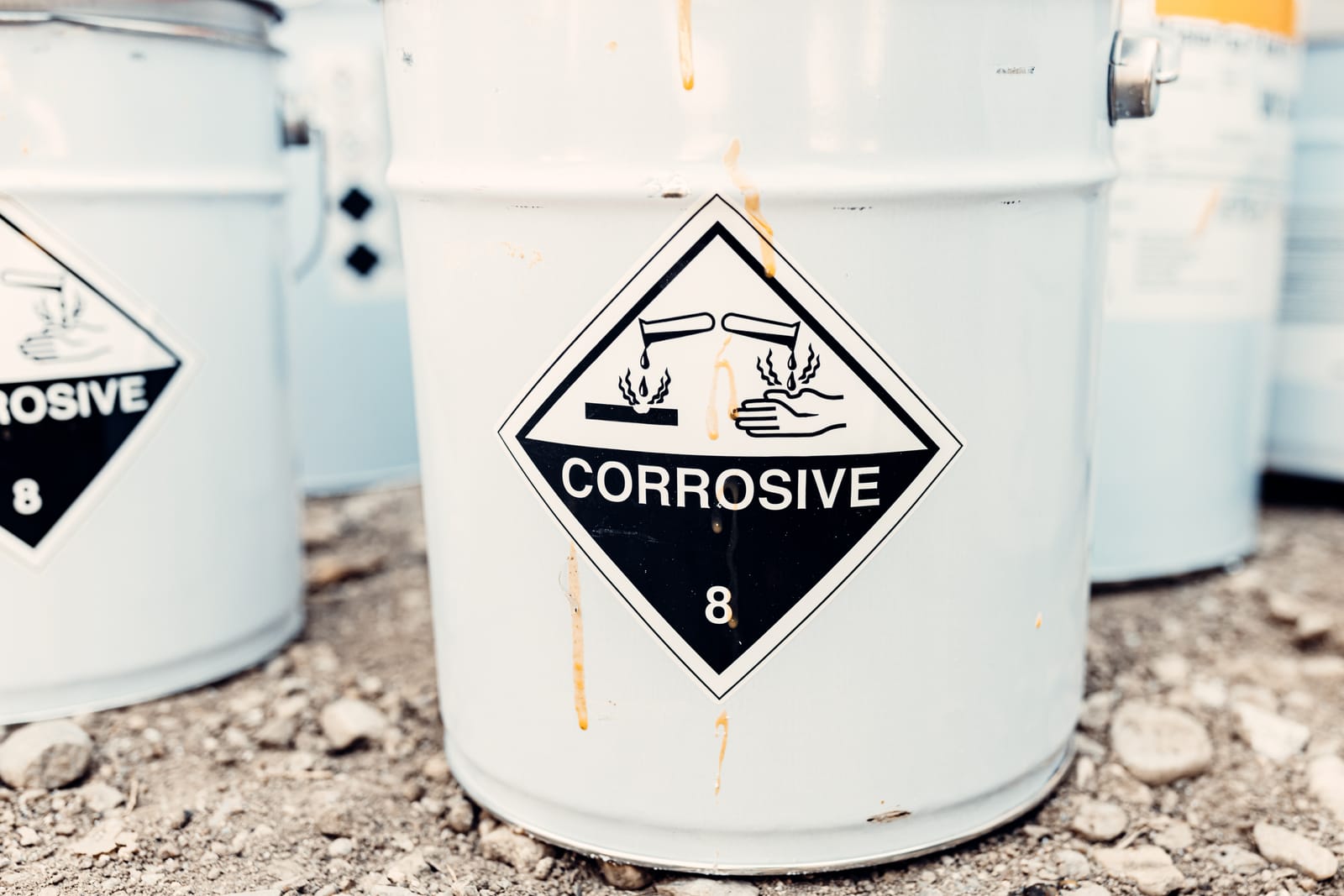
Metal drums and pallets are stacked inside a storage facility. Photo: Fahroni · Envato Elements
In short
Each dangerous substance or article is assigned to a specific class according to the type of hazard. The class and the packing group determine the packaging and the labels, and the consignor is responsible for classification, packing, marking and the transport document.
Contents
- In brief
- ADR classes
- Packing groups
- ADR class table: how to read Table A
- ADR classes for packages: packing, marking and labelling
- What data you need to send us
- What affects the cost
- Practical steps
- Frequently asked questions
- Who is responsible for the classification and marking of packages containing dangerous goods?
- Where do I find the packing group of a substance?
- What packing groups are there?
- Request a quote
In brief
Each dangerous substance or article is assigned to a specific class, in accordance with the type of hazard the substance presents. Together, the packing group and the class determine how packing must be carried out, the suitable materials the packagings must be made of, and the marks and labels that must be applied to them.
The consignor is responsible for the classification, packing and marking of dangerous goods, as well as for drawing up the transport document. Without this data, the transport cannot be organised correctly.
ADR classes
The road transport of dangerous goods, both domestic and international, is carried out in accordance with the Agreement concerning the International Carriage of Dangerous Goods by Road – ADR. The UN Model Regulations harmonise the rules for all modes of transport. In this system, each dangerous substance or article is assigned to a class, according to the hazard it presents.

| Class | Class name | Rows in Table A |
|---|---|---|
| 1 | Explosive substances and articles | 382 |
| 2 | Gases | 254 |
| 3 | Flammable liquids | 552 |
| 4.1 | Flammable solids, self-reactive substances, polymerising substances and desensitised solid explosives | 134 |
| 4.2 | Substances liable to spontaneous combustion | 102 |
| 4.3 | Substances which, in contact with water, emit flammable gases | 126 |
| 5.1 | Oxidising substances | 169 |
| 5.2 | Organic peroxides | 21 |
| 6.1 | Toxic substances | 725 |
| 6.2 | Infectious substances | 11 |
| 7 | Radioactive materials | 25 |
| 8 | Corrosive substances | 365 |
| 9 | Miscellaneous dangerous substances and articles | 45 |
The table above shows how many rows each class has in Table A. The data set is extracted from the official ADR 2025 volume and verified by HONEXPRES: 2,939 rows, 2,347 UN numbers.
Please note: you may come across several pictogram systems on packagings. Transport pictograms and hazard classes are established under ADR. GHS/CLP pictograms are those on the product, and a third set of symbols has expired but still sometimes appears on packagings.
For the classification of dangerous goods, see our dedicated article.
Packing groups
For packing purposes, substances other than those of Classes 1, 2, 5.2, 6.2 and 7 and other than self-reactive substances of Class 4.1 are assigned to packing groups according to the degree of danger they present.
- Group I: substances presenting high danger;
- Group II: substances presenting medium danger;
- Group III: substances presenting low danger.
Articles are not assigned to a packing group. The packing group or groups of each substance are indicated in Table A of Chapter 3.2 of ADR.
ADR class table: how to read Table A
Table A is the list of dangerous goods in ADR. For each UN number, it indicates, among other things:

- the classification code (col. 3b);
- the packing group (col. 4);
- the limited quantity (col. 7a);
- the transport category (col. 15);
- the hazard identification number (col. 20).
The same UN number may have several rows, for example depending on the flash point or the vapour pressure. Choose the row that corresponds exactly to your product.
ADR classes for packages: packing, marking and labelling
- Approval mark. UN-approved packagings bear the prefix "UN". Those approved only for RID/ADR bear the mark "RID/ADR". UN-approved packagings and those approved only for RID/ADR are marked with codes provided for in Part 6 of ADR.
- Marking and labelling. Consignors of dangerous goods must mark and label packages in accordance with the provisions of Chapters 5.1 and 5.2 of ADR.
- UN number. Unless otherwise provided in ADR, the UN number corresponding to the goods contained, preceded by the letters "UN", must appear clearly and durably on each package.
- Overpack. It is marked with the word "OVERPACK" and with the UN number.
- LQ and EQ in an overpack. Overpacks are regulated for both limited quantities (3.4.11) and excepted quantities (3.5.4.3).
The general rules of the transport of dangerous goods are explained in a separate article.
What data you need to send us
- the UN number and the proper shipping name of the goods;
- the class, the classification code and the packing group (if any);
- the safety data sheet (the supplier is obliged to make it available to you);
- the type of packaging, the approval mark and whether you use overpacks;
- the number of packages, the quantity per package and the total quantity;
- whether the goods are shipped in limited quantities (LQ) or excepted quantities (EQ);
- the loading and unloading addresses, the requested dates and any restrictions at the location;
- other goods loaded together, especially in groupage.
What affects the cost
- the hazard class and the packing group;
- the transport category and the total quantity;
- the LQ/EQ regime or full ADR transport;
- the type of load: full load (FTL), part load (PTL) or groupage (LTL);
- compatibility with other goods in the same transport;
Note: the ADR tank is designed for fuels and liquid chemicals in bulk. It is not suitable for packaged goods.
Practical steps
- Identify the product in the safety data sheet and find the UN number.
- Check the correct row in Table A of ADR: the class, the packing group and the limited quantity.
- Choose a suitable approved packaging, or check whether the LQ or EQ regime applies.
- Mark and label each package. If you use an overpack, mark it as well.
- Draw up the transport document and send us the data above.
Frequently asked questions
Who is responsible for the classification and marking of packages containing dangerous goods?
The consignor is responsible for the classification, packing and marking of dangerous goods, as well as for drawing up the transport document.
No. Substances of Classes 1, 2, 5.2, 6.2 and 7, self-reactive substances of Class 4.1 and articles are not assigned to a packing group.
Where do I find the packing group of a substance?
For land transport, the packing group or groups to which substances are assigned are indicated in Table A of Chapter 3.2 of the ADR and ADN Agreements and the RID Regulations.
What packing groups are there?
Packing group I: substances presenting high danger. Packing group II: substances presenting medium danger. Packing group III: substances presenting low danger.
Request a quote
Send us the safety data sheet, the UN number and the package details for an ADR transport of dangerous goods. We will reply with the suitable transport solution and with the information that is still missing.
The information in this article is for information purposes only and does not constitute legal advice. For a specific situation, check the requirements in the official texts in force.
Have something similar to move? Request a quote →
Frequently asked questions
Who is responsible for the classification and marking of packages containing dangerous goods?
The consignor is responsible for the classification, packing and marking of dangerous goods, as well as for drawing up the transport document. No. Substances of Classes 1, 2, 5.2, 6.2 and 7, self-reactive substances of Class 4.1 and articles are not assigned to a packing group.
Where do I find the packing group of a substance?
For land transport, the packing group or groups to which substances are assigned are indicated in Table A of Chapter 3.2 of the ADR and ADN Agreements and the RID Regulations.
What packing groups are there?
Packing group I: substances presenting high danger. Packing group II: substances presenting medium danger. Packing group III: substances presenting low danger.
Sources (6)
- ADR 2025, Tabelul A: privire de ansamblu pe clase si exemple de randuri (set de date HONEXPRES verificat) · accessed 2026-10-21
- Autoritatea Rutiera Romana (ARR): Transport marfuri periculoase - ADR · accessed 2026-10-21
- Comisia Europeana (SAMANCTA): Simboluri de pericol si clase de pericol ADR · accessed 2026-10-21
- Transport mărfuri periculoase (ADR) · accessed 2026-09-27
- Transport rutier de marfă · accessed 2026-09-27
- Cisternă ADR (carburanți / chimicale) · accessed 2026-10-09
Related services