ADR dangerous goods by road · Guides
ADR transport in limited quantity: everything you need to know!
Article translated automatically from Romanian and checked automatically. If there is any difference, the original prevails. See the original in Romanian · How we use automatic translation

In short
An ADR transport can be classed both as a limited quantity and as an excepted quantity.
Contents
- What is the difference between the two types of transport exemption?
- Packing in limited quantities
- Excepted quantity per transport unit
- How is the points score for dangerous goods calculated?
- Packing in limited quantities vs. excepted quantity per ADR transport unit
- Conclusion
- For efficient dangerous goods transport solutions, see Honexpres freight transport services!
An ADR transport can be classed both as a limited quantity and as an excepted quantity.
There is widespread confusion among transport operators about how an ADR transport is classed as a limited quantity.
According to Chapter 1.1.3 of the Agreement concerning the International Carriage of Dangerous Goods by Road (ADR), there are several types of dangerous goods transport that are regarded as exemptions.
Among the exemptions mentioned in Chapter 1.1.3., you will find:
- Exemptions related to dangerous goods packed in limited or excepted quantities;
- Exemptions related to the quantities carried per transport unit.
Based on our analysis of the two categories of exemptions, and given our experience in ADR transport, we have found that when transport operators try to class a shipment as a limited quantity, they are referring to the quantity of goods carried per transport unit, which may be carried exempt (wholly or partly) from the provisions of the ADR agreement, and not to packing in excepted quantities.
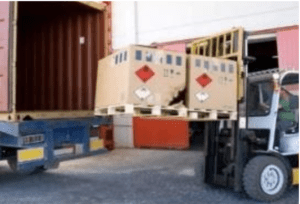
What is the difference between the two types of transport exemption?
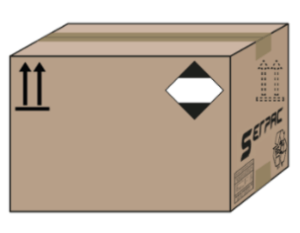
The exemption concerning the limited quantity (or, to put it better, concerning dangerous goods packed in limited quantities) is determined by the way in which the dangerous goods are packed. Dangerous goods that fall within the excepted quantity, that is, within a quantity limit whose ceiling is 1000 points, are called an excepted quantity. This is possible because it is regarded as a small quantity of dangerous goods per shipment.
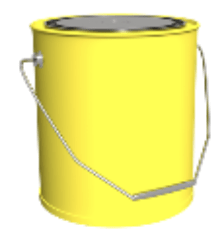
Thus, dangerous goods packed in limited quantities (LQ) are exempted because they are packed in small quantities. Dangerous goods exempted (partly) from the provisions of ADR benefit from exemptions because of the small quantity per transport unit.
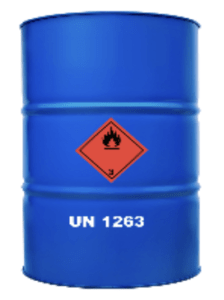
To bring out the difference between the two types of exemption as clearly as possible, we will use as an example a dangerous substance whose proper shipping name is PAINT. This substance is assigned to UN number 1263, packing group II.
Packing in limited quantities
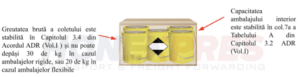
The substance PAINT is packed in 5-litre metal drums. Several drums may be placed in a cardboard box, in such a way that the gross weight of the package is 26 kg. In this case, the package falls under the exemption for packing in ADR limited quantities.
Excepted quantity per transport unit
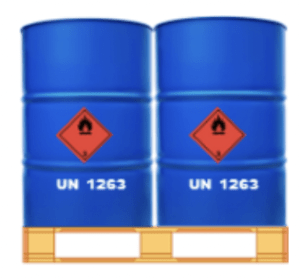
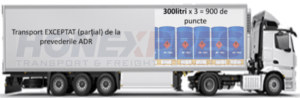
The same substance, PAINT, may also be packed in 100-litre drums. In this case, the maximum quantity that may be carried under the exemption is 300 litres, because it is regarded as a small quantity per transport unit and falls within the limits imposed by the legislation.
How is the points score for dangerous goods calculated?
The maximum score for a transport may not exceed 1000 points. Where different dangerous goods are carried, the total score (1000 pts/transport) is the sum of the scores for each category of goods, calculated using the formula:
Quantity of substance/transport cat. x risk factor = score/transport cat., where:
- The transport category of each substance can be found in col.(15) of Table A in Ch.3.2 of ADR (Vol. I, page 251).
- The risk factor for each substance is indicated in chapter 1.1.3.6.4.1. The risk factor differs from one transport category to another, as follows:
- Transport category 1 : 50
- Transport category 1*: 20
- Transport category 2: 3
- Transport category 3: 1
- Transport category 4 : It has no risk factor, and any quantity may be carried under the exemption
(E.g. empty, uncleaned packagings which nevertheless show traces of dangerous substances)
*Valid for UN numbers 0081, 0082, 0084, 0241, 0331, 0332, 0482, 1005 and 1017.
The ADR agreement can be accessed and downloaded from the link: https://www.adradviser.ro/acordul-adr
Packing in limited quantities vs. excepted quantity per ADR transport unit
In the table below you can find all the particular features of the two types of exemption, with the aim of giving you an overview of the two methods of transporting dangerous goods.
Conclusion
ADR therefore provides for two types of exemption that can be used to carry small quantities of dangerous goods.
Using either type of transport exemption means that the shipment has to be carried out under strict conditions. Besides complying with the legislation on the transport of dangerous goods, it is important that the truck driver adapts his or her driving behaviour to the goods being carried.
Neither of the methods we have presented is better than the other. Each method can offer maximum efficiency, depending on the customer's needs.
For efficient dangerous goods transport solutions, see Honexpres freight transport services!
Have something similar to move? Request a quote →
Sources (1)
All guides in ADR dangerous goods by road (22)
Related services