Guides
Project cargo and heavy lift shipping: how the door-to-door chain works
AI Text written with AI assistance and checked by the editorial team. How we work with AI
Article translated automatically from Romanian and checked automatically. If there is any difference, the original prevails. See the original in Romanian · How we use automatic translation
In short
Project cargo means large, heavy or multi-piece shipments for one project, often moved by heavy lift or multipurpose ships, RoRo or flat racks, with road legs at both ends. The ship, port, road permits, transport document and liability must be planned together, starting from accurate dimensions, weights and lifting points.
Contents
- What makes a shipment "project cargo"
- Ship options for project cargo
- The door-to-door chain: road legs, ports and sea
- Documents: bill of lading, sea waybill and multimodal documents
- Bill of lading (B/L)
- Sea waybill / non-negotiable document
- Liability and declared value
- Cost factors in project cargo shipping
- Data to prepare for a quote
- How HONEXPRES organises project cargo transport
- FAQ
- What is the difference between a heavy lift cargo ship and a multipurpose ship?
- Can project cargo go in containers?
- Is RoRo always cheaper than lift-on/lift-off?
- Who arranges the road permits for the oversized legs?
- Do I need a negotiable bill of lading?
- Request a project cargo quote
- Official sources consulted
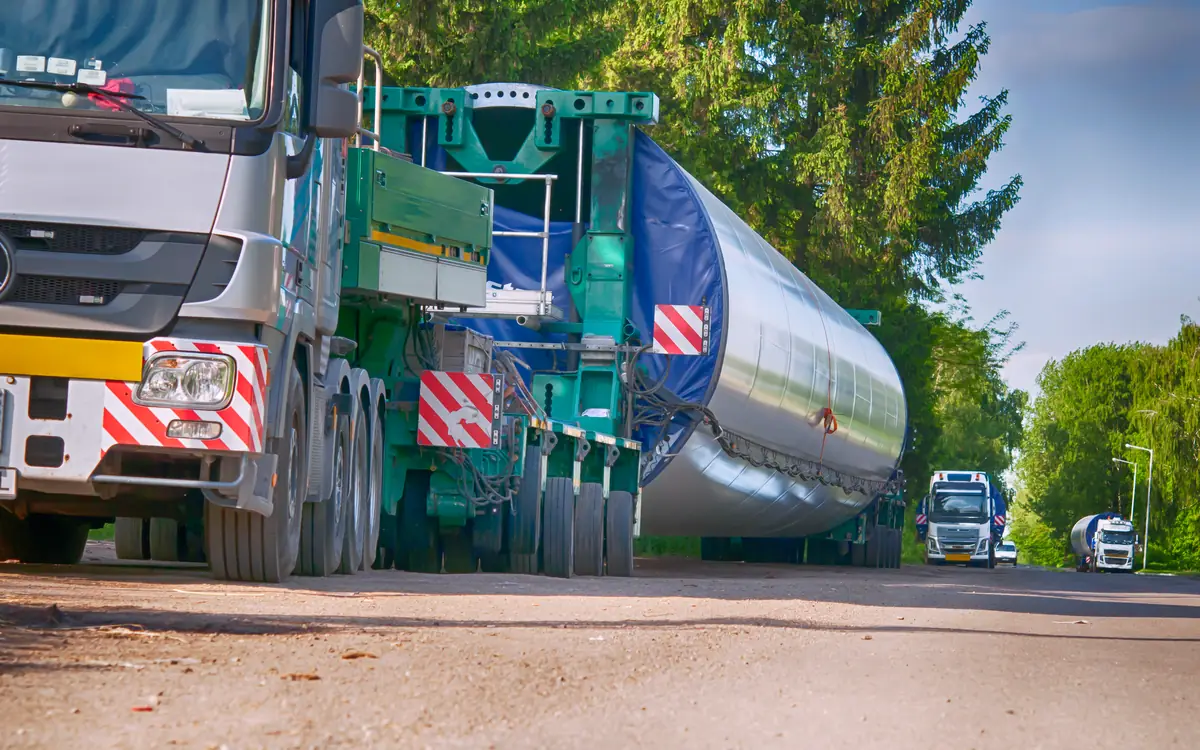
Project cargo and heavy lift shipping covers shipments that are too large, too heavy or too complex for a standard container or trailer: transformers, turbine sections, press lines, tanks, modular plant or a complete production line moved as one project. The cargo usually travels on a heavy lift cargo ship, a multipurpose project cargo ship, a RoRo vessel or on flat racks, with special road legs to and from the ports. What decides success is not the ship alone but the whole chain: accurate data, the right vessel and lifting method, road permits at both ends, the correct transport document and a clear view of liability and insurance.
This guide explains how that chain works, what drives the cost and what information you should prepare before asking for a quote. HONEXPRES SRL is a freight forwarder in Oradea: we do not own ships, cranes or trucks; we organise project cargo transport with partner carriers, shipping lines and port operators.
What makes a shipment "project cargo"
In everyday use the term covers cargo that needs individual engineering: one-off dimensions, high unit weight, sensitive or high-value equipment, or many pieces that must arrive in a fixed sequence for installation on site.
The road side of the chain uses a stricter concept. In Great Britain, for example, the enforcement guide of the Driver & Vehicle Standards Agency describes an abnormal indivisible load as a load that cannot be divided into two or more loads to be transported by road [1]. The same guide states that a large load that can easily be divided by undoing a few bolts must be split up for transport [1]. In practice this means the question "can we dismantle it?" should be answered before the sea booking, because it changes the vehicle, the permits and sometimes the type of ship.
Ship options for project cargo
The choice of vessel depends on the weight of the heaviest piece, its dimensions, whether it can move on its own wheels or tracks and on the lifting equipment available in the loading and discharge ports. The main options are:
| Option | How cargo is loaded | Typically used for | Points to check |
|---|---|---|---|
| Heavy lift cargo ship | Lift-on/lift-off with the ship's own heavy cranes or with port/floating cranes | Very heavy single units, modules, transformers | Crane capacity at the actual outreach, lifting points, sea-fastening on deck or in the hold |
| Multipurpose project cargo ship | Lift-on/lift-off, mix of breakbulk, project pieces and sometimes containers | Mixed project shipments, steel structures, machinery | Hold and hatch dimensions, deck strength, sailing schedule |
| RoRo vessel | Rolled on and off via ramp, on own wheels/tracks or on rolltrailers | Self-propelled machinery, cargo on trailers or mafis | Ramp and deck clearance, ramp capacity, whether cargo can be driven or must be towed |
| Container ship with flat racks / open tops | Out-of-gauge cargo on 40' flat rack containers or open tops | Moderately oversized machinery on regular liner routes | Overwidth/overheight acceptance by the line, stowage position, lashing |
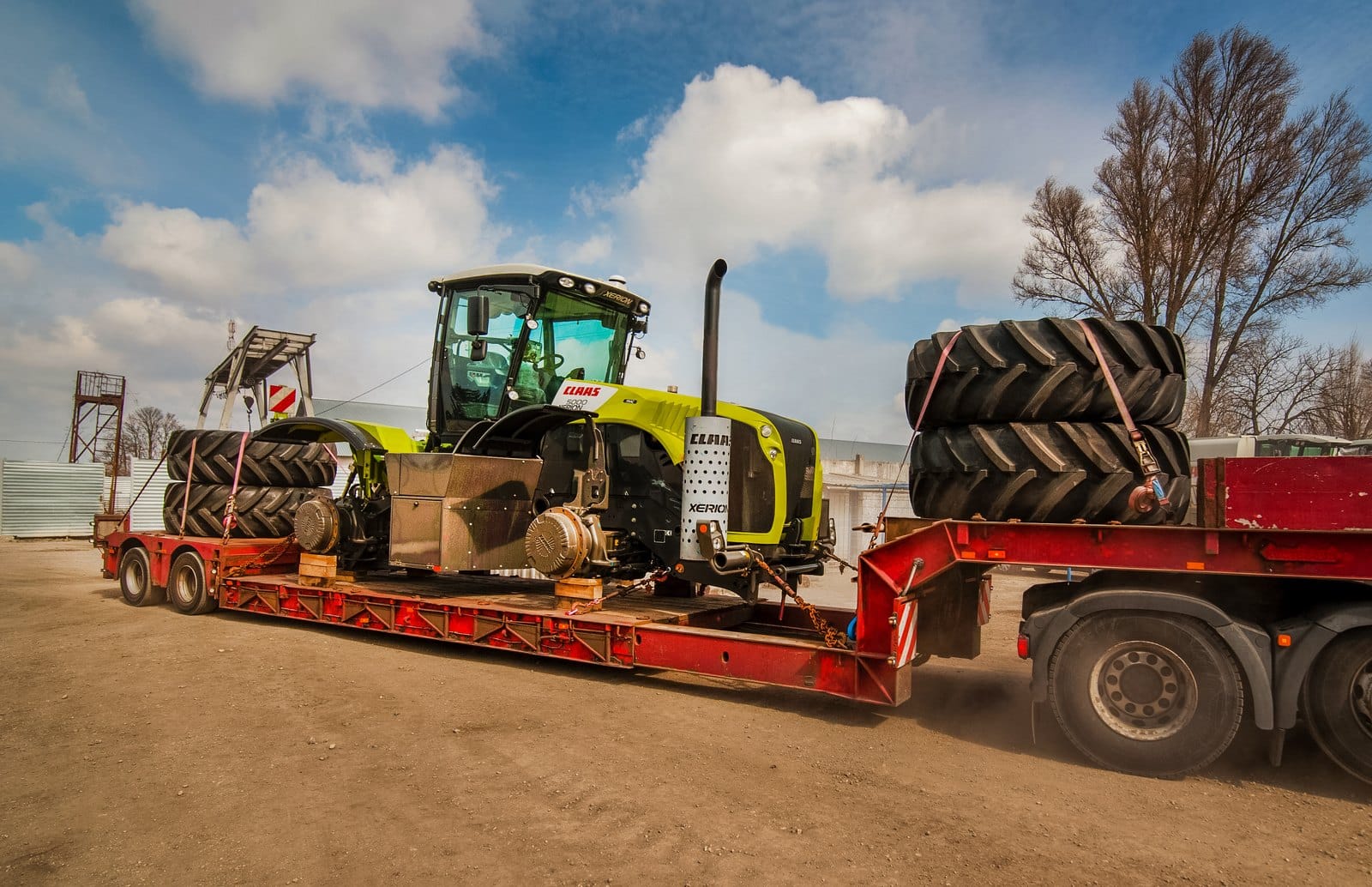
None of these is "better" in general. A machine that fits a flat rack may move on a regular container service; a unit too heavy for any rack may need a heavy lift vessel or a RoRo solution. For standard containerised flows, see our sea freight service; for project pieces we compare options case by case with partner lines.
One contractual detail matters for project cargo: large pieces are often stowed on deck. The standard conditions of the FIATA multimodal bill of lading define goods as any property, whether carried on or under deck [6]. On/under deck stowage should be agreed and shown in the booking, because it affects risk, lashing and insurance.
The door-to-door chain: road legs, ports and sea
Most project cargo transport is multimodal: factory to port by road (sometimes barge or rail), port handling and lifting, sea leg, discharge, then a second road leg to site. Each link has its own constraints:
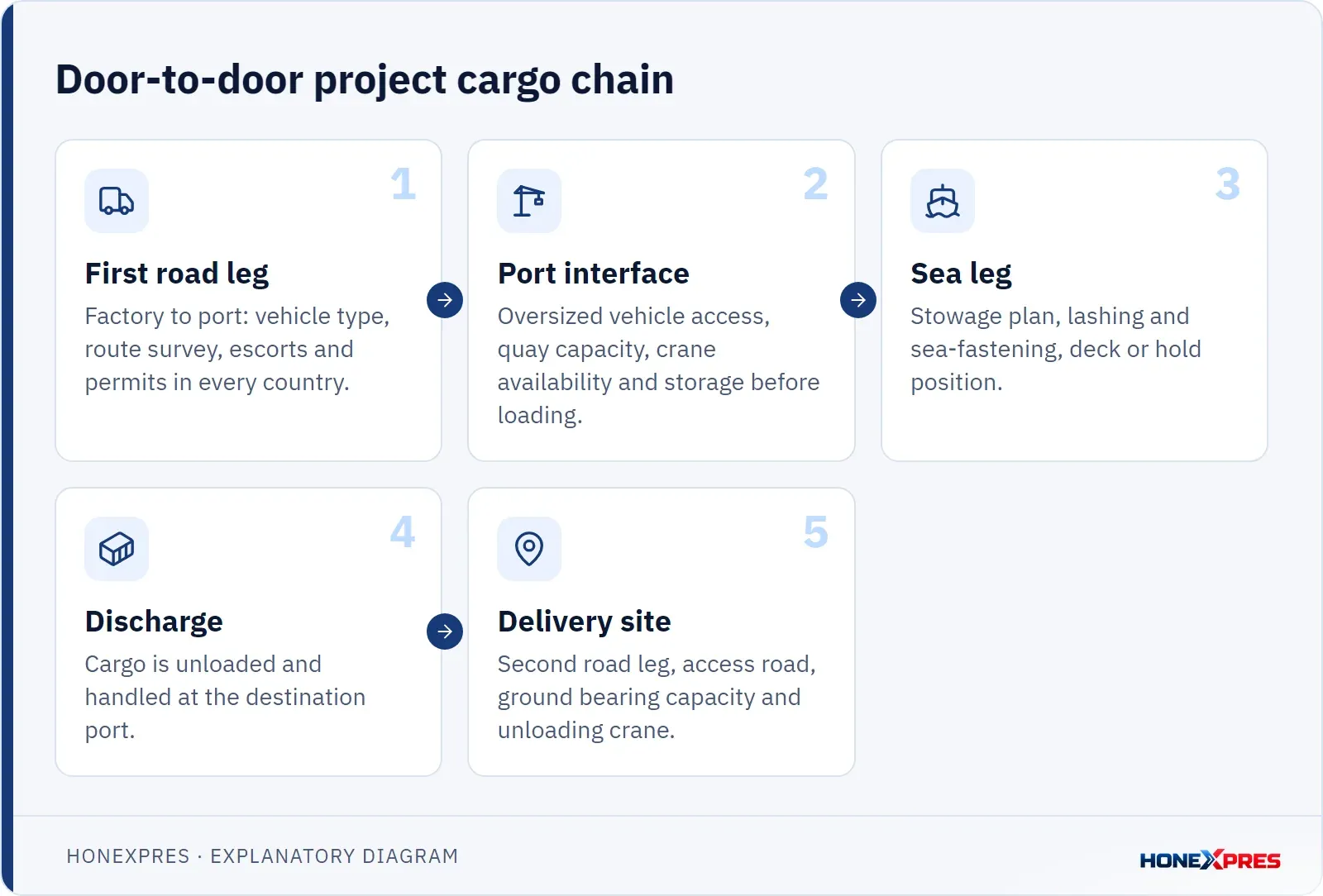
- First and last road leg: vehicle type (for example a low-bed low loader or modular trailer), route survey, bridges and clearances, escorts, permits in every country crossed.
- Port interface: access for oversized vehicles, quay capacity, crane availability, storage before loading, timing with the vessel's arrival.
- Sea leg: stowage plan, lashing and sea-fastening, deck or hold position.
- Delivery site: access road, ground bearing capacity, unloading crane or jacking-and-skidding at destination.
Road permits differ by country and must be checked with the competent authority for each leg. As an example of how detailed this can be, in Great Britain special types vehicles are those that do not meet the Construction and Use and Authorised Weight rules but may run under the Road Vehicles (Authorisation of Special Types) (General) Order 2003 [1]. The DVSA guide lists, for instance, that a load wider than 5 metres needs approval from the Secretary of State in the form of a VR1 permit, notice to the police and an attendant [2]. Vehicles more than 6.1 metres wide or more than 150,000 kg need a special order [3]. The guide also states that operators should make a separate plan for every abnormal load movement and secure the load appropriately [3].
A point that affects planning by a forwarder: in Great Britain the notice given to the authorities is operator specific, so the movement cannot be subcontracted without the consent of the relevant authority [4]. Changing the haulier at the last minute is therefore not a formality. For shipments to or from Ireland or Northern Ireland, and for the continental legs, the rules are set by each country's authorities; check them before committing dates. More background on the road side is in our article on technical requirements for oversized freight transport and on our oversized transport service page.
If the cargo contains dangerous goods (fuel in a machine, batteries, gas in equipment) and a road vehicle subject to ADR travels part of the route by ship, ADR 2025, 1.1.4.5.1, states that for that part of the journey only the national or international rules governing dangerous goods for the mode used apply [5]. Declare such contents at booking so both the road and sea rules can be applied.
Documents: bill of lading, sea waybill and multimodal documents
The transport document is not just paperwork for project cargo; it defines who can take delivery and on what terms.
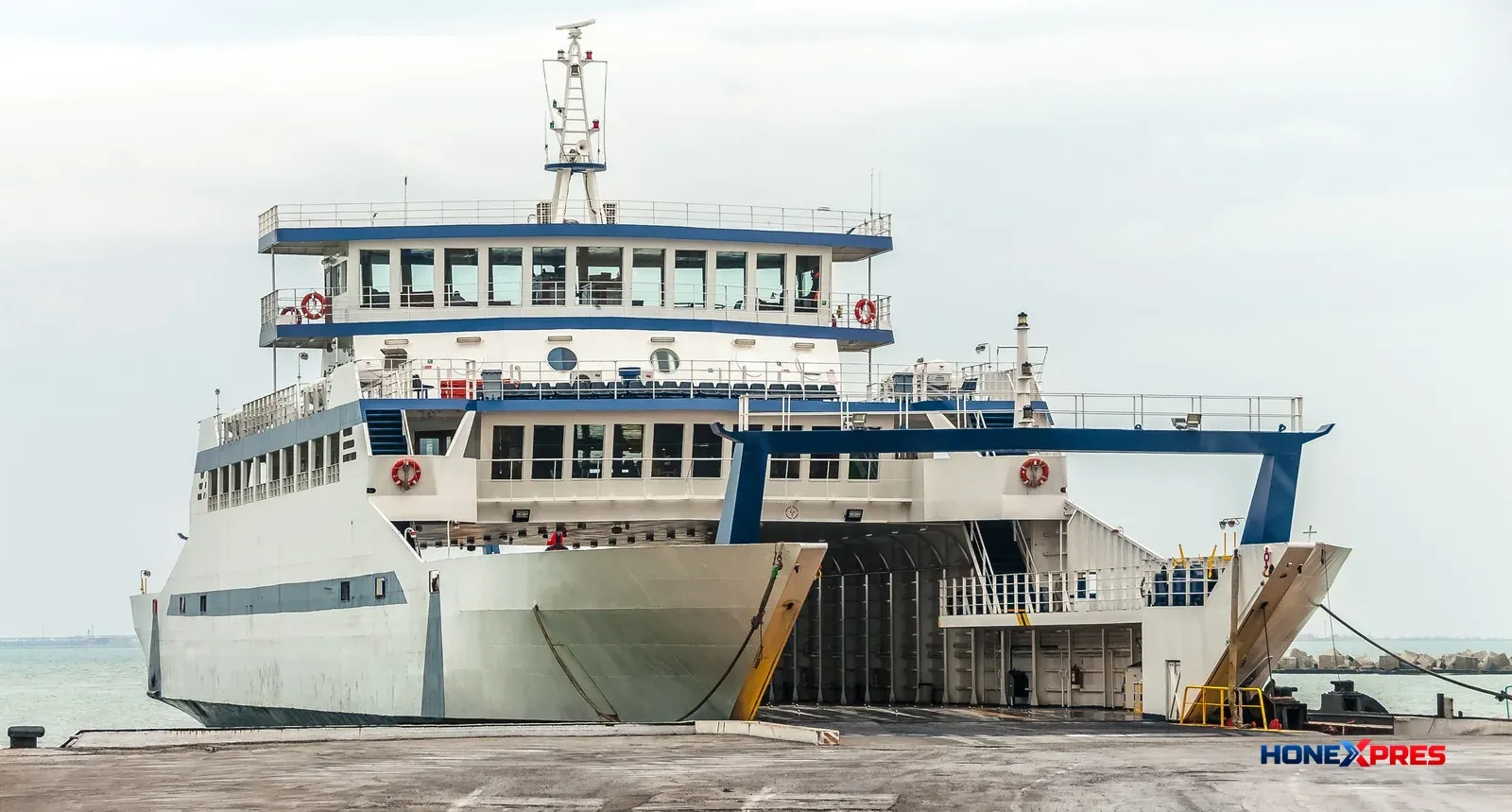
Bill of lading (B/L)
A bill of lading serves as the contract of carriage and receipt of the goods and also works as a document of title [7]. The FIATA multimodal bill of lading (FBL) can also be issued as a marine bill of lading [7]. Its standard conditions also apply when only one mode of transport is used [6]. The B/L records that goods were taken in charge in apparent good order and condition unless otherwise noted [8], so any visible damage, rust or missing parts noted at handover will follow the cargo. For the difference between documents issued by a forwarder and by the line, read house bill of lading versus master bill of lading.
Sea waybill / non-negotiable document
The FIATA multimodal waybill (FWB) is not negotiable [9]. Unlike the FBL, it does not have to be presented by the consignee to take delivery [9]. A waybill is useful when the buyer is known and the cargo will not be sold in transit; a negotiable B/L is used when a bank or a letter of credit requires it.
Liability and declared value
Carrier and forwarder liability is limited by the contract terms and by the conventions that apply. Under the FIATA documents, when loss or damage can be attributed to a specific stage of a multimodal transport, liability is limited by the mandatory national or international law applicable to that stage [10]. The FWB conditions provide for a basic limit unless a higher value has been declared [9]. For a single high-value unit, a limit calculated per package or per kilogram may be far below the replacement cost, so discuss declared value and cargo insurance early; see why cargo insurance is important. HONEXPRES does not provide insurance itself.
Cost factors in project cargo shipping
We do not publish tariffs, because every project cargo ship booking is priced on its own facts. What drives the cost:
- Dimensions and weight of the largest piece: they decide the vessel type, the crane and the road equipment.
- Freight basis: the basis of charge and any out-of-gauge surcharges are set by each line or carrier, so ask how your shipment will be calculated.
- Lifting: ship's gear versus hired port or floating cranes, rigging, spreader beams, lifting supervision.
- Lashing and sea-fastening: materials, welding of stoppers, surveyor attendance.
- Road legs: trailer type, number of axles, escorts, permits, route surveys, night-only movements, temporary removal of street furniture.
- Port costs: terminal handling for breakbulk, storage, quay access for oversized vehicles.
- Time and flexibility: fixed sailing dates versus waiting for a suitable vessel; delays in permits can create waiting costs for trucks and cranes.
- Documentation and customs: export/import formalities, type of transport document, declared value.
- Insurance: separate cargo insurance, especially for on-deck stowage.
Data to prepare for a quote
- Commodity description and quantity of pieces.
- Length, width, height and gross weight of each piece, plus drawings with the centre of gravity marked.
- Lifting and lashing points, and whether the piece can be driven, towed or only lifted.
- Exact pick-up and delivery addresses, with site access details and available unloading equipment.
- Ready date and required delivery window on site.
- Incoterms rule and who handles customs at each end.
- Required transport document (negotiable B/L, waybill) and letter of credit conditions, if any.
- Presence of fuel, batteries or other dangerous goods.
- Value of the cargo and insurance instructions.
- Packaging or preservation (crating, shrink-wrap, rust protection for on-deck stowage).
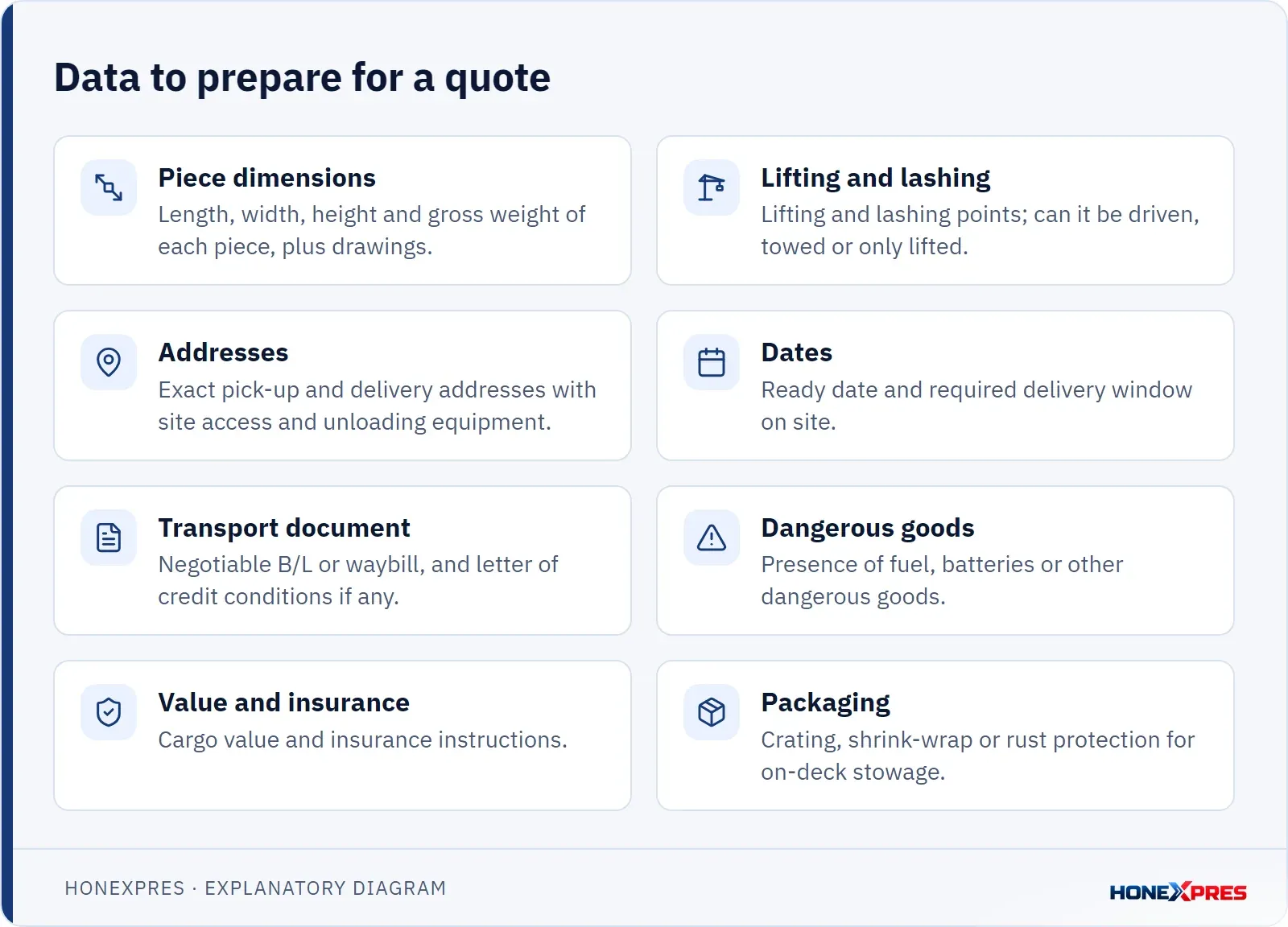
Complete and accurate dimensions help avoid re-quoting, because they decide the vessel type, the crane and the road equipment.
How HONEXPRES organises project cargo transport
As a freight forwarder, we act as the coordinator: we collect your technical data, request options from partner shipping lines and specialised hauliers, compare vessel and routing alternatives, and align road permits, port handling and sailing dates. Lifting, carriage and road movements are performed by our partner carriers and port operators, under their own authorisations. We tell you clearly which document will be issued, by whom, and on what liability terms, so that you can decide on declared value and insurance.
FAQ
What is the difference between a heavy lift cargo ship and a multipurpose ship?
Both can carry project cargo. A heavy lift vessel is built around lifting very heavy single pieces, while a multipurpose ship carries mixed breakbulk, project pieces and sometimes containers. The right choice depends on the heaviest unit, its dimensions and the port equipment; we check this with the lines for each shipment.
Can project cargo go in containers?
Yes, if the pieces fit within what a line accepts on flat racks or open-top containers. Out-of-gauge acceptance and surcharges are set by each line, so the dimensions must be confirmed before booking.
Is RoRo always cheaper than lift-on/lift-off?
Not necessarily. RoRo avoids crane costs for cargo that can be driven or rolled, but ramp and deck clearances, rolltrailer use and route availability can change the balance. We compare both where both are feasible.
Who arranges the road permits for the oversized legs?
The permits are obtained by or for the haulier performing each leg, under the rules of each country. In Great Britain, for example, the notice to the authorities is operator specific and the movement cannot be subcontracted without the authority's consent [4]. We plan the legs with partner hauliers who hold the necessary permits.
Do I need a negotiable bill of lading?
Only if you need a document of title, for example for a letter of credit or a sale in transit. Otherwise a non-negotiable waybill can be simpler, because the consignee does not have to present it to take delivery [9].
Request a project cargo quote
Send us the drawings, weights, lifting points and addresses of your shipment and we will organise a door-to-door proposal with partner carriers and shipping lines, explaining the vessel option, the road legs and the documents. Use our quote request form to get started.
Official sources consulted
- [1] Driver & Vehicle Standards Agency, Special types enforcement guide (gov.uk, updated 27 September 2018), section 1.1 Vehicles most likely to be used under an STGO
- [2] Driver & Vehicle Standards Agency, Special types enforcement guide, section 5.2 Over-width projections
- [3] Driver & Vehicle Standards Agency, Special types enforcement guide, section 1.3 Special order movements
- [4] Driver & Vehicle Standards Agency, Special types enforcement guide, section 9 Documentation
- [5] ADR 2025 (ECE/TRANS/352, Vol. I), 1.1.4.5.1 Vehicle carried other than by road traction
- [6] FIATA Multimodal Transport Bill of Lading (FBL), Standard Conditions (1992), Definitions
- [7] FIATA explanatory brochure on the Negotiable FIATA Multimodal Transport Bill of Lading (FBL)
- [8] FIATA Multimodal Transport Bill of Lading (FBL), face of the document
- [9] FIATA explanatory brochure on the Non-negotiable FIATA Multimodal Transport Waybill (FWB)
- [10] FIATA explanatory brochure on the FBL, referring to Art. 8.6.a of the FBL conditions
Send us the drawings, weights and addresses of your project cargo and we will organise a door-to-door proposal with partner carriers and shipping lines.
Have something similar to move? Request a quote →
Sources (1)
Related services