Guides
Heavy equipment moving service: how it works, what it costs and how to get a quote
AI Text written with AI assistance and checked by the editorial team. How we work with AI
Article translated automatically from Romanian and checked automatically. If there is any difference, the original prevails. See the original in Romanian · How we use automatic translation
In short
A heavy equipment move depends on exact machine data, the right trailer, a loading and securing plan, and any notifications or permits the dimensions and weight trigger. In Great Britain these are set by the C&U and AW Regulations and the STGO. Send full specifications, addresses and site conditions to get a realistic quote.
Contents
- What a heavy equipment moving service actually covers
- Step 1: get the machine data right
- Step 2: choose the trailer
- Step 3: lifting and loading
- Step 4: securing the load
- Step 5: permits, notifications and escorts in Great Britain
- Weight categories for abnormal indivisible loads
- Width, length and projections
- Why the carrier must handle the notifications
- Outside Great Britain
- Insurance questions to ask before you book
- Documents to prepare
- What drives the cost of moving heavy equipment
- What to send for an accurate quote
- FAQ
- How far in advance should I book a heavy equipment move?
- Can my excavator travel with its bucket and other attachments?
- Is an escort vehicle always required?
- Can a forwarder file the abnormal load notice on my behalf?
- What happens if the actual load differs from what was notified?
- Request a quote for your heavy equipment move
- Official sources consulted
Moving an excavator, a crawler crane, a hydraulic press or a production line is a different job from shipping pallets. The truck is the easy part. What decides whether a heavy equipment moving service runs smoothly is the preparation: exact machine data, the right trailer, a safe way to load and secure it, and the notifications or permits that the dimensions and weight trigger on every road crossed. HONEXPRES is a freight forwarder based in Oradea, Romania. We do not run our own fleet. We organise heavy equipment transport with partner carriers that operate low loaders and specialised trailers, and we coordinate the planning, paperwork and timing for the shipper.
This guide explains how a typical move is planned, what the rules in Great Britain require, which questions to ask about insurance, and what information to send so a quote reflects the real job.
What a heavy equipment moving service actually covers
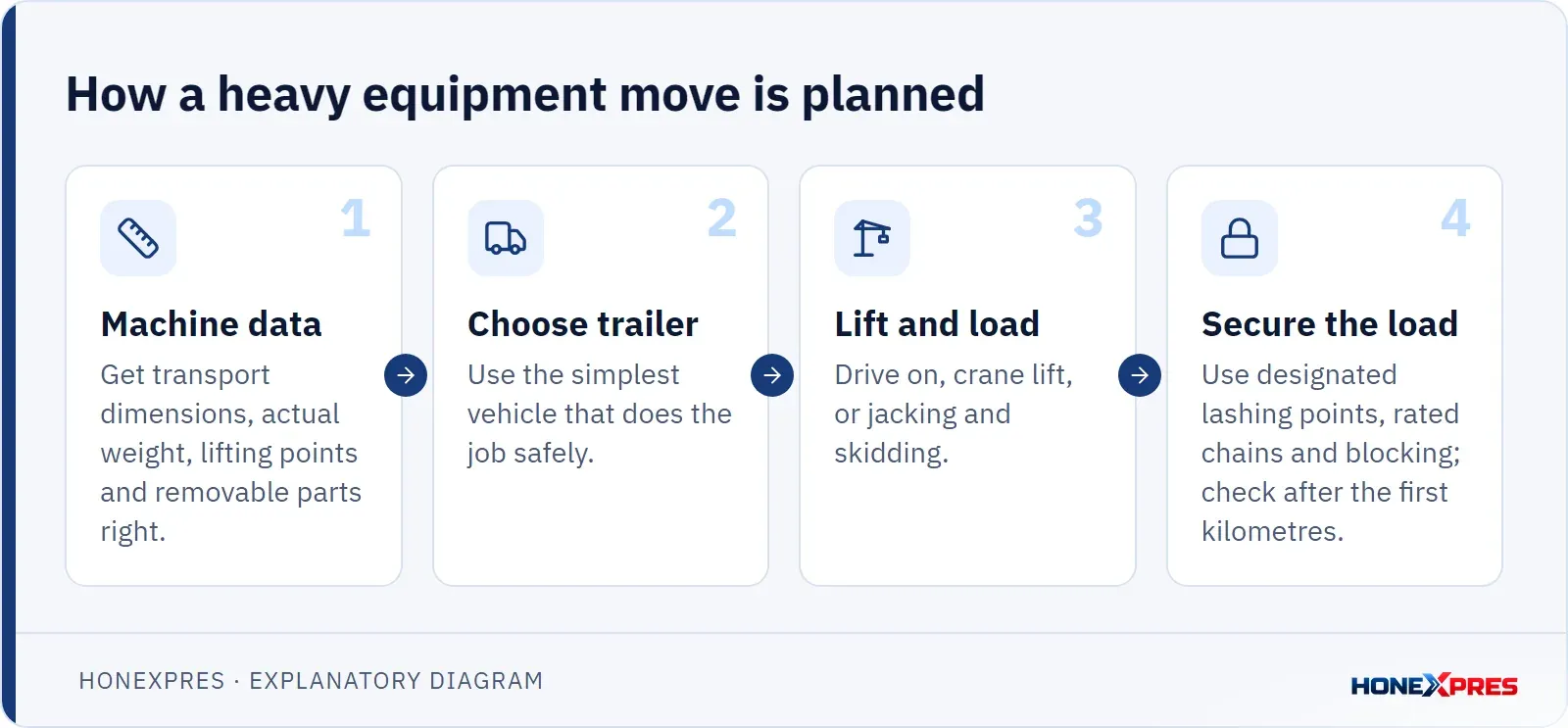
When you ask someone to move heavy equipment, you are buying a sequence of decisions. Each step depends on the one before it:
- Machine data: dimensions, weight, axle or track layout, lifting points and removable parts.
- Vehicle choice: the lowest-risk trailer that keeps the load within legal and practical limits.
- Loading method: driving on, crane lift, jacking or skidding, and who supplies the equipment and the operator.
- Securing plan: lashing points, blocking, chains and protection of sensitive parts.
- Notifications, permits and escorts: these depend on width, length, weight and the countries crossed.
- Route and timing: bridges, low structures, time windows and site access at both ends.
- Documents and insurance: transport documents, customs where relevant, and clarity on who covers what.
Our machinery transport service page shows the types of agricultural, construction and industrial machines we regularly arrange. The steps below show how we approach them.
Step 1: get the machine data right
Almost every problem in machinery transport starts with wrong or missing figures. You need the transport dimensions, not the catalogue dimensions. That means the length with the boom folded, the height with the cab or exhaust in transport position, and the width over tracks, mirrors or counterweights. Measure the actual weight, including attachments, fuel and any extra counterweight left on the machine.
Next, decide whether the machine can be made smaller. In Great Britain, the legal framework distinguishes loads that cannot be divided. The DVSA Special types enforcement guide describes an abnormal indivisible load as "loads which cannot be divided into 2 or more loads to be transported by road". [1] The same guide makes clear that a large load that can easily be halved by undoing a few bolts must be split up for transport. [1] Engineering plant is defined there as "a moveable piece of plant or equipment which is a motor vehicle or trailer specially built for engineering operations". [1]
In practice, removing a bucket, a blade, a counterweight or a cab guard can bring a machine into a lower category, onto a smaller trailer, or out of the permit regime altogether. Ask the manufacturer or your workshop what can be detached safely, and how long it takes to remove and refit.
Step 2: choose the trailer
The trailer follows from the machine, not the other way round. British guidance states that, where possible and safe, a "normal-sized" vehicle must be used even if the load overhangs, and a larger vehicle or combination is used only where a normal one is not safe. [1] That principle is useful everywhere: the simplest vehicle that does the job safely usually means fewer formalities and lower cost.
| Vehicle type | Typical use | What to check |
|---|---|---|
| Flatbed semi-trailer | Compact machines, parts, crated equipment | Overall height once loaded; lashing points |
| Extendable flatbed | Long items such as beams, booms, long frames | Overhang and length notifications |
| Semi low-loader | Mid-size construction machinery, tall industrial equipment | Ramps, deck height, axle loads |
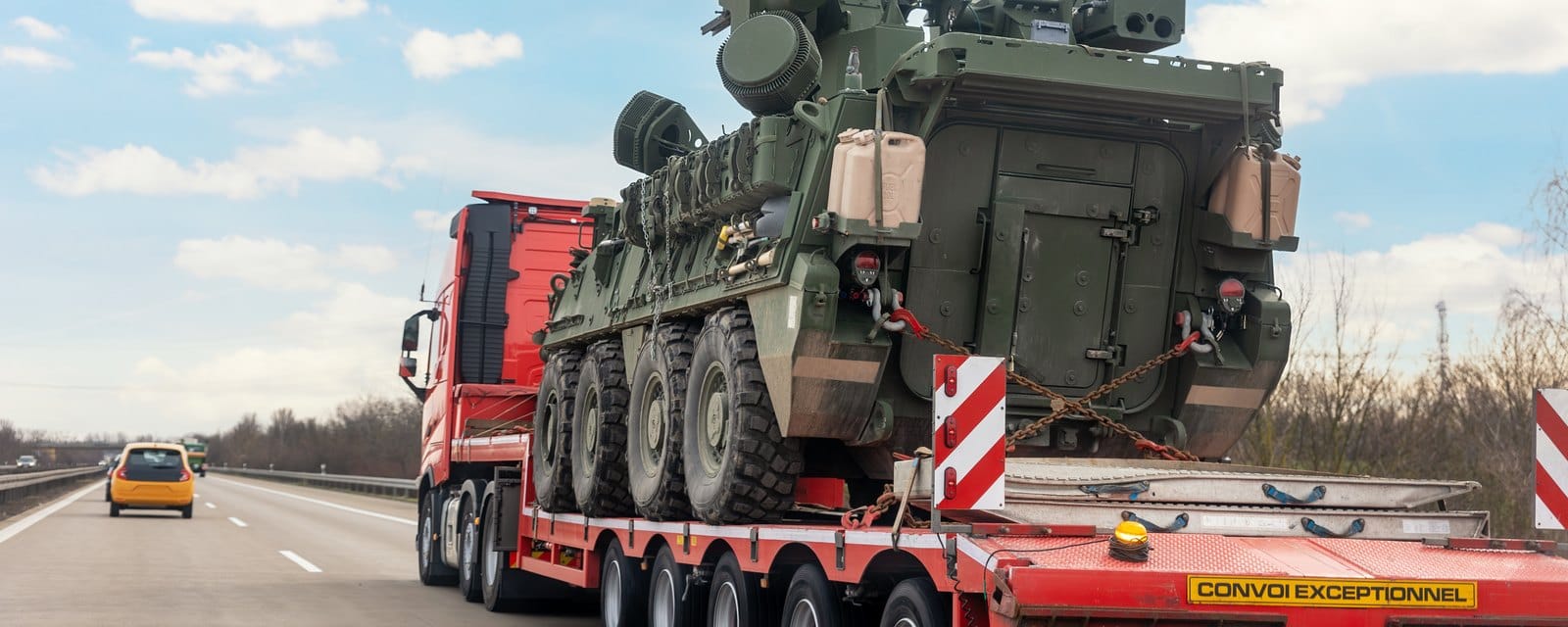
| Low-bed low loader | Heavy excavators, dozers, cranes on tracks, tall presses | Ground clearance on the route, number of axles |
| Modular or multi-axle combinations | The heaviest indivisible loads | Permits, escorts, structures on the route |
| 40' flat rack container | Machinery moving partly by sea | Port handling, lashing for sea transport |
The right choice also depends on how the machine will be loaded and unloaded. A tracked machine that drives up ramps needs a different deck from a press lifted by crane. The deck height directly affects the loaded height, and that often decides the route.
Step 3: lifting and loading
There are three common ways to get heavy equipment onto a trailer:
- Drive-on / drive-off: for self-propelled machines with a competent operator. The ramp angle, deck surface and weather matter. Wet steel and rubber tracks are a bad combination.
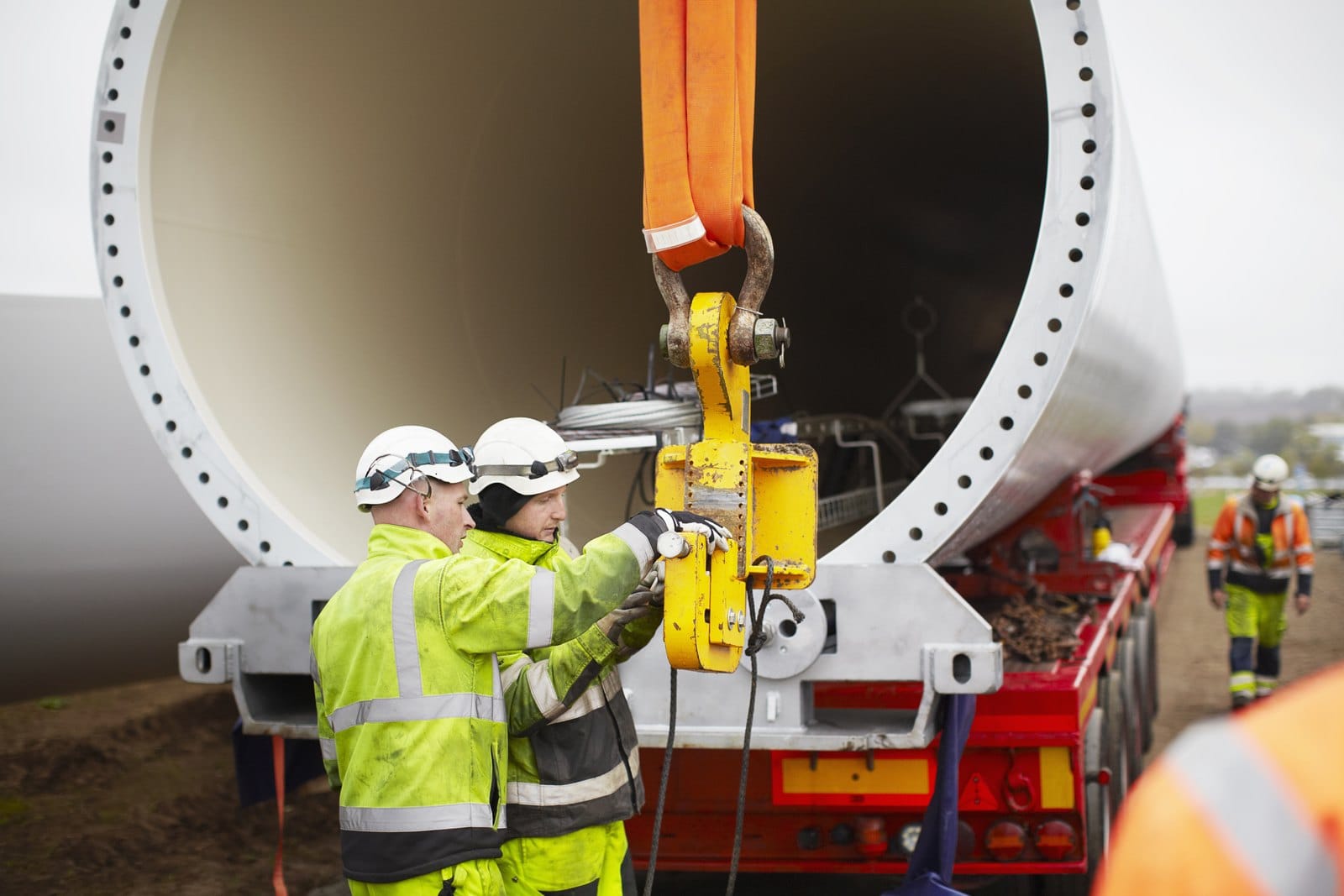
- Crane lift: for machines without their own drive, such as presses, CNC machines, generators and transformers. You need certified lifting points, a lifting plan, the right slings or spreader beam and enough ground for the crane outriggers.
- Jacking and skidding: for machines inside buildings where a crane cannot reach. This is usually done by a specialised rigging team before the truck arrives.
Agree in writing who supplies the crane or rigging team, who operates the machine, who is responsible for the lift, and what happens if the site is not ready when the truck arrives. Waiting time and an aborted collection are among the most common causes of extra cost.
Carrying several items together is restricted for abnormal loads. In Great Britain, detachable component parts of engineering plant may travel with the plant, but only under conditions such as the part being loaded and unloaded at the same place. [2] The guide's own example is a bulldozer with its detachable blade, while a trailer towed by the bulldozer may not be carried on the same vehicle. [2]
Step 4: securing the load
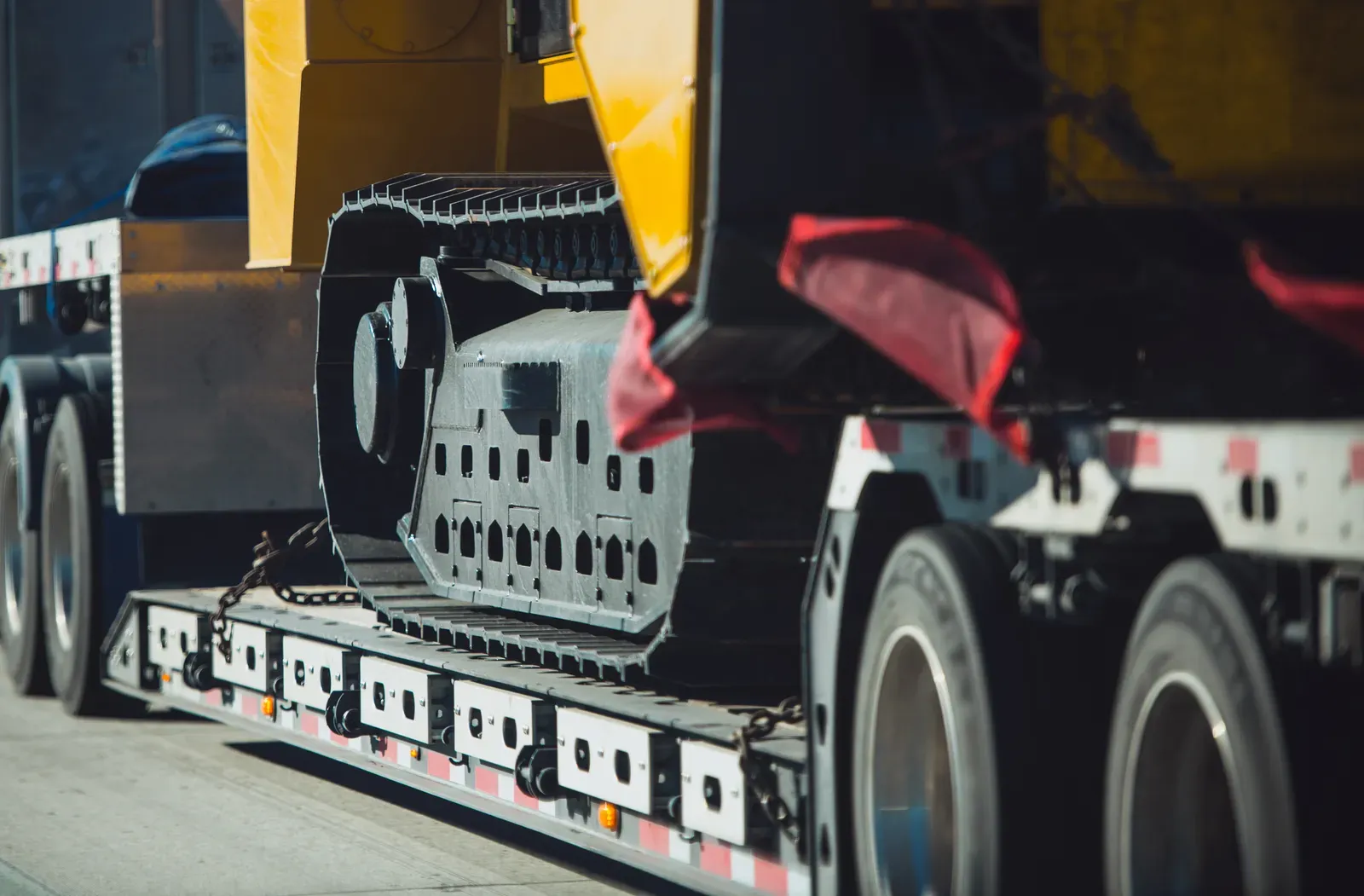
A heavy machine that moves on the deck can shift the vehicle's centre of gravity, overload an axle or break free. British guidance says operators should make a separate plan for every abnormal load movement and secure the load appropriately. [2] It also states that reasonably practicable steps must be taken to secure abnormal loads. [2]
In Romania, Order no. 980/2011 requires transport operators carrying out paid road transport to use a load securing system that withstands a deceleration of 0.8 g forwards. [3] It also requires it to withstand 0.5 g rearwards and 0.5 g towards each side. [3] The same article requires the load's centre of gravity to be as close as possible to the centre of the vehicle. [3]
On the practical side, a good securing plan for heavy equipment usually covers:
- the use of the machine's designated lashing points, never hydraulic hoses, handrails or light brackets;
- chains and binders rated for the forces involved, with blocking against the tracks or wheels;
- boom, arm and bucket lowered and secured, slew lock engaged, and parking brake applied;
- loose items such as keys, documents and attachments stowed or removed;
- protection against weather and road spray for electrical cabinets and control panels;
- checks after the first kilometres and at every stop, because chains can settle.
Step 5: permits, notifications and escorts in Great Britain
This is where most shippers need help, because the trigger points are precise. In Great Britain, vehicle dimensions and weights are regulated by the Road Vehicles (Construction & Use) Regulations 1986 and the Road Vehicles (Authorised Weight) Regulations 1998. [1] Vehicles that do not meet those rules can operate under the Road Vehicles (Authorisation of Special Types) (General) Order 2003, known as the STGO. [1] The DVSA guide summarising these rules applies to England, Scotland and Wales. [1]
Weight categories for abnormal indivisible loads
| STGO category | Weight and axles | Notice to highway and bridge authorities |
|---|---|---|
| Category 1 | Up to 46,000 kg with at least 5 axles, or up to 50,000 kg with at least 6 axles | 2 working days |
| Category 2 | Not exceeding 80,000 kg, at least 6 axles, axle weight up to 12,500 kg | 2 working days |
| Category 3 | Not exceeding 150,000 kg, at least 6 axles, axle weight up to 16,500 kg | 5 working days |
These category limits and notice periods are taken from the DVSA guide. [1] [2] For Category 1 the guide sets speed limits of 60 mph on motorways, 50 mph on dual carriageways and 40 mph on other roads. [1] For Categories 2 and 3 the limits are 40 mph, 35 mph and 30 mph respectively. [1] [2] A special order is needed for vehicles over 150,000 kg, over 16,500 kg per axle, over 6.1 metres wide or over 30 metres in rigid length when loaded. [2]
Width, length and projections
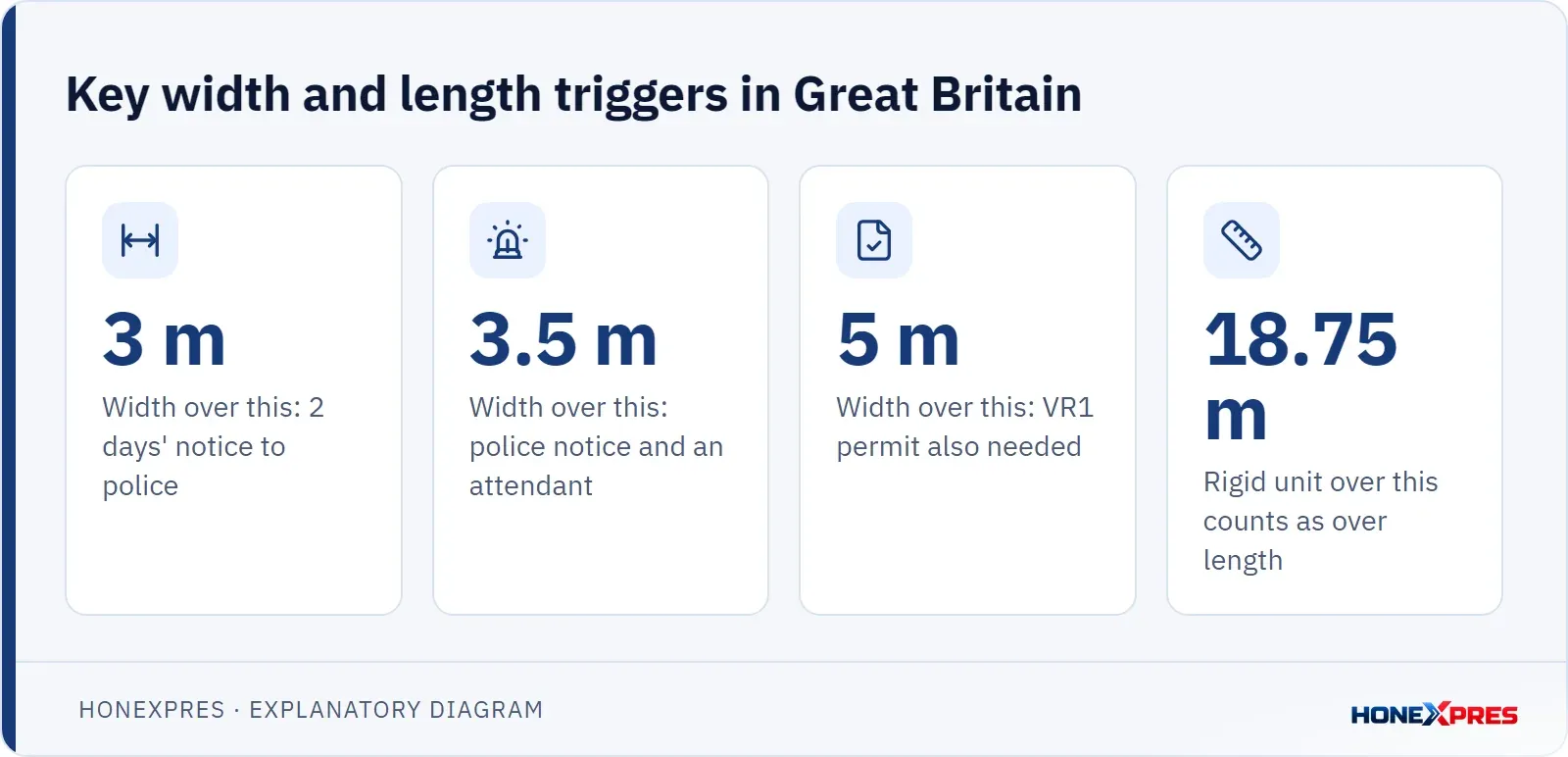
- A load width over 3 metres, including projections, requires 2 days' notice to the police. [4]
- Over 3.5 metres, notice to the police and an attendant are required. [4]
- Over 5 metres, approval from the Secretary of State in the form of a VR1 permit is also needed. [4]
- A single rigid unit over 18.75 metres including projections counts as over length. [4] So does a combination over 25.9 metres. [4] In both cases the police must be notified and an attendant must accompany the load. [4]
- A front or rear projection over 2 metres must carry an end marker. [4]
There is no law requiring an escort vehicle under the STGO or a special order, but the police can require one when necessary. [5] Vehicles from outside Great Britain follow the same dimension and weight rules and can use the STGO exemptions under the same conditions. [5] This matters for machinery coming from continental Europe on an EU-registered low loader.
Why the carrier must handle the notifications
One point surprises many shippers. The notice given to the authorities is operator specific, so the movement cannot be subcontracted without the authority's consent. [6] If the vehicle does not match the notice in weight, dimensions, operator or route, the exemptions no longer apply and enforcement action may follow. [6] When we organise a move into or within Great Britain, we therefore make sure the partner carrier that will actually perform the transport files the notifications on time. The data we pass on must match the machine exactly.
Goods vehicles operating under the STGO and special orders must still follow drivers' hours and tachograph rules. [2] Mobile cranes and engineering plant travelling on their own wheels have their own STGO regimes. [7] If your crane or machine will be driven on the road rather than carried, check those rules separately.
Outside Great Britain
Every country has its own limits and permit procedure. In Romania, drivers of oversized transports are trained under a programme that covers, among other topics, choosing the vehicle according to the load, axle loads and stability. [8] They hold a certificate for oversized transport issued by the Romanian Road Authority (ARR). [8] Romanian operators must also follow the rules for transports whose masses or dimensions exceed the maximum permitted values. [3] For each other country on the route, the carrier must check the current requirements with the competent road authority before departure. For more background, see our article on technical requirements for oversized freight transport and our oversized transport service.
Insurance questions to ask before you book
Heavy equipment is often worth far more than the transport itself, so clarify cover before the machine leaves your site. Who is liable for the goods in transit, and up to what limit, depends on the contracts concluded and the applicable law, so check this before booking; the cover available may not match the value of your machine. Ask:
- What liability cover does the performing carrier hold, and up to what value?
- Is loading and unloading, including any crane lift, covered, and by whom?
- Do you need separate cargo insurance for the full value of the machine?
- Who is responsible if damage is caused by poor lifting points or incorrect data supplied by the shipper?
The difference between carrier liability and cargo insurance is explained in CMR or CARGO insurance: which one do you need?
Documents to prepare
- Technical data sheet or drawing with transport dimensions, weight and lifting or lashing points.
- Photos of the machine in transport position, and of the loading and unloading areas.
- Consignment note for the road leg. The CMR note is commonly used for international road transport.
- Commercial invoice and packing list if the machine crosses a customs border.
- Copies of the notifications or permits required for the route, filed by the carrier.
- Any operating instructions the carrier's driver needs for drive-on loading.
For moves between Great Britain and the European Union, the customs side has to be planned as carefully as the road side. Check the current requirements with a customs broker or the competent customs authority. We can arrange the formalities through our customs services.
What drives the cost of moving heavy equipment
We do not publish price lists, because two machines of similar weight can produce very different quotes. The main cost factors are:
- Dimensions and weight: they decide the trailer type, the number of axles and whether permits, attendants or escorts are needed.
- Distance and route: detours around bridges, low structures or restricted roads add kilometres and time.
- Notice periods and timing: authority notice periods limit how quickly a move can start, and night or weekend windows cost more.
- Loading and unloading: crane hire, rigging teams and waiting time at sites that are not ready.
- Empty running: specialised trailers are fewer, so positioning a low loader to your site can be a significant part of the cost.
- Borders and customs: documents, clearance and possible waiting at border crossings.
- Dismantling: removing parts may add workshop hours but can cut permit and trailer costs considerably.
What to send for an accurate quote
- Machine type, make and model, and a photo.
- Transport length, width and height, and the exact weight, including attachments.
- Whether it is self-propelled, tracked or wheeled, and whether parts can be removed.
- Full collection and delivery addresses, with access restrictions and opening hours.
- How it will be loaded and unloaded, and who provides the crane or operator.
- Preferred dates and how flexible they are.
- Value of the machine and your insurance expectations.
- Customs status, if the move crosses a customs border.
FAQ
How far in advance should I book a heavy equipment move?
As early as you can. Apart from finding a suitable trailer, authority notice periods apply: in Great Britain, Category 3 abnormal loads require 5 working days' notice to highway and bridge authorities. [2] Larger moves under a special order also need notice to the police. [2]
Can my excavator travel with its bucket and other attachments?
Often, yes, but not always together with an abnormal load. In Great Britain, detachable parts of engineering plant may be carried only under specific conditions, for example being loaded and unloaded at the same place. [2] If the parts are removable, check whether moving them separately would take the machine below a permit threshold.
Is an escort vehicle always required?
No. In Great Britain there is no law requiring an escort vehicle for STGO or special order movements, although the police can require one. [5] An attendant is a separate requirement, triggered, for example, by a width over 3.5 metres. [4]
Can a forwarder file the abnormal load notice on my behalf?
In Great Britain, the notice is operator specific, so the movement cannot be subcontracted without the authority's consent. [6] We provide the data and coordinate. The notice itself must come from the carrier performing the move.
What happens if the actual load differs from what was notified?
If the weight, dimensions, operator or route do not match the notice, the STGO exemptions stop applying and enforcement action may be taken. [6] That is why we ask for measured figures rather than catalogue data.
Request a quote for your heavy equipment move
Send us the machine's transport dimensions, weight, photos and the collection and delivery addresses. We will check the options with partner carriers, flag any permit or notice periods, and come back with a written quote and a realistic timeline. Request a heavy equipment transport quote.
Official sources consulted
- [1] DVSA, Special types enforcement guide (gov.uk), section 1.1
- [2] DVSA, Special types enforcement guide (gov.uk), section 1.2, Category 3
- [3] Romanian Order no. 980 of 30 November 2011, Article 134(k)
- [4] DVSA, Special types enforcement guide (gov.uk), section 5.2 Over-width projections
- [5] DVSA, Special types enforcement guide (gov.uk), section 8.1 Escort vehicles
- [6] DVSA, Special types enforcement guide (gov.uk), section 9 Documentation
- [7] DVSA, Special types enforcement guide (gov.uk), section 3 Engineering plant
- [8] Romanian Order no. 1.214/2015, Norms, Article 6(8)
Send us your machine's dimensions, weight and addresses, and we will arrange a suitable partner carrier and a written quote.
Have something similar to move? Request a quote →
Sources (1)
Related services