ADR dangerous goods by road · Guides
Classification of dangerous goods
Article translated automatically from Romanian and checked automatically. If there is any difference, the original prevails. See the original in Romanian · How we use automatic translation
In short
In this Honexpres article, we will look at the classification of dangerous goods. Manufacturers of chemical substances that meet the classification criteria of the dangerous goods classes must classify dangerous substances or mixtures in the 13 classes of dangerous goods.
Contents
- Classification of dangerous goods
- ADR Class 1 – EXPLOSIVE substances and articles are considered to be:
- ADR Class 2 – Gases
- Class 3 – Flammable liquids
- Class 4.1 Flammable solids, self-reactive substances, polymerizing substances and solid desensitized explosives
- Class 4.2 Substances liable to spontaneous combustion
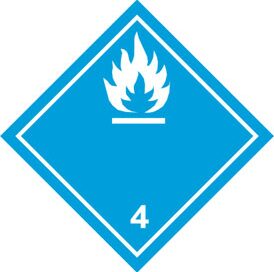
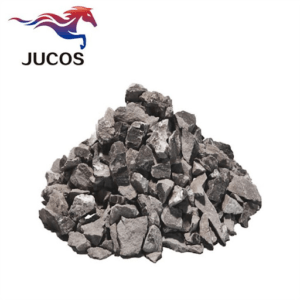
- Class 4.3 Substances which, in contact with water, emit flammable gases covers substances which react with water to emit flammable gases liable to form explosive mixtures with air, as well as articles containing such substances
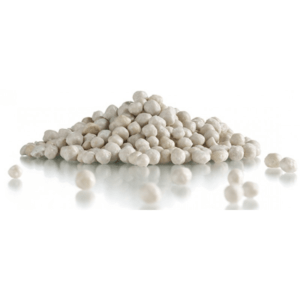
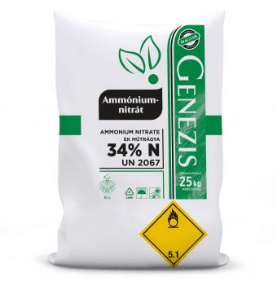
- Class 5.1 Oxidizing substances are substances which, while not necessarily combustible themselves, may, generally by yielding oxygen, cause or contribute to the combustion of other substances and of articles containing such substances.
- Class 5.2 Organic peroxides contains organic peroxides and formulations of organic peroxides
- Class 6.1 Toxic substances
- Class 6.2 Infectious substances
- Class 7 – Radioactive material
- Class 8 – Corrosive substances
- Class 9 – Miscellaneous dangerous substances and articles
- ADR freight transport
In this Honexpres article, we will look at the classification of dangerous goods. Manufacturers of chemical substances that meet the classification criteria of the dangerous goods classes must classify dangerous substances or mixtures in the 13 classes of dangerous goods.
By dangerous goods we mean those goods which, by their physical and chemical nature, can harm people, animals or the environment.
Classification of dangerous goods
Dangerous goods and mixtures must be assigned to the 13 classes of dangerous goods. These are:1, 2, 3, 4.1, 4.2, 4.3, 5.1, 5.2, 6.1, 6.2, 7, 8 and 9. They are divided according to the main hazard and the physical state, in line with the classification criteria of each class.
In general, transport operators and freight forwarders work with dangerous goods that have already been classified. These are assigned to a UN identification number. The number appears in Table A of Ch.3.2 of the ADR Agreement. The class to which already classified dangerous goods are assigned is indicated in column (3a) of Table A of Ch.3.2 of ADR for each UN identification number.
At the same time, the hazard class of dangerous goods can be identified in the product's safety data sheet. In it, under section 14., the manufacturer gives the transport information.
Example: Petrol
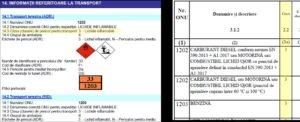
ADR safety data sheet Table A of chapter 3.2 of ADR
Below, we present the classes of dangerous goods, the classification criteria and the danger label(s) of each class.
-
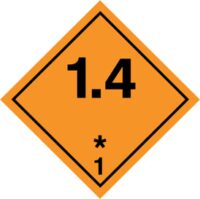
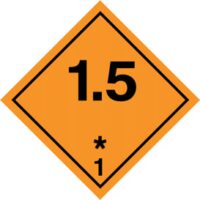
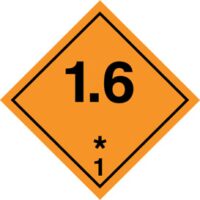
ADR Class 1 – EXPLOSIVE substances and articles are considered to be:
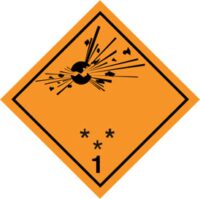 solid or liquid substances (or mixtures of substances) capable, by chemical reaction, of producing gases at such a temperature, pressure and speed as to cause damage to the surroundings.
-
pyrotechnic substances: substances or mixtures of substances designed to produce an effect by heat, light, sound, gas or smoke, or a combination of these, as the result of non-detonating, self-sustaining exothermic chemical reactions.

explosive articles: articles containing one or more explosive or pyrotechnic substances.
-
substances and articles not mentioned above, manufactured with a view to producing a practical explosive or pyrotechnic effect.
-
ADR Class 2 – Gases
A gas is understood to be a substance which:
(a) at 50 °C has a vapour pressure greater than 300 kPa (3 bar); or
(b) is completely gaseous at 20 °C at the standard pressure of 101.3 kPa.
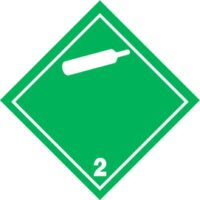
In the UN Model Regulations, in the IMDG Code and in the ICAO Technical Instructions, gases are assigned to one of the three divisions below, according to the primary hazard they present:
- Division 2.1: flammable gases – the groups
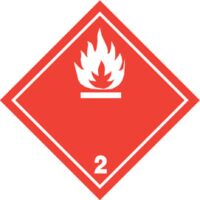
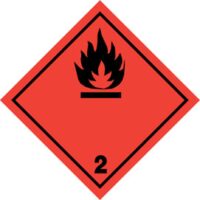
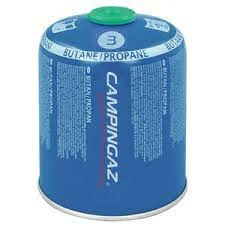
- Division 2.2: non-flammable, non-toxic gases – also called asphyxiant gases
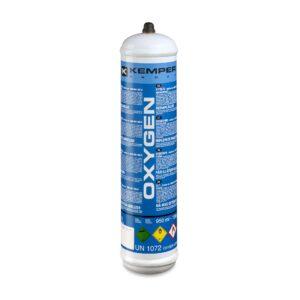
- Division 2.3: toxic gases


-
Class 3 – Flammable liquids
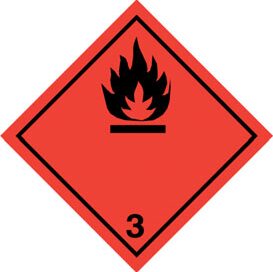
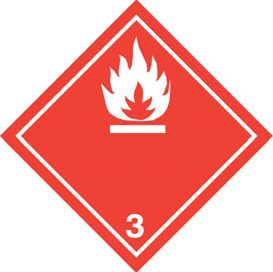 This class covers substances which:
-
Are liquids according to the definition of “liquid”,
-
Have at 50 °C a vapour pressure of not more than 300kPa (3 bar) and are not completely gaseous at 20 °C and at the standard pressure of 101.3 kPa; and
-
Have a flash-point of not more than 60 °C.
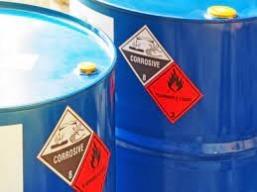
For Class 3, UN number 3256 also covers liquid substances and molten solid substances whose flash-point is higher than 60 °C and which are handed over for carriage or carried whilst heated at a temperature equal to or higher than their flash-point.
By derogation from the classification criteria, diesel fuel, gas oil and heating oil (light), including such products obtained by synthesis which have a flash-point above 60 °C, without exceeding 100 °C, are deemed to be substances of Class 3 under UN number 1202.
-
Class 4.1 Flammable solids, self-reactive substances, polymerizing substances and solid desensitized explosives
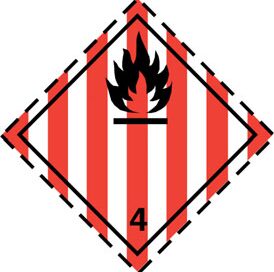
The following are assigned to Class 4.1:
-
Readily flammable solid substances and articles
Flammable solids are readily combustible solids and solids which may cause fire through friction.
Readily combustible solids are powdered, granular or pasty substances which are dangerous if they can be easily ignited by brief contact with an ignition source, such as a burning match, and if the flame spreads rapidly. The danger may come not only from the fire but also from toxic combustion products. Metal powders are especially dangerous because they are difficult to extinguish once ignited, since normal extinguishing agents such as carbon dioxide and water can increase the hazard.
-
Self-reactive solids or liquids
For the purposes of ADR, self-reactive substances are thermally unstable substances liable to undergo a strongly exothermic decomposition even without the participation of oxygen (air).
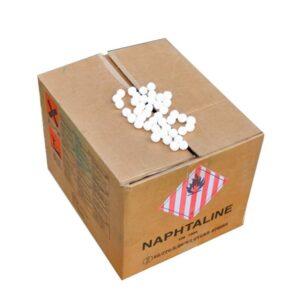
Solid desensitized explosives
Solid desensitized explosives are substances which are wetted with water or alcohols or are diluted with other substances to suppress their explosive properties.
-
Substances related to self-reactive substances
-
Polymerizing substances
These are substances which, without stabilization, are liable to undergo a strongly exothermic reaction resulting in the formation of larger molecules or of polymers under normal conditions of carriage.
-
Class 4.2 Substances liable to spontaneous combustion
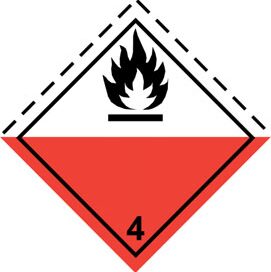
This class covers:
-
pyrophoric substances are substances, including mixtures and solutions, liquid or solid, which even in small quantities ignite on contact with air within 5 minutes.
-
self-heating substances and articles are substances and articles, including mixtures and solutions, which, on contact with air, without energy supply, are liable to self-heating. These substances will ignite only in large amounts (several kilograms) and after long periods of time (hours or days).
The self-heating of a substance is a process in which the gradual reaction of that substance with oxygen (in the air) generates heat. If the rate of heat production exceeds the rate of heat loss, then the temperature of the substance rises, which, after an induction time, may lead to self-ignition and combustion.
-
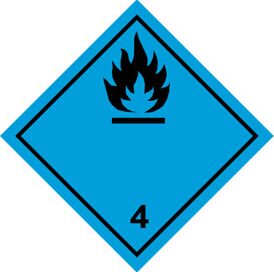
Class 4.3 Substances which, in contact with water, emit flammable gases covers substances which react with water to emit flammable gases liable to form explosive mixtures with air, as well as articles containing such substances
-
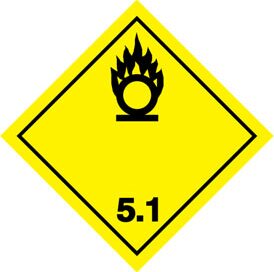
Class 5.1 Oxidizing substances are substances which, while not necessarily combustible themselves, may, generally by yielding oxygen, cause or contribute to the combustion of other substances and of articles containing such substances.
-
Class 5.2 Organic peroxides contains organic peroxides and formulations of organic peroxides
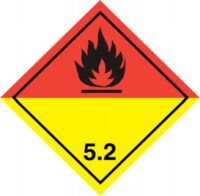
Class 5.2 ADR
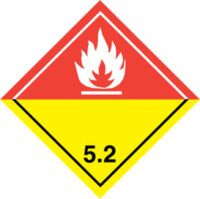 These substances are subdivided into two groups:
- those not requiring temperature control,
- those requiring temperature control.
They are liable to exothermic decomposition at normal or elevated temperatures, and this decomposition can be initiated by heat, friction, impact or contact with impurities (acids, heavy-metal compounds, amines, etc.).
Any contact of organic peroxides with the eyes must be avoided. Some peroxides can cause serious injury to the cornea, even after brief contact, or can be corrosive to the skin.
-
Class 6.1 Toxic substances

 These are substances which are known to be able, in relatively small quantities and by a single action of short duration, to damage human health or cause death, by:
- inhalation,
- cutaneous absorption or by
- ingestion.
-
Class 6.2 Infectious substances

For the purposes of ADR, infectious substances are substances which are known or are reasonably expected to contain pathogens. Pathogens are defined as micro-organisms (including bacteria, viruses, parasites or fungi). Other agents such as prions, which can cause infectious diseases in animals or humans.
Note: The carriage of live animals that have been unintentionally or naturally infected is subject only to the relevant rules and regulations of the countries of origin, transit and destination.
Four categories of infectious substances are recognised:
-
infectious to humans,
-
infectious to animals only,

clinical waste: waste derived from the medical treatment of human beings. It may derive from the veterinary treatment of animals or from biological research,
-
diagnostic specimens: collected directly from humans or animals, including, but not limited to, excreta, secreta, blood and its components, tissue and tissue fluid swabs, and body parts being carried for purposes such as research, diagnosis, investigational activities, disease treatment and prevention.
-
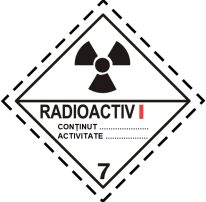
Class 7 – Radioactive material
Radioactive material means any material containing radionuclides where both the activity concentration and the total activity in the consignment exceed the values specified in chapters 2.2.7.2.2.1 to 2.2.7.2.2.6.
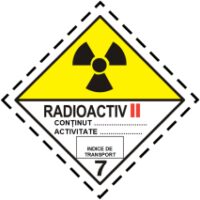

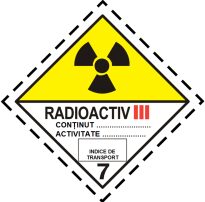
-
Class 8 – Corrosive substances

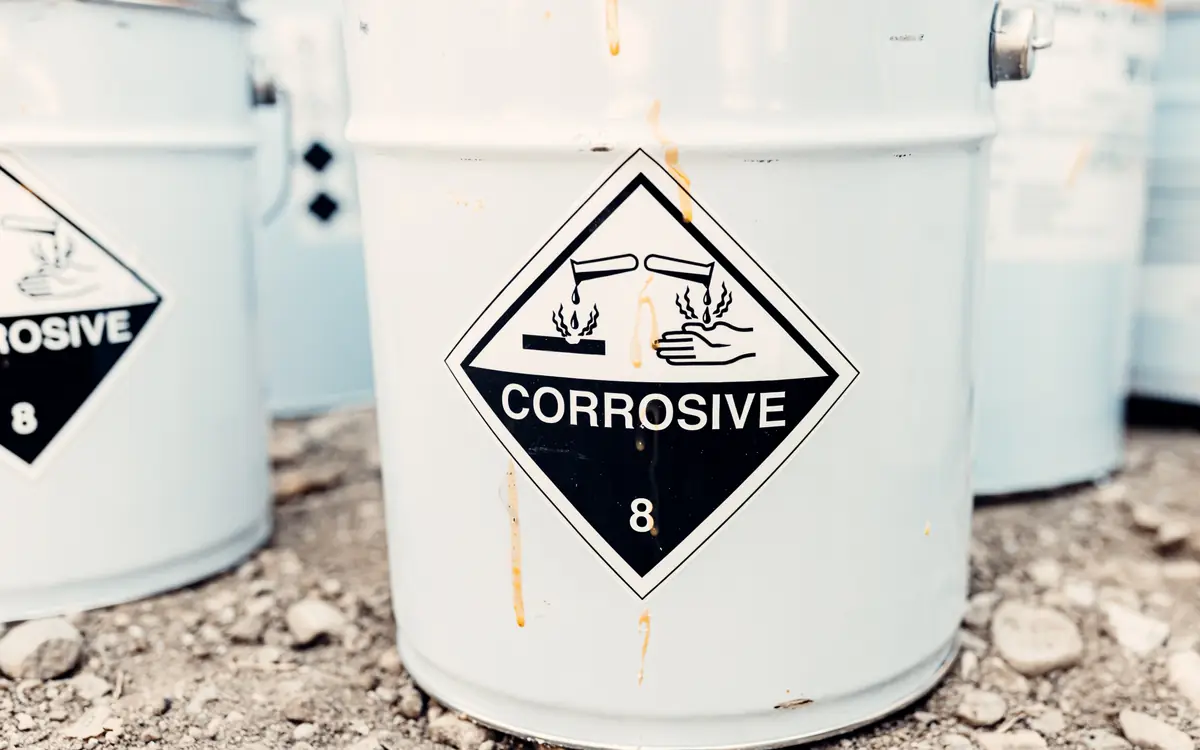
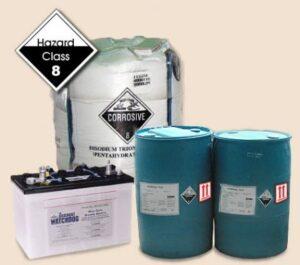 These are substances which, by chemical action, cause irreversible damage to the skin or which, in the event of leakage, can seriously damage or even destroy other goods or the means of transport.
This class also covers other substances which form a corrosive liquid only in the presence of water, or which produce corrosive vapour or mist in the presence of natural moisture in the air.
-
Class 9 – Miscellaneous dangerous substances and articles
Class 9 covers substances and articles which, during carriage, present a danger not covered by the other classes, in particular:
-
substances which, when inhaled as fine dust, may endanger health, comprising asbestos and mixtures containing asbestos,
-
substances and apparatus which, in the event of fire, may form dioxins – transformers, condensers and other articles containing these substances,
-
substances evolving flammable vapour – polymers containing flammable liquids with a flash-point below 55 °C,
-
lithium batteries,
-
life-saving appliances,
-
environmentally hazardous substances.
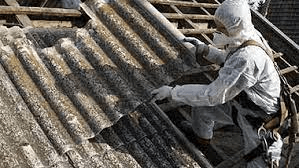
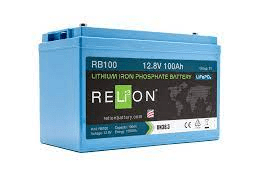
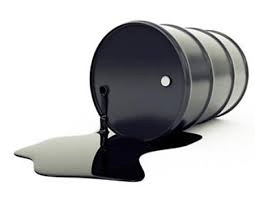

Substances or mixtures classified as environmentally hazardous substances (aquatic environment). This covers those which do not meet the classification criteria of any other class
or of any other substance of Class 9, and they must be designated as follows:
UN No. 3077 ENVIRONMENTALLY HAZARDOUS SUBSTANCE, SOLID, N.O.S.; or
UN No. 3082 ENVIRONMENTALLY HAZARDOUS SUBSTANCE, LIQUID, N.O.S.
-
Elevated temperature substances
-
In the liquid state at a temperature equal to or above 100 °C,
-
In the solid state at a temperature equal to or above 240 °C.
-
ADR freight transport
The freight forwarder Honexpres offers ADR freight transport services. Leave everything to do with compliance with the legislation in this field to us! We offer you the best transit times and the most advantageous rates. Contact us and let's talk about your transport!
Photo source: Dreamstime.com
Have something similar to move? Request a quote →
All guides in ADR dangerous goods by road (22)
Related services