Guides
LDM: what a loading metre means and how it affects transport cost
AI Text written with AI assistance and checked by the editorial team. How we work with AI
Article translated automatically from Romanian and checked automatically. If there is any difference, the original prevails. See the original in Romanian · How we use automatic translation
In short
LDM (loading metre) shows how much of the trailer floor length the goods take up, across the vehicle's full usable width. It is calculated from the footprint of the goods relative to the usable width. In groupage, bidders usually compare LDM, weight and volume and charge on the highest.
Contents
- LDM meaning: the short definition
- Why LDM exists: space is as limited a resource as weight
- How LDM is calculated
- Step 1: the actual dimensions of the goods
- Step 2: the usable width of the vehicle, not the width on the plate
- Step 3: stacking and rounding
- Pallet to LDM conversion: how to think about loading
- LDM, weight and volume: what is actually charged
- The role of LDM in the groupage price
- When LDM is no longer the right unit
- Full truckload (FTL)
- Oversized transport
- Container and rail
- Common mistakes when calculating loading metres
- Frequently asked questions about LDM
- What does LDM mean in a transport quote?
- Is LDM defined by law?
- How do I quickly calculate LDM for my pallets?
- Why do I pay by LDM and not by weight?
- Do non-stackable pallets cost more?
- When is a full truckload worth it instead of groupage?
- Request a quote calculated correctly in loading metres
- Official sources consulted
If you have received a transport quote containing "LDM", or searched for "ldm meaning" after an e-mail from a foreign partner, you are not the only one. The abbreviation stands for loading metre. It is one of the units used to express the space goods take up in a truck, and it directly affects the cost of a groupage shipment. Below we explain what LDM means, how it is calculated, how to convert pallets into loading metres and what role it plays in the price. We also cover the situations in which LDM is no longer the right unit.
LDM meaning: the short definition
In market practice, one loading metre (1 LDM) means one metre of trailer floor length, across its whole usable width. In other words, LDM does not measure how big the goods are, but how much of the truck's length becomes unusable for other customers because of them.
The definition does not come from a legal act. It is a commercial convention used by carriers and freight forwarders, especially in European road transport. For that reason, the details may differ from one bidder to another: the reference value for the width, the rounding rules, the way non-stackable pallets are treated. When you compare quotes, always ask on what basis the LDM was calculated.
The term appears in several forms: LDM, ldm, loading meter, lademeter (in German) or loading metres. They all refer to the same thing. If you often work with partners abroad, you will find other terms used in quotes and documents in our RO-EN transport glossary.
Why LDM exists: space is as limited a resource as weight
A truck has two main limits: how much mass it can carry and how much floor space it has. With heavy, compact goods, for example sheet metal or sacks of cement, the truck reaches its mass limit before the floor is full. With light, bulky goods, for example furniture, polystyrene or empty packaging, the floor fills up long before mass becomes relevant.
The maximum dimensions and masses of road vehicles circulating in the European Union are laid down by Council Directive 96/53/EC [2]. Exceeding the maximum permitted mass is treated as an infringement, with different degrees of seriousness depending on the percentage by which it is exceeded [2]. The specific values should be checked in the consolidated text of the directive currently in force and in the national transposing legislation. For the discussion about LDM, the underlying idea is what matters: the carrier has a fixed capacity and has to sell it correctly, regardless of whether your goods "use up" mass or space.
LDM solves the space problem. Goods that occupy the floor block the space even if they are light, and the carrier can no longer sell it to another customer. Through loading metres, this blocked space becomes measurable and can be charged for.
How LDM is calculated
The principle is simple. You take the floor area occupied by the goods and divide it by the usable width of the vehicle. The result is the equivalent length the goods would take up if they covered the whole width of the trailer.
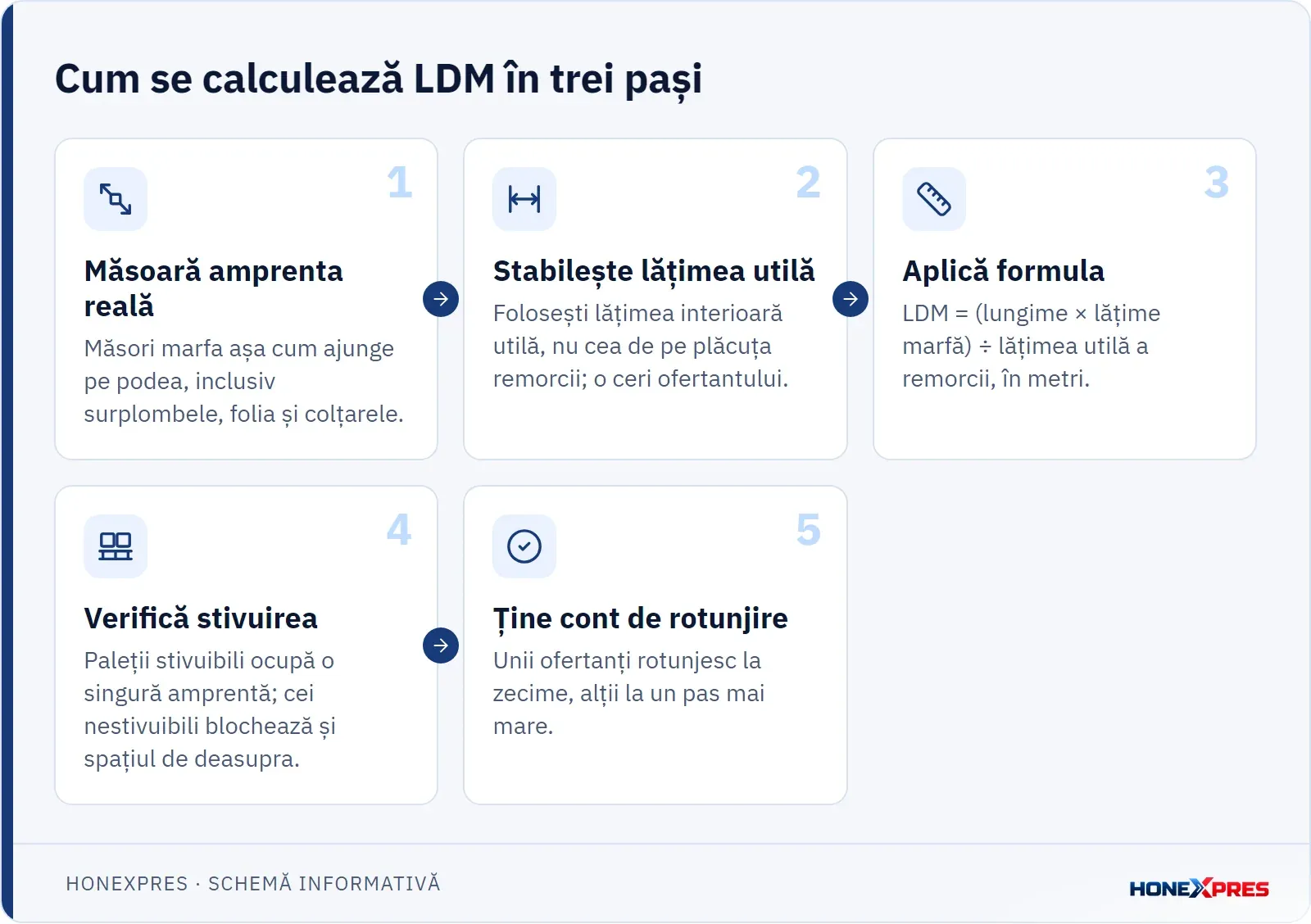
LDM = (length of goods × width of goods) ÷ usable width of the trailer, with the dimensions expressed in metres.
The formula has three elements. Each of them can introduce errors if it is not handled carefully.
Step 1: the actual dimensions of the goods
You measure the final footprint of the package or pallet, that is, what actually ends up on the floor, not the theoretical dimension of the packaging. Several details matter:
- Overhang: if the goods extend beyond the edge of the pallet, you measure the goods, not the pallet.
- Stretch film and corner protectors add a few centimetres which, with several pallets placed in a row, can make the difference.
- Irregular shape: for machinery or parts with protruding arms, you take the rectangle that encloses the whole object, because the space between the arms cannot be used by other goods.
Step 2: the usable width of the vehicle, not the width on the plate
This is where the most frequent confusion arises. The plate showing the maximum authorised masses and dimensions of a trailer or semi-trailer states, among other things, the length (L) and the width (W), in millimetres [1]. For LDM, however, what matters is the usable internal width, the space between the walls or side boards in which pallets can actually be placed.
In the market, the calculation is usually made with a reference width agreed by the carrier. The value differs depending on the type of body: curtain-sided, box, refrigerated. Ask the bidder for it explicitly or consult the sheets in the types of trucks and semi-trailers section before doing your own calculations.
Step 3: stacking and rounding
The basic formula assumes that the goods stand directly on the floor. If pallets can be placed one on top of the other, the same floor area serves two units, so the LDM per unit decreases. If the goods cannot be stacked, for example a fragile pallet or a pallet with an irregular top, the space above remains blocked. Many carriers then calculate the LDM with no reduction at all, or even increased.
Rounding differs too. Some bidders round to the nearest tenth, others to a larger step. For small consignments, the rounding can matter more than the calculation itself.
To avoid doing these calculations by hand, you can use the LDM calculator for loading metres, volume and pallets. You enter the dimensions of the goods and see the space occupied for each type of vehicle.
Pallet to LDM conversion: how to think about loading
Most shippers do not work with arbitrary dimensions but with standard pallets. The conversion from pallets to loading metres depends on four things.

- Type of pallet. The European pallet and the industrial pallet have different footprints, so they take up different LDM. Check the exact size of your pallets and do not automatically assume they are "standard".
- Orientation on the floor. The same pallet can be placed with its long side in the direction of travel or crosswise. Depending on the usable width, one of the orientations allows more pallets per row. The carrier usually chooses the orientation that leaves the least wasted space, but in groupage the arrangement also depends on the other customers' goods.
- Combining pallets. A consignment with pallets of different sizes rarely fits together perfectly. The gaps between them are wasted space, and some bidders include it in the LDM.
- Stacking. Two stackable pallets, placed one on top of the other, take up the footprint of one. Two non-stackable pallets take up double.
In practice, carriers work with indicative equivalences between the number of pallets and LDM for the usual types. These equivalences are not laid down by any rule. They result from the geometry of the vehicle used and from the commercial rules of each partner, which is why we do not reproduce them here as a universal table. Our recommendation: send the exact number of pallets, their type, their height and whether they are stackable. With this data, the conversion is made by whoever calculates your quote, on the actual vehicle.
LDM, weight and volume: what is actually charged
LDM is not the only unit of measurement in transport. In a quote you may come across three reference points:
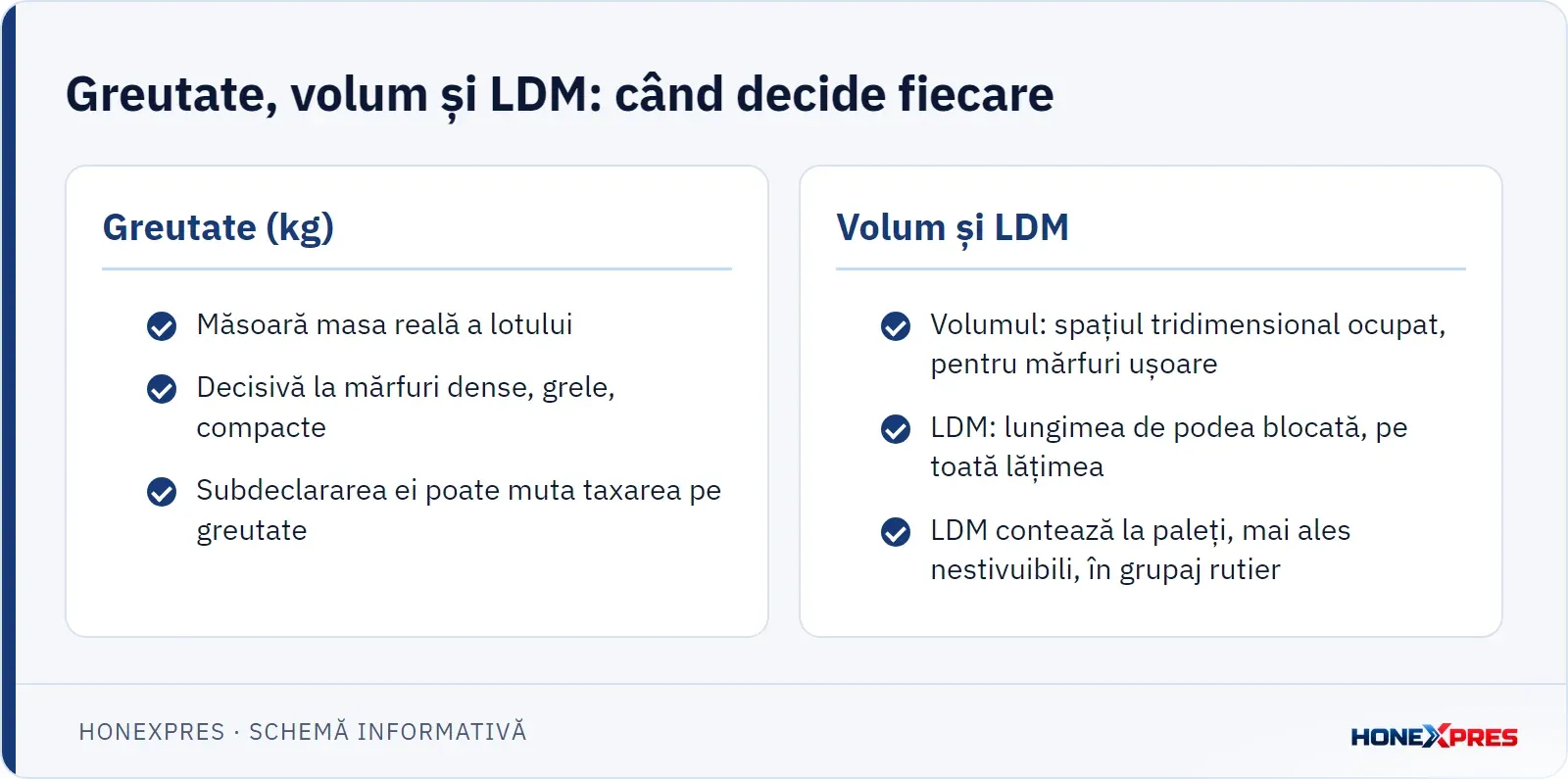
| Reference point | What it measures | When it becomes decisive |
|---|---|---|
| Weight (kg) | Actual mass of the consignment | Dense, heavy, compact goods |
| Volume (m³) | Three-dimensional space occupied | Light and bulky goods, especially for parcels and in air or sea transport |
| LDM | Floor length blocked, across the whole width | Pallets, especially non-stackable ones, in road groupage transport |
In groupage, the usual practice is for the bidder to calculate all three reference points and convert them into a common unit. For this it uses its own conversion factors, for example a certain equivalent weight for one LDM. The rule by which the charged value is chosen differs between carriers, so check it in the terms of the quote. The factors differ between carriers and between routes, so two quotes for the same consignment may start from different bases. If the price difference seems large to you, first ask on what criterion the goods were charged.
The role of LDM in the groupage price
In groupage transport (LTL), several shippers share the same vehicle. Each pays their share of the capacity, and LDM is the instrument by which this share is determined. Besides LDM, the price of a groupage shipment depends on several factors:
- Route and distance, including whether the loading and unloading points are on busy corridors or in remote areas.
- How full the route is. On directions with a lot of freight it is easier to find space, on unbalanced ones it is harder.
- Stacking. Whether or not the goods are stackable may influence the charging; ask the bidder how it treats each situation.
- Handling at consolidation and deconsolidation warehouses, transhipments and any need for a tail-lift at delivery.
- Special requirements: controlled temperature, dangerous goods, delivery at a fixed time, addresses without a ramp.
- Lead time. A groupage shipment usually waits for the vehicle to be filled, and an immediate departure costs more.
LDM is a factor that the shipper can control directly. Well-built pallets, with the goods kept within the footprint of the pallet, with uniform height and, where possible, stackable, mean fewer loading metres charged. For a realistic quote, how complete the data you send is also matters a great deal. We have detailed this aspect in the guide how to request a freight transport quote.
When LDM is no longer the right unit
Full truckload (FTL)
If the goods take up most of the floor or if you need a dedicated vehicle, LDM is no longer calculated. The whole vehicle is hired. Above a certain occupancy threshold, a full truckload (FTL) transport quote may be simpler and sometimes more advantageous than groupage charged on many loading metres. The threshold is not fixed: it depends on the route, on the market and on the flexibility of the lead time.
Oversized transport
LDM assumes that the goods fit in the vehicle. When the load exceeds the maximum permitted dimensions, the transport falls under a different regime, with specific signalling obligations. A vehicle travelling with the maximum permitted dimensions exceeded must be fitted with additional signalling devices, in accordance with Order No 1,236/2018, art. 35 [3]. For example, if the width exceeds 2.55 m, the side outline of the vehicle or of the load is marked with yellow lights [3]. In such cases we are no longer talking about loading metres, but about an oversized transport planned separately, with permits and a route set for each journey.
Container and rail
In containerised sea transport, the work is done with a full container or by volume for consolidated loads. In rail transport, the basic unit is the wagon. The Uniform Freight Rules in Order No 655/2007, Annex 5.5, code wagons by category and use [4], including special wagons for out-of-gauge transports [4]. LDM remains primarily a notion of road transport.
Common mistakes when calculating loading metres
- Using the external width of the trailer instead of the usable internal width. The result is an underestimated LDM and a surprise on the invoice.
- Ignoring overhang. Goods that extend beyond the pallet increase the footprint.
- Declaring pallets as stackable when they are not. If it is found at loading that they cannot be placed one on top of another, the LDM is recalculated, and sometimes there is no longer room in the planned vehicle.
- Leaving out the height. Without the height, the bidder cannot assess stacking, and often not the volume either.
- Comparing quotes by price alone, without checking the charging criterion (LDM, weight or volume) and the rounding rules.
- Weight estimated "by eye". Even if the LDM is correct, an under-declared weight may shift the charging to the weight criterion and may cause problems at loading.
Frequently asked questions about LDM
What does LDM mean in a transport quote?
LDM (loading metre) shows how many metres of the vehicle's floor length your goods take up, across the full usable width. It is the basis of calculation for your share of the truck's capacity, especially in groupage.
Is LDM defined by law?
No. LDM is a commercial convention in road transport. Legislation sets the limits of the vehicle, that is, the maximum authorised dimensions and masses, through Directive 96/53/EC and the transposing acts [2]. The way LDM is calculated and charged is a matter for the contract with the carrier, so check the rules in the quote you have received.
How do I quickly calculate LDM for my pallets?
You multiply the length by the width of the pallet, in metres, and divide the result by the usable width of the vehicle, as communicated by the carrier. Then you add up the values for all the pallets and take stacking into account. It is simpler to use the LDM calculator or to send us the data, and we will do the calculation together with the partner carrying out the transport.
Why do I pay by LDM and not by weight?
Because your goods take up more space than their weight would justify. The carrier cannot sell the blocked space to anyone else, so it charges on the criterion that actually limits it: here, the floor length.
Do non-stackable pallets cost more?
As a rule, yes. The space above them can no longer be used, and many carriers include it in the calculation. If the goods allow it, packaging that makes the pallet stackable reduces the cost.
When is a full truckload worth it instead of groupage?
When the goods take up a large part of the floor, when you need a fixed lead time or when you want to avoid intermediate handling. There is no universal threshold, so the safest approach is to request both options for the same load and compare them.
Request a quote calculated correctly in loading metres
HONEXPRES is a freight forwarder. We organise groupage and full truckload transports together with partner carriers, domestically and internationally. Send us the type and number of pallets, the dimensions, the height, the weight, whether the goods are stackable, the addresses and the desired period. On this basis we check with our partners the LDM calculation and the option suited to your consignment. Fill in the freight transport quote request form, and we will come back to you with a proposal.
Official sources consulted
- [1] Order of the Minister of Transport No 980/2011, Annex No 46 (introduced by Order No 1,640/2012), plate showing maximum authorised masses and dimensions of a trailer or semi-trailer, letter f)
- [2] Commission Regulation (EU) 2016/403, Annex I, point 4, note (1) on Council Directive 96/53/EC
- [3] Order No 1,236 of 7 August 2018, art. 35 (Signalling of vehicles with excess dimensions)
- [4] Order No 655/2007, Uniform Freight Rules, Annex No 5.5 (Coding of wagons)
Send us the dimensions, the number of pallets and the weight, and we will organise, with partner carriers, a quote calculated correctly in LDM.
Have something similar to move? Request a quote →
Related services