Freight forwarding · Guides
Trade in goods between countries – what is the role of forwarding?
Article translated automatically from Romanian and checked automatically. If there is any difference, the original prevails. See the original in Romanian · How we use automatic translation
In short
In the age of speed, the international transport of goods has to be carried out within short and precise timeframes. Exactly those modes of transport are used that are most efficient in terms of the time-efficiency-cost ratio. This is how trade in goods between countries takes place. What is the role of forwarding in this trade? Find out everything from this Honexpres article!
Contents
In the age of speed, the international transport of goods has to be carried out within short and precise timeframes. Exactly those modes of transport are used that are most efficient in terms of the time-efficiency-cost ratio. This is how trade in goods between countries takes place. What is the role of forwarding in this trade? Find out everything from this Honexpres article!
Trade in goods between countries
When a company needs a particular item, it has to transport it to its premises. This item may be a piece of machinery or goods of a certain type. It may be in another town, in another country or on another continent. Several questions arise from this:
- How much does the item cost?
- How is ownership of the item transferred between the company that sells and the one that buys?
- At what moment is the transfer of ownership deemed to have taken place?
- Who organises the movement of the item?
- What is the price of the transport?
- Who will be responsible for paying for the transport?
- Who is liable for the integrity of the item for the duration of the transport?
- Who pays the customs duties, if applicable?
We can therefore see that transport is one of the essential links in the movement of goods. Forwarding ensures the transfer of goods between seller and buyer, whatever the distance between them.
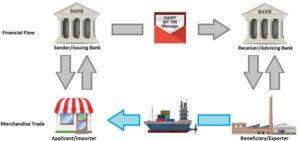
Freight forwarding
Freight forwarding emerged naturally as a consequence of:
- the different transport options between two geographical areas,
- the emergence of an ever-growing number of international regulations on how imports and exports are handled on the territory of different states,
- the need to provide certain ancillary operations and services so that goods can be transported in good conditions.
The particular features of the business of transporting goods have led to the emergence of commercial companies that deal with forwarding. These are called freight forwarders. Freight forwarders act as intermediaries between the owner of the goods and the carrier that actually carries the goods with its own means of transport.
In practice, a freight forwarder mediates between the demand for and the supply of transport: it brings those who need freight transport into contact with those who offer such services. Over time, freight forwarders have drawn into their sphere of activity new services and operations that help to increase the value of the goods.
Freight forwarders and international trade in goods
Thus, as transport developed, the specific nature and the differing degree of complexity of each branch of transport and each trade lane led to the emergence of these specialised forwarding companies. Freight forwarders deal with organising the dispatch of goods from the place of handover to the place of destination – by mode of transport (road, sea, inland waterway, rail, air, multimodal, etc); type of traffic (export, import, transit); particular trade lanes; groups of goods or types of operation.
Below we show the complexity of a freight forwarder's activities:
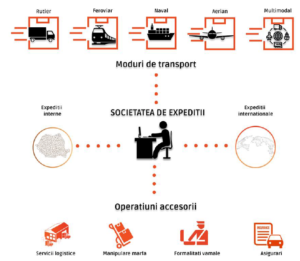
The freight forwarder is, therefore, a legal entity. In return for a sum of money (a commission or a flat fee) received from its principals, it undertakes towards them to carry out the whole range of operations needed to ensure the transport of the goods from the seller to the buyer. This transport will be carried out economically, safely, with minimal risks and as quickly as possible.
Monitoring and performing these operations requires knowledge of all the regulations that apply in the field of domestic and international goods transport. This is not always within the reach of sellers or buyers. Their main concern is selling the goods, and they cannot always have staff who know the tariffs, regulations and conditions of the various transport organisations. Nor can they have staff specialised in the issues of domestic and international goods traffic at every border point, in ports or in the centres where the dispatch of goods is concentrated.
Incorrect routing of the goods, declaring them wrongly in the documents that are drawn up, faulty handling – all of these can cause significant losses and can even prevent concluded commercial contracts from being performed. This has serious consequences for the present and future relations between the contracting parties.
That is why the need for a freight forwarder is indisputable when we talk about trade in goods between countries.
Conclusions
A distinction needs to be made between the activity of transport (carriage) and the activity of forwarding in general. The carrier's core activity is that of actually carrying the goods with its own means of transport. The freight forwarder's task is to ensure the dispatch of the goods on the instructions and for the account of its principals, using the carriers' means of transport.
We can say that forwarding is to the transport of goods what architecture is to construction. Do you need a reliable freight forwarder? Turn to Honexpres!
Photo sources: xfactorapp.com, elibrary.imf.org
Have something similar to move? Request a quote →
All guides in Freight forwarding (11)
Related services