Guides
7.5-tonne lorry with crane: a practical guide to self-loading transport
AI Text written with AI assistance and checked by the editorial team. How we work with AI
Article translated automatically from Romanian and checked automatically. If there is any difference, the original prevails. See the original in Romanian · How we use automatic translation

Illustrative photograph: a lorry-mounted crane lifting a pallet of building materials during unloading.
In short
A 7.5-tonne lorry with crane loads and unloads the goods itself where there is no forklift or ramp. What it can lift depends on the crane model and the working radius, not on the lorry’s tonnage. For a correct quote you need the weight, dimensions and lifting points of the goods, plus the conditions at loading and unloading.
Contents
- What a 7.5-tonne lorry with crane is
- When transport with a crane makes sense
- Lifting capacity: what it depends on and what you should ask
- The load chart
- Lifting accessories
- Crane and operator documents
- Mass, dimensions, licence and driving times: what to check
- Stabilising the lorry at the work site
- Securing the goods on the platform
- If the goods are dangerous
- What influences the cost of a transport with crane
- How to request a quote for a 7.5-tonne lorry with crane
- How we work at HONEXPRES
- Frequently asked questions
- How much can a 7.5-tonne lorry with crane lift?
- What does “7.5 tonnes” in the name of the lorry mean?
- What licence must the driver hold?
- Do the driving-time rules apply to a 7.5-tonne lorry?
- Who is responsible for securing the goods?
- What happens if the lorry cannot be stabilised at the destination?
- Request a quote for transport with crane
- Official sources consulted
A 7.5-tonne lorry with crane (also called a self-loading lorry or a boom lorry) solves a common problem: goods have to be loaded or unloaded at a location with no forklift, no ramp and no site crane. The lorry brings the goods and puts them in place with its own lifting equipment. For the shipper, the right choice is not only a matter of tonnage. What matters is what the crane can lift at the actual working radius, how the vehicle is stabilised, how the load is secured and what information must be sent to obtain a realistic quote. The guide below explains these aspects in turn, from the point of view of the person ordering the transport.
What a 7.5-tonne lorry with crane is
It is a medium-class rigid lorry with a hydraulic crane mounted on the chassis, usually behind the cab or at the end of the platform. The crane is usually articulated, with a telescopic boom and side outriggers. It is operated from the control panel on the vehicle or by remote control. Several names are in use on the market, such as 7.5-tonne crane lorry, crane-equipped utility vehicle or self-loading lorry. In practice, they all describe the same principle: the vehicle that carries the goods also handles them.
The value of “7.5 tonnes” in the name refers to the mass of the vehicle, not to the capacity of the crane. Romanian legislation defines the maximum authorised total mass as the maximum total mass of a road vehicle, as declared by its manufacturer [1]. The crane, the outriggers and the platform take up part of that mass, so the payload left for the goods is lower than on a lorry of the same class without a crane. The exact value is read from the documents of the specific vehicle. For the platform dimensions and the indicative number of pallets on a lorry of this class, see the 7.5 t lorry page.
When transport with a crane makes sense
A transport with crane is justified when the cost and organisation of separate handling at the destination are higher than the difference compared with an ordinary lorry. Typical situations:
- Sites and locations without unloading equipment: pallets of materials, formwork, small precast elements, tool containers.
- Small machines and industrial equipment: compressors, generators, mini-excavators, machine tools, provided they have lifting points and a mass compatible with the crane.
- Deliveries to yards, farms or residential areas, where a large lorry has no access and the goods have to be placed over a fence, on a foundation or next to a building.
- Equipment relocations between two locations of the same company, where there is no forklift at either end.
- Small containers, tanks, empty vessels or metal structures that are lifted from the ground and placed directly on the platform.
For machines that are heavier, longer or wider than a 7.5 t platform allows, the solution is a different type of vehicle. It may be a 12 t lorry, a flatbed or a low-loader, with a separate crane at loading. We compare them on the dedicated page about machinery transport.
Lifting capacity: what it depends on and what you should ask
The most common mistake is to assume that a 7.5-tonne lorry “lifts” a fixed mass. The capacity of a crane depends on its model and decreases as the boom extends. A crane may be able to lift a large load close to the column, but much less at the end of the boom. For this reason we do not give general figures: they vary from one installation to another and are set by the crane manufacturer.
The load chart
Every crane has a load chart (table) showing the maximum permitted mass at each working radius. When you request a 7.5-tonne lorry with crane, the right question is not “how much does it lift?”. The right question is: “can it lift X kg at Y metres from the axis of the crane, on the side where the work will be done?”. For this, the carrier needs to know:
- the actual mass of the heaviest item, including packaging, pallet or frame;
- the horizontal distance between the place where the lorry will stand and the place where the goods are to be set down;
- any obstacles the goods have to be moved over (fence, wall, ditch);
- the height to which the goods are raised or lowered (for example, onto a foundation or a technical floor).
Lifting accessories
Slings, chains, hooks, pallet forks or grabs must suit the weight and shape of the goods. Machines usually have lifting points marked by the manufacturer, and these must be used. If the goods have no lifting points or have an off-centre centre of gravity, say so in the request. The carrier can then bring the right accessories or decline an unsafe operation in good time.
Crane and operator documents
A crane mounted on a lorry is lifting equipment. The requirements for its technical inspection and for the qualification of the person operating it are governed by specific regulations. You can confirm them with the competent authority or in the text in force. As the customer, it is reasonable to ask the carrier to confirm that the equipment and the operator hold the required documents and that inspections are up to date.
Mass, dimensions, licence and driving times: what to check
The European framework for the masses and dimensions of road vehicles is set by Directive 96/53/EC. It fixes the maximum authorised dimensions in national and international traffic and the maximum authorised weight in international traffic [2]. Regulation (EU) 2016/403 treats infringements of the rules on weights and dimensions as a separate group of infringements. Their gravity is assessed according to the percentage by which the limit is exceeded [2]. For the shipper, the conclusion is practical: the declared mass of the goods must be the real one. An underestimate puts the legality of the transport at risk and, with a self-loading lorry, the lifting operation itself.
Driving licence. The licence category required for a lorry of this mass and the obligations of the driver are set by the road legislation in force. If you organise the transport with your own or a hired vehicle without a driver, check these requirements with DRPCIV or in the updated text of the regulations. When you order the transport through a freight forwarder, the vehicle and the driver are provided by the carrier performing the journey; the division of liability is set by contract.
Driving and rest times. Regulation (EC) No 561/2006 lists the situations in which it does not apply. Among them are vehicles with a maximum authorised mass not exceeding 7.5 tonnes, used for the carriage of goods for non-commercial purposes [3]. The exemption therefore concerns only non-commercial transport. For a commercial journey, the applicable regime must be checked in the text of the regulation in force, and compliance is the carrier’s responsibility.
Access to roads and localities. Tonnage restrictions, time bans in towns and any permits for stopping on public land during the crane operation differ from one locality to another. Check them with the local administration or the road administrator before the agreed date. If the goods exceed the gauge of an ordinary lorry, the rules for oversized transport apply.
Stabilising the lorry at the work site
A crane on a lorry works safely only if the vehicle is properly supported. Stability depends on the ground, on how far the outriggers are extended and on the position of the load relative to the vehicle. The technical details and working limits are set by the crane manufacturer and applied by the operator. The shipper can, however, prepare the site so that the operation is not postponed or does not become dangerous.
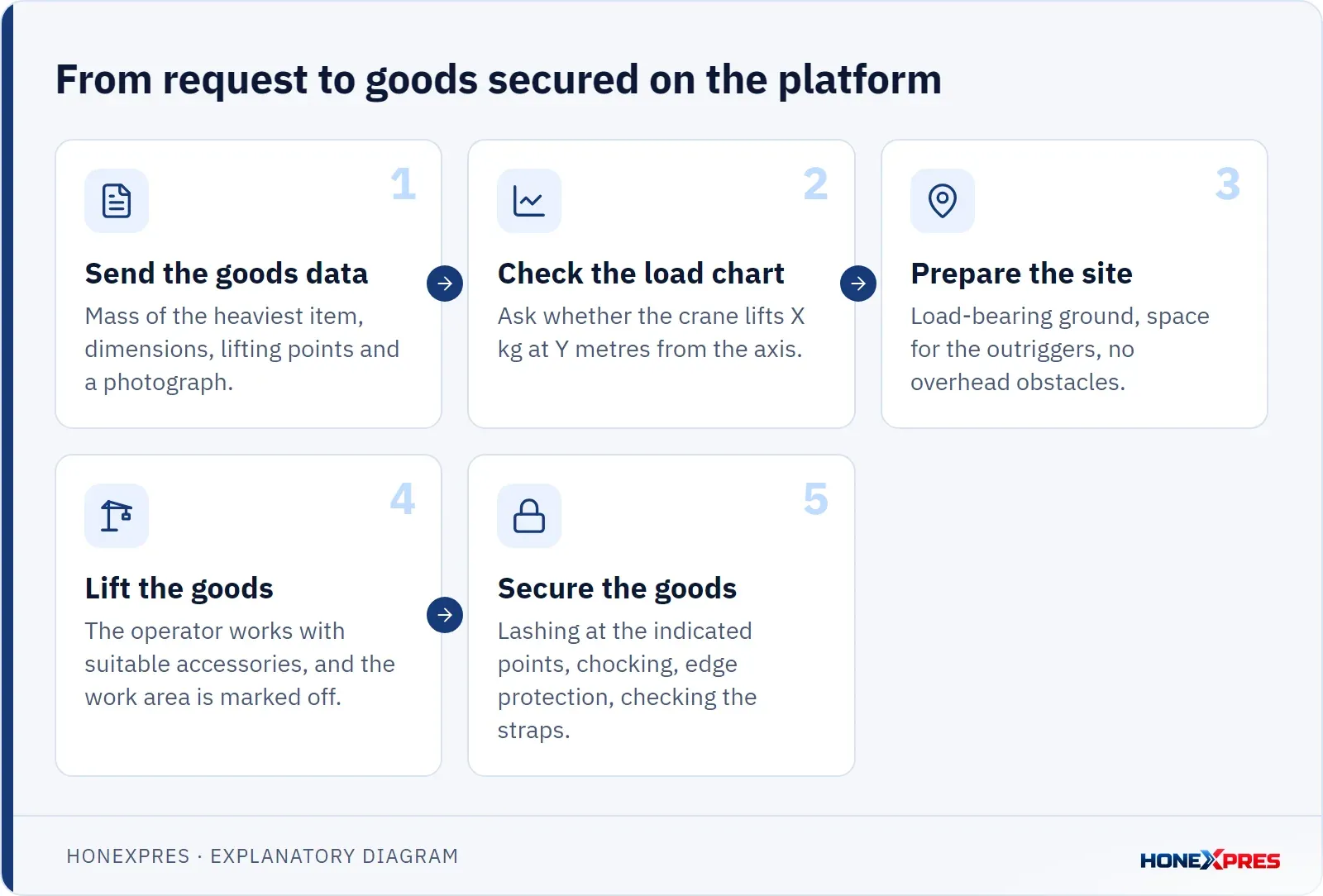
- The ground: a load-bearing and as level a surface as possible. On soft soil, fresh fill, manhole covers or the edge of a ditch, the outriggers may sink. Say in advance what type of ground it is, so that the operator brings load-spreading plates.
- Side space: the outriggers extend sideways beyond the body. The standing place must allow them to be extended, not just the lorry to enter.
- Overhead obstacles: power lines, cables, trees, canopies. Power lines are a major risk for any crane and must be flagged in the request.
- Work area: while lifting is under way, people must not stand under the load. On a site or in a yard, someone on the spot must mark off the area and control access.
- Weather: strong wind affects bulky and light loads, for example panels. The operator may decide to postpone, and this risk must be accepted contractually.
Securing the goods on the platform
After lifting, the goods must be secured for the journey. The platform of a self-loading lorry is usually open or has low side boards, so securing cannot rely on the walls of the body. ADR, the agreement on dangerous goods, contains explicit rules on securing the load [4]. Their principles are, however, useful for any heavy load.
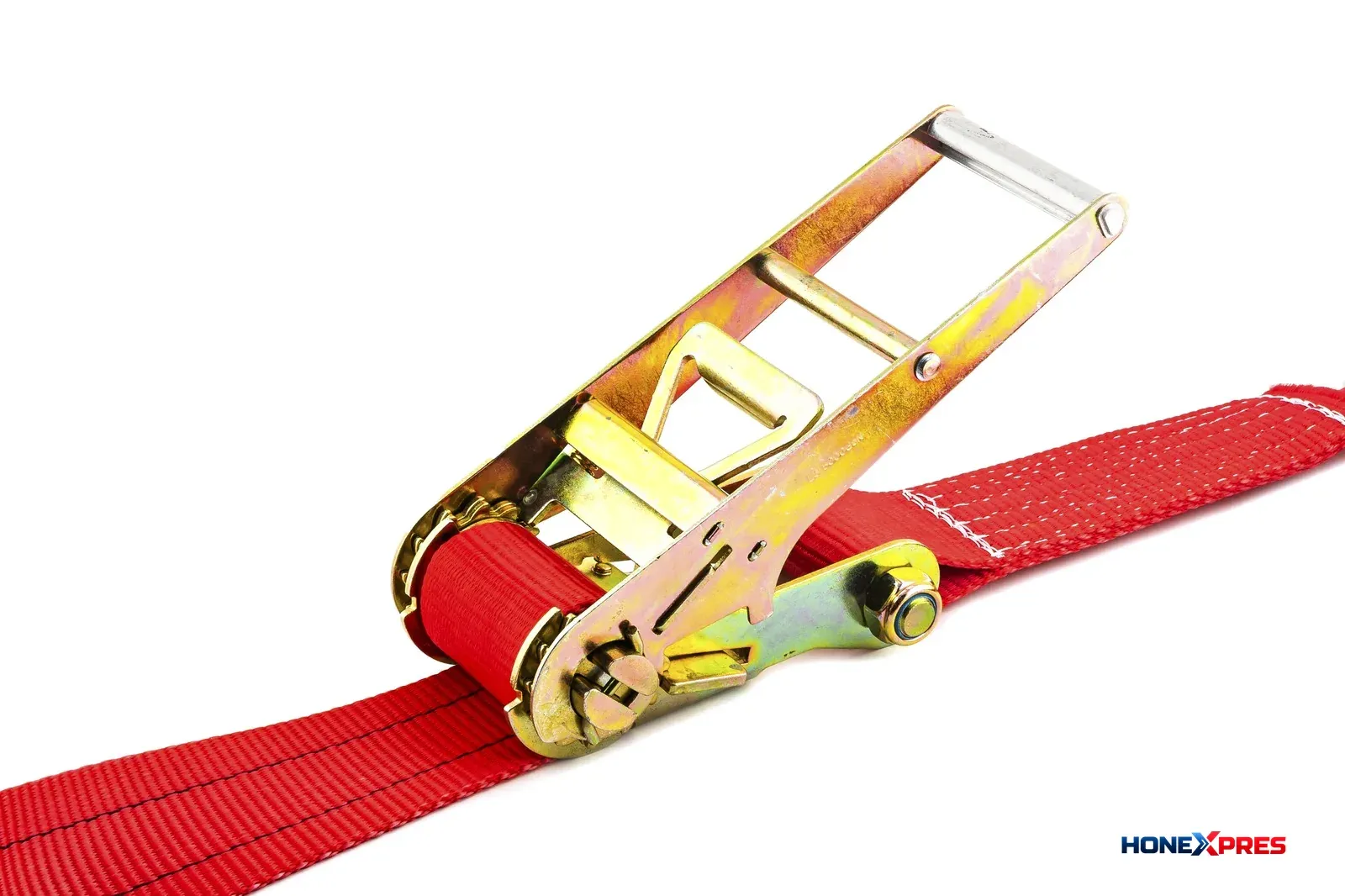
ADR 2025, at 7.5.7.1, requires packages to be secured by means capable of restraining the goods, such as lashing straps, sliding slatboards or adjustable brackets [4]. Securing must prevent any movement that would change the orientation of the packages or damage them [4]. The same provision shows that movement can also be prevented by filling gaps with wedging material or by blocking and bracing [4]. Straps must not be tightened so much that they damage or deform the package [4]. When dangerous goods are carried together with other goods, for example heavy machines or crates, all the goods must be securely fastened or packed in the vehicle [4].
ADR refers to the standard EN 12195-1:2010: the requirements of the paragraph are considered met if the load is secured in accordance with this standard [4]. As a practical guide, ADR also points to the document “European Best Practice Guidelines on Cargo Securing for Road Transport”, published by the European Commission [4]. For general cargo, these sources are a good reference for discussing with the carrier how the load will be secured.
In practice, for a mini-machine or an item of equipment on the platform of a lorry with crane:
- the machine is lashed at the tie-down points indicated by the manufacturer, not to fragile parts (hoses, pipes, casings);
- wheels or tracks are chocked, and booms and movable attachments are lowered and locked;
- sharp edges are protected so that the straps do not get cut;
- after the first kilometres, the driver checks the tension of the straps, because the load can settle.
Loading and unloading require as much care as the journey. ADR provides that, during loading and unloading, packages of dangerous goods must be protected against damage. With a self-loading lorry, most damage occurs during lifting: the goods swing, hit the side board or are slung incorrectly. The lifting instructions from the equipment manufacturer must therefore be passed to the operator before the journey.
If the goods are dangerous
If the items lifted include dangerous goods, for example gas cylinders, fuel canisters, batteries or chemicals, ADR applies. At roadside inspection, the checklist in the rules approved by HG no. 1.175/2007 includes the item “Loading, securing of the load and handling (ADR 7.5)” [5]. Declare these goods in the request. First check, in the text of ADR in force or with the competent authority, whether the transport can benefit from any exemption; see also our article on the ADR exemptions. If it does not qualify, the transport is organised as an ADR transport, with a suitable vehicle and driver.
What influences the cost of a transport with crane
We do not publish rates, because a transport with a self-loading lorry is calculated for each situation individually. The factors that matter most are:
| Factor | Why it matters |
|---|---|
| Distance and route | Loaded and empty kilometres (repositioning of the vehicle), roads with restrictions, road tolls. |
| Handling time | The number of lifts, the time taken to set up the outriggers, waiting at loading or unloading. |
| Difficulty of the lift | A large working radius, obstacles, and goods without lifting points or with an off-centre centre of gravity require a larger crane and more time. |
| Vehicle availability | There are fewer self-loading lorries than ordinary lorries. Short notice, weekends or a remote area can limit the choice. |
| Accessories | Forks, grabs, special straps, load-spreading plates. |
| One-way or return journey | Using the lorry on the return leg reduces the cost; a dedicated journey with no load on the return increases it. |
| Permits and local conditions | Stopping on public land, imposed time windows, any escort or marking of the area. |
| Cargo insurance | The value of the goods and the level of cover required. |
For the general logic of calculating a road transport, see also the guide on cost factors in freight transport. For the difference between the carrier’s liability and separate cargo insurance, read the article CMR or CARGO insurance. It is especially relevant for expensive machines, where an incident during lifting can cause major damage.
How to request a quote for a 7.5-tonne lorry with crane
A complete request shortens the time to a quote and reduces the risk of the vehicle arriving on site and being unable to work. Send:
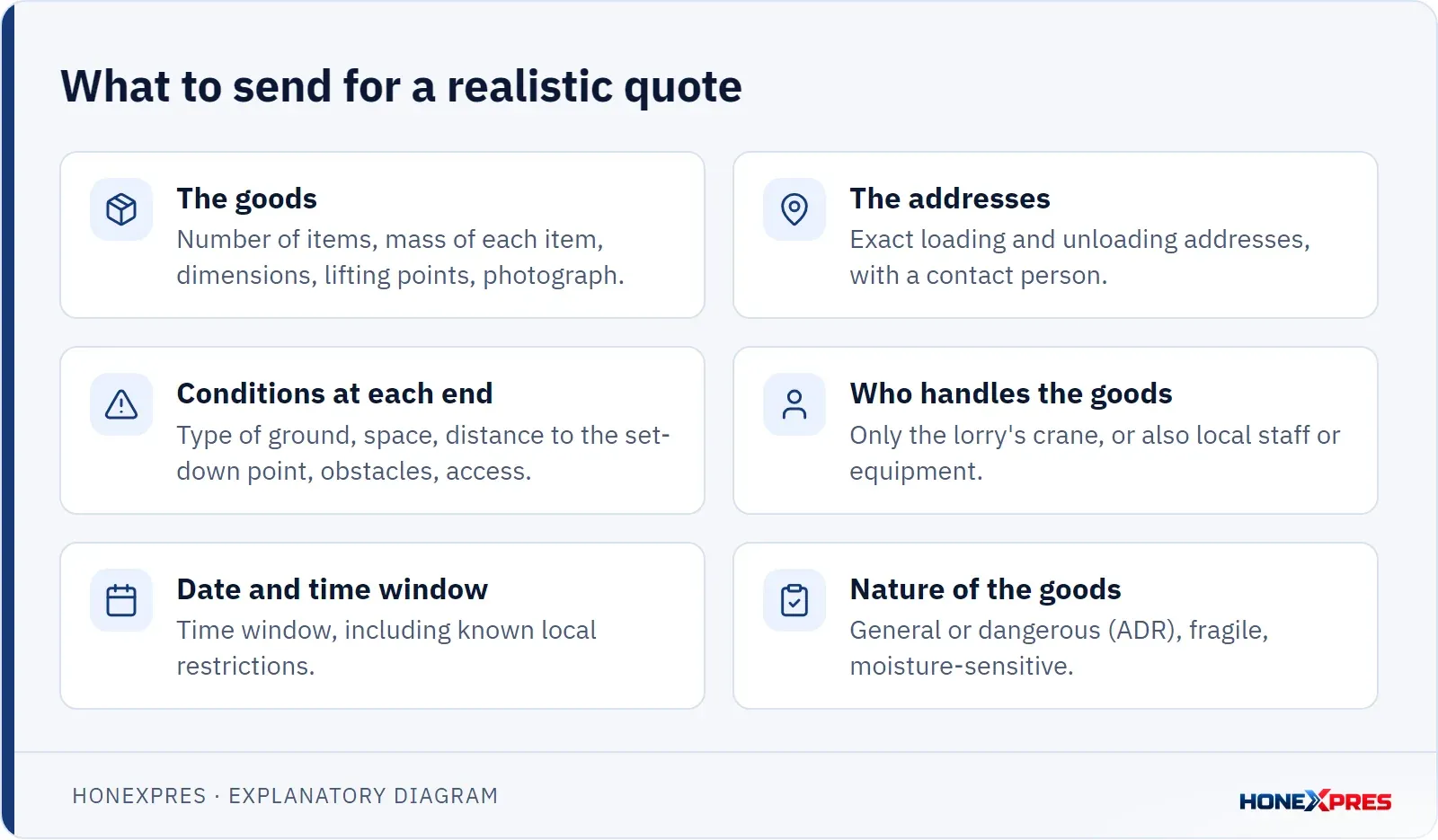
- The goods: what they are, the number of items, the mass of each item (especially the heaviest), the dimensions (length, width, height), the lifting points and a photograph.
- The exact addresses for loading and unloading, with a contact person at each.
- The conditions at each end: the type of ground, the standing space, the distance between the lorry and the set-down point, obstacles (fences, power lines, trees), access for a lorry of this class.
- Who handles the goods: only the lorry’s crane, or also staff or equipment on site.
- The date and time window, including any known local restrictions.
- The nature of the goods: general or dangerous (ADR), fragile, sensitive to moisture.
- The value of the goods and whether you want separate insurance.
- The documents: the accompanying delivery note (aviz), CMR for international journeys, any customs formalities.
You can also find the general steps for any transport request in the article how to request a freight transport quote.
How we work at HONEXPRES
HONEXPRES SRL is a freight forwarder based in Oradea. We do not have our own fleet. We organise transport with a crane together with partner carriers, who provide the vehicle, the crane and the operator. Romanian legislation describes intermediation in road transport as taking over from customers orders for national and/or international road transport, which are then performed by one or more transport operators [1].
Specifically, we take care of the following:
- we analyse the data on the goods and the site;
- we look for a partner with equipment suited to the required mass and working radius;
- we pass the carrier the information on stabilisation, accessories and securing;
- we coordinate scheduling and documents.
We do not guarantee response times and we do not offer our own GPS tracking. We do, however, keep you informed of the status of the order through direct contact with the carrier. If it turns out that a 7.5 t self-loading lorry is not the right solution, we will propose an alternative: another vehicle, a separate crane or a groupage transport.
Frequently asked questions
How much can a 7.5-tonne lorry with crane lift?
There is no single value. The capacity depends on the model of the crane and decreases with the distance at which the boom works. Send the mass of the heaviest item and the distance between the lorry and the set-down point. The carrier then checks the load chart of the crane.
What does “7.5 tonnes” in the name of the lorry mean?
It refers to the maximum authorised total mass of the vehicle, that is, the maximum mass declared by the manufacturer [1]. The mass of the crane is deducted from the payload, so less is left for the goods than on a lorry of the same class without a crane.
What licence must the driver hold?
The licence category is set by the road legislation in force. Check the updated text or ask DRPCIV. When the transport is organised through us, the driver is provided by the partner carrier; liability is set by contract.
Do the driving-time rules apply to a 7.5-tonne lorry?
Regulation (EC) No 561/2006 exempts vehicles of up to 7.5 tonnes used for the carriage of goods for non-commercial purposes [3]. For commercial transport, the applicable regime must be checked in the text of the regulation in force.
Who is responsible for securing the goods?
Liability is set by the transport contract and by the rules applicable to the type of goods. For dangerous goods, ADR 2025 at 7.5.7.1 requires packages to be secured by means capable of preventing their movement [4]. Whatever the goods, discuss in advance with the carrier how the load will be lashed and who supplies the accessories.
What happens if the lorry cannot be stabilised at the destination?
The operator may refuse to lift if the ground or the space does not allow safe working. The time lost and any return visit generate additional costs. This is why the request must describe the ground, the side space and the obstacles correctly.
Request a quote for transport with crane
Do you need a 7.5-tonne lorry with crane for a site, an equipment delivery or the relocation of a small machine? Send us the data on the goods and the conditions at loading and unloading through the quote request form. We analyse the situation and organise the transport together with partner carriers suited to your goods.
Official sources consulted
- [1] Government Ordinance (OG) no. 27/2011 on road transport, definitions, point 23
- [2] Regulation (EU) 2016/403, annex, point 4 and the footnote on Directive 96/53/EC
- [3] Regulation (EC) No 561/2006, Article 3(h)
- [4] ADR 2025, 7.5.7.1 Handling and stowage
- [5] Government Decision (HG) no. 1.175/2007, checklist for the road transport of dangerous goods, point 22
Send us the data on the goods and on the loading and unloading site, and we will organise the transport with a crane together with partner carriers.
Have something similar to move? Request a quote →
Related services