
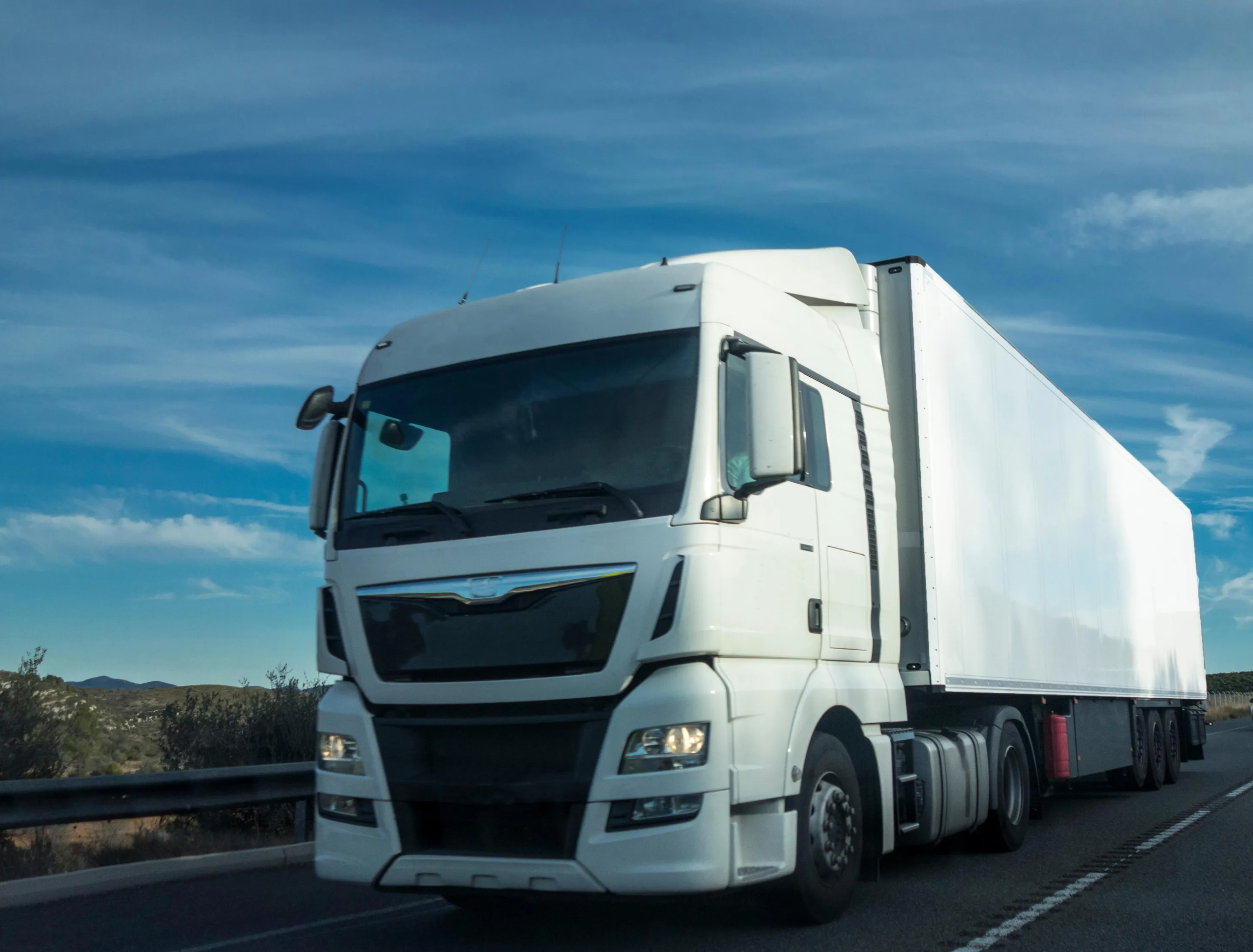
Road transport · temperature-controlled
Refrigerated transport with temperature control, domestic and international
We organise temperature-controlled transport for chilled or frozen food, flowers, pharmaceuticals and other sensitive goods, with carriers that have the right equipment.
- Temperature Chilled, frozen, constant You give us the range; we choose the right equipment.
- Routes Domestic and international In Romania and across Europe, as a full truckload or, on some routes, as groupage.
- ATP · GDP Checked equipment ATP for perishable food, GDP for pharma, where applicable.
- Proof Temperature report Thermograph printout or data-logger report, on request.
On this page
Temperature control
What temperature-controlled transport means
Some goods spoil if the temperature leaves the range, even for a short time. Refrigerated transport keeps them within the required range all the way, with an insulated semi-trailer and a refrigeration unit that, on many models, can also heat. Tell us the temperature range, the type of product and whether you need a temperature report on delivery: the HONEXPRES team chooses the refrigerated semi-trailer and confirms the set temperature before loading.
-
Good to know · 1
The unit maintains the temperature; it does not cool the goods
The goods are loaded already at transport temperature, and the semi-trailer is pre-cooled before loading.
-
Good to know · 2
The temperature can be proven
On request, the carrier provides the thermograph printout or the temperature data-logger report for the whole trip.
-
Good to know · 3
Requirements are set before departure, not during the trip
The temperature, the unit mode and the documents are confirmed in the quote, before loading.
Types of goods
What types of goods we transport
- Chilled food: dairy, meat, cold cuts, ready meals
- Frozen food
- Fresh fruit and vegetables
- Flowers and plants
- Chocolate and confectionery, especially in summer
- Temperature-sensitive pharmaceuticals and cosmetics (pharma only with GDP-qualified carriers)
- Biological and medical products, with the requirements confirmed in the quote
- Chemicals that must not freeze or overheat (if they are dangerous goods, see ADR transport)
Options
The required temperature: chilled, frozen or constant
For each transport we set the transport temperature or the accepted range, minimum and maximum, in °C. You give us the exact value, according to the requirements of the product; we choose the equipment that can maintain it.
-
Chilled
The goods stay cool without freezing: dairy, meat, cold cuts, fruit and vegetables, flowers.
-
Frozen
The goods stay below the required threshold for the whole trip: frozen products and frozen raw materials.
-
Constant temperature
No large variations, in summer or in winter: chocolate, pharma, beverages, some chemicals that must not freeze.
The unit can run continuously or in start-stop mode; if you do not know which suits you, we suggest it. Several temperatures in the same transport mean separate compartments and less capacity. Not sure which vehicle you need? Which vehicle do I need?
Domestic and international
Domestic and international refrigerated transport
-
Refrigerated transport in Romania
Trips between producers, warehouses and shops across the country, including from Oradea and Bihor County, as a full truckload or, on some routes, as refrigerated groupage. For recurring flows we look at loading hours, transit times and unloading windows, so that the goods are received without unnecessary waiting.
-
International refrigerated transport
Import and export across Europe with refrigerated semi-trailers. For perishable food, the equipment generally has to be ATP-approved. For routes outside the EU we also coordinate the customs formalities. By sea, reefer containers are used; for urgent shipments, air freight.
See also:
Sea freight · reefer containersAir freight · chilled cargoCustoms formalities related to transport
ATP and GDP
ATP and GDP: when they are required
-
ATP for perishable food in international transport
For perishable food transported internationally, the equipment generally has to be ATP-approved for the appropriate temperature class. The ATP certificate is the carrier’s; we check it when the transport is assigned.
-
GDP for pharmaceuticals
We organise transports that require Good Distribution Practice (GDP) only with GDP-qualified carriers, on the routes where we have them, confirmed in the quote.
Guide:
Equipment
What we check on the refrigerated semi-trailer
The vehicles belong to the carriers we work with. Before assigning one, we check that the equipment suits your goods and your route:
- The refrigeration unit can maintain the required range, including heating in winter
- The equipment’s ATP certificate and its class, for perishable food in international transport
- The temperature data logger or thermograph, if you need a report on delivery
- Separate compartments and partition walls, for several temperatures on the same trip
- Cleanliness of the load space, for food
- Fittings required by the goods, for example rails for hanging meat or straps for securing
We do not promise permanent real-time monitoring: the temperature is recorded throughout the trip, and you receive the report on request.
How it works
How it works: five steps, from temperature range to delivery
- Step 1
The temperature range
You tell us the transport temperature (or the minimum–maximum range) and the type of product; we choose the right equipment.
- Step 2
The quote
The quote confirms the temperature, the unit mode (continuous or start-stop) and what proof of temperature you receive.
- Step 3
Pre-cooling
The semi-trailer is brought to the set temperature before loading.
- Step 4
Loading
The goods, already at transport temperature, are loaded quickly; the temperature is entered on the documents.
- Step 5
Transport and delivery
The temperature is recorded throughout the trip. We let you know if there is any deviation from the plan, and on delivery you can receive the printout or the temperature report.
What we need for a quote
Information needed for a refrigerated transport quote
The more exact the data, the more precise the quote. If you do not know something, choose “I don’t know” in the request, and the team will help you.
- The transport temperature or the accepted range (minimum and maximum, in °C)
- The type of product: chilled food, frozen, fruit and vegetables, flowers, pharma, chemical
- Whether the goods are already at transport temperature at loading
- The unit mode: continuous or start-stop (if you do not know, we suggest it)
- The proof required: thermograph printout, data-logger report or none
- Whether ATP equipment or GDP-qualified transport (pharma) is needed
- Pallets, dimensions, weight, addresses and dates
- Several temperatures in the same transport (separate compartments)
Documents
The documents for a refrigerated transport
- CMR consignment note With the transport temperature stated.
- Thermograph printout or temperature report On request; proof of the temperature for the whole trip.
- ATP certificate of the equipment The carrier’s, for perishable food in international transport.
- Veterinary health or phytosanitary certificates Where they are required for the product; issued by the consignor through the competent authority.
- Customs documents For routes outside the EU; see the customs formalities related to transport.
Restrictions
Restrictions we take into account
- We cannot cool goods loaded warm; the semi-trailer only maintains the temperature.
- Frozen and chilled goods do not travel in the same compartment; multi-temperature transport reduces capacity.
- The refrigerated semi-trailer is loaded only from the rear, at a loading dock.
- We accept GDP pharmaceutical transports only if there is a GDP-qualified carrier on the route; we confirm this in the quote.
- Long waiting times at loading or unloading put the cold chain at risk; exact scheduling is important.
Costs
What affects the cost of refrigerated transport
We do not publish fixed rates per kilometre: each quote is calculated on the data of the trip and is sent by the HONEXPRES team.
-
01
The temperature range (frozen or chilled) and the unit mode
-
02
The distance and duration of the trip (the unit uses extra fuel)
-
03
The equipment required
ATP, several compartments, temperature data logger
-
04
The availability of refrigerated semi-trailers on the route and for the return
-
05
The number of delivery points and the waiting times
-
06
GDP requirements for pharma
Guide:
How much does freight transport cost in 2026? Prices per kilometre and calculation factors
Related services
Refrigerated, full truckload or another service?
Temperature control is often combined with other requirements. See the closely related services or request a quote directly.
-
Road freight
All road options, from general cargo to goods with special requirements.
-
Full truckload (FTL)
A whole refrigerated semi-trailer just for your goods, without transhipment.
-
Dangerous goods transport (ADR)
When temperature-controlled goods are also dangerous goods.
-
Sea freight (FCL / LCL)
Reefer containers for routes overseas, with road connections at both ends.
Can you cool the goods on the way?
No. The refrigeration unit maintains the temperature, but it does not have the power to cool a warm load. The goods must be at transport temperature when they are loaded, and the semi-trailer is pre-cooled beforehand.
How do I prove that the temperature was maintained?
State in your request that you need the thermograph printout or the temperature data-logger report. The carrier provides it on delivery or immediately afterwards, for the whole trip.
Do I need ATP transport?
For perishable food transported internationally, generally yes: the equipment must be ATP-approved for the appropriate temperature class. The ATP certificate is the carrier’s; we check it when the transport is assigned.
Do you organise international refrigerated transport?
Yes: import and export across Europe with refrigerated semi-trailers; for perishable food, the equipment generally has to be ATP-approved. For routes outside the EU we also coordinate the customs formalities; by sea, reefer containers are used, and for urgent shipments, air freight.
Do you transport pharmaceuticals?
Only with carriers qualified for GDP-compliant distribution, on the routes where we have them. Tell us in your request the temperature range, the qualification requirements and the documents you need; we confirm in the quote whether we can.
Can goods that must not freeze be transported in winter?
Yes. On many models, the refrigeration unit can also heat, so it keeps the goods above a minimum threshold, for example for beverages or some chemicals. Before assigning the vehicle, we check that the unit can maintain the required range, including heating in winter.
Guides
Useful guides and articles
Articles that help you prepare a temperature-controlled transport: ATP approval, costs, choosing the vehicle.
-
Approval for the transport of perishable products
Transporting goods is a responsibility, especially when it comes to sensitive products, such as a stock of perishable products.
-
How much does freight transport cost in 2026? Prices per kilometre and calculation factors
How much does freight transport cost in 2026? It is one of the first questions asked by companies that need to deliver pallets, equipment…
-
How to choose the right vehicle for road freight transport
There are many ways in which companies can access road freight transport.

Relevant articles
More about temperature-controlled transport
- CARGO insurance – why is it important? Sep 26, 2022
Suitable vehicles
-
Reefer semi-trailer
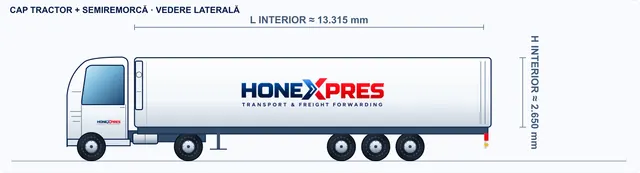
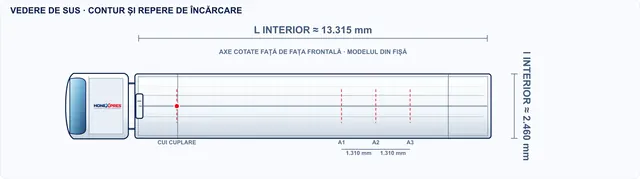
~13.3 m · ~2.46 m · ~2.6 m · 33 EUR pallets · 22 t
Indicative Sketch: Refrigerated semi-trailer
Suitable containers
-
20' Reefer
~5.45 m · ~2.29 m · ~2.15 m usable (up to the load line) · ~28 m³ (~27 m³ usable) · 10 EUR pallets · ~25 t on the road (40 t, without genset)
-
40' Reefer High Cube
~11.6 m · ~2.29 m · ~2.4 m usable (up to the load line) · ~67 m³ (~65 m³ usable) · 23 EUR pallets · ~22 t on the road (40 t, without genset)
Practical reference values. We confirm the exact dimensions in the quote. Honexpres organises transport with this vehicle, on request.
Quote request
Do you have goods that need temperature control?
Tell us what you are transporting, the temperature range and the route. The HONEXPRES team reviews the request and comes back to you with a quote.
Automatic translation, automatically checked. This page was translated automatically from Romanian and passed the automatic checks for language, terminology, figures and links. If there is any difference, the Romanian version prevails. How we use automatic translation